
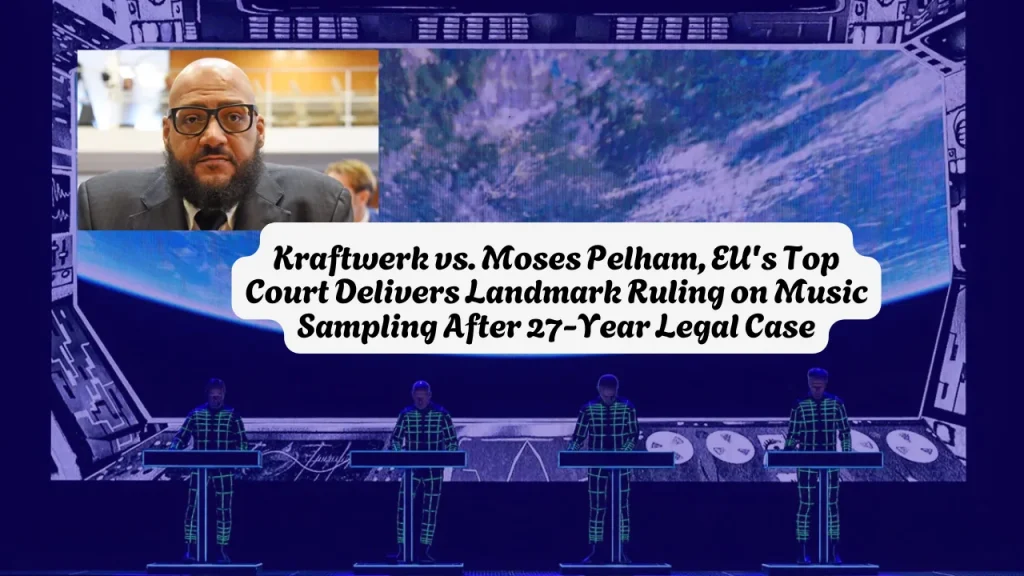
Kraftwerk vs. Moses Pelham, EU’s Top Court Delivers Landmark Ruling on Music Sampling After 27-Year Legal Case
Europe’s highest court has issued one of the most consequential music copyright rulings in a generation — and the case behind it has been grinding through the courts since 1999. On April 14, 2026, the Grand Chamber of the Court of Justice of the European Union (CJEU) ruled in Pelham II (Case C-590/23), delivering a landmark — if deliberately nuanced — definition of “pastiche” under EU copyright law.
The ruling, which stems from German producer Moses Pelham sampling two seconds of Kraftwerk’s 1977 classic “Metall auf Metall” without permission, gives sampling artists a conditional path to use copyrighted material without clearance, but stops well short of a blanket green light. For the global music industry, it may be the most important copyright decision since the internet era began.
Quick Case Snapshot
| Field | Detail |
| Case Name | Pelham II — Case C-590/23, CJEU Grand Chamber |
| Parties | CG, YN (Kraftwerk founders Ralf Hütter and Florian Schneider-Esleben) v. Pelham GmbH, SD, UP (Moses Pelham and Martin Haas) |
| Court | Court of Justice of the European Union (CJEU), Grand Chamber |
| Decision Date | April 14, 2026 |
| Referred By | Bundesgerichtshof (German Federal Court of Justice, BGH) |
| Legal Issue | Whether music sampling can qualify as “pastiche” under Article 5(3)(k) of the EU InfoSoc Directive, exempting it from copyright infringement liability |
| Song Sampled | 2-second drum sequence from Kraftwerk’s “Metall auf Metall” (1977, Trans-Europe Express album) |
| Song Using Sample | Sabrina Setlur’s “Nur Mir” (1997), produced by Moses Pelham |
| Outcome | CJEU defined pastiche broadly enough to potentially cover sampling — but with strict conditions; case remanded to German Federal Court (BGH) for final ruling |
| Case Still Active? | Yes — BGH must now apply the CJEU’s definition to the specific facts |
The Two-Second Sample That Launched 27 Years of Litigation
To understand what all the fuss is about, you need to hear the music — and understand how much modern music is built on exactly this kind of borrowing.
The dispute came about after Pelham used a two-second sample of Kraftwerk’s 1977 track “Metall auf Metall,” modified it slightly and looped it as part of the bassline for the 1997 Sabrina Setlur song “Nur Mir.” Pelham slowed the original Kraftwerk drum sequence down slightly and repeated it as a continuous loop running throughout the track — a technique that is the very foundation of hip-hop and electronic music production.
Kraftwerk co-founder Ralf Hütter felt the sample had been stolen and sued the producer for copyright infringement, seeking an injunction, damages, and destruction of all copies of the record. Pelham had not asked for permission, and had not paid any licensing fee. The legal dispute was filed in 1999 and has now been ongoing for more than 27 years — a case older than many of the music producers it will affect.
A Complete Timeline of the Case — Every Key Moment
This case has bounced between German courts and Europe’s top court so many times it has become almost a legal institution in itself. Here is every significant stage:
1977 — Kraftwerk releases “Metall auf Metall” on the Trans-Europe Express album, featuring the distinctive rhythm sequence at the center of this dispute.
1997 — Moses Pelham produces “Nur Mir” for German rapper Sabrina Setlur, looping a slightly slowed two-second sample from the Kraftwerk track without permission.
1999 — Ralf Hütter and other Kraftwerk members file suit at the Hamburg Regional Court for copyright infringement, seeking an injunction and damages.
2012 — Germany’s Federal Court of Justice (BGH) sides with Kraftwerk, ruling that the song should no longer be promoted and that Pelham could have simply re-recorded the sequence himself instead of sampling it — making the sampling unnecessary and therefore indefensible.
2016 — German Constitutional Court overturns the BGH ruling in Pelham’s favor, finding that blocking the sample would unjustifiably interfere with artistic freedom, and that “the impact on Kraftwerk did not outweigh artistic freedom.” The case is sent back to the BGH.
2019 — The CJEU overturned the 2016 ruling in Kraftwerk’s favor, establishing that samples are classified as copyright infringement if taken without permission, unless the sample itself is unrecognisable to the ear. This became known as Pelham I.
2021 — A major new wrinkle: Changes to European copyright rules, implemented in Germany in 2021, introduced an exception allowing the use of existing works without permission if they qualify as a “pastiche.” This opened an entirely new phase of the litigation.
2022–2023 — German courts struggle with applying the new pastiche exception. The Hamburg Higher Regional Court rules that the sample is recognizable — which under the 2019 Pelham I ruling would mean infringement — but only for the period from 2002 to 2021. For the post-2021 period, pastiche may apply, but the term remains legally undefined.
2023 — The German Federal Court of Justice suspends proceedings and sends the case to the CJEU for a second time, asking for a legal definition of “pastiche” under EU law.
April 14, 2026 — The Grand Chamber of the CJEU issues its ruling in Pelham II, providing that definition.
Related article: Elon Musk’s xAI Sues Colorado to Kill Its First-in-Nation AI Law — Here’s What Everyone’s Missing About This Case
What the CJEU Ruled — The Pastiche Definition That Changes Everything
The CJEU’s Grand Chamber did not deliver a simple win for either side. It instead did something more consequential: it defined, for the first time in binding EU law, exactly what “pastiche” means and when it can protect sampling artists from copyright liability.
The ruling said that the pastiche exception covers creations that “evoke one or more existing works, while being noticeably different from them, and which use, including by means of sampling, some of those works’ characteristic elements protected by copyright.” The court further specified that “that dialogue can take different forms, in particular the form of an overt stylistic imitation of those works, of a tribute to them or of humorous or critical engagement with them.”
In plain English: a sample can be used without permission if the new work is recognizably different from the original, engages in an artistic dialogue with it — whether as tribute, homage, imitation of style, or creative commentary — and is not simply a copy dressed up as something new.
The court defined pastiche as a work that evokes an existing piece while showing clear differences and engaging in a recognisable artistic dialogue with the original.
Crucially, music sampling may fall under the “pastiche” copyright exception, but that is not a “catch-all” justification, the EU’s top court stressed. The exception has real limits. Not every sample qualifies. The artistic dialogue must be genuine and recognizable, not merely asserted.
The court noted that this interpretation of the exception for “pastiche” ensures a fair balance between the protection of the freedom of the arts and copyright protection, as well as legal certainty.
What Both Sides Are Saying
The reaction from the parties reveals just how genuinely contested the ruling’s implications are.
Hermann Lindhorst, a lawyer representing Kraftwerk’s side, called the judgment a clear win for rights holders. “Pastiche is not a catch-all exception to justify copyright infringements!” he said, framing the ruling as a reminder that artistic freedom does not override the need for permission.
Pelham’s legal team took a different view, pointing to the court’s recognition of artistic dialogue as a legitimate basis for sampling. Lawyers for Moses Pelham pointed to recognition of artistic dialogue as a meaningful expansion of the exception’s scope.
Both readings are defensible — which is precisely why the German Federal Court of Justice must now apply this definition to the specific facts of the Pelham case and decide, once and for all, whether Pelham’s use of the Kraftwerk sample actually qualifies.
What This Ruling Means for Music Producers, Labels, and Artists Worldwide
This is the question the entire music industry has been watching this case to answer.
For producers and sampling artists: The answer to the question “do you need permission if you sample a tiny snippet of another track?” has shifted from the 2019 “yes” to a 2026 “maybe.” In theory, this is good news for anyone putting samples into their recordings, in that if you don’t need permission to sample, you don’t need to find the copyright owner of the track you’re sampling from, or pay them a fee, or share the new copyright in your finished work with them.
However, the requirement to show a recognizable artistic dialogue could be hard to meet, especially for very short samples, which legal experts note may complicate matters for Pelham specifically. At the same time, the decision is still good news for sampling artists more broadly, as it allows even longer samples, as long as that creative dialogue with the original work can be shown.
For rights holders and record labels: The ruling confirms that pastiche is not a blank check. Rights holders can still challenge samples that do not demonstrate a genuine artistic dialogue with the original — meaning clearance licensing and copyright enforcement remain live commercial realities.
For the EU broadly: This ruling applies across all 27 EU member states and sets binding EU-wide precedent on how national courts must interpret the pastiche exception in their own copyright systems. Every EU jurisdiction that has implemented the 2019 EU Copyright Directive — which required all member states to introduce a pastiche exception — must now apply this definition.
What Happens Next — The Case Still Isn’t Over
Despite 27 years of litigation and a second CJEU ruling, the Kraftwerk vs. Pelham case is not finished. The matter will now return to the German Federal Court of Justice for them to rule on the post-2021 usage issue — specifically, whether Pelham’s use of the sample, assessed against the CJEU’s newly defined pastiche standard, was lawful for the period after Germany introduced the pastiche exception in June 2021.
Whether the concrete use of the two Kraftwerk seconds in the Pelham case is actually permissible must now be decided by the Federal Court of Justice on the basis of the new CJEU decision. Until a final resolution of the Kraftwerk vs. Pelham case, several more years may pass.
Legal proceedings in Germany are expected to resume in summer 2026.
Why Does This Case Keep Going? A Plain-English Explanation of the Legal Structure
For readers unfamiliar with how EU and German law interact, the repeated bouncing of this case between courts can seem baffling. Here is why it keeps happening.
Germany is bound by EU law, which means certain legal concepts — like the pastiche exception — must be interpreted consistently across all EU countries. When German courts are uncertain how to interpret an EU legal concept, they must refer the question to the CJEU before they can make their final ruling. The CJEU doesn’t decide the actual case — it only tells national courts what the EU law means. Then the national court applies that definition to the specific facts.
This case has required two separate CJEU references because two separate EU law questions arose at different stages: first, the basic question of whether sampling without permission constitutes copyright infringement (2019, answered yes unless unrecognisable); and second, whether sampling can qualify as pastiche under the post-2021 EU exception (2026, answered conditionally yes if there is genuine artistic dialogue).
The BGH’s final ruling, when it eventually comes, will be binding on all German courts and will bring the litigation to a close — unless either party appeals further, which remains possible.
FAQs: What People Are Searching About the Kraftwerk Pelham Lawsuit
What is the Kraftwerk vs. Pelham case about?
At its core, the case asks whether Moses Pelham needed Kraftwerk’s permission to sample a two-second drum loop from “Metall auf Metall” and loop it throughout a 1997 hit song. Kraftwerk says yes — it’s their copyrighted recording, and no one can use it without permission. Pelham argues that the way he used it — transforming and contextualising it as part of a new hip-hop production — should qualify as a legitimate artistic exception to copyright law.
Who won the April 2026 CJEU ruling?
Neither side won outright. The CJEU defined the pastiche exception broadly enough to potentially cover sampling, which is a significant development for Pelham and artists who sample. But the court also rejected pastiche as a blanket excuse for sampling and set clear conditions. The case now goes back to the German Federal Court of Justice to decide whether Pelham’s actual use meets the newly defined standard.
Does this ruling mean producers can now sample without permission in Europe?
Not automatically. The ruling establishes a conditional exception: sampling may be permitted without clearance if the new work evokes the original while being noticeably different, and if it engages in a genuine artistic or creative dialogue with the original. If those conditions are not met, permission is still required. Every case must be assessed individually.
What is “pastiche” in copyright law?
Pastiche is a legal exception to copyright infringement that allows artists to use elements of existing copyrighted works without permission, provided the new work constitutes a creative engagement with the original. The CJEU’s April 2026 ruling is the first binding EU-wide definition of what pastiche means in the context of music sampling.
Why has this case been going on for 27 years?
The combination of evolving German copyright law, two separate referrals to the CJEU required for EU law clarification, multiple appeals by both parties, and a significant 2021 change in EU copyright law that added a new pastiche exception — which required its own round of litigation — has stretched the case across nearly three decades.
What does this mean for hip-hop, electronic music, and producers globally?
For artists in the EU, this ruling provides a legal basis — though not a guarantee — for sampling without clearance when the use constitutes artistic dialogue with the original. For artists outside the EU, the ruling has no direct legal force, but it may influence future copyright reform debates in the UK, US, and elsewhere. The US currently has no equivalent pastiche exception; sampling without clearance there remains legally risky and highly dependent on fair use doctrine.
Last Updated: April 18, 2026
This article is for informational purposes only and does not constitute legal advice. The CJEU’s ruling addressed the legal definition of pastiche under EU law; the final outcome of the underlying dispute between Kraftwerk and Moses Pelham remains pending before the German Federal Court of Justice.
About the Author
Israr Ahmad is a legal content researcher with 4+ years of experience covering class action settlements and consumer rights cases. He has researched and published coverage of 2,500+ settlements using verified court records, settlement administrator filings, and government sources. Learn more about Israr.