
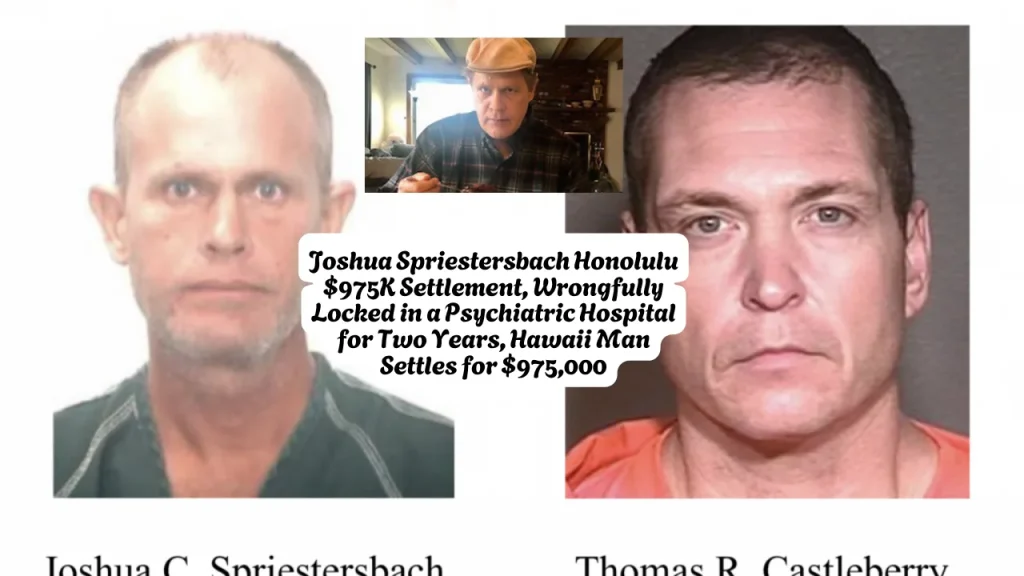
Joshua Spriestersbach Honolulu $975K Settlement, Wrongfully Locked in a Psychiatric Hospital for Two Years, Hawaii Man Settles for $975,000
Joshua Spriestersbach spent four months in jail and more than two years confined at the Hawaiʻi State Hospital — all because authorities kept mistaking him for a man named Thomas Castleberry. He told police, public defenders, and hospital staff repeatedly that they had the wrong person. Nobody acted on it. On March 26, 2026, the Honolulu City Council approved a $975,000 settlement to resolve his civil rights claims against the City and County of Honolulu. He may also receive an additional $200,000 from the state over the public defender’s failure to investigate his repeated claims of mistaken identity.
This is not a class action lawsuit. It is an individual civil rights settlement involving one man and multiple government defendants.
| Field | Detail |
| Plaintiff | Joshua Spriestersbach |
| Defendants | City and County of Honolulu (HPD); State of Hawaiʻi (Public Defender’s Office); treating physician at Hawaiʻi State Hospital |
| Settlement from City | $975,000 — approved by Honolulu City Council March 26, 2026 |
| Settlement from State | $200,000 — pending state legislative approval |
| Private Insurance Settlement | $600,000 — malpractice claim against treating physician |
| Total Combined Settlement | $1,775,000 |
| Admission of Liability | None — no defendant admits wrongdoing |
| Lawsuit Filed | 2021 (federal); 2024 (state court, public defender claim) |
| Case Status | City settlement approved; state portion pending legislative approval |
How a Homeless Man Spent Over Two Years Locked Up for Someone Else’s Crimes
The mistaken identity started taking root as early as 2011. Spriestersbach was sleeping at Kawananakoa Middle School in Punchbowl when an officer woke him up and asked for his name. He would not give a first name and offered only his grandfather’s last name: Castleberry. The officer found a 2009 warrant for Thomas Castleberry and arrested Spriestersbach. Spriestersbach told the officer he was not Thomas Castleberry, but the officer arrested him anyway. The court later dropped the warrant against him — but the mislabeled record stayed in HPD’s system.
A second encounter in 2015 should have fixed everything. An HPD officer approached Spriestersbach after hours in ʻAʻala Park. Officers took Spriestersbach’s fingerprints that time and confirmed he was not Castleberry. Still, the complaint says, they did not update the police department’s records.
The uncorrected record sealed his fate in 2017. Spriestersbach was waiting for food outside Safe Haven in Chinatown, fell asleep on the sidewalk, and an HPD officer woke him up and arrested him on Castleberry’s outstanding warrant. Spriestersbach spent four months at Oʻahu Community Correctional Center and more than two years at the Hawaiʻi State Hospital before being released on January 17, 2020.
Police officers, public defenders, and doctors all had access to information that would have correctly identified both men — but nobody used it. When Spriestersbach insisted he wasn’t Castleberry, the system turned his own truthfulness against him. His complaint states that authorities “determined that Joshua was delusional and incompetent just because he refused to admit that he was Thomas R. Castleberry and refused to acknowledge Thomas R. Castleberry’s crimes.”
He was not released from the state hospital until January 17, 2020, after medical staff there finally confirmed he was Spriestersbach and not Castleberry.
Who Is Being Held Responsible — and For What
Three separate defendants are paying out, reflecting three separate failures:
The $975,000 from Honolulu taxpayers is tied to HPD’s arrest of Spriestersbach without conducting a fingerprint check to verify his identity. The $200,000 from the state relates to the public defender’s office failing to act on Spriestersbach’s repeated claims of mistaken identity. The $600,000 from private insurance is part of a malpractice claim against his treating physician at the state hospital.
Multiple attorneys at the public defender’s office heard Spriestersbach’s account but did not act on it. His lawsuit argues that the city’s practices for identifying homeless and mentally ill people — and its failure to correct erroneous records — were the direct cause of his wrongful detention.
The Honolulu City Council approved the $975,000 settlement on March 26, 2026, though council member Val Okimoto voted to approve it with reservations.
Related article: Eye Physicians of Central Florida Data Breach Settlement, Do You Qualify for Up to $9,500 Until May 15, 2026?
Key Dates in the Spriestersbach Case
| Event | Date |
| First mistaken identity incident (Kawananakoa Middle School) | 2011 |
| Second encounter — fingerprinted, confirmed not Castleberry, records not corrected | 2015 |
| Wrongful arrest on Castleberry’s warrant | May 11, 2017 |
| Began detention at Oʻahu Community Correctional Center | 2017 |
| Transferred to Hawaiʻi State Hospital | 2017 |
| Released after hospital staff confirmed his true identity | January 17, 2020 |
| Federal lawsuit filed | 2021 |
| State lawsuit filed (public defender’s office) | 2024 |
| State $200,000 settlement proposed | February 2026 |
| Honolulu City Council approves $975,000 settlement | March 26, 2026 |
| State legislative approval of $200,000 | Pending |
| Expected payment | Summer 2026 (pending approvals) |
Questions People Are Asking About This Case
Why did this go on for over two years if Spriestersbach kept saying he wasn’t Castleberry?
Authorities concluded that Spriestersbach was delusional and incompetent rather than truthful — because he refused to admit he was Castleberry and refused to acknowledge Castleberry’s criminal history. The more he told the truth, the more the system treated him as mentally incompetent. That reasoning kept him institutionalized long after anyone should have verified his real identity.
Didn’t police already confirm his identity with fingerprints in 2015?
Yes — and that’s one of the most damning parts of the case. Officers fingerprinted Spriestersbach in 2015 and confirmed he was not Castleberry, but they did not update HPD’s records. Two years later, a different officer used those same uncorrected records to arrest him.
Does this settlement mean the city or police admitted they did something wrong?
No. None of the defendants admits liability as part of the deal. Settlements of this kind resolve legal claims without a court verdict on guilt or wrongdoing.
Will Spriestersbach actually receive all of this money soon?
He is expected to receive the settlement money this summer, pending legislative and city council approval. The city council approved the $975,000 portion on March 26, 2026. The $200,000 state payment still requires state legislative approval.
Could something like this happen to someone else in Hawaii?
The lawsuit directly raises that concern. The complaint argues that city practices failing to properly identify homeless and mentally ill people — and failing to correct mistaken records that result in their arrests — were the driving force behind Spriestersbach’s wrongful detention. Whether HPD has since changed those practices is not addressed in the settlement.
Is there anything a person can do if they are wrongfully held due to mistaken identity?
Spriestersbach’s case shows how difficult it can be to correct the record from inside the system. Contacting a civil rights attorney, the local public defender’s office, or organizations like the Hawaii Innocence Project — which assisted in this case — is the most direct path to getting errors investigated and corrected. If you believe you or someone you know is being wrongfully detained, contact a civil rights attorney immediately.
Last Updated: March 27, 2026
Disclaimer: This article is for informational purposes only and does not constitute legal advice. Legal claims and outcomes depend on specific facts and applicable law. For advice regarding a particular situation, consult a qualified attorney.
About the Author
Israr Ahmad is a legal content researcher with 4+ years of experience covering class action settlements and consumer rights cases. He has researched and published coverage of 2,500+ settlements using verified court records, settlement administrator filings, and government sources. Learn more about Israr.