
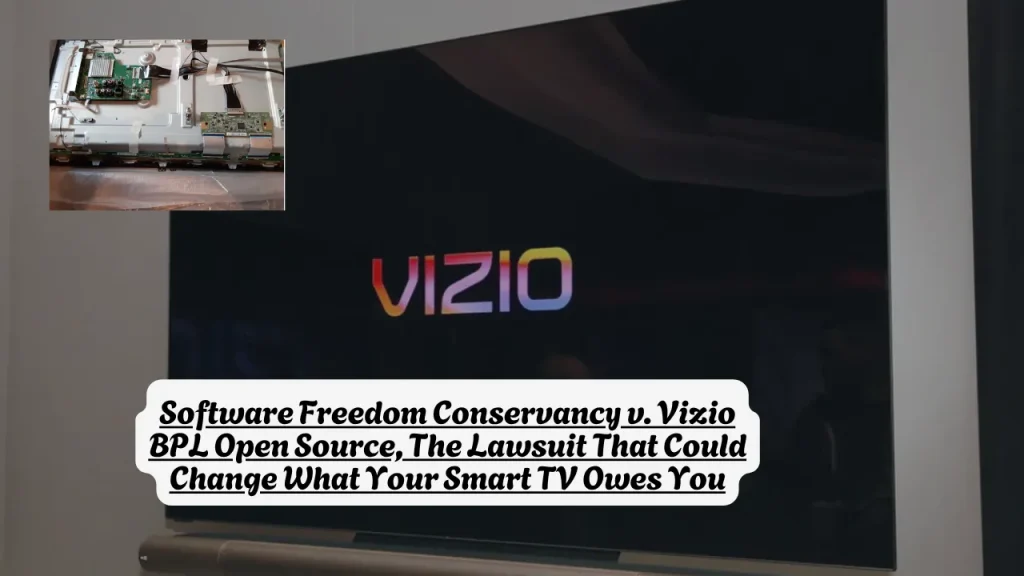
Software Freedom Conservancy v. Vizio BPL Open Source, The Lawsuit That Could Change What Your Smart TV Owes You
The Software Freedom Conservancy purchased a Vizio TV to develop an open-source version of the operating system that was more customizable and didn’t track users to show them ads. The TV runs on Linux, an operating system that legally requires manufacturers to share the code that lets users customize their devices. When SFC asked Vizio to provide the complete, corresponding source code, Vizio refused. So in October 2021, SFC sued Vizio in California state court. The case is now heading to trial in August 2026 — and the outcome could determine whether every American who buys a smart TV has a legal right to demand its software source code.
SFC v. Vizio — Quick Facts
| Field | Detail |
| Lawsuit Filed | October 19, 2021 |
| Case Number | No. 30-2021-01226723-CU-BC-CJC |
| Court | Superior Court of California, Orange County |
| Plaintiff | Software Freedom Conservancy, Inc. (SFC) |
| Defendant | Vizio, Inc. |
| What SFC Is Asking For | Source code for open source software used in Vizio’s SmartCast TV platform |
| Legal Theory | Breach of contract — SFC as third-party beneficiary of GPLv2 and LGPLv2.1 |
| License at Issue | GNU General Public License v2 (GPLv2); GNU Lesser General Public License v2.1 (LGPLv2.1) |
| Key December 2025 Ruling | Court ruled GPLv2 does NOT require Vizio to allow reinstallation of modified software on TVs |
| Key February 2026 Ruling | Court ruled factual disputes require trial — case moves forward |
| Trial Date | August 2026 |
| Judge | Judge Sandy Leal |
| Settlement | None — active litigation |
| Last Updated | May 21, 2026 |
What Is the SFC v. Vizio Lawsuit About?
If you own a Vizio smart TV, your television runs on Linux. Linux is open source software — meaning it is free for anyone to use, but it comes with an important condition: anyone who distributes a product built on Linux must also make the source code available to the people who receive that product. This rule is written into the GNU General Public License version 2 (GPLv2), one of the most widely used open source licenses in the world.
Vizio’s SmartCast TVs include software licensed under the GPL and LGPL, including the Linux kernel, FFmpeg, systemd, and others. Vizio didn’t provide the source code along with the device, and on request provided only some of it.
What makes this lawsuit different from every prior GPL enforcement case is who brought it. Instead of being initiated by a copyright holder — a developer who wrote the code — the lawsuit was filed by a consumer advocacy nonprofit representing the interests of end users. The court allowed the case to proceed based on the argument that consumers are “third-party beneficiaries” of the GPL license and therefore have standing to enforce its terms.
The lawsuit is filed as a third-party beneficiary of GPLv2, meaning that as a purchaser of a Vizio TV, SFC has rights in the contract that Vizio has with the developers of Linux and other software Vizio uses. SFC seeks to confirm in the courts that purchasers of devices running Linux and other software with reciprocal licenses like GPLv2 have a legal right to ask for, and receive, the source code for those devices, so they can adapt the software to their needs, and make practical use of those adaptations by being able to install those changes back onto the devices they purchased.
Vizio was acquired by Walmart for $2.3 billion in a deal announced in February 2024 and closed that December, giving the company deep pockets to defend the litigation.
Related article: $1.5M Wisp Inc. Website Privacy Tracking Settlement, Do You Qualify for a $18 Cash Payment Before July 13?
Are You Affected by the SFC v. Vizio Lawsuit?
This is not a class action and there is no claim form. But if you own or have owned a Vizio smart TV — particularly any model running the SmartCast platform — the outcome of this trial directly affects your legal rights as a consumer.
You may be directly affected if:
- You own or owned any Vizio SmartCast TV — the platform SFC alleges contains GPL-licensed software that was never properly disclosed
- You have ever tried to modify your Vizio TV’s software or install alternative firmware and were denied the source code needed to do so
- You are a developer, researcher, or privacy advocate who wants to audit what software runs on smart TV devices in your home
The broader implication — if SFC wins:
If SFC prevails, it could open the door for other consumers to bring similar lawsuits. Every person who buys a smart TV, router, IoT device, or any product built on GPL-licensed open source software could potentially have a legal right to demand the source code — not as a copyright holder, but as an ordinary consumer. This would represent one of the most significant expansions of consumer rights in the technology space in decades.
If Vizio wins:
The status quo continues. Companies can use GPL-licensed code in consumer products and largely ignore source code requests from end users, with enforcement limited to the original software developers who hold copyright — not the consumers who bought the device.
What Are the Two Key Court Rulings So Far?
The case has already produced two important decisions that define the boundaries of the trial.
December 2025 — Vizio wins on one narrow issue. On December 23, 2025, Judge Leal granted a motion brought by Vizio on the question of whether GPLv2 requires the licensee to provide information necessary to install modified versions of the licensed software back onto the Smart TVs with which the software was originally distributed while ensuring the TVs continue to function properly. The court sided with Vizio: the obligation is merely to provide source code in a manner that allows it to be obtained and revised by the users or others for use in other applications — not to guarantee reinstallation works. SFC states that it never advanced the position that the GPLv2 requires ensuring that devices remain functional after user modification and therefore contends that the December 2025 ruling is “irrelevant.”
February 2026 — SFC survives, case goes to trial. In February 2026, the judge ruled that the case must proceed to trial because factual disputes remain for a jury to resolve. SFC is pursuing two main arguments.
First: SFC claims that anyone who buys a product with open source software has the right to demand the source code, even though the consumer didn’t write the software. The court found this issue to be unsettled, turning in part on disputed evidence regarding the intent and scope of the license.
Second: SFC argues that Vizio made a direct promise to provide source code. SFC alleges that Vizio’s TVs include a menu offering to provide source code upon request, and that one of SFC’s employees accepted that offer through Vizio’s customer support. However, the court found there are factual disputes about when this happened and who made the request.
What Should You Do Right Now?
You cannot join this lawsuit and there is no claim form. But here is what matters to you as a consumer:
- If you want the source code for your Vizio TV’s software today, submit a written request to Vizio’s customer support citing GPLv2. Document your request and their response. This creates a record of whether Vizio complies with the license obligation even before trial.
- If you are a software developer or researcher who has been denied source code by any electronics manufacturer — not just Vizio — this case may open new legal options. Monitor the trial outcome before deciding your next steps.
- If you care about smart TV privacy, understand that modern smart TVs come with software that tracks viewing habits to deliver targeted advertising directly on the TV screen. Access to source code lets researchers and privacy advocates audit and potentially block that tracking. That is exactly what SFC bought its Vizio TV to do.
- Follow trial updates at sfconservancy.org/copyleft-compliance/vizio.html — SFC updates its case page as developments occur.
SFC v. Vizio — Case Timeline
| Milestone | Date |
| SFC raises GPL compliance concerns with Vizio | 2018 |
| SFC purchases Vizio SmartCast TV; requests source code | 2018 |
| SFC files lawsuit in California state court | October 19, 2021 |
| Vizio removes case to federal court; SFC wins remand back to state court | 2022 |
| Orange County Superior Court denies Vizio’s motion for summary judgment | December 29, 2023 |
| Court rules GPL functions as both a copyright license and a contract | 2023 |
| FSF deposed regarding GPL FAQ interpretations | 2024 |
| Court rules GPLv2 does NOT require reinstallation guarantee on TV devices | December 23, 2025 |
| Court rules factual disputes remain; case proceeds to trial | February 17, 2026 |
| Trial date set | August 2026 |
| Expected verdict | TBD — trial scheduled August 2026 |
Frequently Asked Questions — SFC v. Vizio
Is there a class action lawsuit against Vizio over GPL source code?
No. SFC sued Vizio in California Superior Court, Orange County, Case No. 30-2021-01226723-CU-BC-CJC. This is an individual breach of contract claim brought by one nonprofit organization. There is no class action and no claim form for Vizio TV owners.
Do I need to do anything right now to be included?
No. This is not a class action — there is no class to join. If the case results in a ruling that establishes consumer rights to GPL source code, that legal right would apply broadly to future enforcement actions, not just to SFC’s claim.
What is the GPL and why does it matter to me as a Vizio TV owner?
The GPL (GNU General Public License) is a software license that allows free use of software on one condition: anyone who distributes a product containing that software must also share the underlying code. Vizio’s SmartCast TVs include software licensed under the GPL, including the Linux kernel, FFmpeg, and systemd. If SFC wins, you would have a legal right to ask for and receive that code for your device.
When will a verdict come in the SFC v. Vizio case?
The trial is scheduled for August 2026. After trial, either party may appeal. A final, binding decision could take additional time beyond the initial verdict.
Can I file my own lawsuit against Vizio for not providing GPL source code?
That is exactly the question this case is designed to answer. If SFC wins on the third-party beneficiary theory, the answer becomes yes — ordinary consumers would have standing to sue. Until the trial produces a ruling, consult a consumer rights lawyer if you have made a documented request for source code and been denied.
What happens if SFC wins at trial?
Even if SFC establishes a breach of contract, demonstrating actual monetary harm may prove difficult. The nonprofit’s interest is promoting open source principles, not recovering money. This could make traditional damages hard to calculate, though the court could order specific performance — requiring Vizio to provide the source code. A win on the legal theory — that consumers are third-party beneficiaries with standing — would be the more consequential outcome, as it would reshape open source compliance obligations across the entire electronics industry.
Sources & References
- Software Freedom Conservancy — official case page: sfconservancy.org/copyleft-compliance/vizio.html
- Court docket: Software Freedom Conservancy, Inc. v. Vizio, Inc., No. 30-2021-01226723-CU-BC-CJC, Superior Court of California, Orange County
- Baker Botts: When Consumers Enforce Open Source — The SFC v. Vizio Case (May 2026)
- SFC Blog: Some Unfortunate Delays in Our Struggle for Copyleft Justice (January 26, 2026)
- SFC Blog: Judge in Vizio Case Rules on Issue Irrelevant to Rights Under Copyleft (December 24, 2025)
- FOSS Force: Judge Signals Win for Software Freedom Conservancy in Vizio GPL Case (December 5, 2025)
Prepared by the AllAboutLawyer.com Editorial Team and reviewed for factual accuracy against official SFC case documentation and court records on May 21, 2026. Last Updated: May 21, 2026
Disclaimer: This article is for informational purposes only and does not constitute legal advice. Legal claims and outcomes depend on specific facts and applicable law. For advice regarding a particular situation, consult a qualified attorney.
About the Author
Israr Ahmad is a legal content researcher with 4+ years of experience covering class action settlements and consumer rights cases. He has researched and published coverage of 2,500+ settlements using verified court records, settlement administrator filings, and government sources. Learn more about Israr.