
Roundup Glyphosate Cancer Lawsuit 2026, Supreme Court Ruling Could Block Over 100,000 Claims And a $7.25 Billion Settlement Is Already on the Table
Prepared by the AllAboutLawyer.com Editorial Team and reviewed for factual accuracy against SCOTUSblog’s coverage of oral argument in Monsanto Company v. Durnell (April 28, 2026), the official Bayer settlement preliminary approval order (March 4, 2026), and reporting from Drugwatch, the Chemical & Engineering News, and the Lawsuit Information Center. Last Updated: May 6, 2026
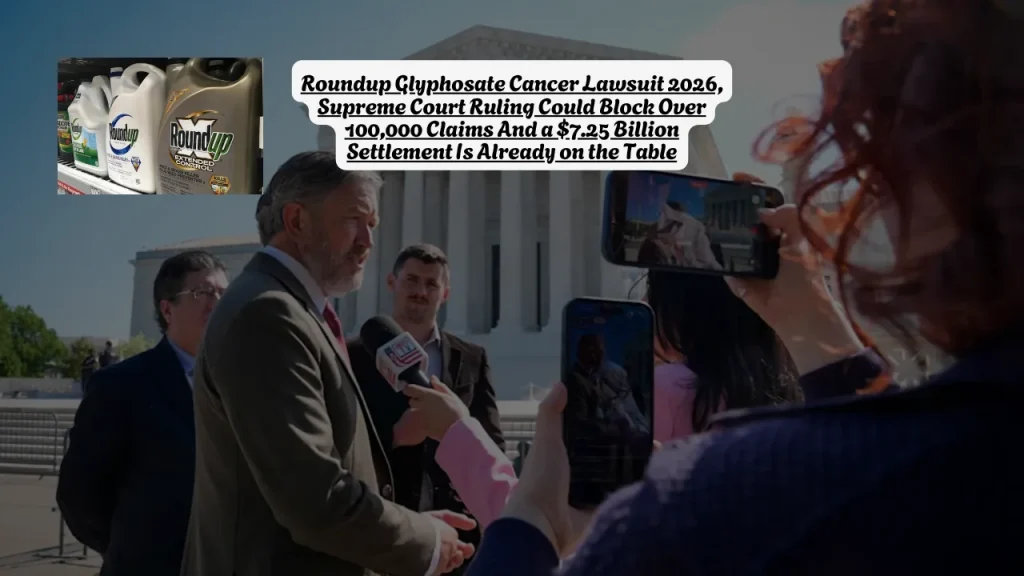
Monsanto is facing a U.S. Supreme Court ruling that could decide whether more than 100,000 Americans who developed non-Hodgkin lymphoma after using Roundup weedkiller can continue pursuing their toxic exposure lawsuits in state court. The case, Monsanto Company v. Durnell, No. 24-1068, was argued before the Supreme Court on April 27, 2026, and a decision is expected by early July. At the same time, Monsanto’s parent company Bayer AG has proposed a separate $7.25 billion class action settlement that is already moving through Missouri state court — with an opt-out deadline of June 4, 2026, weeks before the Supreme Court is expected to rule.
Roundup / Glyphosate Lawsuit — Quick Facts
| Field | Detail |
| Supreme Court Case | Monsanto Company v. Durnell, No. 24-1068 |
| Oral Argument Date | April 27, 2026 |
| Expected Ruling | Early July 2026 |
| Defendant | Monsanto Company (owned by Bayer AG since 2018) |
| Alleged Violation | Failure to warn consumers of cancer risk — state law claims; federal preemption dispute under FIFRA |
| Who Is Affected | U.S. residents who used Roundup or glyphosate-based products and developed non-Hodgkin lymphoma (NHL) |
| Total Active Claims | Approximately 100,000–125,000+ pending nationwide |
| Parallel Settlement | $7,250,000,000 proposed — preliminarily approved March 4, 2026 in St. Louis Circuit Court |
| Settlement Opt-Out Deadline | June 4, 2026 |
| Settlement Final Hearing | July 9, 2026 |
| Court & Jurisdiction | U.S. Supreme Court (federal case); 22nd Judicial Circuit Court of Missouri (settlement) |
| Lead Law Firms (Plaintiffs) | Clarkson Law Firm; multiple mass tort plaintiffs’ firms |
| Official Settlement Website | TBD — class members notified directly |
| Last Updated | May 6, 2026 |
Where the Roundup Litigation Stands Right Now
- The Supreme Court heard 75 minutes of oral argument on April 27, 2026, with justices visibly divided on whether federal pesticide law shuts down state-court failure-to-warn claims.
- A ruling is expected before the end of the Court’s term in early July 2026.
- Bayer’s $7.25 billion proposed settlement received preliminary approval from a Missouri state court on March 4, 2026, and covers both existing claimants and people who may be diagnosed with NHL in the future.
- Class members who want to opt out and preserve their right to sue individually must do so by June 4, 2026 — before the Supreme Court rules.
- Lawyers representing nearly 20,000 plaintiffs have moved to slow the settlement approval process, arguing the deal was negotiated without sufficient input from all affected parties.
- Bayer has reserved the right to walk away from the settlement entirely if too many plaintiffs opt out.
What Is the Roundup Glyphosate Lawsuit About? Monsanto Company v. Durnell, No. 24-1068
Roundup is the most widely used herbicide in the United States. Its main active ingredient, glyphosate, has been approved by the EPA since 1974, and the agency has repeatedly concluded that glyphosate does not cause cancer in humans when used as directed.
In 2015, a different scientific body told a different story. The International Agency for Research on Cancer (IARC), part of the World Health Organization, classified glyphosate as “probably carcinogenic to humans” based on limited evidence from human exposure and sufficient evidence from animal studies. That classification opened the door to a wave of lawsuits — now exceeding 100,000 — from Americans who developed non-Hodgkin lymphoma (NHL), a type of blood cancer, after years of Roundup use.
John Durnell is one of those people. He is a St. Louis resident who used Roundup for years in neighborhood beautification work, later developed NHL, and sued Monsanto in 2019 in Missouri state court under a state law failure-to-warn claim — arguing that Monsanto should have put a cancer warning on its Roundup labels. A Missouri jury agreed and awarded him $1.25 million in compensatory damages in 2023. The Missouri Court of Appeals affirmed that verdict in February 2025.
Related article: $850K BMO Bank Wisconsin Repossession Settlement, Were You One of the ~269 Affected Borrowers? Here Is How You Get Paid
Monsanto’s entire defense strategy rests on a federal law called the Federal Insecticide, Fungicide, and Rodenticide Act (FIFRA). FIFRA explicitly prohibits states from imposing labeling requirements on pesticides that differ from what federal law requires. Monsanto argues that because the EPA has never required a cancer warning on glyphosate products — and in fact has consistently concluded the chemical is safe — no state court can hold Monsanto liable for not putting one there. Plaintiffs argue that a state tort lawsuit for failing to warn is not the same as a state imposing a labeling rule, and that FIFRA does not eliminate the right to sue.
Lower courts across the country have split sharply on this question. That split is exactly why the Supreme Court took the case. For context on how environmental damage lawsuits move through federal and state courts, see our guide to Roundup Glyphosate Class Action coverage on AllAboutLawyer.com.
Are You Part of the Roundup Glyphosate Class Action?
If you used Roundup or another glyphosate-based product and were later diagnosed with non-Hodgkin lymphoma, you may already be affected by both the Supreme Court case and the Bayer settlement — even if you have never taken any legal action.
You may be part of the Bayer $7.25 billion settlement class if:
- You were living in the United States on March 4, 2026
- You had contact with Roundup or another qualifying glyphosate-based product in the U.S. before February 17, 2026
- Your exposure came from applying the product yourself, purchasing it, directing its application, or otherwise having reason to know you were exposed
- You have been diagnosed with non-Hodgkin lymphoma — or you have not been diagnosed yet but were exposed before the cutoff date (future claimants diagnosed within 16 years of final approval may also qualify)
You are likely NOT included if:
- Your cancer diagnosis is a type other than non-Hodgkin lymphoma
- Your claim was already resolved under a prior Bayer settlement program
- You have no documented or traceable exposure to Roundup or glyphosate-based products
If you meet the class definition and do nothing, you remain in the settlement by default. That means if the court grants final approval, you must go through the settlement’s claims process for any NHL diagnosis — and you cannot sue Bayer separately afterward. The only way to preserve your right to file your own lawsuit is to formally opt out by June 4, 2026.
This decision carries enormous weight right now. If you opt out and the Supreme Court rules in Monsanto’s favor, your individual lawsuit could be legally blocked. If you stay in the settlement and the Supreme Court rules against Monsanto, you may have accepted less compensation than you could have won in court. Anyone in this position should consult a product liability attorney as soon as possible. Many mass tort attorneys handle these cases on contingency — meaning no upfront costs. See also our related coverage of the FIS $210M securities class action settlement on AllAboutLawyer.com for an example of how large multi-plaintiff settlements distribute funds over time.
What Are Plaintiffs Seeking in the Roundup Glyphosate Lawsuit?
Plaintiffs in the individual Roundup lawsuits are seeking compensation for damages tied to their NHL diagnoses — including medical expenses, lost income, pain and suffering, and in many cases punitive damages for Monsanto’s alleged failure to warn.
Under the $7.25 billion proposed settlement, individual payouts are expected to range from approximately $10,000 to $165,000 or more, depending on factors including:
- Whether the exposure was occupational (farmworkers, landscapers, groundskeepers) or residential (backyard use)
- The claimant’s age at diagnosis
- The severity of the NHL diagnosis
The $7.25 billion would be paid out over up to 21 years through annual payments. Bayer has also reserved the right to terminate the settlement if opt-out numbers are too high. In the Supreme Court case, plaintiffs are seeking a ruling that FIFRA does not preempt state failure-to-warn claims — which would keep the door open for both ongoing and future individual lawsuits regardless of what the settlement ultimately does.
There is no claim form tied to the Supreme Court case itself. That case will determine the legal framework for all existing and future Roundup litigation — it is not a direct mechanism for individual compensation.
What Should You Do If You Used Roundup and Were Diagnosed with NHL?
The most important thing you can do right now is act before the June 4, 2026 opt-out deadline. Here is your practical roadmap:
- If you have a lawyer and an active Roundup claim: Talk to your attorney immediately about whether to opt in or opt out of the Bayer settlement. They are tracking the Supreme Court argument closely and can advise you based on your specific facts.
- If you have no attorney: Contact a toxic exposure attorney or product liability attorney who handles Roundup cases for a free consultation before June 4, 2026. Many work on contingency — you pay nothing unless you recover money. Attorney fees under the settlement are capped at 22% of your award.
- If you have NHL but have not yet filed any claim: You are likely automatically included in the Bayer settlement class. If you want to preserve your right to sue individually, you must opt out in writing before June 4.
- If you were exposed to Roundup but have not been diagnosed with NHL: You are in the settlement class for potential future claims. You can opt out now, wait for a diagnosis, or remain in the class and file through the settlement program if diagnosed within 16 years of final approval.
- Save all records: Receipts, product containers, medical records, and any documentation showing your Roundup use and your NHL diagnosis are critical to any claim, whether individual or through the settlement.
- Monitor the Supreme Court’s ruling — expected by early July 2026 — at the official docket page for Monsanto Company v. Durnell, No. 24-1068, via SCOTUSblog.
Roundup Glyphosate Lawsuit Timeline
| Milestone | Date |
| EPA First Approved Glyphosate | 1974 |
| Monsanto Developed Roundup | 1970s |
| Bayer Acquired Monsanto | 2018 |
| IARC Classified Glyphosate as “Probably Carcinogenic” | 2015 |
| Wave of U.S. Lawsuits Began | 2015 onward |
| John Durnell Filed Lawsuit in Missouri | 2019 |
| Missouri Jury Awarded Durnell $1.25M | 2023 |
| Missouri Court of Appeals Affirmed Verdict | February 2025 |
| Supreme Court Agreed to Review | January 2026 |
| Bayer $7.25B Settlement Proposed | February 17, 2026 |
| Trump Executive Order on Glyphosate Signed | February 2026 |
| Missouri Court Granted Preliminary Approval | March 4, 2026 |
| Supreme Court Oral Argument | April 27, 2026 |
| Settlement Opt-Out / Objection Deadline | June 4, 2026 |
| Expected Supreme Court Ruling | Early July 2026 |
| Settlement Final Approval Hearing | July 9, 2026 |
Frequently Asked Questions
Is there a class action lawsuit against Monsanto/Bayer for Roundup cancer claims?
Yes — there are over 100,000 active claims across the country alleging that glyphosate in Roundup caused non-Hodgkin lymphoma. The U.S. Supreme Court heard oral argument in the leading case, Monsanto Company v. Durnell, No. 24-1068, on April 27, 2026. Separately, a $7.25 billion proposed class settlement is pending final approval in Missouri state court.
Do I need to do anything right now to be part of the Bayer Roundup settlement?
Only if you want to opt out. If you used Roundup before February 17, 2026 and meet the class definition, you are automatically included. To preserve your right to sue individually, you must mail a formal opt-out letter received by June 4, 2026. Do nothing and you remain in the class.
When will the Supreme Court rule in the Roundup case?
The Supreme Court’s ruling in Monsanto Company v. Durnell is expected by early July 2026, before the Court’s term ends. That ruling will determine whether state-court failure-to-warn claims against Roundup are preempted by the federal FIFRA law.
What happens to my lawsuit if the Supreme Court rules for Monsanto?
A ruling in Monsanto’s favor could legally block failure-to-warn claims across all state and federal courts, potentially dismissing thousands of pending individual Roundup lawsuits. This is why the opt-out decision before June 4 is so critical — if you opt out and the Court rules for Monsanto, your individual case could be foreclosed.
Can I file my own Roundup lawsuit against [Company] instead of joining the settlement?
Yes. You can opt out of the Bayer $7.25 billion settlement and pursue your own lawsuit. However, a Supreme Court ruling in Monsanto’s favor could significantly limit or eliminate those claims. Consulting a consumer rights lawyer experienced in mass tort litigation before June 4 is strongly recommended.
How will I know if the Roundup settlement is approved?
Class members receive direct notice by mail or email. You can also monitor the docket in the 22nd Judicial Circuit Court, City of St. Louis, Missouri. The final fairness hearing is scheduled for July 9, 2026.
Is glyphosate still in Roundup products sold today?
Bayer removed glyphosate from Roundup products sold in the U.S. residential lawn and garden market in 2023. Glyphosate remains present in Roundup products sold to farmers and commercial users. It is also still the active ingredient in many competing herbicide products sold worldwide.
Will the Roundup settlement payment affect my taxes?
Portions of a personal injury settlement are often excludable from federal income tax under Section 104 of the Internal Revenue Code, but the tax treatment depends on the specific nature of your damages. Consult a qualified tax professional regarding your individual situation.
Disclaimer: This article is for informational purposes only and does not constitute legal advice. Legal claims and outcomes depend on specific facts and applicable law. For advice regarding a particular situation, consult a qualified attorney.
About the Author
Israr Ahmad is a legal content researcher with 4+ years of experience covering class action settlements and consumer rights cases. He has researched and published coverage of 2,500+ settlements using verified court records, settlement administrator filings, and government sources. Learn more about Israr.