
RECA New Mexico 2026, Who Qualifies for $100,000 in Radiation Compensation?
New Mexico residents and former residents who developed certain cancers after historical nuclear weapons testing may qualify for $100,000 in federal compensation under the expanded Radiation Exposure Compensation Act (RECA). Qualifying uranium miners, millers, ore transporters, core drillers, and remediation workers may also receive $100,000. If a qualifying person has died, eligible surviving beneficiaries may apply.
The U.S. Department of Justice (DOJ) is accepting applications following Congress’s July 4, 2025 reauthorization and expansion of the program under Public Law 119-21. The filing deadline is December 31, 2027.
Unlike earlier versions of RECA, the expanded law includes every New Mexico county for downwinder eligibility. That means people who lived in Albuquerque, Tularosa, Socorro, Las Cruces, Santa Fe, Los Alamos, Grants, Gallup, and other New Mexico communities, including Navajo Nation and Pueblo communities within the state, during qualifying periods may be eligible.
However, living in New Mexico alone does not guarantee payment. Applicants must document historical residence or qualifying employment and an eligible medical condition. Under RECA, claimants do not have to prove a direct causal link between radiation exposure and their illness once the statutory residence or work and diagnosis criteria are established. RECA is a non-adversarial federal compensation program, not a private class action.
You can apply directly through the official DOJ RECA portal without hiring a lawyer. The program also accepts applications by mail, but never by email.
Official DOJ RECA page (forms and instructions): https://www.justice.gov/civil/reca
Official online claim portal: https://reca.justice.gov/
RECA New Mexico 2026: Quick Facts
| Detail | Verified information |
| Program | Radiation Exposure Compensation Act |
| Federal administrator | U.S. Department of Justice, Civil Division |
| RECA expansion signed | July 4, 2025 (Public Law 119-21) |
| Legal authority | RECA, 42 U.S.C. § 2210 note, as amended; regulations at 28 C.F.R. Part 79 |
| Eligible state | All of New Mexico (all 33 counties) for downwinders |
| Downwinder compensation | $100,000 |
| Uranium worker compensation | $100,000 |
| Onsite participant compensation | $100,000, subject to applicable offsets |
| Historical downwinder period | September 24, 1944–November 6, 1962 |
| Uranium employment period | January 1, 1942–December 31, 1990 |
| Eligible medical conditions | Specified cancers or qualifying uranium-worker diseases |
| Eligible deceased claimants | Certain surviving family members may apply |
| Prior-recipient rule | Individuals who already received prior RECA compensation generally cannot submit additional claims for that same prior award |
| Application deadline | December 31, 2027 |
| Application status | Open |
| Filing options | Online or mail (no email applications) |
| Official DOJ RECA page | https://www.justice.gov/civil/reca |
| Official claim portal | https://reca.justice.gov/ |
| DOJ telephone | 1-800-729-7327 |
| Mailing address | Radiation Exposure Compensation Program, U.S. Department of Justice, P.O. Box 146, Ben Franklin Station, Washington, DC 20044-0146 |
Who Qualifies for $100,000 Under RECA in New Mexico?
Eligibility depends on meeting both the qualifying location or work and date rules and having a diagnosis of a specified compensable disease. Three categories are especially relevant to New Mexicans.
| Category | Main eligibility requirement | Payment |
| Downwinders | Historical presence in New Mexico during qualifying dates plus a covered cancer | $100,000 (or equal survivor shares if deceased) |
| Uranium workers | Qualifying uranium employment during 1942–1990 plus a covered disease | $100,000 (or equal survivor shares if deceased) |
| Onsite participants | Qualifying participation at an atmospheric nuclear weapons test plus a covered cancer | $100,000, subject to certain VA offsets |
These categories have different requirements. A former uranium miner does not need to establish eligibility under the downwinder residence rules if their occupational history qualifies under the uranium worker provisions. Likewise, someone who attended school in New Mexico during the testing period may be eligible as a downwinder even without employment in the nuclear industry.
You do not need to live in New Mexico today to qualify if the qualifying residence or uranium employment occurred during the covered window.
New Mexico Downwinders: Does Every County Qualify?
Yes. All 33 counties in New Mexico are geographically included under the expanded downwinder provisions. The law does not restrict eligibility to communities immediately surrounding the July 16, 1945 Trinity nuclear test.
Examples of communities whose historical residents may qualify:
- Southern New Mexico: Tularosa, Alamogordo, Las Cruces, Truth or Consequences, and surrounding communities
- Central New Mexico: Socorro, Albuquerque, Belen, and Los Lunas
- Northern New Mexico: Santa Fe, Española, Taos, Los Alamos, and Farmington
- Western New Mexico: Gallup, Grants, and other communities
- Eastern New Mexico: Roswell, Clovis, Hobbs, Carlsbad, and nearby areas
These are geographic examples, not lists of automatically eligible claimants. Every applicant must also satisfy the presence-duration and medical requirements.
What Years Did You Need to Live in New Mexico?
DOJ recognizes three alternative downwinder presence tests.
| Qualifying historical period | Required presence |
| September 24, 1944–November 6, 1962 | At least one year in New Mexico |
| January 21, 1951–November 6, 1962 | At least one year in a covered downwinder area |
| June 30–July 31, 1962 | Present in a covered area throughout the specified period |
For New Mexico residents, the first test is particularly important because it includes the period surrounding the Trinity Test.
The qualifying one-year period does not necessarily have to be continuous. Congressional guidance explains that qualifying periods can be accumulated. For example, someone who attended school in New Mexico for six months in 1952 and returned for another six months in 1954 may have a qualifying period, provided the documentation and other requirements are met.
What if You Were a Child During the Trinity Test?
People who were children during the eligible period may qualify. The law does not require that you were an adult, owned property, or worked in New Mexico. For example, someone born in New Mexico in 1946 who lived there through 1948 and developed a qualifying cancer decades later may meet the historical presence requirement. An applicant must still establish the required records and diagnosis.
What if You Moved Away From New Mexico?
Moving away does not eliminate eligibility. A person who lived in New Mexico during the relevant period and now lives in Texas, Arizona, California, or another state can still apply. The historical exposure location matters more than the person’s current home address.
Why Did Congress Expand RECA to Include New Mexico?
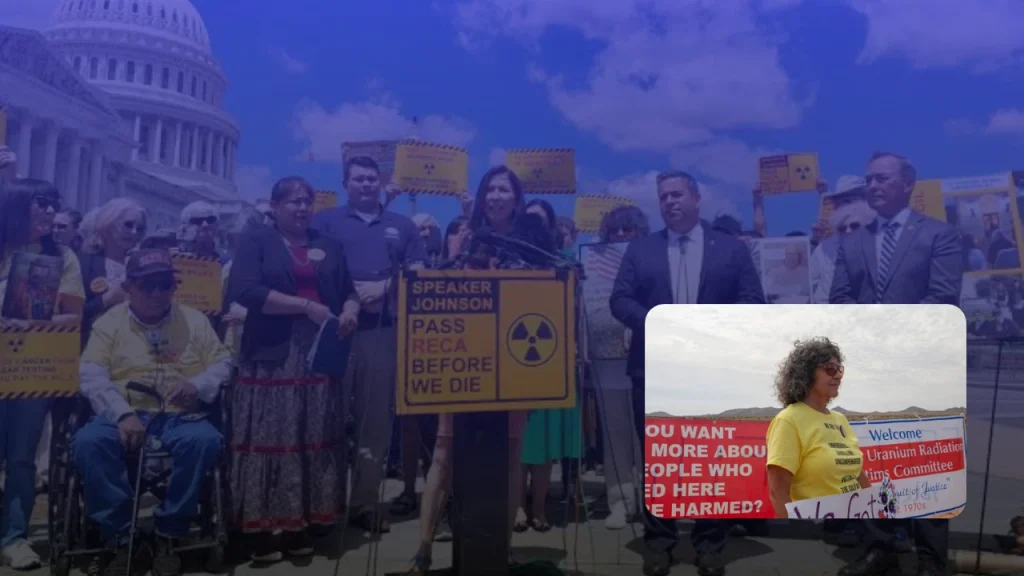
The expansion followed decades of advocacy by communities affected by the U.S. nuclear weapons program. On July 16, 1945, the federal government conducted the world’s first nuclear explosion, the Trinity Test, at the Alamogordo Bombing Range in south-central New Mexico, as part of the Manhattan Project. People in surrounding communities later raised concerns about radioactive fallout and serious illnesses, including cancer.
Yet New Mexico downwinders were previously excluded from the original RECA geographic coverage. The July 2025 amendments added the entire state.
The law does not require each claimant to prove that Trinity fallout directly caused their particular cancer. The federal program relies on designated exposure locations, historical dates, and specified diagnoses, and statutory rules resolve reasonable doubt in favor of claimants. This is one of the most important differences between RECA and traditional toxic-exposure lawsuits.
Which Cancers Qualify for New Mexico Downwinder Compensation?
| Covered disease | Qualification |
| Leukemia | Except chronic lymphocytic leukemia |
| Multiple myeloma | Covered |
| Lymphoma | Except Hodgkin’s disease (non-Hodgkin lymphomas covered) |
| Thyroid cancer | Covered |
| Breast cancer | Male and female |
| Lung cancer | Covered |
| Colon cancer | Covered |
| Brain cancer | Covered |
| Esophageal cancer | Covered |
| Stomach cancer | Covered |
| Pancreatic cancer | Covered |
| Ovarian cancer | Covered |
| Bladder cancer | Covered |
| Primary liver cancer | Subject to statutory exclusions involving cirrhosis or hepatitis B |
| Other specified primary cancers | Pharynx, small intestine, bile ducts, gallbladder, and salivary gland |
Not every cancer diagnosis qualifies. Chronic lymphocytic leukemia and Hodgkin’s disease are excluded under the downwinder provisions. The distinction between a primary cancer and cancer that spread from another organ can also matter. Confirm the precise diagnosis through pathology records or other medical documentation.
RECA New Mexico Uranium Workers: Who Qualifies?
The 2025 amendments expanded compensation for people who worked in uranium mining and processing. Covered employment now runs from January 1, 1942, through December 31, 1990, rather than ending in 1971. This particularly matters for people who worked in New Mexico’s uranium industry in the 1970s and 1980s.
Which Uranium Jobs Are Covered?
- Uranium miners
- Uranium millers
- Core drillers
- Workers transporting uranium or vanadium-uranium ore from qualifying mines or mills
- Workers performing qualifying remediation at uranium mines or mills
The employment must have occurred in a covered occupation and qualifying location. The general requirement is at least one year of covered employment. Uranium mine workers can alternatively establish 40 working-level months of qualifying radiation exposure. Certain periods in different covered occupations may be combined.
Which New Mexico Uranium Mining Areas Are Relevant?
New Mexico has a long uranium mining history, particularly around the Grants Mineral Belt and northwestern New Mexico. Communities associated with the industry include Grants, Milan, Church Rock, Ambrosia Lake, Shiprock, and surrounding parts of McKinley, Cibola, and San Juan counties.
However, working in one of these communities does not automatically qualify someone for RECA. The claimant must establish that the actual job, mine or mill, and employment period meet federal requirements.
Which Diseases Qualify for Uranium Workers?
The uranium worker category has a different medical list from the downwinder category:
- Lung cancer
- Pulmonary fibrosis or fibrosis of the lung
- Silicosis
- Pneumoconiosis
- Cor pulmonale related to fibrosis of the lung
- Renal cancer
- Other qualifying chronic renal diseases, including nephritis and kidney tubular tissue injury
Renal cancer and chronic renal disease were significant additions. A uranium worker with kidney disease should not assume the program only compensates lung conditions.
Can New Mexico Uranium Workers Receive More Than $100,000?
Some qualifying uranium workers may be eligible for additional federal compensation under the Energy Employees Occupational Illness Compensation Program Act (EEOICPA), a separate program administered by the U.S. Department of Labor. Eligible workers or survivors who receive a RECA Section 5 award may also qualify for:
| Federal benefit | Potential compensation |
| RECA uranium worker payment | $100,000 |
| Additional EEOICPA Part B payment | $50,000 |
| Qualifying medical benefits | Additional coverage under applicable program rules |
That means certain eligible uranium workers could receive $150,000 in combined lump-sum compensation, along with available medical benefits. The additional payment is not automatic; the Department of Labor must determine eligibility under its own requirements. EEOICPA claimant resources are listed in the Sources section.
Can Surviving Family Members Apply for RECA Compensation?
Yes. If a qualifying New Mexico downwinder, uranium worker, or onsite participant died before filing a successful claim, certain surviving family members may apply. The federal program sets a hierarchy of eligible survivors, generally beginning with a surviving spouse and then eligible descendants or other specified relatives. Multiple qualifying survivors in the applicable class share the single payment.
A $100,000 RECA award is not multiplied by the number of children or grandchildren. For example, if the survivor rules entitle two children to equal shares of one award, each would receive $50,000. The outcome depends on the statutory hierarchy and the family’s circumstances.
Survivor applicants should prepare documents establishing the deceased person’s eligibility and their relationship to that person, such as death certificates, marriage certificates, birth certificates, and other relevant records.
What Records Do New Mexico Claimants Need?
The biggest practical challenge for many families is documenting events from 60–80 years ago. The New Mexico Department of Health has published useful guidance for obtaining historical records.
Proof of Historical New Mexico Residence
| Record | What it may help prove |
| School enrollment records | Presence in a particular community |
| Birth certificates | Birthplace and supporting family information |
| Church or baptismal records | Historical location and dates |
| Employment records | Work in the affected area |
| Historical tax records (and school, utility, or property records) | Residence or employment information |
| Voting records | Registered address and time period |
| Marriage and divorce records | Historical location or family relationships |
| Medical records | Patient address and treatment dates |
| Personal letters and envelopes | Historical addresses and dates |
| Affidavits, where permitted | Presence or work history |
For families whose ancestors lived in rural communities, church records, school archives, and historical correspondence may be particularly useful. DOJ determines whether the evidence is sufficient, and the state health department cannot guarantee that any particular document will be accepted.
How to Prove a Cancer Diagnosis
Applicants may use certified pathology reports, medical records, hospital discharge summaries, operative reports, and other acceptable documentation. One especially useful resource is the New Mexico Tumor Registry. The state reports that the registry holds records for many residents diagnosed after 1973, with partial coverage back to 1966. The DOJ application lets claimants authorize the program to seek qualifying cancer information from a tumor registry, which can help families whose original hospital records are hard to locate.
How to Apply for RECA New Mexico Compensation in 2026
Applications are open through the Justice Department. The official portal and forms page are listed in Quick Facts above.
Step 1: Choose the correct claim category. Decide whether the claim concerns downwinder presence, uranium employment, or onsite participation. Each has its own federal form and requirements.
Step 2: Collect your supporting records. Gather documentation of the required historical location or work history, the covered diagnosis, and personal identification. Survivors should also collect relationship and death records.
Step 3: Apply online. Use the official DOJ RECA Claim Portal, choose the appropriate category, and complete the application. The system accepts uploaded scans of supporting documents. DOJ may later ask for original or certified copies to authenticate them.
Step 4: Or apply by mail. Download the appropriate form from the DOJ RECA forms and instructions page and mail it with the required original or certified documents to:
U.S. Department of Justice Radiation Exposure Compensation Program P.O. Box 146, Ben Franklin Station Washington, DC 20044-0146
Keep copies of everything. DOJ does not accept initial RECA applications by email.
Step 5: Keep your acknowledgment and claim number. DOJ issues an acknowledgment letter after receiving your application, which may be delayed because of high volume. Include your claim number in future correspondence. Do not mail unrequested evidence without an active claim number. Documents that arrive without a completed claim form, or without a cover page showing your RECA Claim Number and the affected individual’s name, cannot be matched and may be destroyed.
Step 6: Respond to requests for more information. Follow any response deadlines in DOJ’s request. Do not assume a pending claim has been denied just because processing takes time.
Where Can New Mexico Families Get Help Filing RECA Claims?
For program questions, check the DOJ RECA page or call 1-800-729-7327. New Mexico residents can also consult local resources through the New Mexico Department of Health and the New Mexico Public Library networks.
New Mexico Department of Health
- Phone: 833-796-8773
- RECA FAQ and records guidance (listed in Sources)
New Mexico Environment Department The Nuclear Workers Advocacy Program assists people with federal nuclear-worker and radiation compensation matters.
- Radiation Control Bureau: 505-476-8600
- Program website listed in Sources
Ask about available application assistance and any fees before agreeing to representation or services.
Do You Need a Lawyer?
No. The federal government allows eligible applicants to file RECA claims themselves. Under the program’s attorney-fee restrictions, the usual maximum for qualifying initial claims is 2% of the award, which is $2,000 on a $100,000 award. Different statutory limits may apply to certain older agreements or resubmitted denied claims.
Be cautious of anyone promising guaranteed approval, special access to DOJ, or faster payment in exchange for an unusually large percentage of your compensation. For related consumer-protection information, see How to Spot Fake Class Action Settlement Notices? Complete Consumer Guide.
How Much Has the Justice Department Paid Under the Expanded RECA Law?
DOJ announced on November 17, 2026 that approved awards under the reauthorized law had surpassed $1 billion. Its November 19 report gives these nationwide figures:
| Category | Claims approved | Approved compensation |
| Downwinders | 6,323 | $632,300,000 |
| Uranium workers | 380 | $38,000,000 |
| Onsite participants | 96 | $9,489,184 |
| Manhattan Project waste | 7,848 | $345,200,000 |
| Total | 14,647 | $1,024,989,184 |
These are approvals across the United States, not New Mexico alone. DOJ also reported 52,510 claims pending. An application awaiting review is not a denial.
Is RECA New Mexico a Class Action Settlement?
No. RECA is a federal compensation program administered by DOJ. Eligible applicants do not have to join a class-action lawsuit or prove that the federal government negligently caused their illness. Congress created specific eligibility rules for historical exposure and qualifying diagnoses.
This differs from litigation over environmental contamination, such as Camp Lejeune Lawsuit Update 2026. It also differs from private VA claims-assistance disputes such as Trajector Medical Lawsuit, Veterans Charged Millions Despite VA Warning Letters. The procedures, responsible agencies, and payment rules are separate.
Frequently Asked Questions About RECA New Mexico
Can Albuquerque residents qualify for $100,000?
Yes, potentially. Albuquerque is covered because the downwinder provisions include the entire state. The claimant must still establish qualifying historical presence and a covered cancer.
Are Tularosa Basin downwinders eligible?
Yes, qualifying residents are covered. Historical residence and a listed diagnosis remain essential.
Can someone who worked at a uranium mine in the 1980s qualify?
Yes, potentially. The expanded employment period extends through December 31, 1990. The job, duration, location, and medical condition must meet federal criteria.
Do people who worked at the Trinity Test Site qualify?
Certain individuals who participated onsite during qualifying atmospheric nuclear tests may qualify under the onsite participant category. Merely visiting the site decades later is not qualifying participation.
Can I receive $100,000 if my parent died from cancer?
Possibly. Eligible survivors can apply with documentation of the deceased person’s exposure history, covered illness, and the family relationship. Survivor priority rules determine who receives the single award.
Is RECA compensation taxable?
The New Mexico Department of Health identifies qualifying RECA compensation as federally tax-free. If your finances are unusual, consult a qualified tax professional.
Does New Mexico have a separate claims deadline?
No. The federal RECA deadline applies nationwide: December 31, 2027.
Can I file by email?
No. Email is not an accepted way to submit an application.
The Bottom Line
New Mexico residents and former residents now have expanded access to federal radiation compensation. All 33 counties qualify geographically under the downwinder provisions, and the 2025 law extended uranium-worker coverage through 1990. Eligible people with specified cancers or occupational diseases may receive a one-time $100,000 payment, and qualifying survivors can also apply.
The most important action is to gather historical residence or employment documentation and medical records, then submit the correct application to DOJ before December 31, 2027. Use the official DOJ portal and forms page listed in Quick Facts above.
Sources
- U.S. Department of Justice, Radiation Exposure Compensation Act, Eligibility and Claim Forms: https://www.justice.gov/civil/reca
- DOJ RECA Electronic Claim Portal: https://reca.justice.gov/
- DOJ, RECA Awards to Date (Nov. 19, 2026): https://www.justice.gov/civil/awards-date-11192026
- New Mexico Department of Health, RECA Eligibility, Records and Application FAQ: https://www.nmhealth.org/about/phd/phdo/reca/
- New Mexico Environment Department, Nuclear Workers Advocacy Program: https://www.env.nm.gov/rcb/nuclear-workers-advocacy-program/
- Congresswoman Teresa Leger Fernández, New Mexico RECA Filing and Eligibility Guide: https://fernandez.house.gov/services/reca.htm
- U.S. Department of Labor, EEOICPA Benefits: https://www.dol.gov/agencies/owcp/energy
- U.S. Department of Labor, EEOICPA Claimant Resources: https://www.dol.gov/agencies/owcp/energy/regs/compliance/claimant_medprovider_resources/claimant_resources
- Library of Congress, Trinity Test Nuclear Explosion, July 16, 1945: https://www.loc.gov/exhibitions/treasures-from-the-library-of-congress/about-this-exhibition/recording-and-retelling/trinity-test-nuclear-explosion/
- Public Law 119-21 and Radiation Exposure Compensation Act, 42 U.S.C. § 2210 note, as amended
- 28 C.F.R. Part 79, Federal RECA Regulations: https://www.ecfr.gov/current/title-28/chapter-I/part-79
Prepared for AllAboutLawyer.com using official federal and New Mexico government resources.
Disclaimer: This article provides general legal and government-benefits information, not individualized medical or legal advice. The U.S. Department of Justice makes final RECA eligibility determinations.
About the Author
Israr Ahmad is a legal content researcher with 4+ years of experience covering class action settlements and consumer rights cases. He has researched and published coverage of 2,500+ settlements using verified court records, settlement administrator filings, and government sources. Learn more about Israr.