
Procter & Gamble Metamucil Lead Class Action, FFiber Supplements Contain Dangerous Levels of Lead
A New York federal judge ruled on March 31, 2026 that Procter & Gamble must face a class action lawsuit claiming its Metamucil fiber supplements contain dangerous levels of lead — and that the company falsely markets the products as healthy and safe while concealing that fact. P&G tried to have the case thrown out, but the court found the claims are not blocked by federal law and the lawsuit moves forward. No settlement exists yet. If you use Metamucil regularly, here is what the evidence shows and what you can do.
Quick Facts
| Field | Detail |
| Defendant | The Procter & Gamble Co. |
| Plaintiff | Regina Pellegrino |
| Case Name | Pellegrino v. The Procter & Gamble Co. |
| Case Number | 7:23-cv-10631 |
| Court | U.S. District Court for the Southern District of New York |
| Filed | December 2023 |
| Key Ruling | March 31, 2026 — court denies P&G’s motion to dismiss lead claims |
| Settlement | None — active litigation |
| Who May Be Covered | New York consumers who purchased Metamucil products in the last three years |
| Plaintiff’s Attorney | Jack Fitzgerald, Fitzgerald Joseph LLP |
| Lead Limit Alleged to Be Exceeded | California Prop 65 limit of 0.5 micrograms per day |
Where This Case Stands Right Now
- On March 31, 2026, a New York federal judge ruled that The Procter & Gamble Co. must face a trimmed class action alleging that it falsely claims its Metamucil fiber supplement is healthy despite the presence of lead, finding that the claims are not barred by federal law. The judge overseeing the case is Kenneth M. Karas.
- P&G argued the case should be dismissed — in part because federal dietary supplement labeling laws preempt state-level claims. The court rejected that argument on the lead-related claims and allowed them to move forward.
- This is an active lawsuit in discovery and litigation. No class has been certified yet, and no settlement has been proposed. The case will continue developing through the court system.
What Did Independent Testing Actually Find?
Independent laboratory testing in July 2023 reportedly found high Metamucil lead content, with each serving containing significantly more than the daily limit allowable under California’s Proposition 65, which sets forth a maximum allowable dose level of 0.5 micrograms per day.
The proposed class action claims Procter & Gamble is selling a product in Metamucil that contains up to 2,724% of the legally allowed concentration of lead under California’s Proposition 65 standards. That is not a rounding error — that is the central allegation the court has now allowed to proceed to the next phase of litigation.
The testing focused on psyllium husk, the main active ingredient in Metamucil. Psyllium is a plant-based fiber that is grown in soil, and plants can naturally absorb heavy metals — including lead — from the ground during cultivation. The lawsuit claims P&G knew or should have known about this risk but chose not to test adequately, disclose it to consumers, or warn anyone who buys the product.
Related article: $8.2M LastPass Data Breach Settlement, Are You Owed Money for the 2022 Hack? Claim It before July 2, 2026
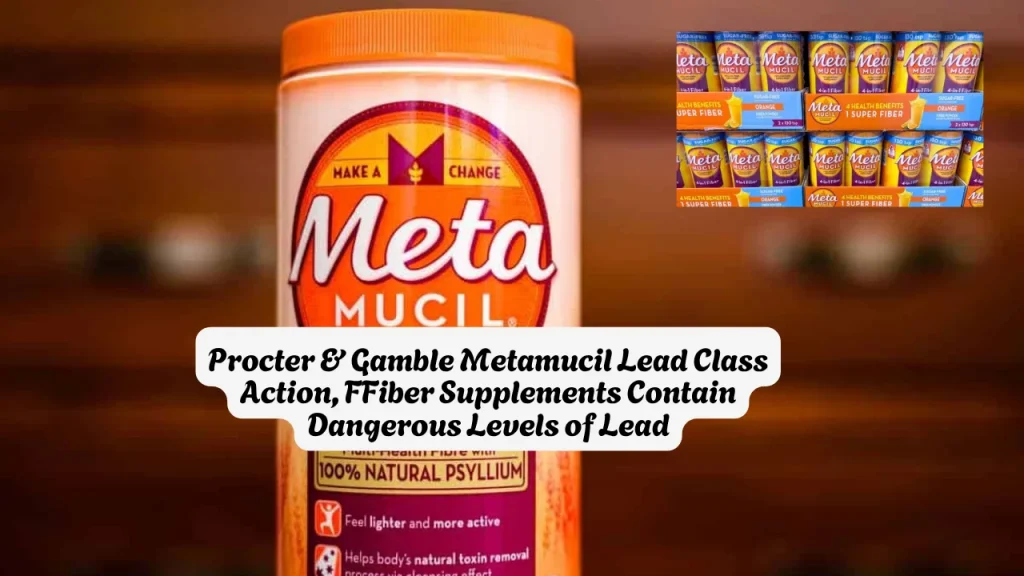
What P&G Says on Its Products — And What the Lawsuit Challenges
P&G markets its Metamucil products as safe and effective at providing health benefits including “appetite control,” “healthy blood sugar levels,” and “digestive health.” The lawsuit claims these health and safety representations are false or at least highly misleading because the Metamucil products contain dangerous amounts of lead, which P&G fails to disclose to consumers.
The complaint also takes direct aim at P&G’s own public messaging. P&G tells consumers on its website that “Safety is at the heart of everything we do” and that it goes “beyond regulatory compliance” to ensure ingredient safety. Each Metamucil product also carries a “Doctor Recommended” label — a claim the lawsuit says adds false credibility to the idea that the product is safe for daily use.
The lawsuit does not claim lead was intentionally added to Metamucil. It claims P&G had a legal obligation to test its product, know what was in it, disclose it on the label, and warn consumers — and that it failed to do any of those things while continuing to market the supplement as a healthy daily habit.
Why Lead in a Fiber Supplement Is a Serious Concern
Lead is a heavy metal with no known safe level of exposure for humans. At high levels of exposure, lead attacks the brain and central nervous system and can cause convulsions, comas, and death. Children who survive lead poisoning may be left intellectually disabled or with behavioral disorders.
Lead exposure can also cause anemia, hypertension, renal impairment, toxicity to the reproductive organs, type 2 diabetes, and cancer.
The concern with a daily fiber supplement is precisely the daily part. Unlike a product someone uses occasionally, Metamucil is specifically marketed as something people should take every single day as part of a long-term health routine. If a product consumed every day contains lead at levels well above the legal limit, the cumulative exposure over months and years is what makes the allegation serious — not any single serving.
Who Does This Lawsuit Seek to Cover?
Pellegrino seeks to represent a class of New York consumers who purchased one or more Metamucil products in the last three years.
The current class definition focuses on New York purchasers, but as the case moves forward through discovery and class certification, the scope of who is covered may expand or be refined by the court.
You may be relevant to this lawsuit if you meet the following:
- You may be relevant if you purchased any Metamucil product in New York within the last three years.
- You may be relevant if you purchased Metamucil in other states and experienced harm — additional cases or an expanded class definition may capture a broader group.
- You may be relevant if you relied on Metamucil’s “Doctor Recommended,” “healthy,” or “safe” labeling when deciding to buy or continue using the product.
- You may be relevant if you or a family member used Metamucil daily for an extended period and have experienced unexplained health issues.
This is still early-stage litigation. No claim form exists and no settlement has been proposed. This case must go through class certification before any broader group of consumers can be formally represented.
What Should Metamucil Users Do Right Now?
There is no recall and no government safety order requiring you to stop using Metamucil. However, this lawsuit raises legitimate questions that daily users deserve to take seriously. Here is what you can do right now.
Step 1 — Talk to your doctor. If you use Metamucil daily, especially if you have used it for years, mention this lawsuit to your doctor at your next appointment. Your doctor can help you evaluate whether your specific health history warrants any concern or testing.
Step 2 — Consider your alternatives. Psyllium husk fiber is also available from other brands, and whole food fiber sources — such as vegetables, legumes, oats, and fruits — carry none of the contamination concerns raised by this lawsuit.
Step 3 — Save your purchase records. If you bought Metamucil products, keep receipts, subscription records, or any documentation showing what you bought and when. If a settlement is eventually reached, purchase records typically help establish your claim.
Step 4 — Monitor this case. Case No. 7:23-cv-10631 can be tracked on the PACER federal court system. The next major milestone is class certification, where the court decides whether this case can formally represent a broader group of consumers.
Step 5 — Contact the plaintiff’s attorney if you believe you were harmed. Jack Fitzgerald of Fitzgerald Joseph LLP represents the plaintiff. If you believe you suffered health harm connected to long-term Metamucil use, you may want to consult a consumer protection or product liability attorney about your options.
Frequently Asked Questions
Is Metamucil being recalled right now?
No. There is no government recall of Metamucil and no FDA order requiring P&G to pull the product from shelves. This is a private class action lawsuit that a court has allowed to move forward. The lawsuit makes allegations that have not yet been proven — P&G denies the claims.
How much lead is allegedly in Metamucil?
Independent testing cited in the lawsuit found that each serving of certain Metamucil products contains lead exceeding California’s Proposition 65 limit of 0.5 micrograms per day. The complaint alleges some products contain up to 2,724% of that legally permitted limit. These are the plaintiff’s allegations — a court has not made a final ruling on whether this is accurate.
Can I file a claim for money right now?
No. There is no settlement and no claim portal. The lawsuit is in active litigation. A claim process would only open if a settlement is reached or the plaintiff wins at trial and a damages process is established. If and when that happens, this article will be updated.
Is P&G contesting the lawsuit?
Yes. P&G argued the case should be dismissed, including on the grounds that federal dietary supplement labeling laws block state-level claims. The court rejected that argument and allowed the lead-related claims to move forward on March 31, 2026. P&G has not admitted any wrongdoing.
Does this affect all Metamucil products?
The original testing and complaint focused on Metamucil powder products, including orange-flavored Metamucil Made with Real Sugar. The plaintiff, Regina Pellegrino, specifically purchased this variety. Whether other Metamucil product lines — capsules, gummies, wafers — are equally affected is a question that may be addressed as the case develops.
Is lead in psyllium supplements a known issue beyond this lawsuit?
Yes. Psyllium husk is a plant grown in soil, and plants can absorb naturally occurring heavy metals from the ground. Several brands of fiber supplements and protein powders have faced similar contamination concerns in recent years. California’s Proposition 65 program exists specifically to flag this type of risk in consumer products.
What law does the lawsuit claim P&G violated?
The complaint alleges violations of New York General Business Law Sections 349 and 350, which prohibit deceptive business practices and false advertising. The court ruled on March 31, 2026 that these state law claims are not preempted by federal law and can proceed.
Last Updated: April 9, 2026
Disclaimer: This article is for informational purposes only and does not constitute legal advice. No court has made a final ruling on the claims described in this lawsuit. Legal claims and outcomes depend on specific facts and applicable law. For advice regarding a particular situation, consult a qualified attorney. If you have health concerns related to product use, consult your doctor.
About the Author
Israr Ahmad is a legal content researcher with 4+ years of experience covering class action settlements and consumer rights cases. He has researched and published coverage of 2,500+ settlements using verified court records, settlement administrator filings, and government sources. Learn more about Israr.