
Orchard Place Iowa Lawsuit Settled 2026, Lawsuit Over Alleged Grooming at an Iowa Teen Treatment Center — and the Defamation Counterclaim It Triggered Just Settled
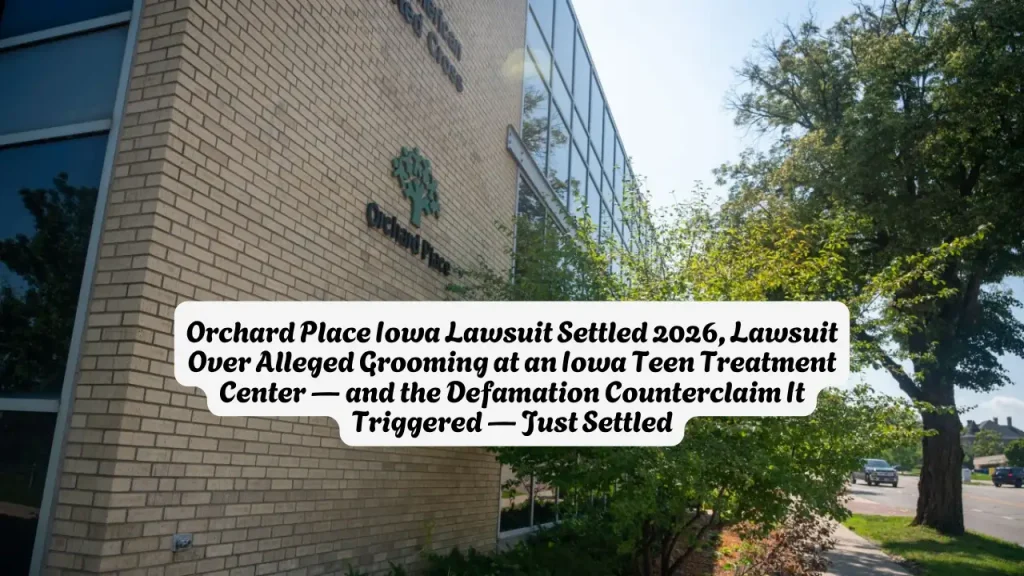
A civil lawsuit alleging that an employee at Orchard Place, a residential treatment facility for adolescents in Des Moines, Iowa, engaged in inappropriate communications with a minor patient has been resolved. The case — which also generated a defamation counterclaim against the plaintiff — was settled by the parties in March 2026 and formally dismissed by Polk County District Court on March 30, 2026. Terms of the settlement were not publicly disclosed.
| Field | Detail |
| Case Name | Heineman v. Orchard Place et al. |
| Court | Polk County District Court, Iowa |
| Filed | 2024 |
| Dismissed | March 30, 2026 |
| Parties | Hayley Heineman (plaintiff); Orchard Place, Cody Lee Loew (defendants) |
| Settlement Amount | Not disclosed |
| Settlement Status | Settled and dismissed |
| Claims | Negligence (plaintiff); Defamation and invasion of privacy (counterclaim) |
She Was a Minor in a Mental Health Facility. She Says an Employee Crossed a Clear Line.
Hayley Heineman — who initially identified herself in court documents only as “Jane Doe” — alleged she lived at Orchard Place, a residential treatment facility for adolescents in Des Moines, from May 20, 2019, to August 19, 2019. The lawsuit indicated she was a minor receiving mental health treatment at the facility at the time.
The lawsuit alleged that Cody Lee Loew, who worked in the residential dorms at Orchard Place during Heineman’s stay, and Heineman engaged in “sexual and impermissible non-sexual communications through texts, phone calls, and Snapchat messages.” After Heineman was discharged, Loew allegedly stopped communicating with her, reportedly sending her into a state of deep depression that led to therapy, medication, and two failed semesters of high school.
The original complaint characterized Orchard Place’s failure to prevent this contact as negligence — specifically, that the facility did not adequately train or supervise its employees. The initial filing alleged that Orchard Place allowed Loew to “exploit, groom and sexually abuse” Heineman. Attorneys later filed an amended complaint that removed the specific allegation of sexual abuse and instead described the communications as “sexual and impermissible non-sexual” in nature. Loew denied all allegations in the case.
Related article: Veeam Management $367,500 Settlement, Applied for a Veeam Job in Washington? You Could Claim Up to $5,000 Before May 29
The Employee Fired Back — With a Defamation Lawsuit of His Own
Rather than simply defending the negligence claim, Loew took an aggressive legal posture and sued Heineman directly.
Loew filed a counterclaim against Heineman for defamation and invasion of privacy, alleging the claims that he “sexually abused her” were untrue and libelous. Loew also alleged that Heineman maliciously abused the legal process by making the allegation in a court petition in retaliation for Loew’s refusal to communicate with her. The counterclaim sought a court injunction barring Heineman from communicating to others that Loew sexually abused her.
The counterclaim created a case-within-a-case: Heineman was simultaneously the plaintiff in a negligence suit against Orchard Place and the defendant in a defamation suit brought by the very employee she accused. That dual structure added significant complexity and potential liability on both sides heading into trial.
Before It Could Go to Trial, Evidence Questions Put the Case Under a Cloud
As the case moved toward a scheduled May 18, 2026, trial date, Orchard Place raised serious questions about the integrity of Heineman’s electronic evidence.
Orchard Place alleged that just before a court-ordered forensic examination of Heineman’s phone could take place, Heineman erased and then partially restored data on her cellphone using data from an iCloud backup. Orchard Place alleged those actions amounted to a violation of discovery orders and a “manipulation of electronically stored evidence.”
Orchard Place’s motion argued that Heineman’s conduct “constitutes willful noncompliance with the court’s discovery order and has irreparably compromised the ability of the defendants to obtain relevant evidence.” The facility had a pending motion before the court seeking both sanctions against Heineman and outright dismissal of her lawsuit at the time the settlement was reached.
That motion was never ruled on. On March 23, 2026, attorneys for both Heineman and Loew notified the court that the original lawsuit and the defamation counterclaim had both been settled. The court formally dismissed the case on March 30, 2026.
What the Settlement Does — and Doesn’t — Resolve
The dismissal closes all claims in the case: Heineman’s negligence allegations against Orchard Place and Loew, and Loew’s defamation counterclaim against Heineman. Neither side has made public statements about the terms.
What the settlement does not do is establish any finding of fact. No court determined whether Loew’s communications with Heineman were improper. No court ruled on whether Orchard Place was negligent. No court decided whether Heineman’s allegations were defamatory. The case ended without any judicial findings on the merits.
Inspection reports for Orchard Place indicate no violations related to staff behavior or sexual abuse had been cited by the state since May 2019, when Heineman was first admitted. Orchard Place declined to comment publicly on the case throughout its duration, stating only that it remained committed to the safety of the youth it serves.
What This Case Illustrates About Institutional Liability and Defamation Risk
Cases like this one sit at an intersection that comes up repeatedly in residential care litigation: the legal exposure a facility faces when an employee is accused of boundary violations with a vulnerable patient, and the countervailing legal risk a plaintiff takes when framing those allegations in court documents.
Iowa, like most states, imposes a duty of care on residential treatment facilities to protect vulnerable patients — particularly minors — from exploitation by staff. A facility’s failure to train, supervise, or remove an employee who poses a risk of harm to residents can give rise to a negligence claim even if the facility had no direct knowledge of specific incidents.
Defamation counterclaims in cases like this one are less common but not unprecedented. When an accused party disputes the core factual allegations in a lawsuit — particularly allegations of sexual misconduct — a counterclaim for defamation serves both as a legal defense and as a means of increasing the financial risk to the plaintiff of pursuing the case. The tactic can add leverage to settlement negotiations by making the litigation more expensive for both sides.
The evidence dispute over Heineman’s phone added a third dimension: spoliation of evidence — the destruction or alteration of material subject to discovery — is treated seriously by courts and can result in sanctions up to and including dismissal, even in cases where the underlying merits might favor the plaintiff.
Frequently Asked Questions
What is Orchard Place?
Orchard Place is a nonprofit residential treatment facility for adolescents located in Des Moines, Iowa. It provides mental health treatment and other services to young people. The facility has operated in Iowa for decades and serves some of the state’s most vulnerable youth populations.
What were the exact allegations against Cody Lee Loew?
The amended complaint alleged that Loew and Heineman engaged in “sexual and impermissible non-sexual communications through texts, phone calls, and Snapchat messages” while Heineman was a minor patient at Orchard Place. The amended complaint removed an earlier allegation of sexual abuse. Loew specifically denied all allegations throughout the litigation.
What was Loew’s defamation counterclaim based on?
Loew alleged that Heineman’s original characterization of his conduct as “sexual abuse” in a court filing was false and libelous, and that she made the allegation maliciously in retaliation for his refusal to continue communicating with her after her discharge from the facility.
What happened with the evidence dispute over Heineman’s phone?
Orchard Place alleged that Heineman erased and then partially restored data on her phone via iCloud backup just before a court-ordered forensic examination. The facility filed a motion seeking sanctions and dismissal, arguing that her actions constituted willful violation of discovery orders and permanently compromised the defendants’ ability to obtain relevant evidence. That motion was pending at the time of settlement and was never ruled upon.
What does the settlement mean for the parties?
All claims — Heineman’s negligence lawsuit and Loew’s defamation counterclaim — are dismissed. No party was found liable, and no court made any findings on the merits. The terms are confidential.
Does this settlement mean Orchard Place did something wrong?
No. A settlement is not an admission of wrongdoing or a judicial finding of liability. Courts do not determine the merits of a case when parties reach a private settlement. The dismissal simply ends the litigation without a verdict.
Could other former Orchard Place residents bring similar claims?
Potentially, depending on their individual circumstances and the applicable statute of limitations under Iowa law. Anyone who believes they experienced inappropriate conduct by staff at a residential treatment facility should consult a licensed Iowa attorney promptly, as time limits on filing civil claims are strict.
Sources & References
- Iowa Capital Dispatch — original lawsuit: iowacapitaldispatch.com
- Iowa Capital Dispatch — defamation counterclaim: iowacapitaldispatch.com
- Iowa Capital Dispatch — settlement and dismissal: iowacapitaldispatch.com
Last Updated: April 1, 2026
Disclaimer: This article is for informational purposes only and does not constitute legal advice. Legal claims and outcomes depend on specific facts and applicable law. For advice regarding a particular situation, consult a qualified attorney.
About the Author
Israr Ahmad is a legal content researcher with 4+ years of experience covering class action settlements and consumer rights cases. He has researched and published coverage of 2,500+ settlements using verified court records, settlement administrator filings, and government sources. Learn more about Israr.