
Orajel Class Action Lawsuit 2026, Ross v. Church & Dwight Claims Orajel Naturals Kids’ Toothpaste Is Falsely Marketed as “Natural”
A new proposed class action accuses Church & Dwight Co., Inc., the maker of Orajel, of marketing its Orajel Naturals children’s fluoride toothpaste as “natural” even though every tube contains cocamidopropyl betaine (CAPB), a foaming agent the plaintiff calls a manufactured, synthetic detergent. The case is Ross v. Church & Dwight Co., Inc., Case No. 2:26-cv-06491, filed October 8, 2026, in the U.S. District Court for the Eastern District of New York. Plaintiff Janet Ross is represented by Philip J. Furia of Furia Law LLC.
These are allegations in a complaint. Church & Dwight has not been found liable, no class has been certified, and as of October 19, 2026 there is no settlement, claim form or claim deadline. The case is about alleged false advertising and economic loss. It does not allege that any child was injured, and no recall has been reported.
Orajel Natural Toothpaste Lawsuit: Quick Facts
| Detail | Information |
| Case name | Ross v. Church & Dwight Co., Inc. |
| Case number | 2:26-cv-06491 |
| Court | U.S. District Court, Eastern District of New York |
| Date filed | October 8, 2026 |
| Plaintiff | Janet Ross |
| Defendant | Church & Dwight Co., Inc. |
| Plaintiff’s counsel | Philip J. Furia, Furia Law LLC |
| Products at issue | Orajel Naturals children’s anti-cavity fluoride toothpastes |
| Ingredient at issue | Cocamidopropyl betaine (CAPB) |
| Claims | New York General Business Law § 349 (deceptive practices), § 350 (false advertising), common-law fraud |
| Proposed classes | Nationwide purchasers; New York subclass |
| Class certification | Not granted |
| Settlement or claim form | None; no money is currently available to claim |
| Church & Dwight response | None reported as of Oct. 19, 2026 |
| Official docket | Justia docket record and PACER (see Sources) |
1. What Is the Orajel Children’s Toothpaste Lawsuit About?
Ross says Church & Dwight sells the Orajel Naturals line as natural even though the toothpaste contains CAPB. According to reporting on the complaint, the name “Orajel Naturals,” flavor names beginning with “Natural” and ingredient-panel notes such as “coconut-derived” lead reasonable parents to believe the product has no synthetic ingredients.
She also alleges that consumers paid a premium for the natural branding and that Church & Dwight charges more for Orajel Naturals than for comparable children’s toothpastes that make no natural claim. She says she would not have bought the toothpaste, or would have paid less, had she known how the ingredient is made.
The central issue is not a hidden ingredient. CAPB appears on the ingredient list. The question is whether the overall “natural” message gives a misleading impression about that ingredient and the product.
Where the “natural” message allegedly appears
- The “Orajel Naturals” brand name on the front of the package
- Flavor names that begin with “Natural,” including Natural Fruity Bubbles, Natural Berry and Natural Watermelon
- Ingredient-panel notes that tie ingredients to sources such as “vegetable,” “mineral” and “coconut-derived”
- A retailer listing that allegedly described the toothpaste as having over 99 percent naturally sourced ingredients
The packaging features characters from PAW Patrol, Super Mario and Toy Story, and the line is aimed at children ages 2 and up.
Who is Janet Ross, and what did she buy?
Ross is the named plaintiff. According to reporting on the complaint, she bought Orajel Naturals PAW Patrol Anti-Cavity Fluoride Toothpaste in Natural Fruity Bubbles flavor through Amazon around July 2025 for a young child in her household. Her purchase does not establish that every buyer saw the same claims or suffered the same loss, which may matter if the court considers class certification.
2. Which Orajel Products Are Involved?
The complaint concerns Orajel Naturals children’s anti-cavity fluoride toothpastes, not every Orajel product.
| Product or packaging | Reported flavor or description |
| Orajel Naturals PAW Patrol Anti-Cavity Fluoride Toothpaste | Natural Fruity Bubbles |
| Children’s toothpaste featuring Super Mario characters | Natural-branded flavors |
| Children’s toothpaste featuring Toy Story characters | Natural-branded flavors |
| Other Orajel Naturals children’s fluoride toothpastes | Including Natural Berry and Natural Watermelon |
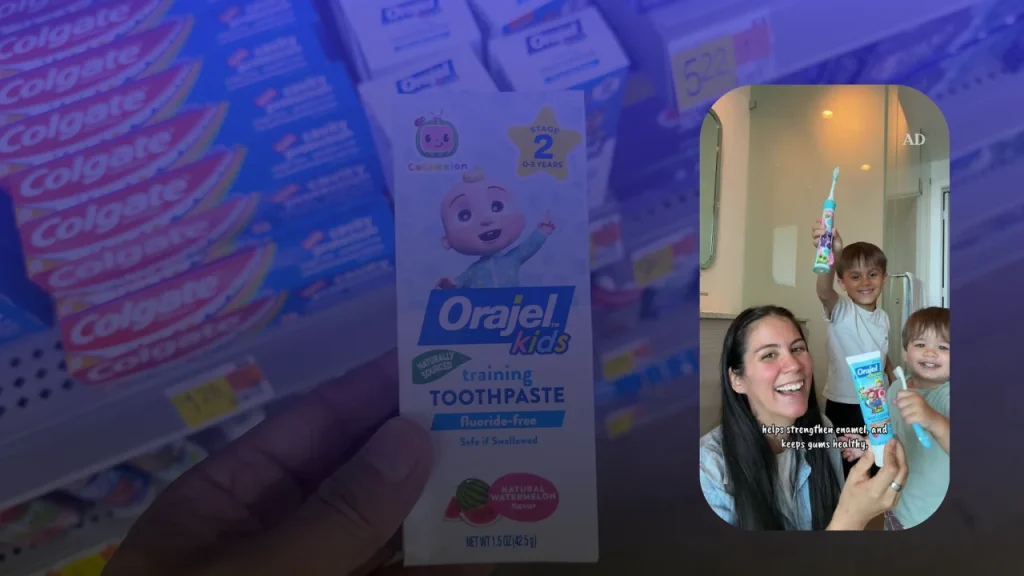
The scope of any class will depend on the pleadings and later court rulings. Do not assume every Orajel toothpaste, including fluoride-free training toothpaste, is covered. Church & Dwight’s published ingredient disclosure for Orajel Kids Anticavity Fluoride Toothpaste lists water, sorbitol, hydrated silica, glycerin, cellulose gum, natural flavor, cocamidopropyl betaine, stevia leaf extract and sodium fluoride, and identifies CAPB as a surfactant. The Orajel Naturals panel lists the ingredient as “Cocamidopropyl Betaine (coconut-derived).”
Related article: H-1B Visa Rules 2026, Wage-Weighted Lottery, Layoff Reviews and the Blocked $100,000 Fee
3. What Is Cocamidopropyl Betaine (CAPB)?
CAPB is a surfactant used in personal-care products. It helps ingredients mix with water and contributes to cleansing and foam.
Why the manufacturing process matters
The complaint describes CAPB as made in two chemical reactions. Fatty acids, which can come from coconut or palm oil, are combined with a petrochemical amine called dimethylaminopropylamine (DMAPA). That product is then reacted with sodium chloroacetate. On this theory the coconut is only a starting material, and the finished molecule is not found in nature.
The complaint argues that the parenthetical “coconut-derived” does not tell an ordinary parent the ingredient is synthetic, because a parent would need working knowledge of industrial chemistry to understand that. Church & Dwight could answer that a plant-derived starting point and accurate source descriptions are enough. Whether a “natural” claim is misleading depends on the whole message conveyed to a reasonable consumer, not on one ingredient alone.
Is this a product safety lawsuit?
No. The complaint does not claim any child was harmed and does not seek damages for a health effect. It mentions that CAPB was named the American Contact Dermatitis Society’s “Allergen of the Year” in 2004, but only as background. The presence of CAPB does not by itself make the toothpaste unsafe, and parents with health questions should speak to a dentist or pediatric professional rather than treat these allegations as a medical finding.
4. What Claims Does the Complaint Bring?
- New York General Business Law § 349 (deceptive business practices), for the New York subclass.
- New York General Business Law § 350 (false advertising), for the New York subclass.
- Common-law fraud, for the nationwide class, with punitive damages sought on this claim.
Ross asks for damages or restitution, a court order stopping the challenged “natural” marketing, interest and attorneys’ fees. She says she is not asking the court to require a new label warning.
5. The Law Behind the Orajel Lawsuit
New York General Business Law § 349
Section 349 prohibits deceptive acts or practices in consumer transactions. A private plaintiff generally must show consumer-oriented conduct, a materially misleading act or practice, and injury caused by it (Oswego Laborers’ Local 214 Pension Fund v. Marine Midland Bank, 85 N.Y.2d 20 (1995)). Courts apply an objective “reasonable consumer” standard (see Fink v. Time Warner Cable, 714 F.3d 739 (2d Cir. 2013)). Reliance is not an element of a § 349 claim (Stutman v. Chemical Bank, 95 N.Y.2d 24 (2000)), though a plaintiff must still show the deception caused the injury.
Section 349(h) allows actual damages or $50, whichever is greater, and a court may increase damages up to three times, to a maximum of $1,000, for a willful or knowing violation. It also allows attorneys’ fees.
New York General Business Law § 350 and § 350-e
Section 350 prohibits false advertising, and § 350-a defines it as advertising that is misleading in a material respect. Section 350-e(3) allows actual damages or $500, whichever is greater, with enhanced damages up to $10,000 for a willful or knowing violation, plus attorneys’ fees. These statutory amounts do not guarantee a payment to any class member in this case.
Common-law fraud and Rule 9(b)
Fraud generally requires a material misrepresentation or omission, knowledge of its falsity, intent to induce reliance, justifiable reliance and damages. In federal court, Fed. R. Civ. P. 9(b) requires fraud to be pleaded with particularity: the statements, where and when they appeared, and why they are misleading. That can be a real hurdle when a complaint covers several product versions and retailer listings. Church & Dwight has not been found to have intentionally deceived anyone.
Limitation periods
New York generally gives three years for §§ 349 and 350 claims (CPLR 214(2)) and the longer of six years from the fraud or two years from discovery for fraud (CPLR 213(8)). The proposed class period reaches back as far as these statutes allow.
Federal jurisdiction
A proposed class action of this size can be heard in federal court under the Class Action Fairness Act, 28 U.S.C. § 1332(d), which covers class actions with at least 100 members, minimal diversity and more than $5 million in controversy.
6. Does Federal Law Define “Natural” for Toothpaste?
FDA rules
Fluoride toothpaste sold to prevent cavities is regulated as an over-the-counter anticaries drug. The FDA’s anticaries monograph at 21 C.F.R. Part 355 sets identity, indication, warning and directions requirements (labeling is at § 355.50). Those rules do not supply a general definition of “natural.” The FDA has said it has not defined “natural” for cosmetics, and its informal policy on “natural” food labeling does not automatically control a toothpaste.
Two federal statutes could matter at the pleading stage:
- Federal Food, Drug, and Cosmetic Act, 21 U.S.C. § 337(a): only the government may enforce the Act. There is no private right to sue directly for FDCA violations.
- 21 U.S.C. § 379r: restricts states from imposing labeling requirements for OTC drugs that are different from or in addition to federal requirements. Church & Dwight could argue this limits state-law claims based on an OTC drug’s labeling. Plaintiffs typically respond that state deception laws merely enforce the same federal standard against misleading statements. Whether and how § 379r applies here has not been decided.
FTC rules
Section 5 of the FTC Act, 15 U.S.C. § 45, prohibits unfair or deceptive acts or practices. In 2016 the FTC announced actions against personal-care companies that advertised products as “all natural” or “100% natural” while using synthetic ingredients: four companies settled and one faced a complaint. Those cases involved other products and records and do not decide this case. The FTC Act gives consumers no private right to sue for damages, so Ross relies on New York law and fraud. The FTC’s Green Guides address environmental marketing claims and do not define “natural” for toothpaste.
7. Why “Natural” Labeling Cases Are Hard to Predict
Courts have not treated “natural” cases consistently. In 2024, a New York federal court decertified three consumer classes challenging “natural” claims on Tom’s of Maine toothpaste and deodorant, a result that differed from several California rulings on similar issues. That history does not decide the Orajel case, but it shows how much depends on the specific label, the evidence and the judge.
8. What Defenses Could Church & Dwight Raise?
The company has not been reported to have filed a response, so these are potential arguments, not positions it has taken in this case.
- The label is not misleading as a whole. It may point to the ingredient list, the “coconut-derived” note and the statement that the fluoride toothpastes are over 99% naturally sourced. A court looks at the whole package, the placement and prominence of qualifying language, and how ordinary consumers read it.
- The ingredient is disclosed. The plaintiff will respond that listing a chemical name does not necessarily cure a misleading overall impression.
- Preemption. See 21 U.S.C. § 379r above.
- No cognizable injury. The plaintiff must prove a real loss, such as a price premium, and a comparison basis for it. Standing under Article III requires a concrete injury, and courts examine “price premium” theories closely.
- Particularity. Rule 9(b) challenges to the fraud claim.
- Class issues. Fraud law varies from state to state, and buyers may have seen different labels, so individual issues may overwhelm common ones in a nationwide class.
9. Who Is in the Proposed Orajel Class?
Neither group is certified.
- Nationwide class: people in the United States who bought the covered Orajel Naturals children’s toothpaste for personal use, not resale.
- New York subclass: people who bought it in New York for personal use, not resale.
Church & Dwight, its affiliates, officers and directors, the assigned judges and people who bought to resell would be excluded. The class period would run as far back as the statutes of limitation allow through the date class notice is given. Buying an Orajel product does not by itself make someone a class member, and the court can narrow the products, dates or geography.
Do you have to live in New York?
The proposed nationwide class covers purchases across the country, while the New York subclass is limited to purchases in New York for the statutory claims. A national fraud class raises extra questions because state laws differ.
10. How Much Could Consumers Receive?
No amount has been approved. Ross seeks restitution or damages based on the difference between what buyers paid and what the product would have been worth without the “natural” branding, plus injunctive relief, fees, interest and punitive damages on the fraud claim. A later settlement could provide a full or partial refund or another benefit, but nothing has been negotiated or approved.
One New York procedural rule can affect class recovery. CPLR 901(b) generally bars class actions for statutory minimum or penalty damages unless the statute authorizes them. In federal court, though, the U.S. Supreme Court held in Shady Grove Orthopedic Associates v. Allstate Insurance Co., 559 U.S. 393 (2010), that Federal Rule of Civil Procedure 23 governs and CPLR 901(b) does not block a class action in federal court. Because this case is in federal court, that rule is likely to be argued.
11. What Happens Next?
As of October 19, no response had been reported, and no judge appeared on the public docket in the summaries reviewed. Check the docket for the latest filings.
- Response or motion to dismiss. Church & Dwight may answer or move to dismiss under Rule 12(b)(6), arguing the claims fail as a matter of law, or under Rule 12(b)(1) for lack of standing. The court may dismiss some claims, let others proceed or allow an amended complaint.
- Discovery. If the case continues, expect evidence on the labels, marketing, ingredient sourcing, pricing and consumer perception.
- Class certification. Under Fed. R. Civ. P. 23(a) the plaintiff must show numerosity, commonality, typicality and adequacy. A damages class under 23(b)(3) also requires that common issues predominate and that a class action is superior. An injunctive class would proceed under 23(b)(2). A certification ruling can be appealed on request under Rule 23(f).
- Settlement. Possible but not guaranteed. A class settlement requires court approval under Rule 23(e), and the court would approve a notice explaining how to claim.
Key dates
| Date | Event |
| October 8, 2026 | Complaint filed in the Eastern District of New York |
| TBD | Church & Dwight’s response (answer or motion to dismiss) |
| TBD | Any ruling on class certification |
12. Can You Join the Orajel Lawsuit or File a Claim?
There is nothing to join or claim right now, and you do not need to do anything. If a class is certified or the case settles, a court-approved notice will explain how to take part. Until then, a reasonable precaution is to keep records:
- Receipts, Amazon order confirmations or other purchase records
- Photos of the packaging and ingredient panel
- The product name, flavor, size and purchase date
- Screenshots of any “natural” claims you saw before buying
Frequently Asked Questions About the Orajel Class Action Lawsuit
Is there an Orajel toothpaste class action lawsuit in 2026?
Yes. Janet Ross filed Ross v. Church & Dwight Co., Inc., No. 2:26-cv-06491, on October 8, 2026, in the Eastern District of New York.
What ingredient is at issue?
Cocamidopropyl betaine (CAPB), a foaming agent. The label calls it “coconut-derived,” but the complaint says it is made by reacting coconut or palm fatty acids with synthetic chemicals.
Does the lawsuit say Orajel Naturals is unsafe for children?
No. The claims concern labeling and price, not injury. No recall has been reported.
Is there an Orajel settlement or claim form?
No. The case is at the complaint stage, and no claims process exists.
Who can be in the class?
The complaint proposes a nationwide class and a New York subclass of people who bought the covered toothpaste for personal use. The court has not approved either.
Has Church & Dwight responded?
Not in reporting available as of October 19. The company’s general product information says its fluoride toothpastes are over 99% naturally sourced, but that is not a verified defense in this case.
Which laws does the complaint rely on?
New York General Business Law §§ 349 and 350 and common-law fraud.
Does the FDA define “natural” for toothpaste?
No single FDA definition resolves this dispute. The FDA has said it has not defined “natural” for cosmetics, and fluoride toothpaste is regulated as an OTC anticaries drug.
How much money could consumers receive?
Nothing has been approved. Any recovery depends on the court’s rulings, class certification and any settlement.
Who represents Janet Ross?
Philip J. Furia of Furia Law LLC.
Editorial Note and Disclaimer
This article describes allegations in a pending proposed class action, not proven facts or a finding of liability. It is general information, not legal advice, and statutory summaries are in plain language and may change. The case is at an early stage, and details may change as the docket develops. Consult a licensed attorney about your own situation. Corrections are welcome.
Sources
- Justia, Ross v. Church & Dwight Co., Inc., No. 2:26-cv-06491 (E.D.N.Y.), docket record: https://dockets.justia.com/docket/new-york/nyedce/2:2026cv06491/552504
- Open Class Actions, Orajel Naturals Kids’ Toothpaste “Natural” Lawsuit, October 9, 2026: https://openclassactions.com/lawsuits/false-advertising/orajel-naturals-kids-toothpaste-natural-class-action-lawsuit.php
- Claim Depot, Orajel class action alleges company falsely markets kids’ toothpaste as natural, October 16, 2026: https://www.claimdepot.com/cases/orajel-naturals-lawsuit-claims-childrens-toothpaste-contains-synthetic-detergent
- Church & Dwight, Orajel Kids Anticavity Fluoride Toothpaste Ingredient Disclosure: https://churchdwight.com/ingredient-disclosure/oral-care/42013386-Kids-Anticavity-Fluoride-Toothpaste.aspx
- Orajel Kids, Frequently Asked Questions: https://www.orajelkids.com/en/faqs
- New York General Business Law § 349: https://www.nysenate.gov/legislation/laws/GBS/349
- New York General Business Law § 350-e: https://www.nysenate.gov/legislation/laws/GBS/350-E
- New York CPLR 901: https://www.nysenate.gov/legislation/laws/CVP/901
- Federal Rule of Civil Procedure 9: https://www.law.cornell.edu/rules/frcp/rule_9
- Federal Rule of Civil Procedure 23: https://www.law.cornell.edu/rules/frcp/rule_23
- 21 C.F.R. § 355.50, labeling of anticaries drug products: https://www.law.cornell.edu/cfr/text/21/355.50
- FDA, Small Businesses & Homemade Cosmetics Fact Sheet: https://www.fda.gov/cosmetics/resources-industry-cosmetics/small-businesses-homemade-cosmetics-fact-sheet
- FTC, Four Companies Agree to Stop Falsely Promoting Personal-Care Products as “All Natural,” April 2016: https://www.ftc.gov/news-events/news/press-releases/2016/04/four-companies-agree-stop-falsely-promoting-their-personal-care-products-all-natural-or-100-natural
- FTC Green Guides: https://www.ftc.gov/legal-library/browse/rules/green-guides
- Davis+Gilbert LLP, Natural Selection: NY Federal Court Dismisses “Natural” Personal Care Claims, Decertifies Class, February 21, 2024: https://www.dglaw.com/tag/natural-toothpaste/
- 21 U.S.C. §§ 337(a) and 379r; 15 U.S.C. § 45; 28 U.S.C. § 1332(d), uscode.house.gov.
- Oswego Laborers’ Local 214 Pension Fund v. Marine Midland Bank, 85 N.Y.2d 20 (1995); Stutman v. Chemical Bank, 95 N.Y.2d 24 (2000); Fink v. Time Warner Cable, 714 F.3d 739 (2d Cir. 2013); Shady Grove Orthopedic Associates v. Allstate Insurance Co., 559 U.S. 393 (2010).
About the Author
Israr Ahmad is a legal content researcher with 4+ years of experience covering class action settlements and consumer rights cases. He has researched and published coverage of 2,500+ settlements using verified court records, settlement administrator filings, and government sources. Learn more about Israr.