
North Carolina’s Lawsuit Over Nursing Student Loans, What Healthcare Students Need to Know Right Now
North Carolina is one of 24 states and the District of Columbia suing the U.S. Department of Education to block new federal student loan rules that would dramatically cut how much graduate students in nursing, physical therapy, and physician assistant programs can borrow — with the new limits set to take effect on July 1, 2026. Attorney General Jeff Jackson filed the lawsuit in federal court in Maryland on May 19, 2026, arguing the Department of Education unlawfully rewrote what Congress authorized.
Quick Facts: NC Nursing Student Loan Lawsuit
| Field | Detail |
| Case Name | TBD — multistate lawsuit filed in federal court, District of Maryland, May 19, 2026 |
| Defendant | U.S. Department of Education |
| Plaintiffs | 24 states + D.C., including NC, NY, AZ, CA, KY, NV |
| Lead NC Official | Attorney General Jeff Jackson |
| Underlying Law | One Big Beautiful Bill Act (H.R. 1), enacted July 2025 |
| DOE Rule Challenged | Final rule limiting “professional degree” definition for graduate loan caps |
| Current Loan Limit | Up to the full cost of tuition |
| New Cap (Graduate) | $20,500 per year / $100,000 lifetime |
| New Cap (Professional) | $50,000 per year / $200,000 lifetime — only for 11 approved fields |
| Effective Date | July 1, 2026 — unless blocked by court |
| What Lawsuit Asks For | Court order blocking the rule before July 1 |
| NC Nursing Shortage | Projected shortage of ~12,500 RNs and ~5,000 LPNs by 2033 |
| Last Updated | May 20, 2026 |
What Is the North Carolina Nursing Student Loan Lawsuit About?
Congress passed the One Big Beautiful Bill Act (H.R. 1) in July 2025. One piece of it set new annual caps on federal student loans for graduate and professional degree programs. Under the old rules, graduate students could borrow up to the full cost of attendance. Under the new law, most graduate students can borrow only $20,500 per year, with a lifetime cap of $100,000. That is a significant drop for programs like nursing, physical therapy, and physician assistant studies, which often cost far more per year.
Congress did carve out a higher limit — $50,000 per year and $200,000 lifetime — for students in “professional degree” programs. This is where the legal fight lives. The Department of Education issued a final rule that defines “professional degree” as only 11 specific fields: chiropractic, clinical psychology, dentistry, law, medicine, optometry, osteopathic medicine, pharmacy, podiatry, theology, and veterinary medicine. Nursing, physical therapy, nurse anesthesia, occupational therapy, and audiology are not on that list. Students in those programs get the lower $20,500 annual cap — the same as a general graduate student — not the higher $50,000 professional cap.
Related article: Arizona Public Records Law Explained, Your Rights, How to File, and What to Do If You Are Denied
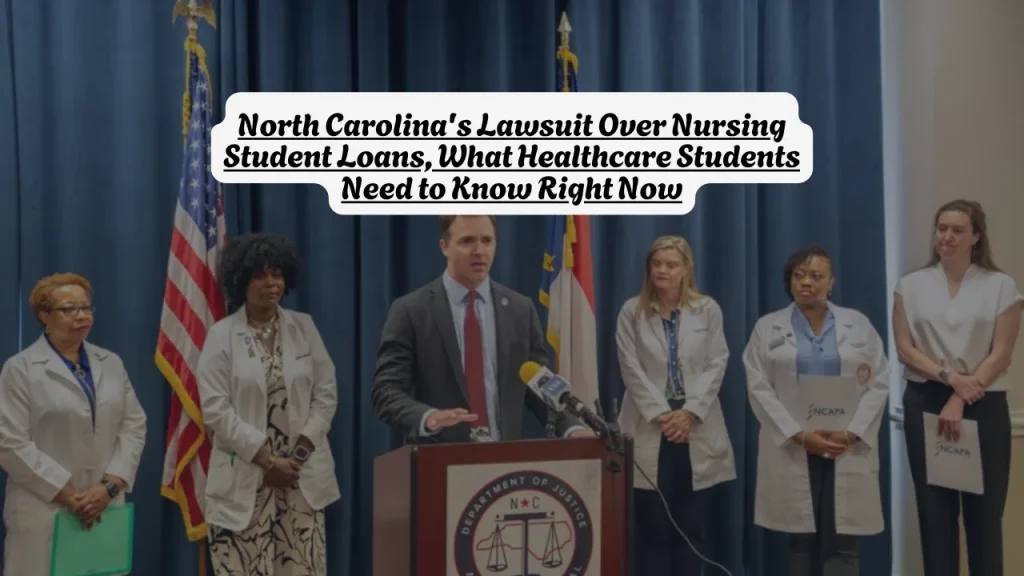
Jackson’s lawsuit argues the Department of Education has no authority to write that list. He frames it as a straightforward administrative law claim — a legal theory that says a federal agency can only act within the power Congress gave it, and that the DOE exceeded its authority by narrowing the definition of “professional degree” beyond what the statute allows. “We don’t have to make a constitutional claim,” Jackson said at a press conference. “We can just say, ‘Department of Education, you only have the authority as vested by Congress, and you are now exceeding that authority.'” The lawsuit also points out that the DOE’s list of professional degree examples was drawn from a regulation unchanged since the 1950s — a time when graduate-level nursing programs barely existed. For background on how administrative law claims work and when they succeed, see our guide to how federal agencies make rules and when courts stop them at AllAboutLawyer.com.
Who Does This Affect in North Carolina?
If you are currently enrolled in, or planning to enroll in, a graduate healthcare program in North Carolina, here is how to know whether the new DOE rule would directly affect your borrowing.
This affects you if you are pursuing or planning:
- A graduate nursing degree — Master of Science in Nursing (MSN), Doctor of Nursing Practice (DNP), Certified Registered Nurse Anesthetist (CRNA) programs
- A physician assistant (PA) degree — students like the Wake Forest PA student cited by Jackson, who noted her program would be capped at $20,500 under the new rule, while medical and dental students remain at $50,000
- A physical therapy (PT) or occupational therapy (OT) doctorate
- An audiology or speech-language pathology graduate program
- Any other allied health graduate program not on the DOE’s 11-program list
This does not affect you if:
- You are in an undergraduate nursing program (BSN, ADN, or LPN) — the new caps apply only to graduate borrowers
- You are in medical school, dental school, law school, pharmacy school, or any of the other 11 fields the DOE defines as “professional”
- You completed enrollment and took out loans before July 1, 2026 — the new limits take effect prospectively
North Carolina has 14,104 students currently enrolled in nursing education programs statewide, per the NC Board of Nursing’s 2024–2025 Education Summary Report. The state already faces a primary care shortage in 93 of its 100 counties, and Governor Josh Stein’s office projected in December 2025 that North Carolina will be short nearly 12,500 registered nurses and more than 5,000 LPNs by 2033. Jackson argues that cutting loan access for people entering those fields makes that shortage worse, not better. Similar federal actions cutting healthcare access and funding have been challenged in the courts — for broader context on that trend, see our coverage of the NC $230 million healthcare funding lawsuit.
The Specific Dollar Impact: Before vs. After July 1, 2026
This is what none of the news reports have laid out clearly. Here is exactly what changes for a student in, say, a two-year physician assistant program at a North Carolina school that costs $45,000 per year in tuition and fees.
Under the old rules: The student could borrow up to $45,000 per year — the full cost — in federal graduate loans.
Under the new DOE rule (if not blocked): The student could borrow a maximum of $20,500 per year — leaving a $24,500 annual gap that must be covered by private loans, scholarships, out-of-pocket, or not at all. Over two years, that gap reaches nearly $50,000. A first-year Wake Forest PA student named Leigh Habegger made exactly this point at Jackson’s press conference: under the new rule, PA students could borrow only $20,500 — half what medical and dental students can borrow for the same academic year.
The Department of Education’s position, stated in an April 2026 statement, is that these changes are designed to curb tuition growth and pressure schools to keep program costs in line with expected earnings. Education Secretary Linda McMahon has argued that the cost of most advanced nursing degrees would still fall within or near the new caps — and that 80% of the nursing workforce does not hold a graduate degree. Critics, including the American Nurses Association, call that reasoning disconnected from how graduate healthcare programs actually work and what they actually cost.
What Should North Carolina Healthcare Students Do Right Now?
The lawsuit asks the court to block the new limits before July 1, 2026. Whether a judge grants that relief before the deadline is unknown — courts can move quickly in emergency motions or not. Here is what students and prospective students should do in the meantime.
If you are currently in a graduate healthcare program, contact your financial aid office now to ask how the new caps would affect your aid package for the 2026–27 academic year if the rule takes effect. Ask specifically whether your program qualifies as a “professional degree” under the DOE’s final rule — because the answer determines which cap applies to you.
If you are starting a graduate healthcare program in fall 2026, do not assume the lawsuit will be resolved in time. Plan your financing around the lower $20,500 cap as a worst case, while monitoring the court proceedings in Maryland for any injunction ruling.
If you want to follow the case, watch the federal court docket in the District of Maryland. Any court order blocking the rule will be reported publicly and will update this article. You can also monitor updates from the NC Department of Justice at ncdoj.gov.
If you believe your borrowing has already been reduced due to this rule taking effect, consult a student loan or consumer rights attorney. A free legal consultation may help you understand your options.
Frequently Asked Questions
Is there a class action lawsuit against the Department of Education over nursing student loans?
Not a class action — this is a multistate lawsuit brought by 24 states and D.C., led by state attorneys general. Individual students are not directly named as plaintiffs, but the outcome would affect all graduate students in the excluded healthcare fields nationwide.
Does this rule affect undergraduate nursing students?
No. The new borrowing caps in the One Big Beautiful Bill Act apply only to graduate-level programs. Undergraduate nursing students — BSN, ADN, and LPN programs — are not affected. The DOE has confirmed this in its own communications.
When do the new student loan limits take effect?
July 1, 2026 — unless a federal court issues an injunction blocking them first. The multistate lawsuit specifically requests emergency relief before that date.
Do I need a lawyer to protect my student loan access?
Not for the lawsuit itself — states are handling that. But if the rule takes effect and affects your specific aid package, a student loan attorney or consumer rights lawyer can help you understand your options. Many offer free consultations.
What law does this lawsuit challenge?
The lawsuit is an administrative law challenge. It does not dispute Congress’s right to set graduate loan limits. It disputes the Department of Education’s final rule, which the states argue unlawfully narrowed the definition of “professional degree” beyond what Congress authorized in the One Big Beautiful Bill Act.
Which states joined NC in this lawsuit?
Arizona, California, Kentucky, Nevada, and New York are among the 24 states plus the District of Columbia that filed the multistate lawsuit in Maryland federal court on May 19, 2026.
Sources & References
- WUNC News, Colin Campbell, “NC attorney general sues to block new student loan restrictions,” May 19, 2026: wunc.org
- WRAL.com, “NC joins multistate lawsuit over healthcare student loan limits,” May 19, 2026: wral.com
Prepared by the AllAboutLawyer.com Editorial Team and reviewed for factual accuracy against official news sources and verified reporting on May 20, 2026. Last Updated: May 20, 2026
Disclaimer: This article is for general informational and educational purposes only and does not constitute legal advice. Laws and legal proceedings are subject to change. For advice about your specific situation, consult a qualified attorney.
About the Author
Israr Ahmad is a legal content researcher with 4+ years of experience covering class action settlements and consumer rights cases. He has researched and published coverage of 2,500+ settlements using verified court records, settlement administrator filings, and government sources. Learn more about Israr.