
New York SAFE for Kids Act Lawsuit, Are TikTok and Instagram Feeds Being Banned?
No. TikTok, Instagram and YouTube feeds are not banned in New York today, and this is What the New York SAFE for Kids Act Requires From not a payout case. New York’s SAFE for Kids Act does not take effect until January 25, 2027. On November 23, 2026, the tech trade group NetChoice sued New York Attorney General Letitia James in federal court in Manhattan, asking a judge to declare the law unconstitutional and block it before that date.
Even when the law is in force, it is not a social media ban. It limits algorithmically personalized feeds and overnight notifications for users under 18 unless a parent consents, and it requires platforms to work out whether a user is an adult.
NetChoice is asking for a court order, not money. There is no settlement fund, no claim form and no deadline for consumers to file anything.
As of November 27, 2026, I found no court order blocking the SAFE for Kids Act in this new case, and no ruling on any preliminary injunction request in it.
NetChoice v. James: SAFE for Kids Act Lawsuit Quick Facts
| Detail | Information |
| Case | NetChoice v. James, No. 1:26-cv-10296 |
| Court | U.S. District Court, Southern District of New York |
| Filed | November 23, 2026 (publicly announced November 24, 2026) |
| Plaintiff | NetChoice, a trade association whose members include Meta, Google, Pinterest and TikTok |
| Defendant | Letitia James, New York Attorney General, in her official capacity |
| Law challenged | Stop Addictive Feeds Exploitation (SAFE) for Kids Act (Senate Bill S7694A) and the Attorney General’s rules, 13 NYCRR Part 700 |
| Effective date | January 25, 2027 |
| Who is protected | Users under 18 in New York |
| Main legal claims | First Amendment; preemption by Section 230 of the Communications Decency Act |
| Relief requested | A declaration that the law is unconstitutional and an order barring enforcement |
| Consumer payout | None |
| Status | Early stage; no ruling on the merits |
Social Media Platforms
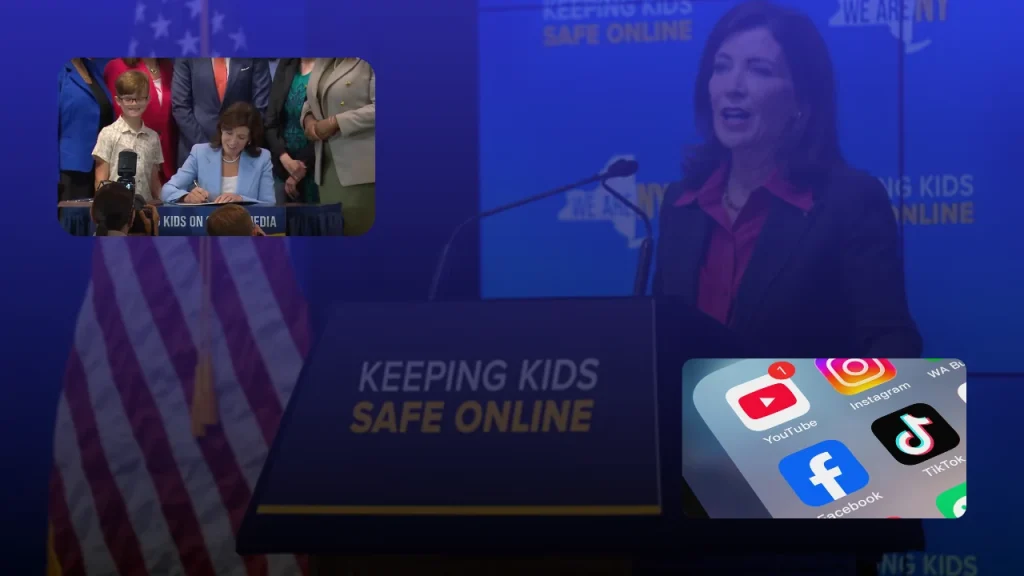
Governor Kathy Hochul signed the SAFE for Kids Act in June 2024. The Legislature told the Attorney General to write the rules on age checks and parental consent before the law could take effect. The Attorney General released final rules on July 28, 2026, and they were published in the State Register on July 29, 2026. That started a 180-day countdown that ends January 25, 2027.
The personalized-feed restriction. A covered platform may not give a New York user an “addictive feed” unless it has determined, through an approved age-assurance method, that the user is an adult, or it has verifiable parental consent for a minor. In the rules, an addictive feed is generally one that picks and orders content based on data about the user or the user’s device, including past activity. The statute carves out several things, such as results of a search, content a user expressly asks for, and private messages.
Which platforms are covered. The rules apply to platforms where users spend at least 20 percent of their time on addictive feeds. The rules do not list companies by name. Whether a particular service meets that test is a factual question the Attorney General and the platform would have to resolve.
The overnight notification restriction. Covered platforms also may not send notifications about addictive feeds to minors between midnight and 6 a.m. Eastern without parental consent. This is not a curfew. Nothing in the law stops a minor from opening an app or reading content at night.
Age assurance. The rules recognize three categories: age estimation, age inference and age verification. Platforms must pick a method with a high accuracy rate, test it every year, and keep the test results for at least 10 years. A government ID upload is not the only route the rules contemplate, but NetChoice argues the practical effect will still be to push adults to reveal identity information.
Parental consent. A platform must first tell the minor that it legally needs a parent’s consent and get the minor’s agreement to contact the parent. The parent then has to go through age assurance too.
Minors cannot be shut out. A minor who lacks parental consent, or does not want a personalized feed, must still be allowed to use the platform. They get a non-personalized version, not a locked account.
Enforcement. The Attorney General enforces the Act. Civil penalties can reach $5,000 per violation under the statute (General Business Law Article 45, §§ 1500 to 1508).
| Platform activity | General treatment under the Act |
| Algorithmic feed built from a minor’s behavior | Restricted without parental consent |
| Chronological feed or posts from accounts a user follows | Generally outside the “addictive feed” definition |
| Search results and expressly requested content | Generally excluded |
| Private messages | Excluded |
| Notifications about addictive feeds, midnight to 6 a.m. Eastern | Restricted for minors without parental consent |
What NetChoice Argues in Its SAFE for Kids Act Complaint
NetChoice says the way a platform arranges and recommends content is editorial judgment protected by the First Amendment. Its spokesperson compared the state’s approach to telling the New York Times how to order the articles in its paper.
Its filings, as reported, also argue that:
- The age-assurance requirement burdens adults who want to read lawful content without handing over identity information or giving up anonymity.
- Section 230 of the Communications Decency Act, which protects platforms’ choices about how to display user-generated content, preempts the New York law.
- The restrictions change what editorial choices platforms can make for New York users and how those users receive speech.
The complaint names services including YouTube, Facebook, Instagram, Threads, Pinterest, Reddit, X and TikTok as affected by the law. NetChoice wants the court to stop enforcement against its members.
SAFE for Kids Act vs. New York’s SB S4505 Warning-Label Lawsuit
This is where most coverage goes wrong. New York is facing two separate NetChoice lawsuits in the same federal court, over two different laws.
| SAFE for Kids Act case | SB S4505 warning-label case | |
| Case number | No. 1:26-cv-10296 | No. 1:26-cv-09983 |
| Filed | November 23, 2026 | November 13, 2026 |
| What the law does | Limits personalized feeds and overnight notifications for minors | Requires state-written warnings on social media sites |
| Main First Amendment theory | Restricting editorial curation; age-check burdens | Compelled speech |
| Where it stands | Early stage | NetChoice has asked Judge Arun Subramanian for a preliminary injunction |
Reporting indicates Judge Subramanian is also assigned to the SAFE for Kids Act case. If you are searching for the warning-label law, it is a different statute with different obligations.
How Courts Have Treated Similar Kids’ Online Safety Laws
No court has ruled on New York’s law yet, and results elsewhere do not control the outcome in Manhattan. A federal court in New York sits in the Second Circuit, so decisions from other circuits are persuasive at most.
- In Moody v. NetChoice (2024), the U.S. Supreme Court said curating a feed can be protected expression, but sent the cases back because the lower courts had not done the full analysis needed for a facial challenge. That reasoning is likely to feature in New York.
- In September 2025, the Ninth Circuit largely let California’s addictive-feed law stand against NetChoice’s challenge (NetChoice v. Bonta, No. 25-146).
- On March 12, 2026, the Ninth Circuit reversed much of the injunction against California’s Age-Appropriate Design Code, according to EPIC.
- The Sixth Circuit issued an opinion in NetChoice v. Yost (No. 25-3371) on June 18, 2026, involving an Ohio law. NetChoice later asked the Supreme Court for more time in that dispute.
The takeaway: outcomes depend heavily on how each statute is written, and the law remains unsettled.
How New York and Privacy Advocates Respond to NetChoice
Attorney General James, State Senator Andrew Gounardes and Assemblymember Nily Rozic, the bill’s sponsors, support the law and argue it protects children from addictive design. The Attorney General’s office has said it will vigorously defend it. Child-safety groups including Common Sense Media backed the final rules.
The Electronic Privacy Information Center (EPIC) published a response on November 25, 2026, saying NetChoice’s challenges to the New York and Vermont laws will fail. The core of that argument, as EPIC frames it, is that these laws regulate product design and data practices, not the content or viewpoint of speech.
Both sides have a serious argument. A court would have to decide whether recommending content is protected editorial activity, and whether the state has justified the burden on that activity.
NetChoice’s Separate Lawsuit Over Vermont’s Age-Appropriate Design Code
On November 24, 2026, NetChoice also sued over Vermont’s Age-Appropriate Design Code in the U.S. District Court for the District of Vermont (No. 2:26-cv-00444). That law, scheduled to take effect January 1, 2027, focuses on children’s privacy, data use and platform design rather than personalized feeds. It is a different statute with a different structure, so it needs its own analysis.
SAFE for Kids Act Timeline
| Date | Event |
| June 2024 | Governor Hochul signs the SAFE for Kids Act |
| September 15, 2025 | Attorney General publishes proposed rules |
| July 28, 2026 | Attorney General releases final rules |
| July 29, 2026 | Final rules published in the State Register |
| November 13, 2026 | NetChoice sues over the SB S4505 warning-label law |
| November 23, 2026 | NetChoice sues over the SAFE for Kids Act |
| November 24, 2026 | NetChoice sues over Vermont’s Age-Appropriate Design Code |
| January 25, 2027 | SAFE for Kids Act scheduled to take effect |
What Happens Next in the NetChoice SAFE for Kids Act Case
The date to watch is January 25, 2027. Unless a court intervenes or the schedule changes, the law takes effect then. Things to watch before that date: whether NetChoice files a preliminary injunction motion in the SAFE for Kids Act case, how the Attorney General responds, and whether the court rules before the effective date.
I will update this page when a motion is filed or a ruling issues.
SAFE for Kids Act Lawsuit FAQ
Is the New York SAFE for Kids Act in effect right now? No. It is scheduled to take effect on January 25, 2027. Filing the lawsuit did not suspend it, and a court has not blocked it as of November 27, 2026.
Does the SAFE for Kids Act ban TikTok, Instagram or YouTube for kids? No. Minors can still use covered platforms. The law restricts algorithmically personalized feeds and overnight notifications unless a parent consents. A minor without consent must still get access to a non-personalized version of the service.
Do adults have to verify their age under the SAFE for Kids Act? Platforms must determine through age assurance that a user is an adult before serving that user an addictive feed. The rules allow estimation, inference and verification methods, not only ID checks. NetChoice argues the burden still falls on adults and threatens anonymity.
Can I get money from the NetChoice lawsuit? No. NetChoice is a trade association seeking a declaration and an injunction. There is no class action, settlement fund or claim form.
What is the difference between the SAFE for Kids Act and SB S4505? The SAFE for Kids Act restricts personalized feeds and overnight notifications for minors. SB S4505 requires state-scripted warning notices on social media. NetChoice challenged them in two separate lawsuits filed ten days apart.
Which court is hearing the NetChoice v. James SAFE for Kids Act case? The U.S. District Court for the Southern District of New York, case number 1:26-cv-10296.
\\
Sources Reviewed
- New York Attorney General, press release announcing final SAFE for Kids Act rules (ag.ny.gov/press-release/2026/attorney-general-james-and-governor-hochul-release-final-safe-kids-act-rules)
- New York Attorney General, SAFE for Kids Act final rule, 13 NYCRR Part 700 (ag.ny.gov/safe-for-kids-act-final-rule)
- New York Attorney General, Assessment of Public Comment, July 2026 (ag.ny.gov/safeforkids-comment-assessment)
- New York State Senate, Senate Bill S7694A (nysenate.gov/legislation/bills/2023/S7694/amendment/A)
- Justia docket, NetChoice v. James, No. 1:26-cv-09983 (S.D.N.Y.)
- NetChoice complaint, SB S4505 warning-label case (netchoice.org/wp-content/uploads/2026/11/2026.11.13-001-Complaint.pdf)
- EPIC, “NetChoice Destined to Lose New Lawsuits Against Vermont Age-Appropriate Design Code, New York SAFE for Kids” (November 25, 2026)
- Reporting on the November 23, 2026 filing: MediaPost (November 25, 2026), Legal Newsline, Privacy Daily (November 24, 2026)
- Ninth Circuit opinion, No. 25-146 (September 9, 2025); Sixth Circuit opinion, NetChoice v. Yost, No. 25-3371 (June 18, 2026)
Update log: November 27, 2026 — Article published.
This article is for informational purposes only and does not constitute legal advice. Laws vary by state and individual circumstances differ. For advice about your specific situation, consult a qualified attorney.
About the Author
Israr Ahmad is a legal content researcher with 4+ years of experience covering class action settlements and consumer rights cases. He has researched and published coverage of 2,500+ settlements using verified court records, settlement administrator filings, and government sources. Learn more about Israr.