
New Mexico v. Meta $3.7 Billion Public Nuisance Case Over Child Safety on Facebook and Instagram
Prepared by the AllAboutLawyer.com Editorial Team and reviewed for factual accuracy against the New Mexico Department of Justice press releases, Meta’s SEC quarterly filing, and court records for New Mexico v. Meta Platforms Inc., et al., Case No. D-101-CV-2023-02838, on May 9, 2026. Last Updated: May 9, 2026
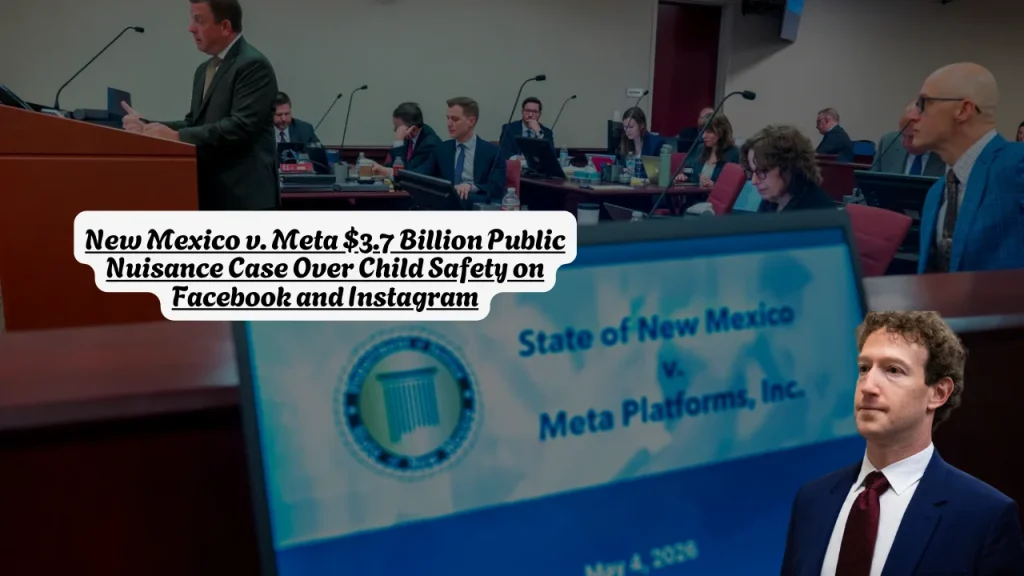
New Mexico is facing a landmark legal battle against Meta Platforms Inc. in the First Judicial District Court of New Mexico in Santa Fe, alleging that Facebook, Instagram, and WhatsApp created a public nuisance by failing to protect children from sexual exploitation and mental health harm — and the state wants Meta to pay for it. Meta’s own SEC quarterly filing confirmed the New Mexico Attorney General’s office is seeking “approximately $3.7 billion in abatement costs as well as injunctive relief, which includes requests for extensive changes to the manner in which we provide our services in New Mexico.” A jury already handed the state a significant win in March 2026. The second phase of this case — the public nuisance trial — is now underway.
New Mexico v. Meta — Quick Facts
| Field | Detail |
| Lawsuit Filed | December 5, 2023 |
| Defendant | Meta Platforms Inc., Instagram LLC, Meta Payments Inc., Meta Platforms Technologies LLC |
| Alleged Violation | New Mexico Unfair Practices Act; public nuisance under New Mexico state law |
| Who Is Affected | New Mexico children and families harmed by Facebook, Instagram, and WhatsApp |
| Current Court Stage | Phase 2 bench trial underway — public nuisance and injunctive relief phase |
| Court & Jurisdiction | First Judicial District Court, Santa Fe County, New Mexico — Judge Bryan Biedscheid |
| Lead Plaintiff Attorneys | AG Raúl Torrez (NM DOJ); Donald Migliori (Motley Rice LLC) |
| Phase 1 Jury Verdict | $375 million awarded on March 24, 2026 — Meta plans to appeal |
| Phase 2 Relief Sought | $3.7 billion abatement fund + sweeping platform changes |
| Next Hearing Date | TBD — bench trial in progress as of May 2026 |
| Official Case Website | nmdoj.gov |
| Last Updated | May 9, 2026 |
Where This Case Stands Right Now
- A Santa Fe jury delivered its verdict on March 24, 2026, finding Meta violated New Mexico’s Unfair Practices Act and misled the public about the risks of its platforms — Facebook, Instagram, and WhatsApp — for underage users’ mental health and risk of sexual exploitation. Meta has said it will appeal.
- The bench trial — the second phase of the case — began on May 4, 2026, with New Mexico seeking $3.7 billion in additional damages plus a court order requiring Meta to fundamentally overhaul how it operates in the state.
- Judge Bryan Biedscheid warned at the opening of the bench trial that he would not “overreach,” signaling he will apply a careful legal standard to the public nuisance theory.
- Meta has said it will fight both the jury verdict and the public nuisance phase. No settlement has been reached.
What Is the New Mexico v. Meta Lawsuit About? Case No. D-101-CV-2023-02838
In 2023, the New Mexico Department of Justice initiated an investigation into Meta’s platforms to protect children from sexual abuse, online solicitation, and other harms. The internal Meta documents and testimony obtained during litigation revealed repeated warnings from Meta employees and outside child safety experts about dangers present on Meta’s platforms.
New Mexico Attorney General Raúl Torrez accused Meta of designing its platforms to addict young users and failing to protect children from sexual exploitation. The state’s complaint alleges Meta concealed or downplayed the extent of harmful activity on its platforms while publicly portraying them as safe for younger users.
The case spans two legal theories. The first — decided by the jury in March 2026 — was that Meta violated New Mexico’s Unfair Practices Act by misleading the public. The second theory, now before Judge Biedscheid in a bench trial, is that Meta created a public nuisance — a legal standard that asks whether a company’s actions harmed public health or safety at a community-wide level. Meta urged the New Mexico judge not to side with the state’s public nuisance theory, arguing during opening statements that several state supreme courts have rejected similar arguments in lawsuits against opioid manufacturers.
This case is one of the most closely watched in what legal experts have described as social media’s “Big Tobacco moment.” For a deeper look at the broader wave of lawsuits against Meta over child safety, see our full coverage of the Instagram and Meta social media addiction lawsuits.
Are You Part of the New Mexico Meta Lawsuit?
This is a government enforcement action brought by the New Mexico Attorney General — not a class action lawsuit where individual consumers file claims. You cannot join this specific case as an individual plaintiff.
That said, if your child was harmed by Instagram or Facebook, you may be part of a separate but related proceeding. Here is how to know where you stand:
Related article: Ford Recalls 1.4 Million F-150 Trucks Over Unexpected Downshift Crash Risk
You may be part of a related individual lawsuit if:
- Your child used Instagram, Facebook, or other Meta platforms as a minor (under age 18)
- Your child developed a diagnosable mental health condition — including depression, anxiety, eating disorders, or self-harm behaviors — connected to social media use
- Your child was contacted by or exploited by predators through Meta’s platforms
- You live in New Mexico or any other U.S. state
You are NOT included in this specific state AG case as a claimant. The $3.7 billion the state is seeking goes toward funding public services — mental health resources, school programs, and law enforcement support — not direct payments to individual families.
If your family was harmed, a consumer rights lawyer specializing in social media addiction litigation can evaluate whether you have an individual claim in the federal MDL proceeding, which currently has over 10,000 cases pending nationwide.
What Is New Mexico Asking the Court to Order Meta to Do?
The state is not just asking for money. The proposed $3.712 billion abatement plan would fund a 15-year effort to address the alleged harms caused by Meta’s platforms, including public education, school resources, law enforcement support, and mental health services for children affected by online bullying and sexual exploitation.
Beyond the money, New Mexico is asking the court to require Meta to implement effective age verification, redesign its algorithm to promote quality content for minors, and end autoplay and infinite scroll for minors.
AG Torrez stated the changes would result in “fundamentally restructuring how Meta is allowed to do business in the state.”
Meta denies the allegations and argues there is no legal basis for the sweeping relief the state is requesting. The company’s attorneys contend the proposed abatement plan does not directly address or stop the alleged harmful conduct and instead seeks compensation for downstream effects.
What Should You Do If Your Family Was Affected by Meta?
Most New Mexico families affected by Meta’s platforms are not required to do anything in relation to this specific state AG case. The state is litigating on behalf of the public interest — not on behalf of individual families seeking personal compensation.
If you believe your child was harmed by Instagram or Facebook, here are your practical options right now:
Step 1 — Document everything. Save screenshots, messages, medical records, school records, and any communications that connect your child’s use of Meta’s platforms to harm they experienced.
Step 2 — Do not wait for the New Mexico case to pay you. Even if New Mexico wins $3.7 billion, those funds go toward public programs — not personal injury claims. Your path to individual compensation is a separate lawsuit.
Step 3 — Contact an attorney for a free legal consultation. Thousands of families have already joined the federal social media addiction MDL (In re: Social Media Adolescent Addiction/Personal Injury Products Liability Litigation). There is no fee to be evaluated.
Step 4 — Monitor both cases. The New Mexico bench trial is ongoing. Two more bellwether trials in the federal MDL are scheduled for summer 2026. Each verdict shapes settlement pressure on Meta.
New Mexico v. Meta — Full Timeline
| Milestone | Date |
| NM DOJ investigation begins | 2023 |
| Complaint filed — First Judicial District Court, Santa Fe | December 5, 2023 |
| Meta removes case to federal court | December 18, 2023 |
| Case remanded back to New Mexico state court | Early 2024 |
| Judge denies Meta’s motion to dismiss — Section 230 immunity rejected | May 30, 2024 |
| Phase 1 jury trial begins | February 9, 2026 |
| Jury verdict — $375M awarded, Unfair Practices Act violated | March 24, 2026 |
| Meta announces intent to appeal Phase 1 verdict | March 2026 |
| Phase 2 bench trial begins — public nuisance and injunctive relief | May 4, 2026 |
| Judge’s ruling on public nuisance phase | TBD — bench trial ongoing |
| Meta appeal of Phase 1 verdict | TBD — timeline not yet set by court |
Frequently Asked Questions
Is there a class action lawsuit against Meta for child safety?
This New Mexico case is a state attorney general enforcement action — not a class action. However, a related federal MDL with over 10,000 individual cases is pending nationwide for families whose children were harmed by Instagram and Facebook.
Do I need to do anything right now to be included in the New Mexico case?
No. This is a government case. You are not a named plaintiff. If the state wins and the abatement fund is established, it will fund public programs — not individual payments to families.
When will a settlement be reached in the New Mexico Meta case?
No settlement talks have been reported as of May 2026. Meta has said it will appeal the Phase 1 verdict and is actively fighting the Phase 2 public nuisance theory. A ruling on Phase 2 could take months after the bench trial concludes.
Can I file my own lawsuit against Meta for harming my child?
Yes. The federal MDL in the Northern District of California accepts plaintiffs from every state whose minor children suffered harm linked to Instagram or Facebook. Most attorneys handling these cases take them on a contingency basis — no upfront cost.
How will I know if the New Mexico Meta case results in public benefits?
Any court order requiring Meta to fund mental health programs or platform changes in New Mexico would be publicized by the New Mexico Department of Justice at nmdoj.gov. You can also monitor AllAboutLawyer.com for updates as this bench trial concludes.
What is a public nuisance claim and why does it matter here?
A public nuisance claim argues that a company’s conduct caused widespread harm to a community — similar to claims brought against opioid manufacturers. If the judge agrees Meta created a public nuisance, it could be ordered to fund the abatement plan and change how it operates in New Mexico. Several state supreme courts have rejected this theory in opioid cases, which is why Meta is fighting it hard here.
What did the Phase 1 jury actually decide?
The jury found that Meta violated New Mexico’s Unfair Practices Act by misleading the public about the safety of its platforms for children. It ordered Meta to pay $375 million in civil penalties. Meta has announced it will appeal that verdict.
Sources & References
- New Mexico Department of Justice press release: nmdoj.gov
- Original complaint: State of New Mexico v. Meta Platforms Inc., et al., Case No. D-101-CV-2023-02838, First Judicial District Court, Santa Fe County (filed December 5, 2023) — nmag.gov
- Meta SEC quarterly filing confirming $3.7B abatement demand (May 2026)
Disclaimer: This article is for informational purposes only and does not constitute legal advice. Legal claims and outcomes depend on specific facts and applicable law. For advice regarding your particular situation, consult a qualified attorney.
About the Author
Israr Ahmad is a legal content researcher with 4+ years of experience covering class action settlements and consumer rights cases. He has researched and published coverage of 2,500+ settlements using verified court records, settlement administrator filings, and government sources. Learn more about Israr.