
Musk v. Altman Trial Reveals the Email Where Gabe Newell Connected Hideo Kojima, SpaceX, and OpenAI, All in One Night
Prepared by the AllAboutLawyer.com Editorial Team and reviewed for factual accuracy against trial evidence, CNBC live trial coverage, PC Gamer, GameSpot, and Kotaku on May 11, 2026. Last Updated: May 11, 2026
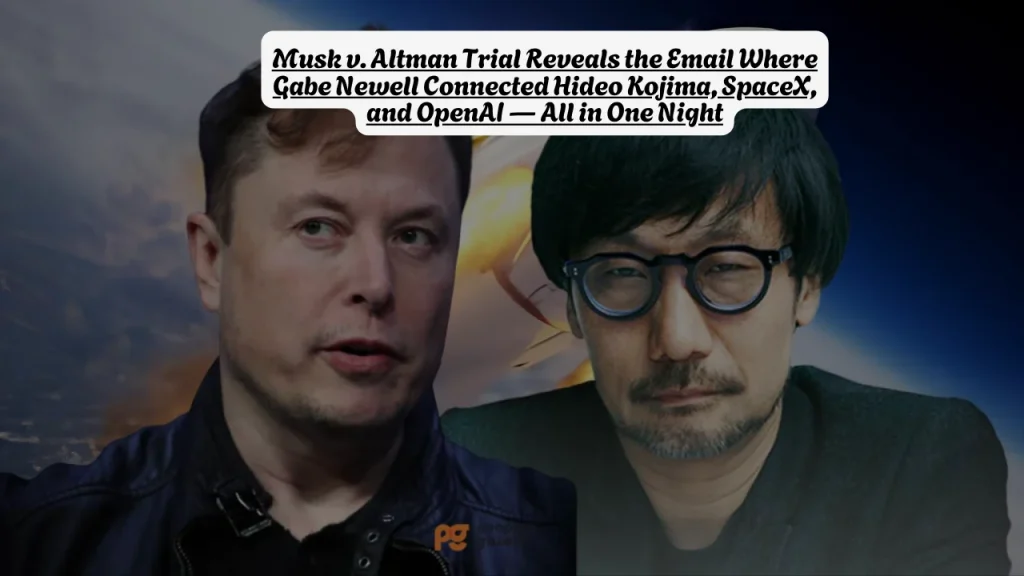
In 2018, Hideo Kojima visited Valve headquarters to talk about Death Stranding. After that meeting, Gabe Newell sent Elon Musk an email — and that email is now sitting in a federal courtroom in Oakland, California, as evidence in one of the biggest tech lawsuits of the decade. Nobody planned for a gaming legend’s space dreams to end up as a court exhibit. But that is exactly what happened, and what the email reveals about Musk and OpenAI matters far beyond the Kojima connection.
Musk v. Altman Trial: Quick Facts
| Field | Detail |
| Case Name | Elon Musk v. Sam Altman, Greg Brockman, OpenAI, Inc., Microsoft Corp. |
| Court & Jurisdiction | U.S. District Court, Northern District of California, Oakland |
| Presiding Judge | U.S. District Judge Yvonne Gonzalez Rogers |
| Trial Start Date | April 27, 2026 |
| Current Status | Active trial — second week of testimony as of May 11, 2026 |
| What Musk Alleges | Altman and Brockman breached a charitable trust by converting OpenAI from nonprofit to for-profit |
| What OpenAI Alleges | Musk is acting in bad faith; he wanted unilateral control and quit when he did not get it |
| Damages Musk Seeks | Financial damages plus Altman’s removal from OpenAI’s board |
| The Email at Issue | Gabe Newell to Elon Musk, October 2018 — unsealed during discovery |
| Last Updated | May 11, 2026 |
What the Gabe Newell Email Actually Says — and Why It Ended Up in Court
Newly unsealed emails from 2018, disclosed during the Musk v. Altman lawsuit, show Valve co-founder Gabe Newell offering to connect Hideo Kojima with OpenAI and asking Musk to host him for a SpaceX tour after Kojima expressed interest in AI and a lifelong desire to go to space.
Newell sent the email to Musk on Halloween 2018 — October 31. He wrote: “Hideo Kojima (Metal Gear series, a real visionary in our field) was here at Valve talking about his new game, and he mentioned the importance he places on future work in AI. I said I’d be happy to introduce him to the people at OpenAI and spoke enthusiastically about the work that team has done with us (I’m not sure how involved you are with them nowadays).”
Newell did not stop there. He also told Musk that Kojima dreams of going to space and offered to make the introduction: “He’d love to get a SpaceX tour.” Musk replied two days later. He said Kojima was welcome to visit the rocket factory and provided a contact email. Whether Kojima ever got that tour remains unknown — but the conversation confirms what Kojima himself hinted at publicly years later.
In a 2020 interview with Geoff Keighley, Kojima recalled that Newell had suggested: “Since we love space so much, let’s go visit SpaceX since I know Elon Musk, and I’ll contact him, and let’s go.” Now the documentary record backs that story up completely.
Why This Email Matters to the OpenAI Trial
The Kojima-SpaceX angle is entertaining. But the reason lawyers unsealed this email has nothing to do with rocket tours. It is about what Musk wrote back — and what that reveals about his relationship with OpenAI and Sam Altman in late 2018.
In the same reply where Musk invited Kojima to the rocket factory, he went on to describe his involvement with OpenAI at the time as “very limited.” He said he continued to provide “some financial support” and had verbal and email updates with Altman every few weeks. Then he wrote something that cuts to the heart of this trial: “I lost confidence that OpenAI could muster the resources to serve as an effective counterweight to Google / Deepmind and decided to attempt that through Tesla instead.”
That statement is now court evidence. Musk’s own words in 2018 show he had already privately stepped back from OpenAI — before his public break, before his lawsuit, and before he positioned himself as OpenAI’s wronged co-founder. His lawyers argue he was misled and betrayed. OpenAI’s lawyers argue he walked away voluntarily and is now trying to relitigate a decision he made himself.
Related article: POET Technologies Securities Class Action Lawsuit, Did You Buy POET Stock Between April 1–27, 2026 and Lose Money?
The email supports OpenAI’s version of events. OpenAI’s attorneys have argued throughout the trial that Musk is angry because the company rejected his offer to merge it with Tesla and name him CEO of the resulting entity — and that his lawsuit is retaliation, not principle.
This connects to a broader pattern of legal conflicts involving powerful tech companies and the question of who controls AI development — a theme also running through the Valve antitrust lawsuit over Steam’s market dominance, currently active in federal court.
What the Musk v. Altman Trial Is Actually About
The jury and judge in this case need to decide whether Altman’s and Brockman’s communications with Musk around the formation of OpenAI established a formal charitable trust and whether Altman and Brockman subsequently violated that trust when they restructured OpenAI so that its nonprofit board no longer had sole control over its for-profit arm.
Musk contends that Altman and Brockman duped him into donating millions of dollars to get OpenAI off the ground with the understanding it would remain a nonprofit — only to flip it to a for-profit later. OpenAI says Musk is angry that the company rejected his offer to merge with Tesla and name him CEO of the new entity.
Musk is seeking damages and a reversal of OpenAI’s transition to a for-profit. If Musk wins, it could derail OpenAI’s plans for an initial public offering.
Most legal analysts say Musk’s case is weak and that he is likely to lose. OpenAI has continued raising money throughout the litigation — including an additional $122 billion fundraise at an $852 billion valuation that closed in March 2026.
What Has Happened in the Courtroom So Far
The trial began April 27, 2026 at the federal courthouse in Oakland before U.S. District Judge Yvonne Gonzalez Rogers. Musk himself took the stand on April 28.
Musk clashed repeatedly with OpenAI’s lead attorney, William Savitt, during cross-examination. When Savitt said he was asking a simple question, Musk fired back: “Your questions are definitionally complex, not simple. It is a lie to say they are simple.” Judge Gonzalez Rogers reprimanded Savitt for interrupting Musk — and then turned to Musk and reminded the jury that Musk is not a lawyer and has not taken a class in evidence. Musk retorted that he has “technically” taken “law 101,” drawing laughter in the courtroom.
OpenAI president Greg Brockman also testified, disclosing that his stake in OpenAI is now worth nearly $30 billion. Brockman said his primary goal was always OpenAI’s mission and that Musk was the one who sought unilateral control.
Former OpenAI board member Shivon Zilis — who has four children with Musk — testified in the second week. She said OpenAI’s corporate structure was debated extensively, including several different for-profit options, and that Musk had at one point suggested offering Altman a board seat at Tesla.
The Bigger Picture: What Musk’s Emails Reveal About OpenAI’s Early Days
Musk co-founded OpenAI with Altman and others in 2015, at which time it operated as a nonprofit. He sued OpenAI and Altman in 2024 over the shift to a for-profit business model. OpenAI countersued, accusing Musk of bad-faith tactics.
Newell was an enthusiastic supporter of OpenAI in 2018 — donating $20 million and acting as the sole member of an informal advisory board. That context makes his email to Musk more significant: when Newell told Musk he wasn’t sure how involved Musk still was with OpenAI, Musk’s answer revealed he had already mentally and financially checked out — months before anyone outside OpenAI’s inner circle knew it.
For readers following the Blue Cross Blue Shield antitrust settlement or other high-profile cases where internal communications became trial turning points, the pattern is familiar: emails people wrote casually in private often become the most damaging evidence in a courtroom years later.
Musk v. Altman Trial Timeline
| Milestone | Date |
| OpenAI founded as nonprofit by Musk, Altman, Brockman, and others | 2015 |
| Musk departs OpenAI board | 2018 |
| Gabe Newell emails Musk about Hideo Kojima, SpaceX, and OpenAI | October 31, 2018 |
| Musk replies, invites Kojima to rocket factory, describes OpenAI involvement as “very limited” | November 2, 2018 |
| OpenAI establishes for-profit subsidiary | Post-2018 |
| Musk files lawsuit against OpenAI, Altman, Brockman, and Microsoft | 2024 |
| OpenAI countersues Musk | 2024 |
| Trial begins in Oakland federal court | April 27, 2026 |
| Musk testifies | April 28–29, 2026 |
| Greg Brockman testifies | Late April–early May 2026 |
| Shivon Zilis testifies | May 5–7, 2026 |
| Musk’s side expected to rest | Early-to-mid May 2026 |
| OpenAI’s defense case begins | TBD — expected mid-May 2026 |
| Verdict | TBD — jury verdict is advisory; judge makes final ruling |
Frequently Asked Questions
Is there an active lawsuit between Elon Musk and OpenAI in 2026?
Yes. Musk’s lawsuit against Sam Altman, Greg Brockman, OpenAI, and Microsoft went to trial in Oakland, California, on April 27, 2026, before U.S. District Judge Yvonne Gonzalez Rogers. The trial is ongoing as of May 11, 2026.
What did Gabe Newell’s email to Elon Musk actually reveal?
Beyond the Kojima connection, the email revealed that Musk told Newell in late 2018 that his involvement with OpenAI at that point was “very limited” and that he had lost confidence in OpenAI’s ability to compete with Google’s DeepMind — deciding instead to pursue AI through Tesla. That admission became key evidence in the trial.
Did Hideo Kojima actually tour SpaceX?
Musk confirmed Kojima was welcome to visit the rocket factory and provided a contact email. Whether the tour ever happened remains unknown from public records. Kojima himself has referenced the conversation publicly but never confirmed a visit.
What is Musk actually asking for in this lawsuit?
Musk is seeking financial damages and a court order reversing OpenAI’s transition to a for-profit structure. He is also asking the court to remove Sam Altman from OpenAI’s board. If he wins, it could disrupt OpenAI’s plans to go public.
Do I need to do anything because of the Musk v. Altman trial?
No. This is not a consumer class action. Ordinary members of the public have no claim to file and no action to take. The case is a dispute between Musk and OpenAI’s founders over the company’s corporate structure.
How will I know when a verdict is reached?
The jury’s verdict in this case is advisory — Judge Gonzalez Rogers makes the final ruling. AllAboutLawyer.com will update this article when a verdict is issued. You can also monitor the case directly through PACER at the Northern District of California federal court docket.
Disclaimer: This article is for informational purposes only and does not constitute legal advice. Legal claims and outcomes depend on specific facts and applicable law. For advice regarding a particular situation, consult a qualified attorney.
About the Author
Israr Ahmad is a legal content researcher with 4+ years of experience covering class action settlements and consumer rights cases. He has researched and published coverage of 2,500+ settlements using verified court records, settlement administrator filings, and government sources. Learn more about Israr.