
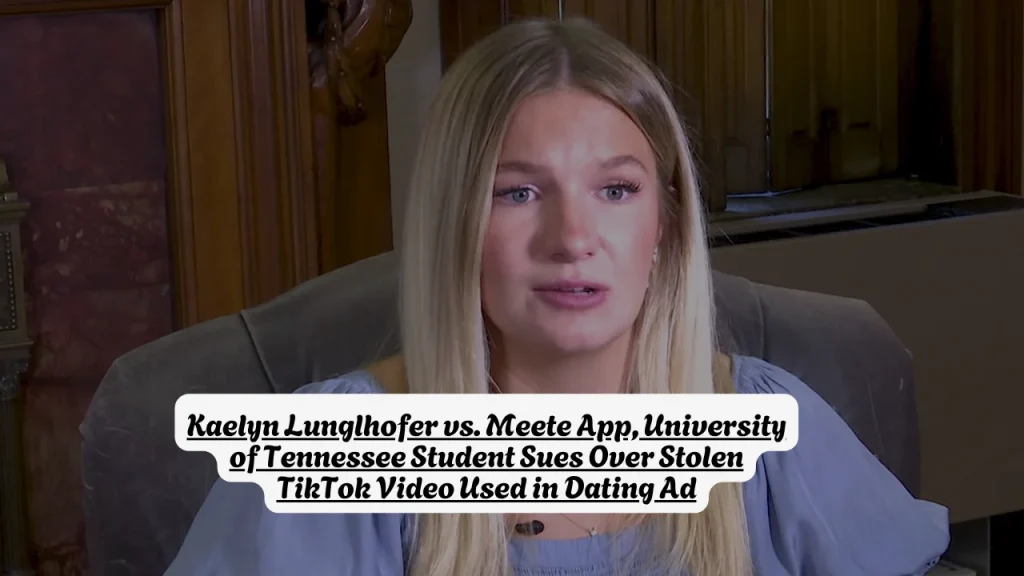
Kaelyn Lunglhofer vs. Meete App, University of Tennessee Student Sues Over Stolen TikTok Video Used in Dating Ad
This article covers a recently filed lawsuit. Information is limited to the complaint as filed on April 28, 2026. This page will be updated as the case develops.
Lunglhofer v. Quantum Communications Development Unlimited et al. is a right-of-publicity and misappropriation lawsuit filed April 28, 2026, in the U.S. District Court for the Eastern District of Tennessee, in which plaintiff Kaelyn Lunglhofer alleges that the operators of the Meete dating app took a TikTok video she posted without her knowledge or consent, edited it with a fake voiceover, and ran it as a geofenced Snapchat advertisement targeted at men near her college dormitory. Lunglhofer is seeking no less than $750,000 from Meete, which according to court filings has approximately 17 million worldwide users. The defendants have not yet responded publicly to the lawsuit.
Quick Facts — Lunglhofer v. Quantum Communications / Meete App
| Field | Detail |
| Plaintiff | Kaelyn Lunglhofer, University of Tennessee student and TikTok influencer |
| Defendants | Quantum Communications Development Unlimited (British Virgin Islands); Starpool Technology Limited dba Starpool Data Limited (Hong Kong); Guangzhou Yuedong Interconnection Technology Co., Ltd. (China) |
| Case Filed | April 28, 2026 |
| Court & Jurisdiction | U.S. District Court for the Eastern District of Tennessee |
| Legal Claims | Right of publicity violation; misappropriation of likeness; unauthorized use of identity for commercial gain |
| Damages Sought | No less than $750,000 plus advertising revenue derived from the unauthorized use |
| Current Stage | Complaint filed — defendants have not yet responded |
| Plaintiff’s Counsel | Abe Pafford, partner at McGuireWoods |
| Next Court Date | TBD — case recently filed; no hearing scheduled yet |
| Last Updated | May 5, 2026 |
What Do We Know About the Lunglhofer vs. Meete Lawsuit?
Kaelyn Lunglhofer says the Meete app took a video from her TikTok account that she posted on the day of her high school graduation. During her freshman year at the University of Tennessee, a male student in her dormitory messaged her on Snapchat and sent her the video.
According to Lunglhofer’s attorney Abe Pafford, his client had no idea Meete was using her likeness until that classmate told her he had repeatedly seen her in ads for the app on his Snapchat shortly after the two had met. Pafford told CyberScoop he called it “implausible” that this was a coincidence, given that Meete’s core premise is connecting users with nearby women and the precision of geofencing technology.
The lawsuit was filed April 28 in Tennessee. Meete’s operators — including Quantum Communications Development Unlimited, Starpool Data Limited, and Guangzhou Yuedong Interconnection Technology — allegedly took Lunglhofer’s graduation TikTok, overlaid it with misleading graphics and audio, then used geofencing technology to serve these ads to men she actually knew. This was not AI-generated imagery — according to the complaint, it was video editing combined with a fake voiceover and targeted ad placement.
Related article: Elon Musk’s SEC Twitter Disclosure Reached Settlement, How an 11-Day Delay Cost Him $1.5 Million
What Does Lunglhofer Allege Against Meete and Its Operators?
According to the complaint, filed in the Eastern District of Tennessee:
- The defendants took Lunglhofer’s TikTok video without her consent, overlaid it with graphics advertising the app, and added a voiceover to make it appear she was endorsing the platform.
- According to court documents, the ad’s narrator said: “Are you looking for a friend with benefits? This app shows you women around you who are looking for some fun. You can video chat with them” — with the narration playing over the TikTok video of Lunglhofer’s high school graduation party.
- The complaint alleges Meete used geo-targeting technology to deliberately serve these ads to male users in the geographic vicinity of Lunglhofer — including men in her own dormitory at the University of Tennessee.
- According to court documents, Meete’s business model allegedly includes “initiating active communication with Meete app account users (particularly female users) and soliciting these users to enter into financial arrangements in which they will agree, for monetary consideration, to communicate with male account holders through the Meete app’s embedded messaging interface.”
- Pafford’s law firm hired an investigative firm to gather additional evidence before filing the case.
- Lunglhofer is a nursing student who had earned brand deals through TikTok and built a small following, making the unauthorized commercial use of her likeness a direct harm to her identity and professional reputation.
The complaint alleges violations of the right of publicity — the legal right of a person to control commercial use of their own name, image, and likeness — under applicable state and federal law. These are allegations in a complaint. No court has ruled on them and the defendants are presumed innocent.
Who Are the Parties in This Lawsuit?
Kaelyn Lunglhofer is a 19-year-old University of Tennessee nursing student and TikTok influencer. She told the court she has been economically successful sharing parts of her life on TikTok, and posted the video at issue — filmed at her high school graduation party — while she was still a teenager, before attending university. She discovered the misuse only because a dormmate recognized her and brought it to her attention.
Quantum Communications Development Unlimited is the primary defendant. The company is based in the British Virgin Islands and operates the Meete app through Chinese affiliates Starpool Technology Limited and Guangzhou Yuedong Interconnection Technology Co., Ltd. Quantum Communications has a sparse internet footprint — its website consists of a single page with a message written in broken English and an email address that no longer appears to work. Despite this, the defendants distribute their app through Apple’s App Store and Google Play while advertising on Snapchat, and have filed U.S. patents and trademarks.
Abe Pafford, a partner at McGuireWoods, represents Lunglhofer. He told reporters that he believes Lunglhofer is likely far from the only victim — and that most people whose videos were stolen would have no way of knowing it happened.
What Happens Next in This Case?
This lawsuit was filed just days ago. Here is what the typical legal process looks like from here:
The defendants — all based overseas — must be properly served with the complaint. Pafford acknowledged that the defendants being based overseas complicates efforts to hold them accountable under U.S. law, but argued that Meete is clearly designed to operate in the United States. International service of process can take months, particularly for defendants in China or British Virgin Islands-registered entities.
Once served, the defendants will have an opportunity to respond to the complaint — either by filing an answer or by moving to dismiss. The court will then set a schedule for discovery and, eventually, trial or settlement. No hearing date has been set yet.
Pafford has indicated this case could eventually have criminal implications alongside the civil suit. No criminal charges have been filed.
Meete App Lawsuit — Key Dates
| Milestone | Date |
| Graduation TikTok video posted by Lunglhofer | Day of high school graduation (exact date not confirmed in public filings) |
| Lunglhofer discovers the ad via dormmate | During 2025–2026 academic year at UT |
| McGuireWoods retains investigative firm | Prior to April 2026 |
| Complaint filed in Eastern District of Tennessee | April 28, 2026 |
| Defendants served | TBD — international service pending |
| Defendants’ response deadline | TBD — depends on service date |
| Next scheduled hearing | TBD — case in earliest stage |
| Trial or settlement | TBD — months to years from filing |
Frequently Asked Questions — Meete App Lawsuit
Is there a lawsuit against the Meete dating app?
Yes. The lawsuit was filed April 28, 2026, in the U.S. District Court for the Eastern District of Tennessee. The plaintiff is University of Tennessee student Kaelyn Lunglhofer, represented by Abe Pafford of McGuireWoods.
Do I need to do anything right now to be included in this case?
This is an individual lawsuit — not a class action. Lunglhofer is suing on her own behalf. However, her attorney believes she is far from the only person whose image Meete has misappropriated, and that most victims likely have no idea it is happening. If you believe your video was used without consent in a Meete ad, contact an attorney to discuss your options separately.
When will a result be reached in the Meete case?
TBD — the lawsuit was filed days ago. With defendants based overseas in the British Virgin Islands and China, service of process alone could take months. A resolution is likely at least one to two years away, if not longer.
Can I file my own lawsuit against Meete instead?
If you believe your likeness was used without consent, you may have your own right-of-publicity or misappropriation claim. Consult a consumer rights lawyer or digital privacy attorney — free legal consultations are widely available for these types of cases. Do not rely on this lawsuit to cover you.
Can I read the court documents in this case?
Yes. The case is filed in the U.S. District Court for the Eastern District of Tennessee and is publicly accessible through PACER at pacer.gov.
Sources & References
- CyberScoop — cyberscoop.com
- WATE Knoxville — wate.com
- Bloomberg Law — May 2026
- U.S. District Court for the Eastern District of Tennessee — Complaint filed April 28, 2026
Prepared by the AllAboutLawyer.com Editorial Team and reviewed for factual accuracy against verified court filings and confirmed news reporting on May 5, 2026. Last Updated: May 5, 2026
Disclaimer: This article is for informational purposes only and does not constitute legal advice. Information about ongoing legal cases is based on publicly available court records and verified reporting. Allegations described in this article have not been proven in court. For advice regarding a particular legal situation, consult a qualified attorney.
About the Author
Israr Ahmad is a legal content researcher with 4+ years of experience covering class action settlements and consumer rights cases. He has researched and published coverage of 2,500+ settlements using verified court records, settlement administrator filings, and government sources. Learn more about Israr.