
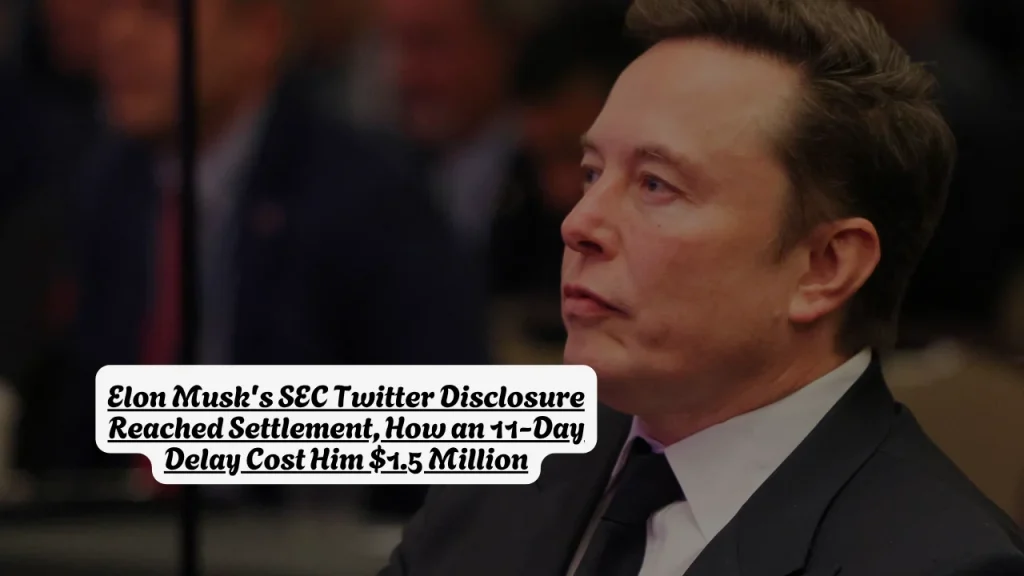
Elon Musk’s SEC Twitter Disclosure Reached Settlement, How an 11-Day Delay Cost Him $1.5 Million
Elon Musk has reached a settlement with the U.S. Securities and Exchange Commission to resolve a civil lawsuit tied to his 2022 Twitter stock purchases. His revocable trust will pay $1.5 million to close the case, without admitting or denying the allegations.
The SEC filed the case in January 2025, accusing Musk of waiting 11 days too long to disclose that he had crossed the 5% ownership threshold in Twitter. That delay, the agency said, allowed him to buy more than $500 million worth of Twitter shares at prices that were artificially low — before other investors knew a major buyer was in the market.
Quick Facts: SEC v. Elon Musk
| Field | Detail |
| Case Name | SEC v. Elon Musk, Case No. 1:25-cv-00105 |
| Court | U.S. District Court for the District of Columbia |
| Presiding Judge | U.S. District Judge Sparkle L. Sooknanan |
| Lawsuit Filed | January 14, 2025 |
| Statute Allegedly Violated | Section 13(d) of the Securities Exchange Act of 1934 |
| Settlement Amount | $1,500,000 |
| Admission of Wrongdoing | None — settled without admission or denial |
| $150M Disgorgement Sought | Not recovered — Musk keeps the alleged savings |
| Settlement Status | Proposed — pending court approval by Judge Sooknanan |
| Last Updated | May 5, 2026 |
Why Musk Was Sued Over His Twitter Purchases
Under Section 13(d) of the Securities Exchange Act of 1934 — a strict liability statute — anyone who acquires more than 5% of a public company’s shares must file a disclosure report with the SEC within 10 calendar days. Strict liability means the SEC does not need to prove Musk intended to break the rule. They only need to show he missed the deadline — which he did.
The SEC alleged that Musk was required to disclose his Twitter holdings by filing a Schedule 13G (or 13D) by March 24, 2022. He did not. Instead, he kept buying shares — nearly 3.5 million additional shares on March 25 alone — while other investors had no idea a buyer of his size was accumulating a stake.
On the morning of April 4, 2022, Musk finally filed a Schedule 13G, disclosing that he owned more than 9% of Twitter’s outstanding shares. Twitter’s stock price jumped by more than 27% that day. That jump is exactly what the SEC said should have happened weeks earlier — when Musk crossed 5% and should have told the public.
For investors who sold Twitter shares during those 11 days without knowing Musk was buying, this was a real financial harm. They sold into a market that did not reflect the true demand. A consumer protection attorney reviewing this kind of case would call it a textbook disclosure violation — the law exists precisely to prevent this.
The FIS $210 million securities class action settlement is a good example of how investors can recover money when public companies make misleading disclosures that distort stock prices.
What Musk Paid — and What He Got to Keep
The SEC had argued Musk should repay the roughly $150 million he allegedly saved by buying shares at artificially low prices. He will not. Under the settlement, Musk does not have to return a single dollar of those alleged savings.
The $1.5 million civil penalty is, however, the largest ever imposed by the SEC for this specific type of violation — a late beneficial ownership disclosure. A legal analyst at the Dynamis law firm called it a modest sum for the world’s wealthiest person, but noted it could still deter similar violations by others.
Related article: Google Demands Dismissal of Jewish Salesperson’s Workplace Discrimination Lawsuit in Illinois
To put that in context: $1.5 million is roughly 0.001% of Musk’s net worth. The SEC originally wanted him to pay 100 times that amount.
Musk called the delay inadvertent and accused the SEC of targeting him in violation of his free speech rights. His attorney Alex Spiro said in a statement that Musk has been cleared of all issues tied to the late filing in the Twitter acquisition.
Are Twitter Shareholders Owed Anything? A Separate Lawsuit Says Yes
This SEC settlement is a regulatory enforcement action — it goes into a government account, not to individual investors. But there is a separate civil case where actual Twitter shareholders are pursuing data breach compensation and damages directly.
A San Francisco jury held Musk liable on March 20 for defrauding Twitter shareholders after he publicly questioned whether Twitter was overrun by fake accounts and bots — a move plaintiffs said was designed to force Twitter to renegotiate the sale price or let him walk away. Shareholders said Musk’s statements caused Twitter’s stock to fall, and that they sold shares at depressed prices as a result. Estimated damages in that case could reach $2.5 billion. Musk’s team is seeking a new trial or dismissal of that verdict.
If you sold Twitter shares between March 24 and April 4, 2022 — the period when the SEC says Musk should have already disclosed his stake — you may have a connection to both matters. A consumer rights lawyer or securities attorney can help you understand whether you have standing to pursue an individual claim.
The Celgene $239 million securities class action settlement shows how securities settlements can return real money to investors who were harmed by misleading disclosures — the legal process Musk’s situation could eventually trigger for Twitter sellers.
Elon Musk SEC Twitter Lawsuit Timeline
| Milestone | Date |
| Musk crosses 5% Twitter ownership threshold | March 14, 2022 |
| SEC-required disclosure deadline | March 24, 2022 |
| Musk continues buying shares undisclosed | March 25 – April 3, 2022 |
| Musk files Schedule 13G (11 days late) | April 4, 2022 |
| Twitter stock jumps 27% after disclosure | April 4, 2022 |
| SEC begins investigation | May 2022 |
| SEC files lawsuit | January 14, 2025 |
| Judge Sooknanan rejects Musk’s dismissal bid | February 2026 |
| Parties announce settlement talks | March 17, 2026 |
| Settlement disclosed in DC federal court | May 4, 2026 |
| Court approval | TBD — pending Judge Sooknanan’s ruling |
Frequently Asked Questions
Is there a class action lawsuit against Elon Musk for Twitter shareholders?
Yes — two separate cases exist. The SEC enforcement action settled for $1.5 million and does not pay investors directly. A separate civil jury verdict held Musk liable for up to $2.5 billion in damages to shareholders who sold Twitter stock after his bot comments. That case is still being contested.
Do I need to do anything right now if I sold Twitter shares in 2022?
Not immediately. Most investors are automatically included in any certified class action. Save your brokerage records showing any Twitter trades between early 2022 and October 2022. Monitor court updates for the San Francisco shareholder case if you believe you sold at a loss tied to Musk’s statements.
Will Musk’s $1.5 million payment go to Twitter investors?
No. This is a civil penalty paid to the U.S. government, not a settlement fund for investors. The SEC’s push to recover the $150 million Musk allegedly saved was dropped as part of this deal.
Why did the SEC settle for so little?
People familiar with the settlement said the SEC’s effort to recover $150 million would have been difficult to prove in court. The $1.5 million represents the largest penalty ever for this specific type of disclosure violation, even if it is a fraction of what regulators originally sought.
Is this settlement final?
Not yet. The settlement requires approval from U.S. District Judge Sparkle Sooknanan, who previously rejected Musk’s bid to have the case dismissed entirely. It is considered likely to be approved but is not official until the court signs off.
Can Musk face more SEC cases in the future?
This settlement ends more than seven years of legal disputes between Musk and the SEC, going back to 2018 when the agency charged him with securities fraud over a tweet claiming he had secured funding to take Tesla private. Whether future enforcement actions follow depends on the current SEC leadership and Musk’s conduct going forward.
What law did Musk actually break?
The case was brought under Section 13(d) of the Securities Exchange Act of 1934. It is a strict liability rule, meaning the SEC does not need to prove Musk meant to break it — only that he filed late, which is not disputed.
Sources & References
- SEC Complaint, Case No. 1:25-cv-00105, filed January 14, 2025: sec.gov
- Reuters reporting, May 4, 2026: investing.com/reuters
Prepared by the AllAboutLawyer.com Editorial Team and reviewed for factual accuracy against SEC court filings (Case No. 1:25-cv-00105) and Reuters reporting. Last Updated: May 5, 2026
Disclaimer: This article is for informational purposes only and does not constitute legal advice. Legal claims and outcomes depend on specific facts and applicable law. For advice regarding a particular situation, consult a qualified attorney.
About the Author
Israr Ahmad is a legal content researcher with 4+ years of experience covering class action settlements and consumer rights cases. He has researched and published coverage of 2,500+ settlements using verified court records, settlement administrator filings, and government sources. Learn more about Israr.