
LOT vs. Boeing 737 MAX Trial, Boeing Is Finally in Front of a Jury for the 737 MAX Crisis LOT Polish Airlines Got Them There
LOT Polish Airlines is the first airline in the world to take Boeing to a jury trial over financial losses from the 2019 global grounding of the 737 MAX, with proceedings underway this week in the U.S. District Court for the Western District of Washington in Seattle before Judge Ricardo S. Martinez. The Polish flag carrier filed its aviation fraud lawsuit against Boeing in October 2021, alleging the manufacturer concealed known safety defects in the 737 MAX to close a 2016 lease deal, then watched as the airline bled more than $150 million when regulators grounded the jet for nearly two years. Boeing denies all claims. The trial opened May 12, 2026 and is expected to run until approximately May 26, 2026.
LOT v. Boeing — Quick Facts
| Field | Detail |
| Case | LOT Polish Airlines v. Boeing Co. |
| Court | U.S. District Court, Western District of Washington (Seattle) |
| Judge | Ricardo S. Martinez |
| Trial Opened | May 12, 2026 |
| Expected End | ~May 26, 2026 |
| Damages Sought | $150M+ (original suit valued at $250M) |
| LOT’s Attorney | Anthony Battista |
| Claims | Fraudulent misrepresentation, negligent misrepresentation, breach of warranty |
| Boeing’s Position | Denies all claims; LOT still operates 26 MAX aircraft |
| Last Updated | May 13, 2026 |
What Is the LOT vs. Boeing Lawsuit About?
In 2016, LOT Polish Airlines was crawling out of a painful period of financial losses and had pinned its turnaround strategy on a new narrow-body fleet. Boeing’s sales team came with a pitch: lease the 737 MAX, a next-generation single-aisle jet with better fuel economy than earlier 737 variants and — critically — a promise that pilots already certified on older 737 models would need minimal retraining to fly it. No costly simulator time. No disruption to operations. Just step into a more efficient plane and start making money.
LOT signed on to lease 15 aircraft. Former LOT executive Maciej Wilk told the jury this week that the pilot training promise was central to everything. Choosing Airbus instead would have required extensive and expensive simulator hours for the entire pilot workforce. Boeing’s promise of a frictionless transition tipped the decision. “And the key promise in all this was about pilot training,” Wilk told jurors.
What LOT says it did not know — and what Boeing allegedly never disclosed — was that Boeing’s own engineers were simultaneously wrestling with a dangerous aerodynamic characteristic of the MAX. The jet had a tendency to pitch its nose upward under certain flight conditions, caused by the placement of its larger, heavier engines. Boeing’s internal fix was the Maneuvering Characteristics Augmentation System, or MCAS — software that automatically pushed the nose back down when sensors detected the condition. To keep the MAX classified as a derivative of older 737 models and avoid requiring full simulator training for pilots, LOT argues Boeing downplayed MCAS’s scope and capabilities to the FAA. If regulators had understood how powerful and autonomous MCAS actually was, they would almost certainly have mandated the expensive additional training Boeing was trying to avoid — and Boeing’s competitive pitch against Airbus would have collapsed.
Two Crashes, 346 Deaths, and a 20-Month Grounding
The consequences of MCAS’s design and the concealment of its risks played out catastrophically. Lion Air Flight 610 crashed in October 2018, followed by Ethiopian Airlines Flight 302 in March 2019 — both in almost identical circumstances, with MCAS repeatedly forcing each aircraft into a nose-down position until it hit the ground. Together, the two crashes killed 346 people.
After the first crash, Boeing executives and sales personnel publicly maintained the MAX was safe. According to LOT’s legal team, Boeing’s sales staff offered the airline similar private reassurances behind the scenes. LOT, like virtually every other MAX operator, kept flying the jet until March 2019, when regulators worldwide simultaneously grounded the entire fleet after it became impossible to deny MCAS’s role in both disasters. The grounding lasted approximately 20 months — one of the longest groundings of a commercial aircraft type in aviation history — while Boeing redesigned MCAS, expanded pilot training requirements, and sought re-certification from aviation authorities around the world.
Related article: Super Micro Computer (SMCI) Investors Lost Money A Federal Fraud Lawsuit Says the Company Hid a $2.5 Billion Illegal Scheme
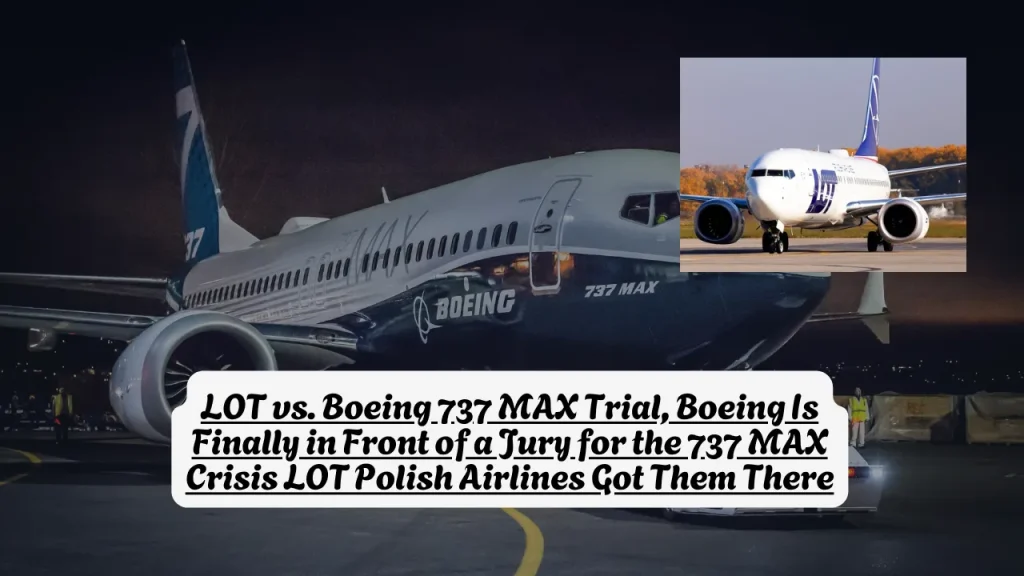
For LOT, the timing could not have been worse. The airline had structured its recovery around the MAX. With those planes parked and useless, it had to scramble for substitute aircraft, restructure its routes, and absorb losses every day the jets sat on the ground. The COVID-19 pandemic landed less than a year after the grounding began, compounding the damage further. LOT’s attorney told the Seattle federal jury that Boeing’s deceit turned the leased aircraft into “giant paperweights” and caused more than $150 million in losses.
What LOT Is Arguing in Court — and How Boeing Is Pushing Back
LOT’s legal theory rests on three claims: fraudulent misrepresentation, negligent misrepresentation, and breach of warranty. The core argument is that Boeing knew the truth about MCAS — its power, its risks, and the training implications — and chose to hide it from both LOT and the FAA for commercial reasons.
The court allowed discovery into Boeing’s internal records on MCAS’s design, development, testing, and certification, as well as materials from former Boeing 737 chief flight technical pilot Mark Forkner and Boeing board meetings where the MAX was discussed. Forkner, whose internal messages became central to criminal and regulatory proceedings against Boeing, allegedly played a key role in how MCAS was described — or not described — to regulators.
Boeing’s defense does not dispute that MCAS was flawed or that the crashes happened. Instead, it attacks the framing of LOT as a victim. Boeing’s attorney challenged the jury directly: LOT “claims fraud out of one side of its mouth in court” while continuing to fly the 737 MAX daily across its network. “Is that how the victim of a multi-million dollar fraud scheme behaves?” It is a pointed question. LOT currently operates 26 Boeing 737 MAX 8 aircraft and has four more on order — making its total committed MAX fleet 30 jets, even as it asks a jury to find the plane’s manufacturer liable for fraud.
LOT’s answer is that the deception happened before it could make an informed choice, that the updated MCAS is genuinely safer than what Boeing originally sold, and that continuing to operate a re-certified aircraft is not the same as endorsing the misconduct that preceded the grounding.
Why This Trial Is a Landmark Moment for Aviation Accountability
Every other airline that suffered losses during the MAX grounding resolved its disputes with Boeing through private out-of-court settlements, amounts undisclosed. Those settlements gave Boeing something it rarely gets to keep in high-stakes litigation: silence. No jury. No public findings. No dollar figure attached to the value of its deception.
LOT’s refusal to settle — or Boeing’s refusal to offer enough — put this case in front of twelve ordinary people in Seattle. Whatever verdict comes back, it will be the first public benchmark any court has set for what the 737 MAX crisis cost an airline that trusted Boeing’s word. A win for LOT could embolden other carriers to revisit their settlements or file new claims. A win for Boeing would give the manufacturer its first clear legal vindication from an airline in a courtroom setting.
Boeing has already paid billions to the families of the 346 people who died in the two crashes, and entered into a deferred prosecution agreement with the U.S. Department of Justice over MCAS-related fraud. This trial does not involve those crash victims — it is purely a commercial dispute between two businesses over money. But its outcome will be watched across the aviation industry, by airlines, insurers, lessors, and regulators, as the first jury verdict directly measuring what Boeing’s conduct during the 737 MAX certification period is worth.
The trial is expected to conclude around May 26, 2026.
Frequently Asked Questions
Is there a class action lawsuit against Boeing over the 737 MAX?
This is not a class action — it is a direct lawsuit by LOT Polish Airlines against Boeing. LOT is the first and only airline to take Boeing to jury trial over the MAX grounding. Other airlines settled their claims privately. Families of crash victims have pursued separate litigation and reached settlements with Boeing.
Is there a class action settlement against Boeing that affected passengers can join?
Boeing entered a deferred prosecution agreement with the U.S. Department of Justice in 2021 related to the MAX crashes, and separately settled wrongful death claims with the families of crash victims. There is currently no open consumer-facing settlement that ordinary passengers can file claims in from this lawsuit. This trial involves airline-to-manufacturer commercial damages only.
How much is LOT asking for from Boeing?
LOT originally valued its lawsuit at $250 million when it was filed in 2021. At trial, LOT’s attorneys told the jury that Boeing caused losses exceeding $150 million — the precise figure the jury will be asked to evaluate.
When will the verdict come in?
The trial opened May 12, 2026 and is expected to wrap up around May 26, 2026, barring a settlement during proceedings. The jury’s timeline for deliberations after closing arguments is not yet known.
What was MCAS and why did it matter so much?
MCAS — the Maneuvering Characteristics Augmentation System — was software Boeing added to the 737 MAX to automatically correct a nose-pitch-up tendency caused by the jet’s larger engines. Boeing downplayed its scope to the FAA to avoid requiring full simulator training for pilots. When MCAS malfunctioned on Lion Air Flight 610 and Ethiopian Airlines Flight 302, pilots were unaware the system existed and were unprepared to override it. Both planes crashed. MCAS has since been redesigned and pilot training requirements expanded before the MAX returned to service.
Can I join the LOT vs. Boeing lawsuit?
No. This is a commercial lawsuit between LOT Polish Airlines and Boeing. It is not open to other parties. If you lost a family member in one of the MAX crashes, that is a separate legal matter — consult a qualified aviation attorney for guidance specific to your situation.
Disclaimer: This article is for informational purposes only and does not constitute legal advice. For advice specific to your situation, consult a qualified attorney.
Prepared by the AllAboutLawyer.com Editorial Team, reviewed for factual accuracy against Reuters, Law360, AFP, and court records from the U.S. District Court for the Western District of Washington on May 13, 2026. Last Updated: May 13, 2026
About the Author
Israr Ahmad is a legal content researcher with 4+ years of experience covering class action settlements and consumer rights cases. He has researched and published coverage of 2,500+ settlements using verified court records, settlement administrator filings, and government sources. Learn more about Israr.