
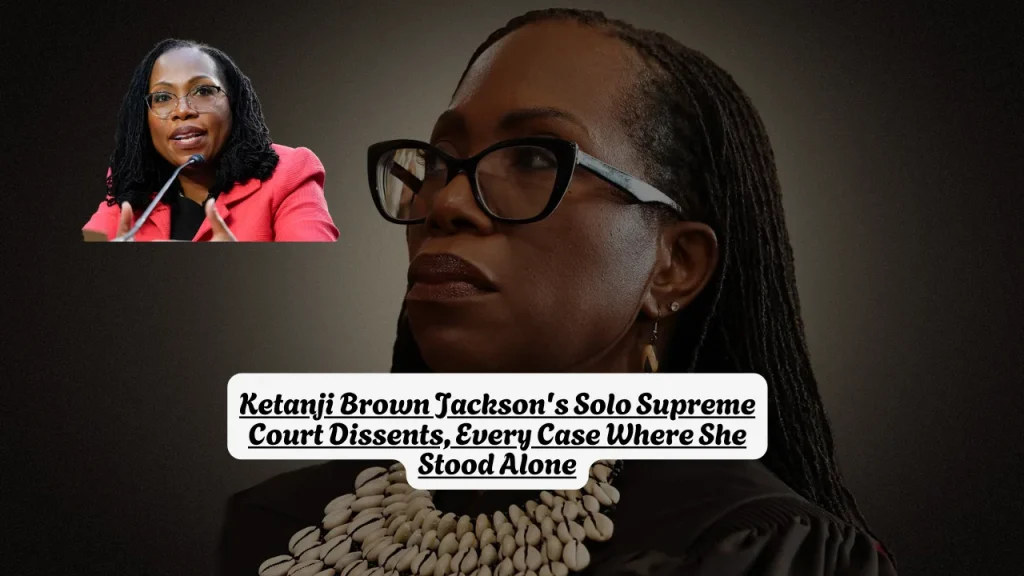
Ketanji Brown Jackson’s Solo Supreme Court Dissents, Every Case Where She Stood Alone
Justice Ketanji Brown Jackson has become the most frequent dissenter on the Roberts Court — and in the 2024–25 term, she went further than any of her colleagues, including fellow liberals, by repeatedly filing solo opinions that no other justice would sign.
In her third term on the court, Jackson wrote more than 24 opinions — second only to Justice Clarence Thomas — and was the justice most often in dissent. She spoke 76,116 words during the 2024–25 term and joined the majority 72% of the time, slightly less than Justices Sotomayor and Kagan in prior terms. But the numbers alone don’t explain why her dissents have become a phenomenon — it’s what she’s saying, and who she’s saying it alone.
Jackson’s Pattern of Standing Alone
Most Supreme Court dissents are written jointly. When the three liberal justices — Jackson, Sonia Sotomayor, and Elena Kagan — disagree with the conservative majority, they usually sign onto one another’s opinions. But Jackson has gone on solo diatribes in some of those cases, highlighting a deeper internal divide within the liberal bloc.
In the three years since she joined the court, Jackson has quickly become its most conspicuous dissenter. Her solo opinions have drawn sharp rebukes not just from conservative justices but from colleagues across the bench — including Barrett, Alito, and even, by implication, Sotomayor and Kagan, who have declined to join her in several cases.
Trump v. CASA — Birthright Citizenship and Nationwide Injunctions (June 2025)
This is the dissent that put Jackson’s name on the front pages. The case involved the legality of universal injunctions, which had prevented President Donald Trump’s executive order on birthright citizenship from going into effect nationwide. The Court ruled 6-3 that district courts could not issue such injunctions.
All three liberal justices dissented. But Jackson wrote separately — and went much further than her colleagues. Jackson contended that the court had “bent over backward to accommodate” the Trump administration and had done so in several other recent rulings on the court’s emergency docket.
The stinging words prompted an unusually scathing response from Justice Amy Coney Barrett in the majority’s opinion, calling Jackson’s dissent “a startling line of attack” and writing: “We will not dwell on Justice Jackson’s argument, which is at odds with more than two centuries’ worth of precedent, not to mention the Constitution itself.”
Jackson’s response to those criticisms was blunt. She told an interviewer: “We have very different opinions, and it’s a tradition of the Court that justices get to voice their opinions in the context of their opinions and writings.”
Federal Workforce Reductions — Trump’s Mass Firings (July 2025)
On July 8, 2025, Jackson was the only justice to oppose the Supreme Court’s decision to pause a district court order that had prevented the Trump administration from proceeding with one of its large-scale reductions to the federal workforce.
Justice Sotomayor agreed with Jackson that plans to restructure federal agencies and fire thousands of workers might run afoul of congressional mandates. But unlike Jackson, she felt it was too early to determine whether that had occurred, so she wrote a concurring opinion instead of a dissent.
That moment illustrated something important: Jackson’s solo dissents aren’t always about reaching a different conclusion than her liberal colleagues — sometimes they disagree on how far to go and when.
Related article: Ray Epps vs. Fox News Defamation Lawsuit, The Full Story and Final Outcome
Louisiana Redistricting — Voting Rights Act (April–May 2026)
Jackson forcefully accused the Supreme Court of overreach after the Court decided to fast-track implementing its redistricting ruling ahead of the 2026 midterms, breaking not only from the conservative majority but also from her two liberal colleagues, who did not join her dissent.
The response from the bench was unusually sharp. Justice Samuel Alito used a concurring opinion, joined by Justices Neil Gorsuch and Clarence Thomas, to directly rebuke Jackson, calling her arguments “baseless and insulting” and stating that her dissent “levels charges that cannot go unanswered.”
Conversion Therapy Case — Chiles v. Colorado (March 2026)
Jackson broke with her two fellow liberal justices as she dissented alone from the Supreme Court’s decision backing a challenge to Colorado’s “conversion therapy” ban. The Court sided 8-1 with a Christian counselor who argued Colorado’s law violated her free speech rights.
In her 34-page solo dissent, Jackson warned of “catastrophic” fallout from the ruling, writing: “Ultimately, because the majority plays with fire in this case, I fear that the people of this country will get burned.”
Even Justices Sotomayor and Kagan — Jackson’s usual liberal allies — voted with the majority in this case, leaving her entirely alone.
D.C. v. R.W. — Police Stop and the Fourth Amendment (April 2026)
Jackson was the lone justice to defend a D.C. appeals court ruling that found a police officer improperly stopped a man in a vehicle. The Supreme Court reversed 7-2, approving the police stop.
Justice Sotomayor also broke with the majority but declined to join Jackson’s dissent, further isolating Jackson as an outlier even among the liberal justices. Jackson argued the Court had no business correcting the lower court on what she called a routine fact-based determination.
Why Jackson Writes Alone
Jackson has addressed this directly and publicly. She has said that “dissents are an opportunity for the justices who disagree with the majority to really describe their view of the law but also their concerns,” and that “you hope that your view will prevail in the long run.”
U.S. Sen. Sheldon Whitehouse, a Judiciary Committee member, said Jackson has “pulled back the curtain” and started to call out the conservative majority’s “patterns and predispositions.”
In both oral arguments and her dissents, Jackson has stood out as a jurist who is unafraid to speak clearly about her concerns, dispensing with the kind of opaque prose that sometimes permeates legal writing.
SCOTUSblog has noted that based on her sheer number of dissents, Jackson has become the lead liberal dissenter of the Roberts Court.
What a Dissenting Opinion Actually Does
A dissenting opinion is a written statement from a justice who disagrees with the majority’s ruling. It has no binding legal force — it does not change the outcome of a case. But it preserves a minority legal argument for the future, sometimes influencing later Courts or encouraging Congress to act.
Jackson herself has made clear she understands this. She isn’t writing to win today. She’s writing for the record — and, increasingly, for the public.
Frequently Asked Questions
What is a solo dissent at the Supreme Court?
A solo dissent is a written opinion filed by a single justice who disagrees with both the majority and every other colleague. It carries no legal weight in that case but preserves the dissenting justice’s legal reasoning for future courts or legislation to consider.
How many solo dissents has Ketanji Brown Jackson filed?
Jackson filed multiple solo dissents in the 2024–25 term alone, including in the birthright citizenship injunction case (Trump v. CASA), the federal workforce reduction case, and others. She continued into 2026 with solo dissents in the conversion therapy case and D.C. v. R.W.
Why don’t the other liberal justices join Jackson’s solo dissents?
In several cases, Justices Sotomayor and Kagan agreed with parts of Jackson’s reasoning but disagreed with how far she went or concluded it was too early to rule definitively. In the conversion therapy case, both joined the 8-1 majority entirely, leaving Jackson alone.
Has Jackson been rebuked by her colleagues for her dissents?
Yes. Justice Amy Coney Barrett wrote in the Trump v. CASA majority that Jackson’s argument was “at odds with more than two centuries’ worth of precedent.” Justice Samuel Alito called her redistricting dissent “baseless and insulting.”
Do Jackson’s dissents have any legal effect?
No. Dissenting opinions do not change the outcome of a case. However, they create a formal legal record that future justices or legislatures may draw from when revisiting the same issues.
Where can I read Jackson’s dissents?
All Supreme Court opinions, including dissents, are publicly available at supremecourt.gov.
Sources: SCOTUSblog (scotusblog.com); ABC News (abcnews.go.com); CNN Politics (cnn.com).
Disclaimer: This article is for informational purposes only and does not constitute legal advice. It is based on publicly available court records and verified reporting. All outcomes described reflect official court decisions.
About the Author
Israr Ahmad is a legal content researcher with 4+ years of experience covering class action settlements and consumer rights cases. He has researched and published coverage of 2,500+ settlements using verified court records, settlement administrator filings, and government sources. Learn more about Israr.