
Kathy McCord vs. South Madison Schools Settlement, What the $195,000 Case Means for Educators
An Indiana school district agreed to pay $195,000 to settle a federal lawsuit filed by Kathy McCord, a 37-year educator who was fired in March 2023 after speaking publicly about her school’s gender identity policy. The settlement was finalized on March 25, 2026, and filed with the U.S. District Court for the Southern District of Indiana. The South Madison Community School Corporation admits no wrongdoing. This is an individual employment lawsuit — not a class action. No other educators or parents can file a claim.
Quick Facts
| Field | Detail |
| Plaintiff | Kathy McCord |
| Defendant | South Madison Community School Corporation (SMCSC) |
| Court | U.S. District Court, Southern District of Indiana |
| Lawsuit Filed | May 2023 |
| Settlement Amount | $195,000 (damages, attorneys’ fees, and court costs) |
| Settlement Finalized | March 25, 2026 |
| Case Type | Individual employment / religious freedom — NOT a class action |
| Claims Filed | First Amendment, Indiana Religious Freedom Restoration Act |
| Court Ruling (Aug. 2025) | Majority of McCord’s claims ruled in favor of SMCSC |
| Admission of Wrongdoing | None — SMCSC explicitly denies liability |
| McCord’s Attorney | Alliance Defending Freedom (ADF) |
| Case Status | Dismissed — fully resolved |
Current Status
- The settlement was made final between the two parties on March 25 and filed to the U.S. District Court for the Southern District of Indiana shortly after.
- The South Madison Community School Corporation states it has not admitted any wrongdoing, and the court made no findings of liability against the district.
- The case has been dismissed. The matter is fully resolved. No further litigation is pending.
What Is the Kathy McCord Lawsuit About?
In 2021, South Madison Community School Corporation issued a directive requiring counselors and other employees to use, upon a student’s request, names and pronouns that do not correspond with the student’s biological sex — without notifying parents or obtaining parental consent.
McCord objected. She explained to her supervisors that she objected to the directive, and her supervisors told her she had no choice: if she wanted to keep her job, she had to follow South Madison’s directive. McCord disagreed and eventually spoke to a journalist about the policy.
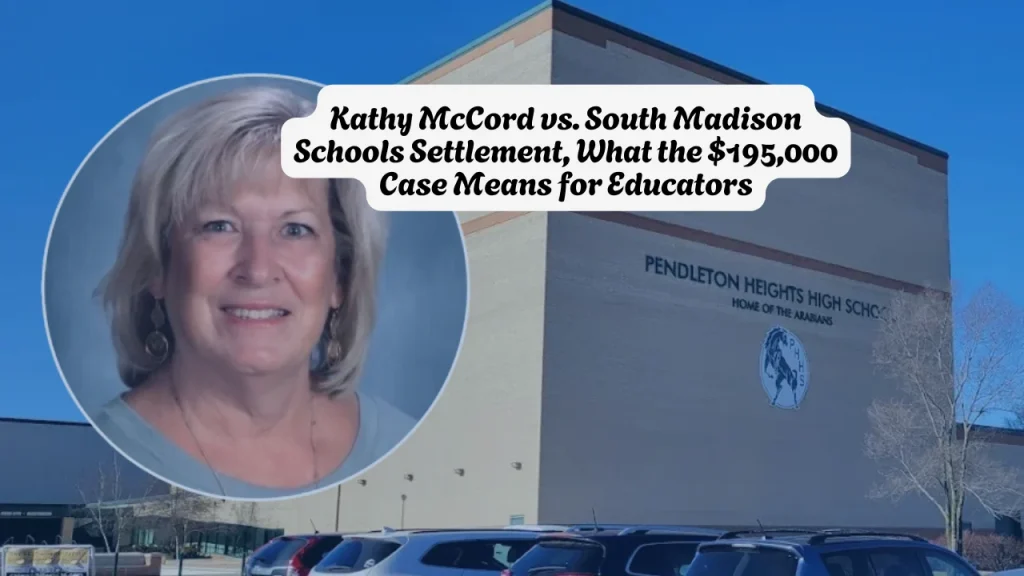
A local journalist learned of the policy from someone in the community and launched his own investigation. The journalist asked Kathy to confirm information he had already gathered from other sources, and she agreed to an interview as a private citizen. When he asked her whether the school district was keeping secrets from parents, she felt compelled to answer honestly. After the article published — and generated community backlash — the school board voted to fire her. McCord brought the suit against South Madison Community Schools Corp. in May 2023, two months after she was fired from her position as a counselor at Pendleton Heights High School.
What Did McCord Claim the School Did Wrong?
McCord’s lawsuit raised two core legal arguments. First, she alleged that firing her for speaking to the press violated her First Amendment right to free speech. Second, she argued that forcing her to use pronouns that conflicted with her Christian beliefs — under threat of termination — violated the Indiana Religious Freedom Restoration Act (RFRA).
Related article: Renaissance Hotel Fort Lauderdale vs. Southwest Airlines, The Sprinkler Flood Lawsuit Explained
In August 2025, the court ruled in favor of SMCSC on the majority of McCord’s claims, including a finding that the district did not violate her First Amendment rights. The First Amendment argument did not succeed.
The question still being litigated at the time of settlement was whether requiring McCord to deceive parents about their own children — over her objections as a Christian — violated the U.S. Constitution and the Indiana Religious Freedom Restoration Act. Those claims were still alive and headed to a jury trial when South Madison agreed to pay the settlement.
Why Did South Madison Settle If the Court Sided With Them?
This is the key question most people ask about this case. The court ruled against McCord on the bulk of her claims in August 2025. So why did the district still pay $195,000?
SMCSC chose to settle to avoid the significant time, expense, and disruption of continued litigation, and to allow the district to remain focused on serving students. In plain terms: the remaining claims — specifically the religious freedom arguments — were still viable enough to go to a jury. Jury trials are expensive, unpredictable, and disruptive for school districts. A $195,000 settlement was less costly than months of trial preparation and the risk of a larger jury verdict.
South Madison will pay $195,000 in damages, attorneys’ fees, and costs as part of the settlement. That total covers everything — McCord’s compensation, the legal fees ADF incurred over three years of litigation, and court costs.
What Changed Because of This Case?
The lawsuit did not just end with a check. Indiana law changed during the course of the litigation — and that change is arguably the bigger win McCord’s attorneys point to.
Shortly after ADF attorneys filed McCord’s lawsuit, a new Indiana law took effect that required South Madison to rescind its directive that lacked parental notification. The school district can no longer instruct counselors to keep students’ pronoun or name changes secret from parents.
Indiana law now requires the South Madison Community School Corporation to notify parents about a child’s request to change his or her name or pronouns. That policy shift affects every educator and every family in the district going forward — not just Kathy McCord.
Does This Case Affect Other Educators or Parents?
Not directly as a legal matter. This was an individual employment lawsuit between one employee and one school district. No class of educators or parents can file a claim based on this settlement.
However, the case carries strong precedent value for similar disputes around the country. ADF has signaled it intends to use this outcome to encourage other educators who face similar conflicts between school gender policies and their personal or religious beliefs. McCord’s attorney said the settlement should encourage public schools around the country to put an end to policies that he characterized as violating educators’ and parents’ rights.
If you are an educator in a similar situation — being asked to follow a gender policy that conflicts with your religious beliefs and being threatened with termination — this case is directly relevant to understanding your legal options. Consult an employment or religious freedom attorney for guidance specific to your state and circumstances.
Important Dates
| Milestone | Date |
| SMCSC Gender Directive Issued | 2021 |
| Kathy McCord Fired | March 2023 |
| Lawsuit Filed (SDNY) | May 2023 |
| New Indiana Parental Notification Law Takes Effect | Shortly after May 2023 |
| Court Rules in SMCSC’s Favor (Majority of Claims) | August 2025 |
| Settlement Finalized | March 25, 2026 |
| Settlement Filed with Federal Court | April 2026 |
| Case Dismissed | April 2026 |
Frequently Asked Questions
Can I file a claim or get compensation from the Kathy McCord settlement?
No. This is an individual employment lawsuit between Kathy McCord and the South Madison Community School Corporation. It is not a class action. No other educators, parents, or community members can file a claim or receive compensation from this settlement.
Do I need a lawyer to get involved in this case?
There is nothing to join. The case is fully resolved and dismissed. If you are an educator facing a similar situation with a school district gender policy, you should consult an employment attorney or contact a religious freedom organization like Alliance Defending Freedom for guidance.
Is this settlement legitimate?
Yes. The settlement was finalized between the parties on March 25, 2026, and filed with the U.S. District Court for the Southern District of Indiana. Both sides confirmed the resolution. The case has been officially dismissed.
When will Kathy McCord receive her payment?
Settlement payments in resolved federal cases are typically disbursed within weeks of the court filing. The settlement was filed in April 2026, so McCord and her attorneys at ADF should receive the $195,000 in damages, fees, and costs promptly. No public timeline has been announced.
Did South Madison admit it did something wrong?
No. SMCSC has not admitted any wrongdoing, and the court made no findings of liability against the district. The district says it settled to avoid the cost and disruption of a jury trial — not because it believed it would lose.
Will McCord’s settlement payment affect her taxes?
Possibly. Settlement proceeds that compensate for lost wages are generally treated as taxable income by the IRS. The portion covering attorneys’ fees may also carry tax implications. McCord should consult a tax professional before filing her return for the year she receives payment.
What happened to the school’s gender policy?
A new Indiana law took effect shortly after the lawsuit was filed, requiring South Madison to rescind its directive and notify parents when a student requests a change in name or pronouns. The original policy no longer exists.
What if I missed the chance to take part in this case?
There was never a chance for public participation — this was always an individual case. If you believe a school employer violated your religious freedom or wrongfully terminated you over a policy dispute, you may have your own independent legal claim. Contact an employment attorney in your state to evaluate your situation.
Last Updated: April 17, 2026
Disclaimer: This article is for informational purposes only and does not constitute legal advice. Legal claims and outcomes depend on specific facts and applicable law. For advice regarding a particular situation, consult a qualified attorney.
About the Author
Israr Ahmad is a legal content researcher with 4+ years of experience covering class action settlements and consumer rights cases. He has researched and published coverage of 2,500+ settlements using verified court records, settlement administrator filings, and government sources. Learn more about Israr.