
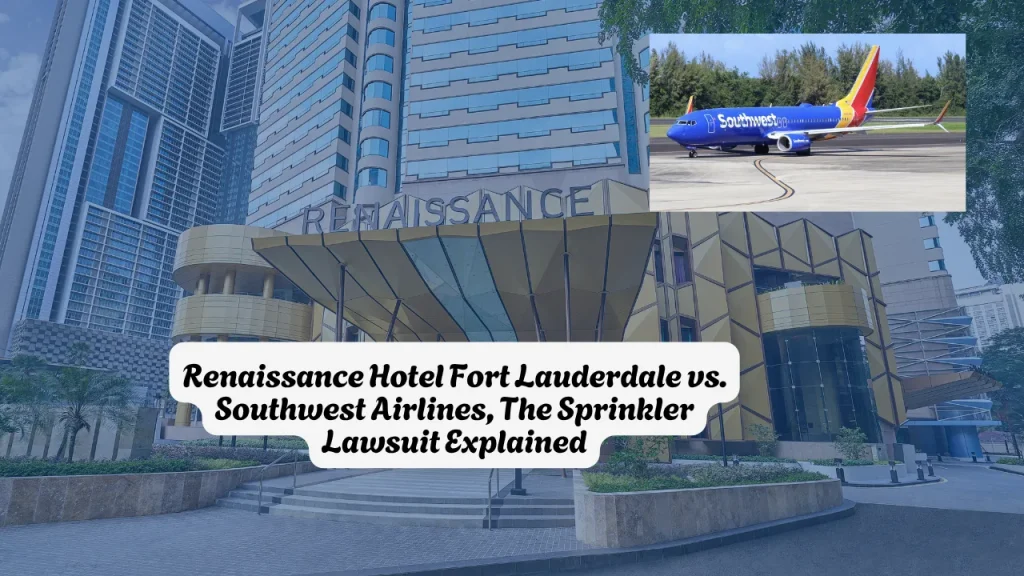
Renaissance Hotel Fort Lauderdale vs. Southwest Airlines, The Sprinkler Flood Lawsuit Explained
A Fort Lauderdale hotel is taking Southwest Airlines to federal court after one of its flight attendants allegedly triggered a fire sprinkler system during a layover stay — flooding multiple rooms, forcing guest cancellations, and racking up over $215,000 in claimed damages. The incident happened on February 1, 2025. The lawsuit was filed in early 2026. Southwest has not formally responded to the allegations. No settlement has been reached.
This is not a class action. Everyday travelers cannot file a claim. But if you stayed at the Renaissance Hotel Fort Lauderdale in early February 2025, or you’re curious about what airline crew liability actually looks like — this case directly answers those questions.
Quick Facts
| Field | Detail |
| Plaintiff | Renaissance Hotel Fort Lauderdale |
| Defendants | Southwest Airlines; unnamed female flight attendant |
| Incident Date | February 1, 2025 |
| Lawsuit Filed | Early 2026 (originally local court; moved to Florida district court) |
| Damages Claimed | Over $215,000 |
| Property Damage | Exceeded $50,000 (remediation, drying, sanitization, deodorizing) |
| Case Type | Commercial negligence / property damage — NOT a class action |
| Southwest’s Response | Filed procedural paperwork; no formal answer to allegations yet |
| Settlement Status | None — active litigation |
| Who Can File a Claim | No public claim available — business-to-business dispute only |
Current Status
- Southwest Airlines has filed some paperwork in the Fort Lauderdale district court but redacted its own internal report into the incident, as well as a statement written by the flight attendant. The carrier has not yet formally responded to the lawsuit.
- The hotel originally filed its suit in a local court, but Southwest moved to have it transferred to a Florida district court due to the sums involved in the claim.
- No trial date, settlement talks, or court ruling has been reported as of April 2026.
What Happened at the Renaissance Hotel Fort Lauderdale?
On February 1, 2025, a Southwest Airlines flight attendant allegedly “negligently interfered” with the fire sprinkler system in her hotel room during a layover. The sprinkler activated not only in the crew member’s room but also in multiple other hotel rooms.
The incident forced the hotel to cancel reservations across multiple rooms while restoration experts were called in to dry out, sanitize, and deodorize the affected rooms. Along with the hotel rooms themselves, the flooding also reached some communal areas, the front desk area, and several office rooms.
The hotel says that after remediation, drying out, sanitization, and deodorizing, the damages in the impacted rooms exceeded $50,000. But the total claimed in the lawsuit goes much further than that. The Renaissance Hotel Fort Lauderdale is claiming over $215,000 in damages overall — a figure that accounts for room cancellations, lost revenue, and the broader disruption to hotel operations, not just the cost of repairs.
There was signage near the sprinkler system telling guests not to tamper with it. The hotel says that warning was visible and that the flight attendant ignored it.
Related article: Ben Pasternak $BELIEVE Token Class Action Lawsuit, Are You Eligible to Join?
Why Is Southwest Airlines Being Sued — Not Just the Flight Attendant?
This is the legal question most people want answered. The flight attendant is also a named defendant. But the hotel’s central argument is that Southwest bears direct responsibility because of how the stay was booked.
The Renaissance Hotel Fort Lauderdale asserts that the room was paid for by Southwest Airlines — and as an employee under the company’s reservation, the hotel wants to hold Southwest directly responsible for the damages.
This legal theory is called vicarious liability — the idea that an employer can be held responsible for the actions of its employees, particularly when those employees are acting within the scope of their employment. A layover stay, booked and paid for by the airline, is part of the job. The hotel argues that puts Southwest on the hook.
Airlines routinely contract hotels across the country to accommodate pilots and flight attendants between scheduled flights. Because these accommodations are typically set up through negotiated contracts rather than individual bookings, incidents involving damage can sometimes become complicated from a liability standpoint. The question of who is responsible can depend on the terms of the agreement, the circumstances surrounding the incident, and whether the employee was acting within the scope of their duties.
Southwest has not publicly disputed those facts. What it has done is redact its internal incident report and the flight attendant’s own written statement — moves that signal it intends to contest the claims carefully rather than quickly settle.
What Evidence Does the Hotel Have?
The Renaissance Hotel is not relying solely on the fact of the flooding. The hotel has retained an “independent fire sprinkler expert” who can testify that the sprinkler was in working condition and that the damages were a direct result of the defendant tampering with the sprinkler system.
That combination of claims is significant because it shifts the case away from ambiguity over equipment failure and toward questions of conduct, supervision, and liability. In plain terms: the hotel is ruling out the argument that the sprinkler malfunctioned on its own. An expert witness who testifies the system worked correctly puts the cause squarely on human action.
The hotel also points to the visible warning signage near the sprinkler as evidence that the risk of tampering was known and communicated — and ignored.
Has Southwest Airlines Faced Similar Incidents Before?
This is not the first time a Southwest flight attendant has been linked to a sprinkler incident at a crew layover hotel.
In 2023, another Southwest flight attendant was arrested for flooding a hotel with the sprinkler system and attacking other guests with a toilet plunger during a late-night incident at a crew layover hotel in Des Moines, Iowa. That incident resulted in criminal charges.
The current Fort Lauderdale case does not involve criminal allegations — the hotel is pursuing civil damages only. But the pattern raises a broader question about how airlines supervise crew behavior during layovers, and whether existing crew lodging agreements adequately address liability when something goes wrong.
In a Florida case involving Lufthansa and a Miami hotel, courts examined whether the airline could shift liability to the hotel after another guest sued the airline when a window fell from a room occupied by a flight attendant. Courts in Florida have dealt with airline crew lodging liability before, which gives this case some legal precedent to draw from on both sides.
What Does This Mean for Hotel Guests?
If you stayed at the Renaissance Hotel Fort Lauderdale in early February 2025 and had your reservation canceled or disrupted, that disruption is directly connected to this incident. However, you are not a party to this lawsuit. The hotel is suing for its own business losses — not on behalf of guests.
If you personally suffered losses from a canceled stay (non-refundable bookings, travel costs, etc.) and believe the hotel failed to adequately compensate you at the time, your recourse would be a separate individual claim — not participation in this case.
For travelers in general, this case is a reminder that crew layover incidents — while rare — do happen, and that large hotels near major airports carry real exposure from airline crew bookings.
Important Dates
| Milestone | Date |
| Sprinkler Incident | February 1, 2025 |
| Lawsuit Originally Filed | Early 2026 (local Florida court) |
| Case Transferred to Federal Court | 2026 (Florida district court) |
| Southwest’s Formal Response | TBD — not yet filed |
| Trial Date | TBD |
| Resolution / Settlement | TBD |
Frequently Asked Questions
Can I file a claim or get compensation from this lawsuit?
No. This is a business-to-business property damage lawsuit between the Renaissance Hotel and Southwest Airlines. There is no public settlement, no claim portal, and no consumer class involved. Everyday travelers cannot file a claim in this case.
Is this a class action lawsuit?
No. The Renaissance Hotel Fort Lauderdale filed this as a standard commercial negligence and property damage case. It does not involve a class of consumers. Only the hotel and the named flight attendant are seeking or facing damages.
How much is the hotel claiming in damages?
The Renaissance Hotel Fort Lauderdale is claiming over $215,000 in total damages. That includes over $50,000 in direct remediation costs plus additional losses from canceled reservations and business disruption.
Has Southwest Airlines admitted any wrongdoing?
No. Southwest has filed procedural paperwork but redacted its internal report and the flight attendant’s statement. The carrier has not yet formally responded to the allegations.
Why did the flooding spread to multiple rooms — not just one?
Fire sprinkler systems in hotels are connected to building-wide plumbing. When a single sprinkler head activates — whether by heat, smoke, or physical interference — water discharges under pressure. Depending on the system design and how long it runs before shutting off, flooding can spread through walls, ceilings, and floors into adjacent and lower-level rooms quickly.
Will this lawsuit affect Southwest Airlines passengers?
Unlikely in the short term. This is a property damage dispute, not a safety or consumer issue. Southwest continues to operate normally. The case could, however, prompt airlines to revisit how their crew lodging contracts address liability for employee conduct during layovers.
When will this case be resolved?
No timeline is set. Commercial property damage cases in federal court typically take one to two years to resolve, depending on whether Southwest files a formal response, whether the parties reach a settlement, or whether the case proceeds to trial.
Last Updated: April 17, 2026
Disclaimer: This article is for informational purposes only and does not constitute legal advice. Legal claims and outcomes depend on specific facts and applicable law. For advice regarding a particular situation, consult a qualified attorney.
About the Author
Israr Ahmad is a legal content researcher with 4+ years of experience covering class action settlements and consumer rights cases. He has researched and published coverage of 2,500+ settlements using verified court records, settlement administrator filings, and government sources. Learn more about Israr.