
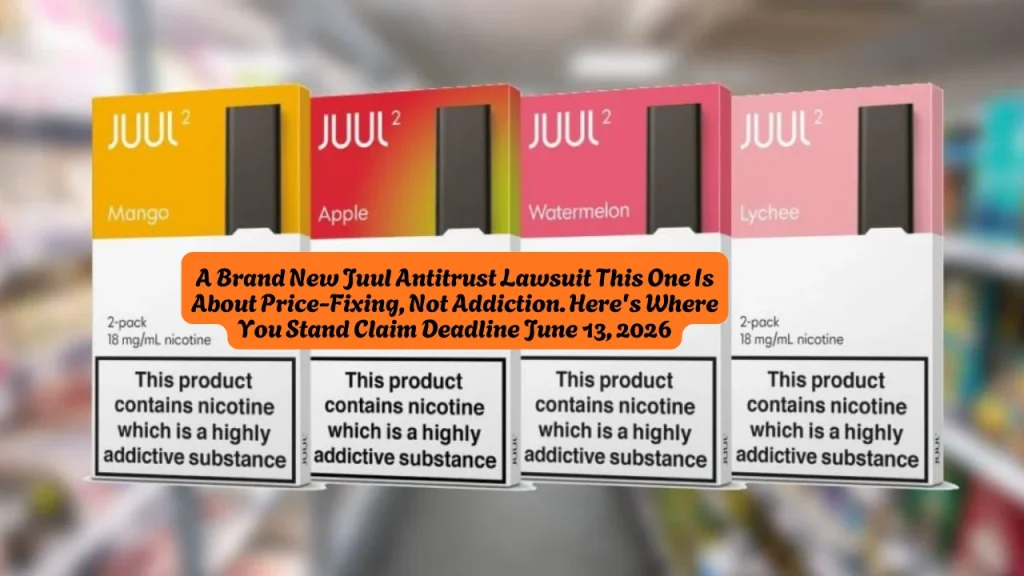
A Brand New Juul Antitrust Lawsuit This One Is About Price-Fixing, Not Addiction. Here’s Where You Stand Claim Deadline June 13, 2026
Most people who followed the Juul story assume it ended with the $300 million false advertising settlement that paid out in 2024. It did not. A completely separate lawsuit — this one about price-fixing, not addiction — has been quietly advancing through a California federal court for six years. On February 5, 2026, a judge certified two new consumer classes. A trial date is now set for September 28, 2026. If you purchased e-cigarette products directly from Juul Labs, Inc. or any of its subsidiaries or affiliates from October 5, 2018, to February 26, 2026, this lawsuit may affect your rights. There is no settlement and no claim form yet — but there is a deadline you need to know about right now.
| Field | Detail |
| Case Name | In re: Juul Labs, Inc. Antitrust Litigation |
| Case Number | 20-cv-02345 (N.D. Cal.) |
| Court | U.S. District Court, Northern District of California |
| Judge | Hon. William H. Orrick |
| Defendants | Juul Labs, Inc. (JLI); Altria Group, Inc. |
| Direct Purchaser Class Period | October 5, 2018 – February 26, 2026 |
| Who Qualifies (Direct) | Bought JUUL products directly from juul.com |
| Opt-Out Deadline (Direct Class) | June 13, 2026 |
| Settlement | None — going to trial |
| Trial Date | September 28, 2026 |
| Official Website (Direct) | juulantitrust.com |
| Official Website (Retail) | juulantitrustconsumer.com |
Where things stand right now:
- On February 5, 2026, the court granted direct purchaser plaintiffs’ motion for class certification. On February 26, 2026, the court granted plaintiffs’ motion for an extension of time to supplement discovery.
- Juul Labs and Altria have filed a petition with the Ninth Circuit Court of Appeals for appellate review of the class certification order. If the Ninth Circuit agrees to hear it, the September 2026 trial date could shift.
- There is no money available and no claim form to file right now. The only actionable deadline at this moment is the opt-out deadline.
This Is Not the Same Juul Lawsuit That Already Paid Out
Before going further, this distinction matters — and it confuses nearly everyone who receives a class notice.
The original Juul class action settlement distributed $300 million to consumers who purchased Juul products. That case centered on deceptive marketing, addiction claims, and allegations that Juul targeted minors. Checks went out. That case is over. The claim deadline for that settlement was February 5, 2024, and it has long since passed.
This new lawsuit is about something entirely different. The allegations this time have nothing to do with marketing or addiction. This is about money — specifically, the allegation that Juul and Altria conspired to eliminate competition in the e-cigarette market and artificially inflate the price of Juul pods for years.
Think of it this way: the first lawsuit said Juul lied to you about what was in its product. This new lawsuit says Juul and Altria rigged the market so you had no choice but to pay more for it.
What Juul and Altria Actually Allegedly Did to the Market
In the fall of 2018, Juul Labs agreed to negotiate with Altria under the condition that Altria withdraw its products and stop competing with Juul in the market for e-cigarettes. At first, Altria refused. In October 2018, however, Altria agreed and began to withdraw its e-cigarette products from the market. Two months later, Altria announced its intention to cease competing in the market. Approximately two weeks after that announcement, Altria disclosed that it had entered into the agreement with Juul Labs.
Plaintiffs allege the investment led Altria to exit the e-cigarette market, reduce product variety, and raise prices. In December 2018, Altria paid $12.8 billion for a 35% stake in Juul. The lawsuit’s core argument is that this was not just an investment — it was a deal to eliminate Altria as a competitor in exchange for billions of dollars and a share of future Juul profits.
At its peak, Juul controlled roughly 72 percent of the entire U.S. e-cigarette market. A four-pack of pods retailed for approximately $15.99, and millions of consumers were purchasing multiple packs per week over a class period spanning from October 2018 through March 2024. The lawsuit claims that without Altria pulling its competing products from shelves, those prices would have been lower.
Related article: Ardagh Glass $602,000 Settlement, Ardagh Glass Left Salary Ranges Off Washington Job Postings, Now It’s Paying Up to $602,000
Defendants deny these allegations and assert that they did not violate any laws and that the transaction at issue did not have anticompetitive effects or result in higher prices for closed system e-vapor products.
Two Different Classes — Which One Are You In?
This is where most readers get lost. The court certified multiple classes on February 5, 2026, and they cover different types of purchasers with different rules and different websites.
Direct Purchaser Class — bought from juul.com
Class members are defined as all natural persons and entities in the United States that purchased e-cigarette products directly from Juul Labs, Inc. or any of its subsidiaries or affiliates from October 5, 2018, to February 26, 2026. This means purchases made through the official JUUL website only — not at a store. The opt-out deadline for this class is June 13, 2026. The official website is juulantitrust.com.
Consumer (Indirect Purchaser) Classes — bought at retail stores
A federal judge also certified multiple classes of consumers who purchased JUUL pods from brick-and-mortar stores such as convenience stores, gas stations, grocery stores, supermarkets, and liquor stores between October 25, 2018 and March 29, 2024. The opt-out deadline for this class is May 20, 2026 — earlier than the direct purchaser deadline. The official website is juulantitrustconsumer.com.
The court certified separate additional state classes for consumers in California, Florida, Hawaii, Massachusetts, New York, and Rhode Island who purchased JUUL pods indirectly during the class period.
If you are a JUUL user who purchased directly from JUUL Labs’ website and also purchased JUUL at retail, you may be a member of both classes. If you choose to opt out of one class, you will still be included in the other unless you separately opt out of that one as well.
What does not qualify in either class: Purchases of Juul devices do not qualify. Pods that came bundled in starter kits with devices do not qualify. Only stand-alone pod purchases count.
No Money Yet — Here Is What to Do Right Now
There is no claim form. There is no settlement fund. The trial has not happened yet. There is no guarantee that the plaintiffs will win, or that they will get any money for the consumer classes.
The only decision class members need to make right now is whether to stay in or opt out.
If you do nothing: You stay in your class automatically. If plaintiffs win at trial or reach a settlement, you will be notified about how to file a claim and share in any benefits. You give up the right to sue Juul and Altria independently for these specific antitrust claims.
If you opt out: You are excluded from the class and receive nothing if the case succeeds. But you preserve the right to bring your own lawsuit against Juul or Altria for these claims. For the vast majority of individual consumers, opting out makes little practical sense — the per-person overcharge amount would not justify the cost of independent litigation.
To opt out of the direct purchaser class: Submit your request online or by mail postmarked by June 13, 2026. Visit juulantitrust.com for instructions.
To opt out of the consumer/indirect purchaser classes: Submit your request online or by mail postmarked by May 20, 2026. Visit juulantitrustconsumer.com or call 1-877-239-5587.
The Full Timeline — Six Years in the Making
| Milestone | Date |
| Altria announces $12.8B Juul investment | December 2018 |
| Class action filed (consolidated) | May 7, 2020 |
| Direct purchaser complaint filed | November 13, 2020 |
| $300M false advertising settlement (separate case) | 2022–2024 |
| Third amended complaint filed | September 7, 2023 |
| Class certification granted | February 5, 2026 |
| Discovery extension granted | February 26, 2026 |
| Consumer class opt-out deadline | May 20, 2026 |
| Direct purchaser opt-out deadline | June 13, 2026 |
| Trial date | September 28, 2026 |
| Claim form availability | TBD — only if plaintiffs win or settle |
| Expected payment date | TBD — likely 2027 at earliest |
Frequently Asked Questions
Didn’t Juul already settle? I thought I got a check.
The original Juul class action settlement distributed $300 million to consumers and centered on deceptive marketing, addiction claims, and allegations that Juul targeted minors. That case is over. This new antitrust lawsuit is a completely separate case with different allegations, different defendants, and a different legal theory. Receiving a check in the first case does not affect your status in this one.
Do I need to do anything right now to get money later?
No — but you need to pay attention to the opt-out deadline. If you want to stay in the class, you do not have to do anything now. If money and benefits are obtained in the future, you will be notified about how you can share in benefits for which you are eligible. Doing nothing keeps you in.
Is there a claim form I can file?
Not yet. There is no Juul antitrust claim form available and there will not be one until the case either settles or the plaintiffs win at trial. Anyone asking you to file a claim form for this case right now is misleading you.
What if the Ninth Circuit takes up the appeal?
Juul Labs and Altria filed a petition with the Ninth Circuit Court of Appeals requesting appellate review of the class certification order. If the Ninth Circuit agrees to hear the petition, the trial date could be postponed. Monitor juulantitrust.com and juulantitrustconsumer.com for updates.
How much could I actually receive if plaintiffs win?
No confirmed figure exists. The ingredients for a significant recovery are present, but no outcome is guaranteed. Juul and Altria deny the allegations entirely and have stated their intention to appeal the class certification. Any estimate of individual payouts at this stage would be speculation.
I bought JUUL pods at a gas station — which class am I in?
The consumer indirect purchaser class covers purchases of JUUL pods from brick-and-mortar retail stores such as convenience stores, gas stations, grocery stores, supermarkets, and liquor stores for personal use and not resale, from October 25, 2018, through March 29, 2024. Your opt-out deadline is May 20, 2026, and the official website is juulantitrustconsumer.com.
I bought from juul.com AND at retail stores — do I need to opt out of both separately?
Yes. If you choose to opt out of this direct purchaser class action, you will still be included in the indirect purchaser class action unless you separately opt out of that one as well. They are separate classes with different deadlines and different websites. Opting out of one does not opt you out of the other.
Will this payment be taxable?
No confirmed tax guidance has been issued for this case because there is no settlement or award yet. Generally, antitrust overcharge recoveries — where you are being reimbursed for money you overpaid — may be treated differently than income. Consult a tax professional once and if a payment becomes available.
Sources & References
- Official direct purchaser class website: juulantitrust.com
- Official consumer/indirect purchaser class website: juulantitrustconsumer.com
- Court PR notice — U.S. District Court, N.D. Cal. — PR Newswire, March 30, 2026
- Joseph Saveri Law Firm case page (Lead Counsel): saverilawfirm.com/our-cases/e-cigarette-antitrust-litigation
- PACER docket: U.S. District Court, N.D. Cal., Case No. 20-cv-02345
Last Updated: March 31, 2026
Disclaimer: This article is for informational purposes only and does not constitute legal advice. The outcome of the trial described in this article is uncertain and not guaranteed. Legal claims and outcomes depend on specific facts and applicable law. For advice regarding a particular situation, consult a qualified attorney.
About the Author
Israr Ahmad is a legal content researcher with 4+ years of experience covering class action settlements and consumer rights cases. He has researched and published coverage of 2,500+ settlements using verified court records, settlement administrator filings, and government sources. Learn more about Israr.