
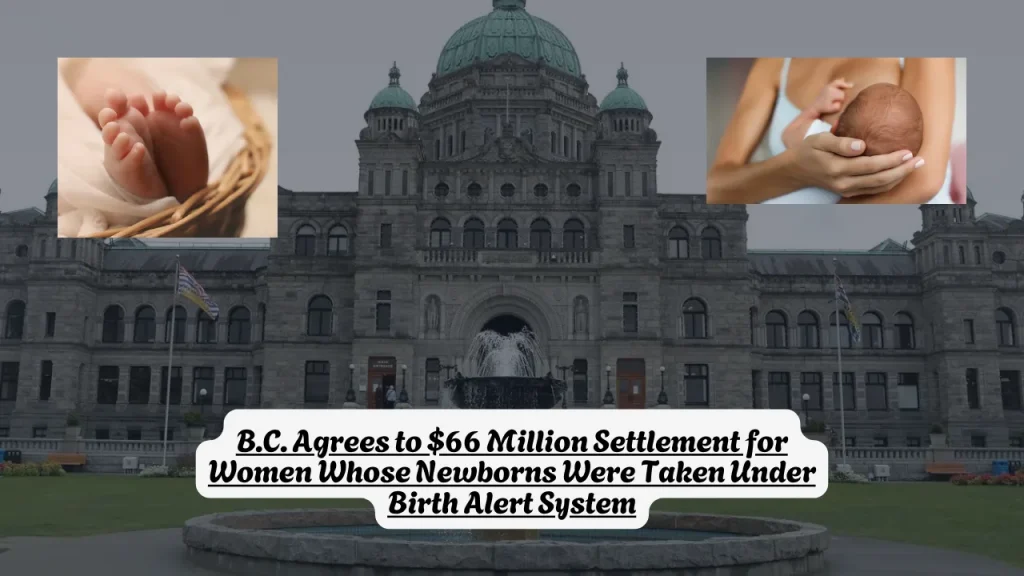
B.C. Agrees to $66 Million Settlement for Women Whose Newborns Were Taken Under Birth Alert System
British Columbia is set to become the first province in Canada to settle a class action lawsuit over birth alerts — a child welfare practice that saw social workers secretly notify hospitals about pregnant people deemed “high-risk,” frequently resulting in newborns being apprehended within hours or days of birth, often without the mother’s knowledge or consent. The proposed settlement, valued at $66 million, was announced May 12, 2026. The case is Zeleniski v. His Majesty the King in Right of British Columbia, filed in the B.C. Supreme Court against the Ministry of Children and Family Development (MCFD). The settlement is not yet court-approved. No claim form or payment timeline exists yet.
A note before reading: This article discusses the forced separation of newborns from their mothers and the disproportionate targeting of Indigenous women by the child welfare system. If this content causes distress, support is available:
- Crisis Services Canada: 1-833-456-4566 or text 45645
- First Nations Health Authority Mental Health Line: 1-855-550-5454
- 2-1-1 BC: Mental health and social services referrals
B.C. Birth Alert Settlement — Quick Facts
| Field | Detail |
| Settlement Amount | $66,000,000 (proposed) |
| Case | Zeleniski v. His Majesty the King in Right of British Columbia |
| Court | Supreme Court of British Columbia |
| Defendant | Province of British Columbia (Ministry of Children and Family Development) |
| Who May Qualify | All persons who were, while pregnant, the subject of a birth alert issued in British Columbia |
| Identified Class Members | ~2,842 (province’s current list — full class size unknown) |
| Settlement Status | Proposed — court approval pending |
| Claim Form | TBD — not yet available; no claim deadline set |
| Payout Per Person | TBD — to be determined after court approval and claims process |
| Class Counsel | Camp Fiorante Matthews Mogerman LLP (CFM); Sharon Wong, Paralegal: 604-689-7555 or [email protected] |
| Last Updated | May 13, 2026 |
What Were Birth Alerts? Zeleniski v. His Majesty the King in Right of British Columbia
A birth alert — also called a hospital alert — was a process where a social worker at British Columbia’s Ministry of Children and Family Development flagged a pregnant person as potentially “high-risk” and, without telling them, notified the hospital where they planned to give birth. When the baby arrived, hospital staff would inform child welfare workers, who could then apprehend the newborn — sometimes within hours of delivery — before the mother had any opportunity to be heard, to arrange family support, or to challenge the decision.
The alerts were issued based on speculative assessments about a person’s parenting capacity, often grounded in their history with the child welfare system, poverty, disability, or prior involvement with MCFD. They were issued without consent, without judicial oversight, and frequently without the mother ever being told one had been placed on her file.
In the final 20 months that B.C. issued official birth alerts, 58 per cent of the people involved were Indigenous. Indigenous people make up about 5.7 per cent of B.C.’s population.
B.C.’s own government lawyers had concluded internally that issuing birth alerts was illegal and unconstitutional — a memo from the Ministry of Attorney General to MCFD confirmed this — before the province formally ended the practice in September 2019. The National Inquiry into Missing and Murdered Indigenous Women and Girls called birth alerts “racist and discriminatory and a gross violation of the rights of the child, the mother, and the community.” The Truth and Reconciliation Commission’s Calls to Action specifically addressed the need to reduce the number of Indigenous children in care.
The class action, filed in the B.C. Supreme Court in September 2021, alleges that by establishing and operating the birth alert scheme, the province breached pregnant persons’ constitutional rights under the Canadian Charter of Rights and Freedoms — specifically the right to liberty and security of the person, and the right to equality — as well as their quasi-constitutional right to privacy in matters of medical care and childbirth.
Adrianna Zeleniski, the representative plaintiff and an Armstrong, B.C. resident, had a security guard stationed outside her hospital room while she was in labour. She was subject to birth alerts during multiple pregnancies. Thirteen years later, she welcomed the settlement. “Everybody here in this class action is going to have something that they can acknowledge, that they can say out loud.”
Are You Part of the B.C. Birth Alert Class?
The class is defined broadly. You do not need to have had your baby apprehended to be included — being subject to the birth alert itself is the harm the lawsuit addresses.
You may be part of this class if:
- You were pregnant at any point while living in British Columbia
- A birth alert or hospital alert was issued about you by MCFD at any time during B.C.’s operation of the scheme (prior to September 2019 when it was officially ended)
- You did not consent to the alert being placed on your file
You are likely NOT included if:
- You were never subject to a birth alert in British Columbia
- Your birth alert was issued in a different province
Many people do not know they were subject to a birth alert because MCFD did not inform them at the time. If you suspect you may have been subject to one — for example, if child welfare workers appeared at the hospital when you gave birth — you can request your records. CFM Lawyers can help you do this. Contact paralegal Sharon Wong at 604-689-7555 or [email protected].
While the total number of class members is not known, the province has a list of about 2,842 people it has identified as potentially being the subject of a birth alert. The actual class is expected to be larger than that list.
Related article: Genesis Recall, Over 94,700 Luxury Vehicles Face Fuel Leak and Fire Risk
What Does the $66 Million Settlement Include?
The $66 million proposed settlement is not just about money. The settlement includes a provision for a senior B.C. government official to make a public statement acknowledging the impact of birth alerts and for the province to facilitate roundtable discussions with class members.
The financial compensation will be distributed among confirmed class members once the settlement receives court approval and a claims process is established. Individual payout amounts are TBD — not yet determined, as they depend on how many class members are identified and confirmed, and what the court approves for legal fees and administration costs.
The settlement is not an admission of wrongdoing by the Province of British Columbia.
Plaintiffs’ lawyer Michelle Segal of CFM said the settlement is significant beyond its dollar value. “It’s a small piece of a much bigger project, which is advocacy around the child welfare system in B.C., specifically, but also in Canada.”
What Should You Do Right Now?
No claim form exists yet. The settlement still requires court approval before any payment process opens. Here is what you should do now:
If you believe you were subject to a birth alert in B.C.: Contact CFM Lawyers as soon as possible to register your interest and get help accessing your records. Reach paralegal Sharon Wong at 604-689-7555 or [email protected]. The firm is working to ensure the process is voluntary, confidential, and trauma-informed.
If you already registered with CFM: Watch for communications from the firm about next steps once the settlement receives court approval.
Save any documents you have: Records of hospital stays, MCFD correspondence, or anything connecting you to a birth alert during a pregnancy in British Columbia will be relevant to the claims process.
Most class members who are identified will be automatically included. But because many people were never told a birth alert existed for them, reaching out proactively to verify and register is the most important step right now.
Why B.C.’s Settlement Is a Landmark — and What Other Provinces Are Doing
B.C. is not the only province being taken to court over birth alerts: Separate class actions have been filed in Quebec, Ontario, Manitoba, and Saskatchewan. But B.C. is the only province to indicate an intention to settle.
The contrast is stark. In Ontario, a court certified the province as a defendant but not children’s aid societies, which plaintiffs argued issued birth alerts, leading to two duelling appeals: one by the plaintiffs trying to get children’s aid societies certified and one by the province seeking to overturn its own certification.
Manitoba has sought to have the class action in that province struck, arguing the representative plaintiff’s birth alert happened too long ago — an argument her lawyers reject in part because, they say, the province concealed the birth alert from her at the time.
Saskatchewan has sought to bar the use of a Missing and Murdered Indigenous Women and Girls report and a Truth and Reconciliation Commission report as evidence in that province’s class action, arguing they constitute hearsay and are insufficiently reliable.
Tina Yang, a lawyer representing plaintiffs in Saskatchewan, Manitoba, and Ontario, would like those provinces to follow B.C.’s lead. At minimum, she wants them to address the Charter right to equal treatment on its merits.
B.C.’s decision to settle sends a signal — though other provinces have yet to follow.
B.C. Birth Alert Settlement Timeline
| Milestone | Date |
| B.C. officially ends birth alert practice | September 2019 |
| Class action filed in B.C. Supreme Court | September 2021 |
| Case renamed Zeleniski v. His Majesty the King in Right of BC | TBD — after representative plaintiff change |
| Proposed $66M settlement announced | May 12, 2026 |
| Court approval hearing | TBD — not yet scheduled |
| Claims process opens | TBD — pending court approval |
| Individual payouts | TBD — after approval and claims determination |
Frequently Asked Questions
Is there a class action settlement in B.C. over birth alerts?
Yes. A proposed $66 million settlement has been announced in Zeleniski v. His Majesty the King in Right of British Columbia, a class action filed in the B.C. Supreme Court. The settlement must still receive court approval before any claims process opens.
Do I need to do anything right now to be part of this settlement?
If you believe you were subject to a birth alert in B.C., contact CFM Lawyers now to register and request your records. No formal claim form has been released yet. Staying in contact with Class Counsel is the most important step you can take today.
How do I find out if I had a birth alert on my file?
Many people were never told. CFM Lawyers can help you submit a freedom of information request to MCFD for your records. Contact paralegal Sharon Wong at 604-689-7555 or [email protected].
How much money will each class member receive?
Individual payout amounts are not yet determined. They will depend on the number of confirmed class members, the court-approved legal fees, and the distribution process established after court approval of the settlement.
Does this settlement cover birth alerts in other provinces?
No. This settlement covers B.C. only. Class actions are underway in Ontario, Manitoba, Saskatchewan, and Quebec, but none of those provinces have announced a settlement.
Is B.C. admitting it did something wrong?
No. The Province of British Columbia is not admitting wrongdoing as part of this settlement. However, the settlement does include a commitment to have a senior government official publicly acknowledge the impact birth alerts had on those affected.
What if I missed a birth alert that happened years ago?
The class covers birth alerts issued at any point during B.C.’s operation of the scheme — from when the practice began until September 2019, when it officially ended. Older alerts are still covered. Contact CFM Lawyers to assess your specific situation.
If you are experiencing distress related to birth alerts or child welfare system involvement, please reach out to Crisis Services Canada at 1-833-456-4566, the First Nations Health Authority at 1-855-550-5454, or 2-1-1 BC for local supports.
Disclaimer: This article is for informational purposes only and does not constitute legal advice. For advice specific to your situation, consult a qualified lawyer.
Prepared by the AllAboutLawyer.com Editorial Team, reviewed for factual accuracy against the Investigative Journalism Bureau / Vancouver Sun report published May 12, 2026, and CFM Lawyers case records. Last Updated: May 13, 2026
About the Author
Israr Ahmad is a legal content researcher with 4+ years of experience covering class action settlements and consumer rights cases. He has researched and published coverage of 2,500+ settlements using verified court records, settlement administrator filings, and government sources. Learn more about Israr.