
Juul Antitrust Class Action,Federal Court Certifies Case Against Juul and Altria Over Alleged Price Fixing on Pods
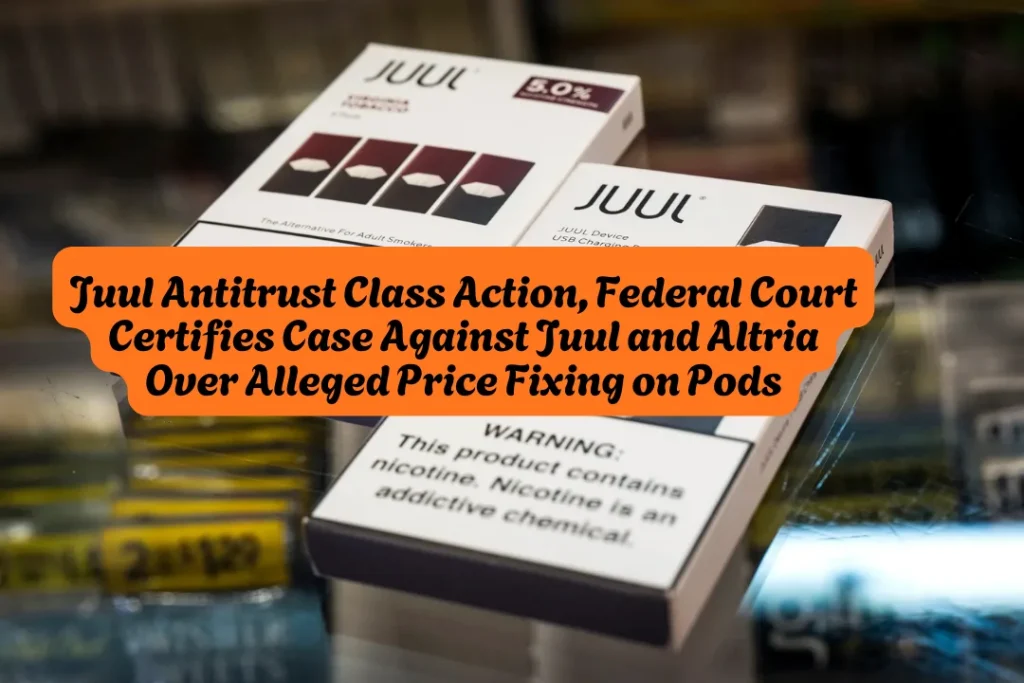
On February 5, 2026, the Hon. William H. Orrick of the U.S. District Court for the Northern District of California certified classes of consumers in an antitrust class action against Juul Labs, Inc. and Altria, Inc., alleging the two companies conspired to restrain competition and entered into a transaction that substantially lessened competition in the market for closed-system e-vapor products. The lawsuit claims consumers paid artificially inflated prices for Juul pods as a direct result. A trial has been scheduled for September 28, 2026. No settlement exists.
Quick Facts
| Field | Detail |
| Case Name | In re: Juul Labs, Inc. Antitrust Litigation |
| Court | U.S. District Court, Northern District of California |
| Case Number | 3:20-cv-02345-WHO |
| Presiding Judge | Hon. William H. Orrick |
| Class Certified | February 5, 2026 |
| Defendants | Juul Labs, Inc. (JLI); Altria, Inc. |
| Alleged Violation | Sherman Antitrust Act (15 U.S.C. § 1); California Cartwright Act; state antitrust laws |
| Products Affected | Juul pods — pre-filled, non-reusable e-liquid cartridges (devices and kits excluded) |
| Geographic Scope | Multistate class — 28 states plus D.C.; separate state classes for California, Florida, Hawaii, Massachusetts, New York, and Rhode Island |
| Class Period | October 25, 2018 — March 29, 2024 |
| Opt-Out Deadline | May 20, 2026 |
| Trial Date | September 28, 2026 (subject to change) |
| Settlement | None — litigation phase only |
| Claim Form Available | No |
| Class Counsel | Zwerling, Schachter & Zwerling, LLP; Joseph Saveri Law Firm; Kaplan Fox & Kilsheimer; Cera LLP |
What Actually Happened?
In 2015, Juul Labs entered the e-cigarette market and quickly captured over 70% market share by 2018. Juul accomplished this by developing a chemical breakthrough that increased the speed of nicotine delivery and offering a stylish device and innovative tobacco flavors. Juul’s swift rise posed a grave competitive threat to Altria in the e-cigarette and traditional cigarette markets.
To eliminate that competitive threat, Altria began a strategy of attempting to acquire Juul while continuing to compete against it. In October 2018, Altria agreed to withdraw its own e-cigarette products from the market. Shortly after, Altria acquired a 35% stake in Juul Labs for approximately $12.8 billion. The lawsuit alleges this was not a routine investment — it was a deal designed to eliminate Altria as a competitor and hand Juul monopoly control over the closed-system e-vapor market.
The FTC took notice and filed its own administrative antitrust complaint against both companies in 2020. While that FTC action was eventually dismissed, the private consumer class action continued pushing forward in federal court. After years of complex litigation — including battles over arbitration clauses, expert witnesses, and class certification standards — Judge Orrick certified the consumer classes on February 5, 2026, allowing the case to proceed to a jury trial
What Does the Lawsuit Allege?
The lawsuit alleges that Juul and Altria violated antitrust laws by conspiring to restrain competition and entering into a transaction that substantially lessened competition in the closed-system e-vapor product market. As a result, consumers who purchased Juul pods indirectly from retail stores allegedly paid higher prices than they would have in a more competitive market.
The complaint alleges the core of the deal was an illegal non-compete agreement. Altria agreed to acquire an ownership interest in Juul in exchange for over $12 billion in cash, and also agreed not to compete with Juul and to provide Juul valuable retail shelf space in the e-cigarette market. Through this agreement, Juul was able to maintain its dominance and earn monopoly profits. Altria then shared in these profits through its ownership stake.
The complaint alleges all pricing channels experienced inflation stemming from the Juul-Altria arrangement, and that proving this relies on showing conduct on the part of the defendants — not on how that conduct affected individual customers differently. This finding was critical to Judge Orrick’s decision to certify the class — it means consumers do not need to prove individually how much they overpaid.
Related article: Adam Coleman Stairs Lawsuit, The Viral Story Is Fake — Here Are the Real Facts
What Laws Were Allegedly Violated?
According to the complaint, the lawsuit claims Juul and Altria violated the following laws:
- Sherman Antitrust Act — Section 1 (15 U.S.C. § 1): The primary federal antitrust law, which prohibits contracts, combinations, or conspiracies that unreasonably restrain trade or commerce. The complaint alleges the Juul-Altria deal was exactly this kind of illegal agreement — a market division arrangement designed to eliminate competition and inflate prices for consumers.
- California Cartwright Act (Cal. Bus. & Prof. Code § 16700 et seq.): California’s state antitrust law, which mirrors and in some respects expands on the Sherman Act. Judge Orrick certified a multistate Cartwright Act class covering consumers in 28 states plus the District of Columbia. This law allows injured consumers to recover treble damages — up to three times their actual losses.
- State Antitrust Laws: The court also certified separate state classes for consumers in California, Florida, Hawaii, Massachusetts, New York, and Rhode Island who purchased Juul pods indirectly. Each of these states has its own consumer protection and antitrust statutes that provide additional avenues for recovery.
Who Does This Lawsuit Affect?
The certified consumer class covers all persons and entities in 28 states plus the District of Columbia who purchased Juul pods indirectly from Juul Labs for personal use and not resale, from October 25, 2018 through March 29, 2024. You may be affected if:
- You purchased Juul pods — pre-filled e-liquid cartridges — at any brick-and-mortar retailer such as a convenience store, gas station, grocery store, supermarket, liquor store, or vape shop
- Your purchases occurred between October 25, 2018, and March 29, 2024
- You bought the pods for personal use — not for resale or commercial purposes
- You live in one of the 28 covered states: Arizona, California, the District of Columbia, Florida, Hawaii, Iowa, Kansas, Maine, Massachusetts, Michigan, Minnesota, Mississippi, Missouri, Nebraska, Nevada, New Hampshire, New Mexico, New York, North Carolina, North Dakota, Oregon, Rhode Island, South Dakota, Utah, Vermont, West Virginia, or Wisconsin
- You did not purchase pods directly from Juul’s own website — direct purchasers are covered under a separate related class action proceeding in the same court
You do NOT qualify if:
- You purchased only Juul devices, starter kits, or Juul kits containing devices — this case covers pods only
- Your purchases fell entirely outside the October 25, 2018 — March 29, 2024 class period
- You live in Arkansas, South Carolina, Tennessee, or Virginia — Judge Orrick excluded consumers from these four states from the certified class because those states do not allow representative or class claims for antitrust litigation on behalf of indirect buyers
⚠️ Important — opt-out deadline is May 20, 2026: If you want to stay in the consumer class, you do not need to do anything right now. To exclude yourself from the class — meaning you want to preserve your right to sue Juul and Altria separately — you must submit a written opt-out request postmarked or electronically submitted by May 20, 2026. If you do nothing, you stay in the class automatically and will be bound by whatever outcome the court reaches.
What Are Juul and Altria Saying?
Both defendants deny the allegations, asserting that their transaction did not harm competition or inflate prices. They have stated their intention to appeal the class certification order to the Ninth Circuit Court of Appeals. An appeal of class certification — known as a Rule 23(f) petition — is a standard defense tactic in large antitrust class actions. If the Ninth Circuit agrees to hear the appeal and reverses certification, the class action cannot proceed as a group lawsuit.
No court has ruled on the merits of the underlying antitrust allegations. No finding of liability against Juul Labs or Altria has been made in this case. Both companies have consistently denied that their 2018 transaction harmed consumers or violated any law.
What Happens Next?
- Defendants petition the Ninth Circuit. Juul and Altria have stated their intention to petition the U.S. Court of Appeals for the Ninth Circuit for appellate review of Judge Orrick’s class certification order. If the Ninth Circuit accepts the petition, the trial date may be pushed back significantly while the appeal is heard.
- Opt-out deadline passes May 20, 2026. Class members who want to pursue their own individual lawsuits against Juul or Altria must opt out in writing before this date. After May 20, all remaining class members are bound by the court’s final judgment or any settlement reached.
- Trial begins September 28, 2026. If no appeal disrupts the schedule and no settlement is reached, the case proceeds to a jury trial on September 28, 2026 in the Northern District of California. This date is subject to change.
- Settlement negotiations remain possible. Large antitrust class actions frequently settle before trial once class certification is secured. The prior Juul consumer class action settled for $300 million. The scale of this case — covering millions of pod purchases across six years — creates substantial settlement pressure on both defendants.
- Timeline. Consumers should not expect a final resolution before late 2026 at the earliest, and a likely longer timeline if the appellate petition is granted.
This page will be updated as the case develops.
Important Case Dates
| Milestone | Date |
| Original Lawsuits Filed | 2019–2020 |
| Cases Consolidated | May 7, 2020 |
| Class Certification Granted | February 5, 2026 |
| Court Notice Issued | March 18, 2026 |
| Opt-Out Deadline | May 20, 2026 |
| Trial Date (subject to change) | September 28, 2026 |
| Settlement (if reached) | TBD |
| Expected Payment Date (if any) | TBD |
Frequently Asked Questions
Is the Juul antitrust class action lawsuit real?
Yes. In re: Juul Labs, Inc. Antitrust Litigation, Case No. 3:20-cv-02345-WHO, is a real active federal class action in the U.S. District Court for the Northern District of California. The consumer class was certified by Hon. William H. Orrick on February 5, 2026. No court has ruled on the merits of the antitrust allegations, and no finding of liability against Juul or Altria has been made.
Can I file a claim against Juul right now?
No. There is no open claim form for this lawsuit. The case has not reached settlement, and no payout exists yet. There is no guarantee that plaintiffs will win or that any money will be recovered for the consumer classes. Any website asking you to file a claim for this specific antitrust case right now should be treated with serious caution.
Do I need to do anything before May 20, 2026?
Only if you want to opt out. If you want to stay in the consumer class, you do not have to do anything. To exclude yourself, you must submit a written opt-out request postmarked or electronically submitted by May 20, 2026. Most consumers choose to stay in the class — opting out only makes sense if you plan to file your own separate lawsuit against Juul or Altria.
Do I need a lawyer to participate in this lawsuit?
No. Class counsel — the attorneys representing the class — will handle the litigation on behalf of all class members. You do not need to hire your own attorney to participate. If you received a settlement from the previous $300 million Juul marketing settlement, this is a completely separate case involving different legal claims, and your participation there does not affect your eligibility here.
What happens if the case settles?
If a settlement is reached and approved by Judge Orrick, a settlement administrator will notify eligible class members with instructions on how to file a claim, the amount available, and the deadline to respond. AllAboutLawyer.com will publish full details immediately when any settlement is announced. The prior Juul consumer settlement paid out approximately $300 million to millions of eligible users.
Will I get notified if there is a settlement?
If money or benefits are recovered for the consumer classes, you will be notified about how you can share in any benefits for which you are eligible. The court requires notice through official channels. You can also register directly at JUULAntitrustConsumer.com or call 1-877-239-5587 to stay informed about case developments.
How is this case different from the previous $300 million Juul settlement I may have received?
These are two completely separate legal matters. The prior $300 million settlement — which paid out in October 2024 — covered claims that Juul falsely advertised its products and targeted minors. This new antitrust lawsuit covers a different legal theory entirely: that Juul and Altria conspired to eliminate competition and artificially inflate pod prices. Different facts, different laws, different class period — and a different potential recovery. Similar antitrust cases — like the Blue Cross Blue Shield antitrust settlement which alleged health insurers illegally divided markets — show how antitrust class actions can result in significant consumer payouts when companies are found to have conspired to restrain competition.
What does “indirect purchaser” mean and why does it matter?
An indirect purchaser is someone who bought Juul pods from a retailer — a gas station, convenience store, or vape shop — rather than directly from Juul’s website. This distinction matters legally because antitrust standing rules differ for direct and indirect purchasers. Judge Orrick separately certified a direct purchaser class for consumers who bought pods directly from Juul Labs. If you bought from a retailer, you are an indirect purchaser covered by the consumer class described in this article.
Sources & References
- Official Court Notice — JUULAntitrustConsumer.com (official court-authorized notice website — call 1-877-239-5587 with questions)
- In re: Juul Labs, Inc. Antitrust Litigation, Case No. 3:20-cv-02345-WHO — Law360 Docket (credible legal industry source)
- FTC.gov — Altria Group/JUUL Labs Antitrust Matter (official U.S. government source)
Last Updated: March 21, 2026
Disclaimer: This article is for informational purposes only and does not constitute legal advice. Legal claims and outcomes depend on specific facts and applicable law. For advice regarding a particular situation, consult a qualified attorney.
About the Author
Israr Ahmad is a legal content researcher with 4+ years of experience covering class action settlements and consumer rights cases. He has researched and published coverage of 2,500+ settlements using verified court records, settlement administrator filings, and government sources. Learn more about Israr.