
Jan. 6 Participants Are Suing the Police Who Stopped Them Here’s What the Lawsuit Actually Claims
Dozens of people who were on the Capitol grounds on January 6, 2021 have filed a class action lawsuit against the two police agencies that defended the building that day. The lawsuit, filed Friday at a federal court in Florida, contends that the actions of U.S. Capitol Police and members of DC’s Metropolitan Police Department were an unjustified response to the incident. The plaintiffs seek more than $18 million in damages. No settlement exists — this is active litigation at its earliest stage.
| Field | Detail |
| Case Name | TBD (filed March 28, 2026) |
| Court | U.S. District Court, Middle District of Florida (Ocala Division) |
| Judge | U.S. District Judge Paul Byron |
| Defendants | U.S. Capitol Police; DC Metropolitan Police Department |
| Lead Plaintiffs | A.J. Fischer; Patrick and Marie Sullivan |
| Total Plaintiffs | 46 named; class could grow to “hundreds or thousands” |
| Damages Sought | $18,405,000 |
| Settlement | None — active litigation |
| Status | Newly Filed — March 28, 2026 |
What the Lawsuit Actually Alleges Police Did
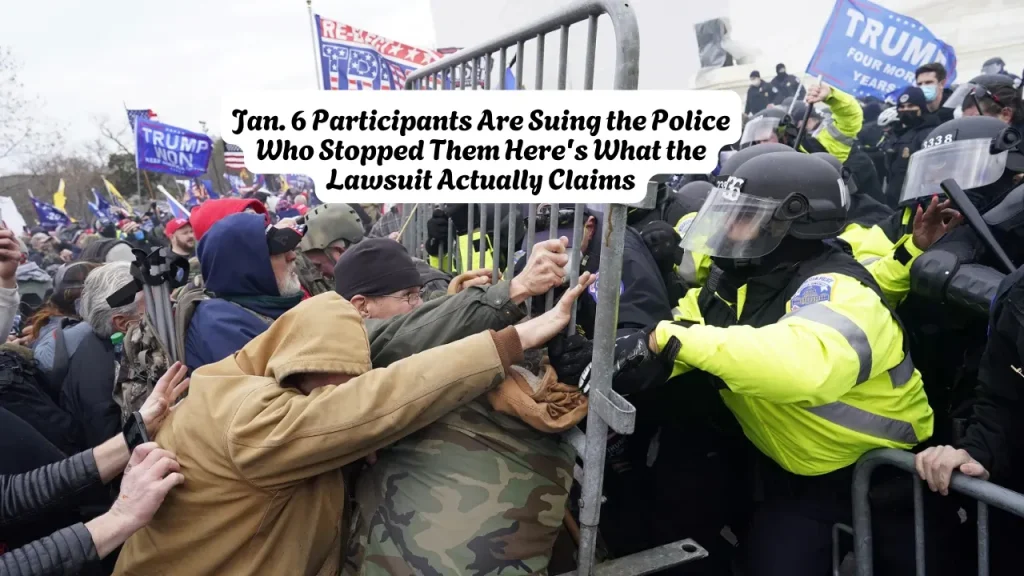
The plaintiffs allege that police actions on January 6 caused them physical and emotional injuries, and seek over $18 million in damages. The lawsuit claims officers “indiscriminately launched explosive munitions, chemical agents, and impact projectiles into a peaceful crowd and physically assaulted members of the crowd” at the Capitol.
The lawsuit alleged that Capitol Police and Metropolitan Police were “indiscriminately shooting chemical munitions and pepper spray into a crowd of thousands of people,” and also used “Billy Clubs, including strikes to the head, and other means of excessive force.”
The lawsuit states that police actions caused “physical and emotional injuries, including but not limited to chemical burns, concussive trauma, emotional distress, and other damages to plaintiffs, class members and thousands of other protesters.”
The lawsuit draws a specific geographic distinction. It argues that the munitions were not aimed at people pushing against the police fence line — but were instead fired further back, into an area it characterizes as containing peaceful attendees who were not engaged in confrontations with officers.
Who Filed It — and What Their Records Show
Among the lead plaintiffs is A.J. Fischer, a member of the Proud Boys who was charged with assault before his case was erased by President Trump’s sweeping pardon. He filed alongside Patrick and Marie Sullivan, who described being in the crowd that day, struck with pepper balls and affected by chemical spray. The Sullivans were not criminally charged for their conduct on January 6.
The lawsuit includes the names of 35 other people who filed written administrative claims more than six months ago under the Federal Tort Claims Act. Several of those named plaintiffs carry significant criminal histories tied directly to the events of that day.
Among the 46 named plaintiffs are several former defendants who were granted clemency under Trump’s sweeping pardons, including rioters who were charged and convicted of attacking law enforcement. Craig Bingert, for example, was among the rioters who grabbed a metal bike rack that police were using as a barricade and pushed it hard against officers, injuring at least one. He was sentenced to 96 months in prison. Christopher Worrell was convicted of shooting pepper spray at officers and sentenced to 10 years in prison. In remarks to a judge before sentencing, he said his conduct was “inexcusable and unjustified” and that he was “truly sorry” to police and members of Congress.
The lawsuit includes broad generalizations of the day that cut against the reality of the attack, including a statement that “no one intentionally harmed any officers.”
The Legal Mechanism Behind the Suit — Federal Tort Claims Act
The plaintiffs are not suing individual officers by name. They are suing the federal government directly, using a legal pathway called the Federal Tort Claims Act (FTCA). The FTCA allows people to sue the U.S. government for injuries caused by federal employees acting in their official capacity — which includes Capitol Police officers.
The lawsuit includes the names of 35 people who filed written administrative claims more than six months ago under the Federal Tort Claims Act. Filing an administrative claim with the relevant agency first is a required step before bringing an FTCA lawsuit in federal court. The six-month waiting period, now elapsed for those 35 plaintiffs, is what made the federal court filing possible.
The named plaintiffs are asking the court to certify a class of individuals comprised of all people on the Capitol grounds that day “who were struck by weapons or exposed to chemicals launched or thrown or weapons used by law enforcement personnel or struck directly by law enforcement personnel.” They are seeking a jury trial to determine how much money, if any, should be awarded.
Related article: OkCupid Shared 3 Million Users’ Photos With a Facial Recognition Firm — And Hid It for 12 Years
What the Plaintiffs Want the Court to Decide
The immediate ask from the court is class certification — a ruling that the case can proceed as a class action representing not just the 46 named individuals, but potentially a much larger group.
In all, 46 people could be part of the class action claim for more than $18.4 million, and the class could eventually consist “of hundreds or potentially thousands of individuals.”
If the court certifies the class, anyone who was on Capitol grounds that day and was struck by police munitions or chemical agents could potentially join. If it does not certify, the case would proceed only on behalf of the 46 named plaintiffs — or collapse entirely.
The case has been assigned to U.S. District Judge Paul Byron, a Barack Obama appointee in Florida. The government has not yet filed a formal response, and it is unclear how the Justice Department under the current administration will approach defending or settling the case.
The Broader Legal Landscape Around January 6 — Settlements Have Already Happened
This lawsuit does not exist in a vacuum. Other January 6-related civil claims against the government have already resulted in significant payouts.
The estate of Ashli Babbitt, who was fatally shot by a Capitol Police officer as she tried to climb through a broken door toward the House chamber, reached a multimillion-dollar settlement. The Trump administration also recently settled a lawsuit with former national security adviser Michael Flynn for $1.25 million.
Those settlements establish that the government has been willing — under the current administration — to resolve January 6-related civil claims. Whether that pattern extends to this broader excessive force lawsuit, which involves plaintiffs convicted of attacking officers, is a central legal and political question the case will force the courts to answer.
The lawsuit is also a touchpoint in broader efforts to recast the assault on the Capitol, which the Trump administration has downplayed during his second term. Trump, on his first day back in office, pardoned nearly all the rioters charged in connection to the 2021 attack.
What Happens Next — and What to Watch For
| Milestone | Status |
| Lawsuit Filed | March 28, 2026 |
| Administrative Claims Filed (35 plaintiffs) | More than 6 months prior to filing |
| Government Response Deadline | TBD |
| Class Certification Ruling | TBD |
| Trial / Settlement | TBD |
| Expected Resolution | TBD — likely years away |
The immediate next step is the government’s formal response to the complaint. After that, the plaintiffs will move for class certification — the most consequential early ruling in the case. A denial would effectively end it as a class action. An approval would open the door to potentially thousands of additional claimants.
Frequently Asked Questions
Can someone convicted of assaulting an officer on January 6 still sue police for excessive force?
Yes, in theory. A criminal conviction does not automatically bar a separate civil excessive force claim. However, it significantly complicates the case — especially when the same plaintiff’s criminal record documents violent conduct toward the officers they are now accusing of misconduct.
What is the Federal Tort Claims Act and why does it matter here?
The FTCA is a federal law that allows individuals to sue the U.S. government for injuries caused by federal employees acting within the scope of their duties. It requires claimants to first file an administrative claim with the relevant agency and wait at least six months before filing in federal court. The 35 plaintiffs who completed that step are what made this lawsuit legally ripe for filing now.
Does a Trump pardon give January 6 participants the right to sue?
A pardon removes criminal penalties — it does not create or expand civil rights claims. The lawsuit does not rely on the pardons as a legal basis. The pardons simply mean that several plaintiffs no longer face prison time for the conduct that is now part of their civil case record.
How is this different from the Ashli Babbitt settlement?
The Babbitt case involved a single fatality — a shooting during the breach of the Capitol building itself — and was litigated by her estate. This lawsuit involves a much larger group alleging non-lethal excessive force during crowd control on the Capitol’s west grounds. Different facts, different legal theories, different scale.
Is there a claim form or settlement to file for?
No. This is active litigation filed on March 28, 2026. There is no settlement, no claim deadline, and no administrator. If the case reaches a settlement in the future, this article will be updated.
When will this case be resolved?
Federal civil rights class actions of this complexity typically take years to litigate. Class certification alone can take a year or more. A final verdict or settlement — if one happens at all — is likely several years away.
What do Capitol Police and DC Metro Police say?
CNN reached out to U.S. Capitol Police for comment. The DC Metropolitan Police Department declined to comment. Neither agency has filed a formal legal response yet.
Sources & References
- U.S. District Court, Middle District of Florida, Ocala Division — Case assigned to Judge Paul Byron
Last Updated: March 31, 2026
Disclaimer: This article is for informational purposes only and does not constitute legal advice. The claims described reflect allegations made in a lawsuit — not findings of fact by any court. Legal outcomes depend on specific facts and applicable law. For advice regarding a particular situation, consult a qualified attorney.
About the Author
Israr Ahmad is a legal content researcher with 4+ years of experience covering class action settlements and consumer rights cases. He has researched and published coverage of 2,500+ settlements using verified court records, settlement administrator filings, and government sources. Learn more about Israr.