
Is Lane Splitting Legal in New York? What VTL § 1252 Actually Says
No. Lane splitting is illegal throughout New York State — no exceptions for traffic jams, no city-specific carve-outs, no gray area like some other motorcycle laws in this state have. The rule comes straight from one statute, and it’s worth reading the actual text rather than just the summary, because it also answers a few questions riders don’t think to ask.
New York Lane Splitting Law — Key Facts
| Field | Detail |
| Is it legal? | No — banned statewide |
| Governing statute | N.Y. Vehicle & Traffic Law § 1252 |
| What’s specifically banned | Overtaking/passing in the same lane as the vehicle being passed; riding between lanes or between rows of vehicles |
| What’s specifically allowed | Two motorcycles riding side-by-side (“abreast”) in a single lane |
| Exemption | Police officers performing official duties are exempt from the passing and between-lanes bans |
| Applies in NYC too? | Yes — no city-specific exception exists |
| Typical DMV points | 2 points per violation, per a New York traffic-ticket law firm’s published point chart (not independently listed on DMV’s own public schedule) |
| Effect on no-fault insurance | Motorcycles are excluded from New York’s no-fault (PIP) system entirely, splitting or not |
| Effect on injury claims if you’re splitting during a crash | Doesn’t bar recovery outright — New York is a pure comparative negligence state |
| Last Updated | September 22, 2026 |
What the Statute Actually Says
VTL § 1252 is short, and it’s worth quoting because most explanations paraphrase it loosely. The statute has five parts:
- (a) Every motorcycle is entitled to full use of a lane, and no other vehicle can be driven in a way that denies a motorcycle that full lane — but this same subsection explicitly allows two motorcycles to ride side-by-side in one lane.
- (b) A motorcyclist may not overtake and pass another vehicle while staying in that vehicle’s lane.
- (c) No one may operate a motorcycle between lanes of traffic, or between adjacent rows of vehicles.
- (d) Motorcycles can’t ride more than two abreast in a single lane.
- (e) Subsections (b) and (c) don’t apply to police officers performing official duties.
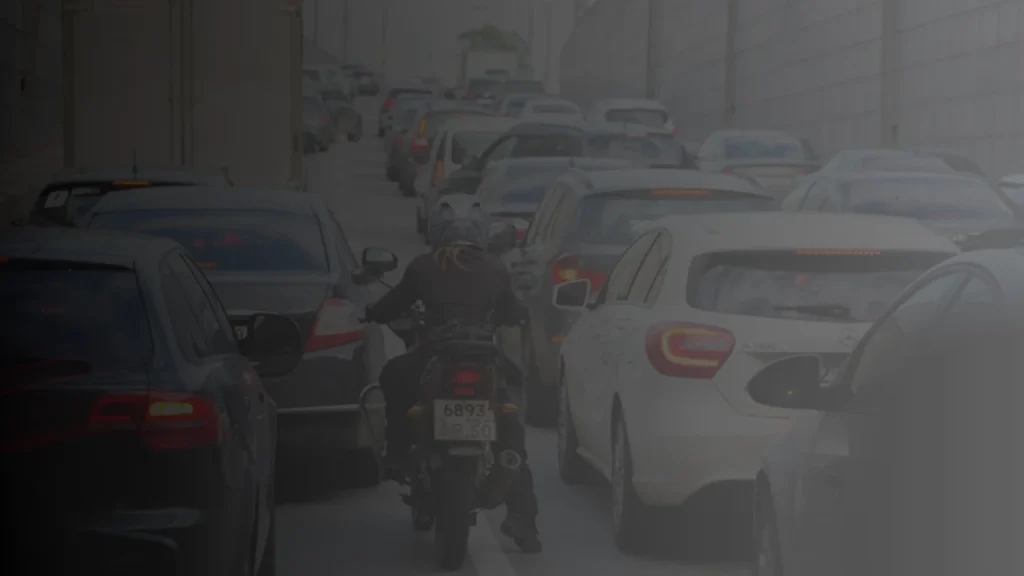
Subsection (c) is the one that directly bans lane splitting — riding a motorcycle in the gap between two lanes of cars, whether those cars are moving or stopped. Subsection (b) closes a related loophole: even if you’re technically staying inside one lane, you still can’t use that lane to slip past a car ahead of you.
Related article: Identity Theft in Atlanta, GA, What Residents Need to Know
Lane Splitting vs. Lane Filtering vs. Riding Two Abreast
These get confused constantly, and New York treats them very differently:
- Lane splitting — riding between two lanes of moving traffic to pass. Illegal.
- Lane filtering — moving between lanes of traffic that’s fully stopped (like at a red light or in stop-and-go gridlock). Some states treat this as a lesser offense or allow it under specific speed limits. New York does not distinguish between the two — both fall under the same § 1252(c) ban, regardless of whether traffic is moving or stopped.
- Riding two abreast — two motorcycles sharing one lane, side-by-side. This is the one maneuver the statute explicitly protects, under § 1252(a) and (d), as long as it’s no more than two bikes.
If you’ve ridden in states like New Jersey, Utah, Arizona, Montana, or Colorado, all of which permit some version of low-speed lane filtering between stopped cars, don’t assume the rule carries over once you cross into New York. As of 2026, California remains the only state that permits lane splitting in moving traffic outright, and New York sits firmly on the “fully banned” side of that line along with most of the country.
Penalties If You’re Ticketed
A § 1252 violation is a moving violation, not a minor infraction. Based on a New York traffic-ticket law firm’s published point breakdown, both the improper-passing violation under (b) and the between-lanes violation under (c) carry 2 points on your license — on top of a fine and the state’s mandatory court surcharge. Accumulate enough points across violations (11 within 18 months triggers possible suspension under New York’s driver point system) and lane splitting tickets stack toward that total just like any other moving violation.
If You’re in a Crash While Lane Splitting: The Insurance Picture Gets Complicated
This is where lane splitting stops being just a traffic-ticket issue and starts affecting real money.
Motorcycles don’t get no-fault coverage. New York’s no-fault insurance system (Insurance Law Article 51) excludes motorcycles entirely. That means a motorcyclist injured in a crash — lane splitting or not — can’t turn to their own no-fault PIP benefits the way a car driver could. Instead, an injured rider has to pursue a claim directly against whichever driver was at fault.
Being cited for lane splitting doesn’t automatically end your claim. New York follows pure comparative negligence under CPLR § 1411. That means a jury or insurer can reduce your damages by whatever percentage they attribute to your own fault — but they can’t wipe out your claim entirely just because you were violating § 1252 when the crash happened. If the other driver was also negligent — say, they made an unsignaled lane change into the gap you were riding through — you can still recover for their share of the fault, even if you were technically breaking the lane-splitting law at the time.
A passenger’s claim isn’t reduced by the rider’s violation. If you were a passenger on a motorcycle that was splitting lanes and you’re injured, your own claim isn’t diminished by the rider’s decision — you didn’t control the bike, so that fault gets assigned to the rider, not subtracted from your recovery.
In practice, insurance adjusters lean hard on a lane-splitting citation to argue for a bigger fault reduction, even when the law doesn’t require zeroing out your claim. That’s the real-world stakes of this statute — less about the ticket itself, more about what it does to your leverage after a crash.
Frequently Asked Questions — Lane Splitting in New York
Is lane splitting illegal in New York City specifically?
Yes, the same way it’s illegal everywhere else in the state. There’s no NYC-specific carve-out or additional local ordinance needed — VTL § 1252 applies statewide, dense traffic or not.
Is it legal to filter between stopped cars, even if I don’t do it while traffic is moving?
No. New York’s statute doesn’t distinguish between moving and stopped traffic — riding between lanes or rows of vehicles is banned under § 1252(c) regardless of whether the cars around you are moving.
Can two motorcyclists ride next to each other in one lane?
Yes — riding two abreast in a single lane is expressly allowed under § 1252(a) and (d), as long as it’s no more than two motorcycles.
If I’m hit by a car while lane splitting, can I still sue?
Generally yes. New York’s pure comparative negligence rule means your damages can be reduced by your share of fault, but a lane-splitting violation alone doesn’t bar you from recovering if the other driver was also at fault.
Does my motorcycle insurance cover me through no-fault if I’m in a crash?
No. Motorcycles are excluded from New York’s no-fault insurance system entirely, so an injured rider has to bring a claim directly against the at-fault driver rather than relying on PIP benefits.
Are police motorcycles allowed to split lanes?
Yes, but only officers performing official duties — § 1252(e) specifically exempts them from the passing and between-lanes restrictions in (b) and (c).
Sources Used in This Article
- N.Y. Vehicle & Traffic Law § 1252, full text: https://www.nysenate.gov/legislation/laws/VAT/1252
- N.Y. CPLR § 1411 (comparative negligence) — referenced via motorcycle injury law analysis: https://jtnylaw.com/resources/is-lane-splitting-legal-in-new-york/
- New York traffic-ticket point schedule for VTL 1252(b)/(c): https://nytrafficticket.com/new-york-motorcycle-laws/comment-page-1
Researched and written by Israr Ahmad, legal content researcher and founder of AllAboutLawyer.com. All facts verified against the text of N.Y. Vehicle & Traffic Law § 1252 and New York’s comparative negligence statute, as of September 22, 2026. Last Updated: September 22, 2026.
This article is for informational purposes only and does not constitute legal advice. Laws vary by state and individual circumstances differ. For advice about your specific situation, consult a qualified attorney.
About the Author
Israr Ahmad is a legal content researcher with 4+ years of experience covering class action settlements and consumer rights cases. He has researched and published coverage of 2,500+ settlements using verified court records, settlement administrator filings, and government sources. Learn more about Israr.