
IRS Form 14039 Identity Theft Affidavit (2026), Who Should File, How to Complete It and Where to Send It
The IRS Form 14039 Identity Theft Affidavit is the form the Internal Revenue Service uses to document tax-related identity theft. If someone used your Social Security number (SSN) or Individual Taxpayer Identification Number (ITIN) to file a federal tax return, claim a refund, or work under your name, the Form 14039 Identity Theft Affidavit may help you report it and start the process of correcting your tax account.
Most people do not need to file this form. The IRS says Form 14039 is for victims of tax-related identity theft who have not received certain IRS identity-verification letters. If you got one of those letters, follow its instructions instead. Do not file a second affidavit for the same incident.
The official form, online portal and IRS guidance are listed in the Sources section at the end of this article. Check the current instructions before you send anything.
IRS Form 14039 Identity Theft Affidavit: Quick Facts
| Question | Answer |
| Official name | Form 14039, Identity Theft Affidavit |
| Issued by | Internal Revenue Service (IRS) |
| Revision reviewed | February 2026 (confirm the revision date printed on your copy) |
| Purpose | Report tax-related identity theft affecting an individual’s federal tax account |
| Online filing | Yes. The IRS calls online the preferred method |
| Mail or fax | Yes. Choose one method only |
| Fax number (non-notice cases) | 855-807-5720 (use a cover sheet marked “Confidential”) |
| Filing fee | None. The IRS does not charge to file |
| Needed by everyone whose SSN was exposed? | No |
| Business identity theft form | Form 14039-B |
| Guaranteed refund or processing time? | No |
| Official links | See the Sources section |
What Is the Form 14039 Identity Theft Affidavit?
It is a sworn statement made under penalty of perjury that helps the IRS document identity theft involving your tax account. The IRS uses it to confirm who the real taxpayer is, investigate the affected tax years, and mark your account so future returns get extra scrutiny.
Tax-related identity theft usually happens when someone files a fraudulent return with your SSN or ITIN to steal a refund, uses your number to get a job, or claims you or your dependent without permission.
The form is not a general identity theft report. If a thief opened a credit card in your name or stole your wallet but your tax account was not affected, the right place to report is the Federal Trade Commission at IdentityTheft.gov.
Who Should File Form 14039 in 2026?
The form generally fits you if the facts match the IRS instructions, for example:
- Your e-filed return was rejected because a return using your SSN or ITIN was already filed. First rule out a typo or transposed digit.
- You got an IRS notice about a return, refund, balance due or income you do not recognize, and the notice does not tell you to use a different process.
- Someone used your SSN or ITIN for employment, such as wages from an employer you never worked for.
- You or a dependent was fraudulently claimed on someone else’s return. A dependent dispute between family members is not automatically identity theft, so check the dependency rules first.
- The IRS tells you to file the form.
When You Should NOT File Form 14039
Filing the wrong form can slow your case down.
- You received an IRS identity-verification letter such as Letter 5071C, 4883C or 5747C. Follow the letter. The IRS says not to file Form 14039 when you are using its Identity and Tax Return Verification Service.
- You already filed Form 14039 for the same incident. Do not send a duplicate.
- The identity theft is not tax-related. Use IdentityTheft.gov.
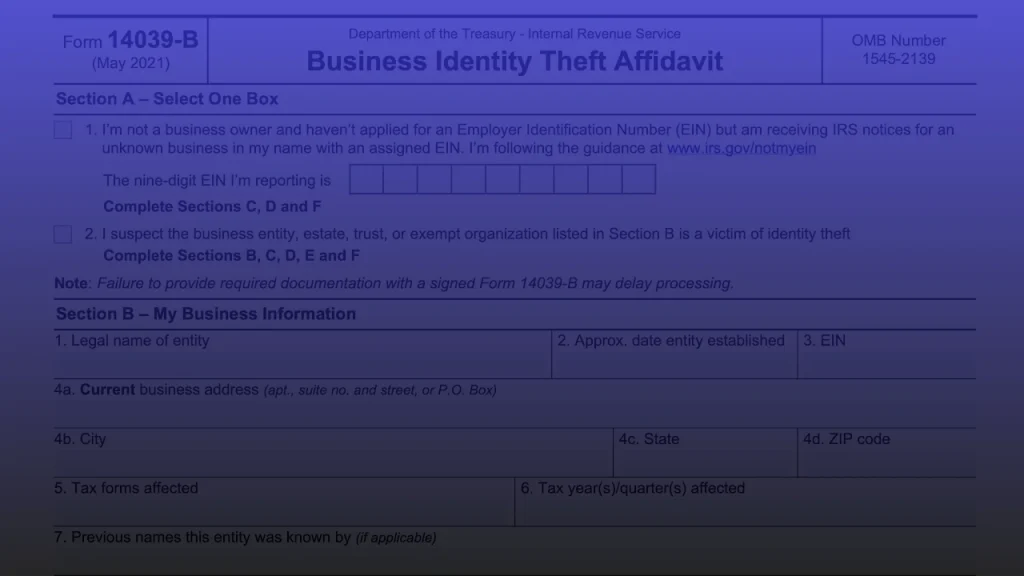
- It is business identity theft. Businesses, trusts, estates and tax-exempt organizations use Form 14039-B.
- Your SSN was only exposed in a data breach and nothing happened to your tax account. Consider an Identity Protection PIN instead.
How to Complete Form 14039 Step by Step
The February 2026 form has Sections A through F. Sections A to E are required, and Section F applies when you complete the form for someone else.
Section A: Why you are submitting. Choose whether you are filing for yourself, responding to an IRS notice (enter the notice or letter number), reporting a dependent, or acting for another person.
Section B: How you were affected. Check every box that applies: a fraudulent federal return, an improper dependent claim, or misuse of an SSN or ITIN for employment. Do not choose an unrelated box just to file.
Section C: Victim contact information. Provide the victim’s name, SSN or ITIN, current mailing address, the address on the last filed return if different, a phone number and a preferred contact language.
Section D: Tax years affected. List the name on the last filed return, the year of that return, and the affected tax year or years. A return filed in 2025 usually relates to tax year 2024. If you do not know, write “Unknown” rather than guessing.
Section E: Signature. You sign under penalty of perjury that the information is true, correct and complete to the best of your knowledge. Unsigned paper forms may be rejected.
Section F: Representative, parent or guardian. Complete this when acting for a dependent, a deceased taxpayer or a conserved person, and follow the form’s instructions on proof of authority, such as a court order or death certificate where required.
Keep your explanation factual and short. Do not invent dates or details. If you are not sure, say what you know and what you do not.
Related article: Employment Identity Theft, How It Occurs, Warning Signs and What to Do If Someone Uses Your SSN to Get a Job (2026)
How to Submit Form 14039: Online, Mail or Fax
Choose one method. Sending the same affidavit through several routes can cause delays.
Option 1: Online (preferred by the IRS)
Use the official IRS Form 14039 online portal. It asks questions about your situation and may tell you that you do not need the form at all. The paper form states that attachments are not accepted online, while the portal’s own instructions may allow limited attachments, so follow the live portal rules. Save your confirmation.
Option 2: By mail
- If you are answering an IRS notice, mail the form (with a copy of the notice if possible) to the address on the notice.
- If your SSN or ITIN was misused and you cannot e-file because a return was already filed, attach Form 14039 to the back of your paper return and mail both to the IRS location where you normally file.
- Other qualifying cases: use the address printed on the current form, which has been listed as Department of the Treasury, Internal Revenue Service, Fresno, CA 93725. Confirm it against your copy, because older sources list different Fresno ZIP codes.
Do not use the affidavit address to file an original tax return unless the instructions for your case say to.
Option 3: By fax
If your IRS notice shows a fax number, use it. Otherwise the form lists toll-free fax 855-807-5720. Add a cover sheet marked “Confidential” and keep your confirmation.
What Documents Do You Need?
Gather what applies to you:
- Name, SSN or ITIN, current address and the address on your last return.
- The affected tax year or years, if known.
- Any IRS notice or rejection message.
- A short, factual description of what happened and when you found out.
- Proof of authority if you file for someone else.
Send clear copies, not originals, unless the IRS asks for originals.
What Happens After You File?
The IRS may review the affidavit, verify who the real taxpayer is, investigate the affected account and correct records tied to the fraud. It may contact you for more information, so keep your contact details current and answer legitimate IRS requests by the deadline. Confirmed victims are often issued an Identity Protection PIN for future filing, and the account may be marked for protection.
Filing the form does not mean:
- The IRS has confirmed identity theft.
- A fraudulent return will be removed right away.
- Your refund will arrive by a certain date.
- You will be compensated for the theft.
- Collection on any balance on your account stops automatically.
How long does it take?
No processing time is guaranteed. Identity theft cases can take many months, and in recent years often longer than a year. Do not rely on an old estimate.
If you get collection notices
If you receive a collection notice such as Letter LT11 or Letter 1058 (a Final Notice of Intent to Levy), respond by the deadline in the notice. You may have the right to request a Collection Due Process hearing within 30 days, using Form 12153, even while your identity theft case is open.
If you are facing financial hardship
If the delay is causing a significant hardship, such as being unable to pay for housing, you can ask the Taxpayer Advocate Service for help, often with Form 911. The Taxpayer Advocate is an independent office inside the IRS.
Laws and Rules Behind Tax Identity Theft Reports
This is general information, not legal advice.
- Penalty of perjury (26 U.S.C. § 7206(1)). Because Form 14039 is signed under penalty of perjury, knowingly false statements can lead to criminal penalties. Make sure every statement is true.
- False statements to the government (18 U.S.C. § 1001). Lying to a federal agency is a separate federal offense.
- Federal identity theft crimes (18 U.S.C. § 1028 and § 1028A). Knowingly using another person’s identification without authority is a federal crime, and aggravated identity theft carries mandatory added prison time.
- Tax return confidentiality (26 U.S.C. § 6103). Tax returns and return information are confidential, which is why the IRS may ask you to prove your identity before discussing your account.
- Taxpayer rights (26 U.S.C. § 7803(a)(3)). The Taxpayer Bill of Rights includes the right to quality service, privacy and to challenge the IRS’s position.
- Taxpayer Advocate (26 U.S.C. § 7811). Provides authority to help taxpayers in significant hardship.
- Time limits (26 U.S.C. §§ 6501 and 6511). The IRS generally has three years to assess tax after a return is filed, and refund claims are generally limited to three years from filing or two years from payment. Fraud and other exceptions can change these periods.
- Credit freezes and fraud alerts (15 U.S.C. § 1681c-1). Under the Fair Credit Reporting Act, credit freezes are free, and you can place fraud alerts with the credit bureaus.
- State laws. Many states also have identity theft statutes, police report rules and credit freeze rights.
How an IRS Identity Protection PIN Helps
An Identity Protection PIN (IP PIN) is a six-digit number that helps the IRS verify your identity when a federal return is filed. A return generally cannot be e-filed with your SSN or ITIN without the correct IP PIN. It is different from Form 14039: the affidavit reports identity theft, while an IP PIN helps prevent fraudulent filing.
Anyone who can verify their identity can request one through the IRS’s IP PIN tool, even without being a victim. People who cannot use the online tool may be eligible to apply by mail or fax using Form 15227. A new IP PIN is issued each year. Keep it private and never share it with anyone who contacts you out of the blue.
If Your Identity Was Stolen but No Return Was Filed
- Report it at IdentityTheft.gov to get a recovery plan.
- Freeze your credit with Equifax, Experian and TransUnion. It is free.
- Secure your accounts with new, unique passwords and multi-factor authentication.
- Get an IP PIN to protect your tax account.
- Contact the right agency for misuse involving Social Security, unemployment benefits or state taxes.
- Check your IRS online account and transcripts for unfamiliar activity.
- Consider a police report if a creditor or agency requires one.
Beware of Scams
The IRS does not start contact with taxpayers by email, text or social media to demand personal or financial information. Filing Form 14039 is free. Be cautious of anyone who charges a fee to “file your identity theft affidavit,” and use only official IRS.gov pages. Report suspected IRS impersonation to the Treasury Inspector General for Tax Administration.
Frequently Asked Questions
What is the Form 14039 Identity Theft Affidavit?
It is the IRS form individuals use to report tax-related identity theft so the IRS can investigate and protect their tax account.
Do I have to file IRS Form 14039 if my Social Security number was stolen?
Not automatically. The form is for specific tax-related situations. If your tax account was not affected, consider an IP PIN and report general identity theft to the FTC.
Can I file Form 14039 online?
Yes. The IRS says online is its preferred method, through the official portal on IRS.gov.
Can I mail or fax Form 14039?
Yes. If you are answering an IRS notice, use the address or fax number on the notice. Otherwise use the address or fax number on the current form. Use only one method.
Should I file Form 14039 if the IRS sent me a letter?
First follow the letter. Some letters, such as 5071C, 4883C and 5747C, direct you to verify your identity another way, and the IRS says you generally do not need Form 14039 in that case.
Can I file Form 14039 for my child or a deceased relative?
Yes, in certain cases, using Section F and any proof of authority the form requires. Misuse of a dependent’s information by a parent or guardian is not treated as identity theft under the form’s instructions.
Is there a fee to file?
No. The IRS does not charge a fee.
Does filing guarantee a refund?
No. The IRS must review the facts and decide how to correct the account.
Can I file more than once?
No. Do not file another affidavit for the same incident. Keep your records and use IRS assistance channels if it is unresolved.
What is the difference between Form 14039 and Form 14039-B?
Form 14039 is for individual taxpayers. Form 14039-B is the Business Identity Theft Affidavit for businesses, trusts, estates and tax-exempt organizations.
How long does it take?
No guaranteed time. Many cases take months, and some take over a year.
Sources
- IRS: Form 14039, Identity Theft Affidavit (PDF) – https://www.irs.gov/pub/irs-pdf/f14039.pdf
- IRS: Complete Form 14039 online – https://www.irs.gov/dmaf/form/14039
- IRS: When to file an Identity Theft Affidavit – https://www.irs.gov/newsroom/when-to-file-an-identity-theft-affidavit
- IRS: Identity Theft Guide for Individuals – https://www.irs.gov/identity-theft-central/identity-theft-guide-for-individuals
- IRS: Get an Identity Protection PIN – https://www.irs.gov/ippin
- Federal Trade Commission: IdentityTheft.gov – https://www.identitytheft.gov
- U.S. Code: 26 U.S.C. §§ 6103, 6501, 6511, 7206, 7803, 7811; 18 U.S.C. §§ 1001, 1028, 1028A; 15 U.S.C. § 1681c-1 – https://www.law.cornell.edu/uscode
Related reading: Identity Theft Victim? Do These Steps First and What Is Tax Identity Theft and How Can It Occur?
Disclaimer: This article is general information only and is not legal, tax or financial advice. AllAboutLawyer.com is a consumer legal information website, not a law firm or tax advisor. For help with a specific tax account problem, use the IRS’s official resources or consult a qualified tax professional.