
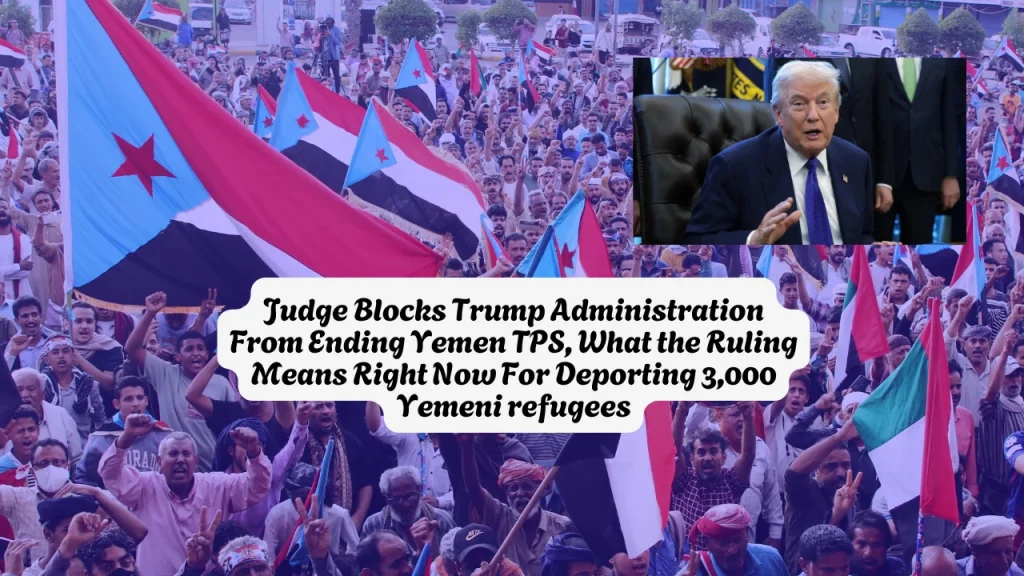
Judge Blocks Trump Administration From Ending Yemen TPS, What the Ruling Means Right Now For Deporting 3,000 Yemeni refugees
This article covers an active lawsuit and a ruling issued May 1, 2026. Information reflects the preliminary injunction as issued. This page will be updated as the case develops.
Hadeel Doe et al. v. U.S. Department of Homeland Security is a civil lawsuit in which 16 Yemeni nationals challenged the Trump administration’s decision to end Temporary Protected Status (TPS) for Yemen, and on May 1, 2026, a federal judge issued an emergency order blocking that termination from taking effect. The program had been set to end May 4, giving Yemeni immigrants authorized to live and work in the U.S. 60 days to leave the country or risk arrest and deportation. The court’s order keeps TPS protections in place while the full lawsuit proceeds.
| Field | Detail |
| Plaintiffs | Hadeel Doe et al. — 16 Yemeni nationals (TPS holders and applicants) |
| Defendant | U.S. Department of Homeland Security / Trump Administration |
| Case Type | Administrative law / Immigration — challenge to TPS termination |
| Court | U.S. District Court, Southern District of New York (Manhattan) |
| Judge | U.S. District Judge Dale Ho (appointed by President Biden) |
| Date Filed | TBD — case filed prior to May 1, 2026 ruling; exact docket date not yet confirmed in available sources |
| Legal Claim | Violation of the Immigration and Nationality Act TPS statute and the Administrative Procedure Act |
| Current Stage | Preliminary injunction granted — full case ongoing |
| Next Scheduled Date | TBD — pending further court proceedings and Supreme Court ruling on related Haiti/Syria TPS case |
| Who Is Protected | Approximately 2,810 current Yemen TPS holders and 425 pending applicants |
| Last Updated | May 2, 2026 |
Case Timeline
| Date | Event |
| 2015 | Yemen first designated for TPS under President Obama after civil war began |
| First Trump term (2017–2021) | TPS for Yemen renewed multiple times, including by Trump’s own DHS |
| February 13, 2026 | DHS Secretary Kristi Noem announces termination of Yemen TPS |
| March 2026 | DHS publishes formal Federal Register notice ending Yemen TPS |
| April 30, 2026 | U.S. Supreme Court hears arguments on related Haiti/Syria TPS terminations |
| May 1, 2026 | Judge Dale Ho issues emergency order blocking Yemen TPS termination |
| May 4, 2026 | Date TPS was originally set to expire — now blocked |
| TBD | Full case proceeds; Supreme Court decision on Haiti/Syria expected by early summer 2026 |
What Is the Hadeel Doe et al. v. DHS Lawsuit About?
The plaintiffs — 16 Yemeni nationals living in the United States — filed suit to stop the Department of Homeland Security from terminating their Temporary Protected Status (TPS). TPS is a legal program created by Congress that protects people from countries experiencing armed conflict, natural disasters, or other extreme conditions from being deported. It also allows recipients to work legally in the United States.
About 2,810 Yemeni nationals currently hold TPS, and another 425 have pending applications. Yemen was first designated for TPS in 2015 after the country plunged into civil war when the Houthis seized control of the capital, Sanaa. DHS has renewed that designation multiple times since — including during the first Trump administration.
The lawsuit’s central legal argument is that DHS Secretary Kristi Noem broke the law when she ended Yemen’s TPS. Judge Ho found that Noem likely violated the law when she failed to adhere to the process mandated by Congress for reviewing a country’s conditions before moving to end TPS for Yemen. Under the Immigration and Nationality Act (INA), the Secretary of Homeland Security must follow a specific review procedure — including consulting with other government agencies — before terminating a country’s TPS designation. The plaintiffs argued, and the judge agreed, that none of that happened here. For context on how similar TPS termination challenges have played out, see our guide to immigration enforcement lawsuits.
Who Are the Plaintiffs and What Is at Stake for Them?
The 16 plaintiffs filed under pseudonyms to protect their safety. They represent a cross-section of Yemeni Americans who have built lives here over years and, in some cases, decades.
The plaintiffs include a pregnant 33-year-old woman in Detroit due to give birth this month whose unborn child has a congenital heart condition that is not treatable in Yemen; a 50-year-old former human rights worker in Brooklyn who is a target of Houthi-aligned militias; and a 36-year-old medical clinician in Houston working on cancer research. These are not abstract legal plaintiffs — these are people facing life-altering consequences if deported to an active war zone.
Judge Ho noted in his opinion that Yemeni nationals operate about half of New York City’s 15,000 family-owned convenience stores, and that TPS holders among them form an integral part of business networks that employ and serve millions of people in the United States. The lawsuit sits within a broader pattern — the administration has sought to terminate TPS designations for 13 countries, and has been blocked by repeated court rulings. For more on the legal framework governing deportation protections, see our explainer on Temporary Protected Status and U.S. immigration law.
What Did the Judge Actually Rule?
Judge Ho issued a preliminary injunction — a court order that temporarily halts the government’s action while the case is decided. This is not a final ruling. It means the judge looked at the evidence and concluded the plaintiffs are likely to win, and that forcing them to leave before the case is resolved would cause irreparable harm.
In his ruling, the judge said the process DHS undertook before ending TPS for Yemen was “short-circuited, violating the TPS statute and frustrating the public accountability that the Administrative Procedure Act is designed to protect.” He found that DHS “acted unlawfully by terminating TPS in clear disregard of the procedural requirements established by Congress.”
Related article: Six transgender Idahoans Sued, HB 752 Bathroom Law Faces Federal Lawsuit, What It Criminalizes and What Comes Next
DHS pushed back immediately. A DHS spokesperson said allowing the Yemeni nationals to remain in the United States was not in the national interest, adding: “Temporary means temporary and the final word will not be from activist judges legislating from the bench.” The administration has appealed similar rulings in the Haiti and Syria TPS cases, and those are now before the U.S. Supreme Court.
What Happens Next in This Case?
The immediate threat of deportation for Yemen TPS holders is paused — but not permanently resolved. The case now continues in federal court, and several things will shape what happens next.
The Supreme Court is preparing to rule on whether judges have any authority to intervene in TPS terminations at all. At oral arguments on April 30, 2026, several conservative justices appeared open to the administration’s argument that the TPS statute bars judicial review. A decision is expected by early summer. If the Supreme Court rules that courts cannot review TPS terminations, that ruling could override Judge Ho’s block — potentially even in the Yemen case.
Judge Ho said he ordinarily would have waited for the Supreme Court to provide guidance, but said the urgency of the moment required him to act immediately given that TPS was set to expire May 4. Yemen TPS holders should continue to monitor this case closely and consult an immigration attorney about their individual situation — the legal landscape could shift significantly before summer’s end.
Frequently Asked Questions
Is there a lawsuit against the Trump administration over Yemen TPS?
Yes. U.S. District Judge Dale Ho in New York ruled in favor of 16 Yemeni nationals who either have Temporary Protected Status or are applying for it, agreeing to keep the program in place while their lawsuit proceeds. The ruling was issued May 1, 2026 — three days before TPS was set to expire.
What is the current status of Yemen TPS right now?
As of May 2, 2026, Yemen TPS is active and protected by a federal court order. The program was set to end May 4, but Judge Ho’s order halts that effective date. TPS holders can continue living and working in the United States while the case proceeds.
Do Yemeni TPS holders need to do anything right now?
No immediate action is required to benefit from the court’s order — it protects all current Yemen TPS holders automatically. However, every TPS holder should consult a qualified immigration attorney about their individual situation, since this ruling is temporary and the legal picture could change with a Supreme Court decision expected by early summer 2026.
What court is handling this case?
The lawsuit is before the U.S. District Court for the Southern District of New York in Manhattan, presided over by U.S. District Judge Dale Ho, who was appointed by President Biden.
Can I read the court documents?
Judge Ho issued a 36-page written opinion explaining his ruling. Court filings in this case are publicly available through the federal court docket system at PACER (pacer.gov) and may also be accessible through CourtListener (courtlistener.com) at no cost.
What happens if the Supreme Court rules against TPS protections?
If the Supreme Court rules that courts have no authority to review TPS terminations — an argument several conservative justices appeared open to at April 30 oral arguments — that decision could affect the Yemen case, potentially removing the judicial protection currently in place. A ruling is expected by late June or early July 2026.
How many Yemeni nationals does this ruling protect?
About 2,810 Yemeni nationals currently hold TPS, and another 425 have pending TPS applications. Judge Ho’s order protects all of them while the lawsuit continues.
Why did the judge say DHS broke the law?
Judge Ho found that DHS Secretary Kristi Noem failed, as required by law, to consult with relevant government agencies before ending TPS for Yemen. He wrote that Congress had established a specific statutory process for reviewing a country’s conditions before terminating TPS — and that Noem did not follow it.
Sources & References
- CBS News — Judge blocks Trump administration from ending deportation protections for 2,800 Yemenis, May 1, 2026
Prepared by the AllAboutLawyer.com Editorial Team and reviewed for factual accuracy against AP, CBS News, and ABC News reporting on verified court proceedings on May 2, 2026. Last Updated: May 2, 2026
Disclaimer: This article is for informational purposes only and does not constitute legal advice. Information about ongoing legal cases is based on publicly available court records and verified reporting. Allegations described in this article have not necessarily been proven in court. For advice regarding a particular legal situation, consult a qualified attorney.
About the Author
Israr Ahmad is a legal content researcher with 4+ years of experience covering class action settlements and consumer rights cases. He has researched and published coverage of 2,500+ settlements using verified court records, settlement administrator filings, and government sources. Learn more about Israr.