
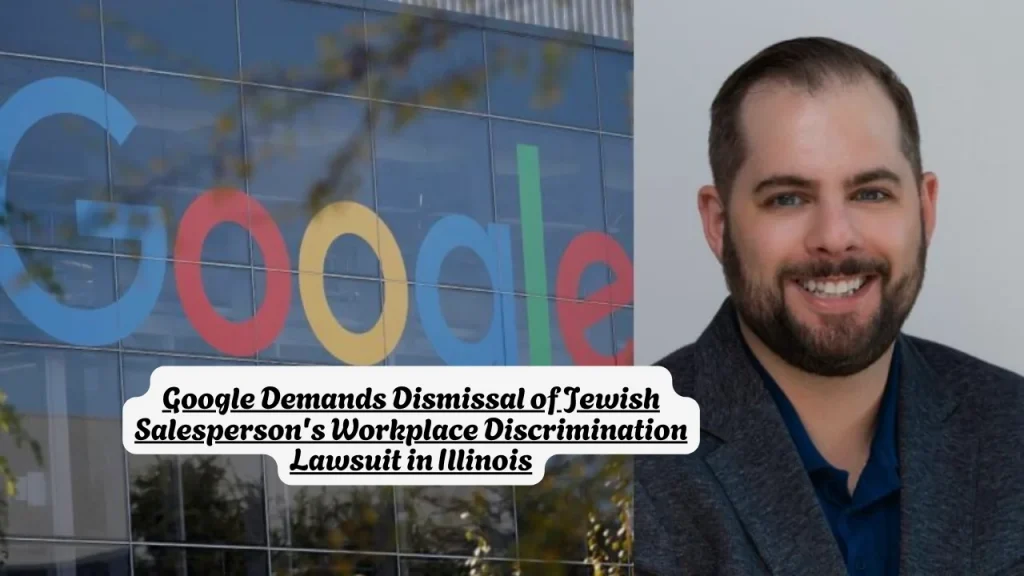
Google Demands Dismissal of Jewish Salesperson’s Workplace Discrimination Lawsuit in Illinois
Google LLC has urged an Illinois federal judge to cut race bias claims from a former salesperson’s lawsuit alleging he was discriminated against because of his Jewish identity. Google’s argument: the plaintiff failed to connect his religious practices to his race or ethnicity.
The case sits at a question that federal courts have wrestled with for years — when does discrimination against a Jewish person cross the line from a religious bias claim into a racial one? The answer matters more than it sounds, because it determines which laws apply and what the plaintiff can actually recover.
Quick Facts: Google Jewish Employee Discrimination Lawsuit
| Field | Detail |
| Defendant | Google LLC |
| Plaintiff | TBD — name not publicly confirmed in available filings |
| Court | U.S. District Court for the Northern District of Illinois |
| Case Number | TBD — paywalled in Law360; not yet confirmed in public docket search |
| Alleged Violation | Race discrimination — Title VII of the Civil Rights Act of 1964 |
| Google’s Position | Moved to dismiss race claims; argues plaintiff did not link Jewish religious practice to a protected racial/ethnic category |
| Plaintiff’s Law Firm | Stowell & Friedman, Ltd. (Chicago) |
| Google’s Law Firm | Littler Mendelson |
| Current Court Stage | Motion to dismiss race claims pending before Illinois federal judge |
| Settlement Status | None — active litigation phase |
| Last Updated | May 5, 2026 |
The Google Jewish Employee Lawsuit: What Happened
A former Google salesperson filed a lawsuit in federal court in Illinois claiming he faced workplace discrimination and a hostile work environment because of his Jewish identity. The complaint raises claims under Title VII of the Civil Rights Act of 1964, which prohibits workplace discrimination based on race, religion, and national origin.
Google moved to cut the race bias claims specifically, telling the court that the plaintiff failed to connect his Jewish religious practices to his race or ethnicity. Google is not asking the court to throw out the entire case — it is targeting the race claims in particular, which suggests the religious discrimination claims may remain.
This distinction is not just legal strategy. It has real consequences for what the employee can seek in damages and how difficult the case is to prove.
This case comes at a time when employment discrimination attorney filings involving Jewish workers have risen significantly across the country, as the broader legal community debates where religious identity ends and ethnic or racial identity begins under federal law. Google itself recently reached a $50 million racial discrimination settlement with more than 4,000 Black employees — showing that employment class action settlement exposure is very real for the company in discrimination cases.
Is Jewish Identity a Race Under Federal Law?
This is the real question at the heart of this lawsuit, and it is genuinely unsettled in some courts.
Title VII protects workers from discrimination based on race, color, religion, sex, and national origin. Judaism covers several of those categories at once — it is a religion, but it is also widely recognized as an ethnic and ancestral identity. Courts have generally held that Section 1981 of the Civil Rights Act of 1866 protects Jewish workers from racial discrimination because Jewish identity shares ethnic and ancestral characteristics with classifications Congress intended to protect.
Under Title VII, Judaism is considered both a religion and, in some cases, an ethnic or ancestral origin. The law protects Jewish employees from disparate treatment — such as being passed over for promotion because of religious identity — as well as harassment through antisemitic slurs or symbols, and failure to accommodate religious practices.
Google’s argument is narrower. The company is saying this specific plaintiff did not adequately plead facts connecting his Jewish practices to a protected racial category — not that Jewish people can never bring race claims. That is an important distinction. An employment discrimination attorney reviewing this filing would likely see it as a pleading challenge rather than a denial of the underlying legal theory.
Are You Part of the Google Jewish Employee Lawsuit?
This is an individual lawsuit by a former salesperson — it is not currently a class action. That means it covers the plaintiff’s own claims, not a broader group of Jewish employees at Google.
If you are a current or former Google employee who faced workplace harassment or discrimination based on your Jewish identity or heritage, you may have your own wrongful termination lawsuit or hostile work environment claim — separate from this case entirely.
Related article: 90 Homes at Del Webb Lake Las Vegas Homeowners Sue Pulte Group Over Sinking, Cracking Million-Dollar Homes
You may have a viable claim if:
- You are or were employed by Google and experienced adverse treatment tied to your Jewish religion or ethnicity
- You were passed over for promotion, reassigned, or terminated under circumstances tied to your Jewish identity
- You reported discrimination or antisemitism at work and faced retaliation
- You experienced a pattern of hostile comments, isolation, or hostility tied to your Jewish heritage
You are likely not part of this specific case if you were not a Google employee, if your situation does not involve Jewish identity discrimination, or if your Google employment ended before any discriminatory conduct began.
If you believe you experienced a workplace harassment claim at Google or another tech employer, speaking with a consumer rights lawyer or employment attorney before statutes of limitations expire is worth your time. In Illinois, the filing window for discrimination charges with the EEOC is 300 days from the incident.
What Google’s Employees Can Learn from This Case
Google has now faced multiple employment discrimination lawsuits in quick succession. The company is simultaneously defending this Jewish employee’s claims in Illinois while navigating the aftermath of its $50 million racial discrimination settlement with Black employees in California and New York.
That earlier settlement, which covers more than 4,000 current and former Black Google employees who worked in California and New York between 2017 and 2023, requires Google to review pay practices for racial disparities, keep reporting channels open for employee concerns, and avoid using salary history when setting compensation.
The Jewish employee’s case raises a different but related question: does Google’s legal exposure extend to employees of other backgrounds who face identity-based discrimination? The Illinois court’s ruling on the motion to dismiss will signal how much legal protection Jewish employees can claim specifically under the race bias framework — a question with implications for Jewish workers across the tech industry.
Google has not publicly commented on this specific Illinois lawsuit. Littler Mendelson, the firm handling Google’s defense, is one of the largest employer-side employment law firms in the country.
For a related case showing how compensation for damages in employment discrimination matters is pursued through the court system, the Celgene $239 million securities class action illustrates how large institutions face accountability when courts find systematic harm to identifiable groups — a model that plaintiffs’ attorneys sometimes draw from in employment discrimination strategy.
Google Jewish Employee Lawsuit Timeline
| Milestone | Date |
| Lawsuit Filed | TBD — not yet confirmed in public court record |
| Google Moves to Dismiss Race Claims | May 4, 2026 |
| Court Ruling on Motion to Dismiss | TBD — pending Illinois federal judge’s decision |
| Next Scheduled Hearing | TBD — not yet publicly disclosed |
| Expected Trial or Settlement Timeline | TBD — case in early litigation stage |
Frequently Asked Questions
Is there a class action lawsuit against Google for Jewish employee discrimination?
Not yet. The current case is an individual lawsuit filed by a former Google salesperson in the U.S. District Court for the Northern District of Illinois. It does not cover a class of Jewish employees. That could change if the court allows the case to proceed and evidence emerges of a broader pattern.
Do I need to do anything right now if I am a Jewish Google employee?
No immediate action is required. This is an individual case and does not create any automatic rights or benefits for other Jewish employees. However, if you experienced similar treatment at Google, documenting your experience and consulting an employment attorney is a practical step — particularly given Illinois’s 300-day EEOC filing window.
Can Jewish employees bring race discrimination claims under federal law?
Yes, in most circumstances. Courts have long recognized that Jewish identity carries ethnic and ancestral characteristics that qualify for protection under federal civil rights statutes, including Section 1981 of the Civil Rights Act of 1866 and, in some cases, Title VII. Google is not disputing this general principle — it is arguing that this plaintiff did not adequately plead the connection in his specific complaint.
When will the Google Jewish employee lawsuit be resolved?
TBD — the case is at the motion to dismiss stage, which is the earliest phase of litigation. If the judge denies Google’s motion, the case will proceed to discovery. Most employment discrimination cases in federal court take two to four years from filing to resolution.
Is there a settlement in the Google Jewish employee case?
No. No settlement exists in this case. The lawsuit is in active litigation and no claim form, compensation fund, or settlement announcement has been made. Do not file any claim related to this matter — none is open.
How is this case different from Google’s $50 million racial discrimination settlement?
That settlement involved Black and Black+ employees in California and New York who alleged systematic race discrimination in hiring, pay, and promotion between 2017 and 2023. This Illinois case involves one former Jewish salesperson alleging discrimination based on Jewish identity. The legal theories overlap — both involve race claims under federal civil rights law — but they are separate lawsuits covering different employees, different states, and different alleged conduct.
Sources & References
- Law360, “Google Says Jewish Ex-Worker’s Race Claims Don’t Add Up,” May 4, 2026: law360.com
- U.S. District Court for the Northern District of Illinois (case details pending public docket confirmation)
Prepared by the AllAboutLawyer.com Editorial Team and reviewed for factual accuracy against Law360 reporting and public court records. Last Updated: May 5, 2026
Disclaimer: This article is for informational purposes only and does not constitute legal advice. Legal claims and outcomes depend on specific facts and applicable law. For advice regarding a particular situation, consult a qualified attorney.
About the Author
Israr Ahmad is a legal content researcher with 4+ years of experience covering class action settlements and consumer rights cases. He has researched and published coverage of 2,500+ settlements using verified court records, settlement administrator filings, and government sources. Learn more about Israr.