
GLP-1 Blindness Lawsuit Update, FDA Orders New Vision Loss Warnings for Ozempic, Wegovy, Mounjaro and Zepbound as Cases Reach 278
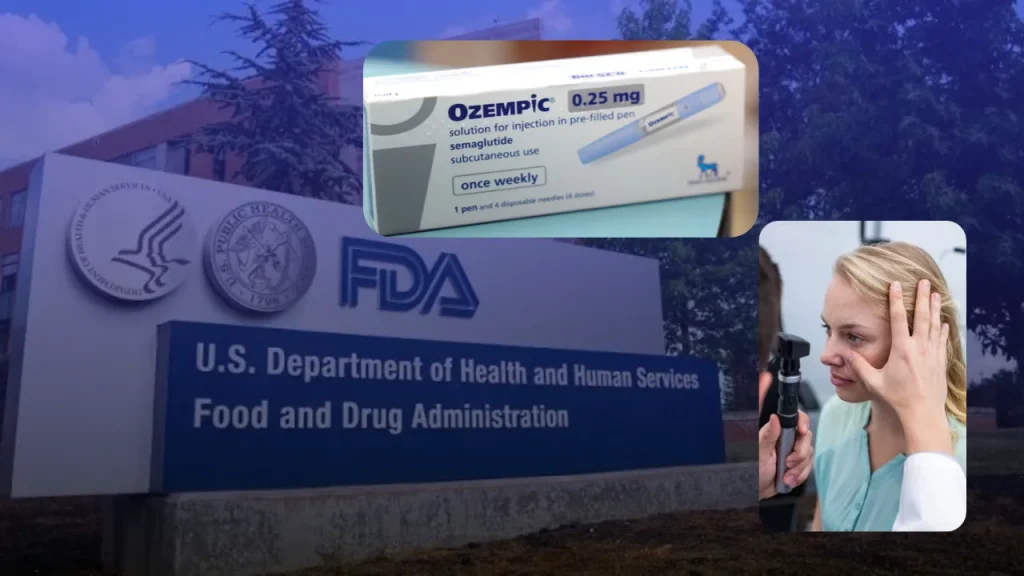
The U.S. Food and Drug Administration has ordered drug manufacturers to add new warnings about a rare but potentially permanent form of vision loss to the labels of all GLP-1 receptor agonist medications, marking a significant development in the growing litigation involving Ozempic, Wegovy, Mounjaro, Zepbound and related drugs.
The FDA announced the requirement on November 9, 2026, after reviewing 126 randomized clinical trials, postmarketing safety reports and observational research involving patients treated with GLP-1 medications.
The agency identified a potential increased risk of non-arteritic anterior ischemic optic neuropathy (NAION), a serious condition caused by reduced blood flow to the optic nerve that can produce sudden, painless and sometimes permanent blindness.
The announcement comes as federal lawsuits alleging GLP-1-related vision loss continue expanding.
According to the U.S. Judicial Panel on Multidistrict Litigation, 278 NAION-related cases were pending as of November 2, 2026, compared with 247 at the beginning of October.
These cases are being coordinated before U.S. District Judge Karen Spencer Marston in the Eastern District of Pennsylvania under In re: GLP-1 RAs NAION Products Liability Litigation, MDL No. 3163.
The plaintiffs allege that pharmaceutical manufacturers failed to adequately warn doctors and patients about vision-loss risks.
Novo Nordisk and Eli Lilly dispute the allegations and have not been found liable.
The new FDA warning does not automatically prove that a GLP-1 medication caused any particular patient’s blindness or guarantee compensation. But it creates an important new regulatory development that courts, manufacturers, physicians and affected patients will need to consider.
Here is what the FDA found, which medications are affected, how the lawsuits are progressing, which laws control these claims, and what people who experienced vision loss should know.
GLP-1 Blindness Lawsuit: November 2026 Quick Facts
| Detail | Latest verified information |
| Breaking development | FDA requires new NAION warnings |
| FDA announcement date | November 9, 2026 |
| Type of FDA warning | Warnings and Precautions section (not a boxed warning) |
| Condition | Non-arteritic anterior ischemic optic neuropathy (NAION) |
| Potential injury | Sudden, painless vision loss; potentially permanent |
| Medications covered | All FDA-approved GLP-1 receptor agonists, including tirzepatide products |
| Major products | Ozempic, Wegovy, Rybelsus, Mounjaro, Zepbound and others |
| Federal blindness litigation | MDL No. 3163 (case number 2:25-md-03163-KSM) |
| Court | U.S. District Court, Eastern District of Pennsylvania |
| Presiding judge | Karen Spencer Marston |
| Pending blindness lawsuits | 278 |
| Case-count date | November 2, 2026 |
| Previous monthly count | 247 on October 1 |
| Other GLP-1 injury litigation | MDL No. 3094, gastrointestinal claims (same judge) |
| GI MDL pending cases | 4,082 |
| Latest blindness MDL court order | October 20, 2026, Plaintiff Fact Sheets |
| Next scheduled status conference | November 17, 2026 |
| Major expert-motion deadline | July 2, 2027 |
| Settlement | No global settlement verified |
| Official claim form | None |
| Class action | No; coordinated individual product-liability lawsuits |
What Did the FDA Announce on November 9, 2026?
The FDA issued a formal Drug Safety Communication announcing that manufacturers of GLP-1 receptor agonist medications must update their prescribing information.
The new language must appear in the Warnings and Precautions section.
It addresses a potential increased risk of NAION associated with GLP-1 treatment.
The FDA stated that NAION cases have been reported with all currently marketed GLP-1 products. After reviewing clinical trial data, observational studies and case reports, the agency concluded there is a potential increased risk.
This is not a boxed (black-box) warning. A boxed warning is the FDA’s most prominent label warning and is reserved for the most serious risks. Warnings and Precautions is a lower tier of label warning.
The FDA’s decision goes beyond the narrower semaglutide-focused warnings previously announced by European regulators.
It applies across the GLP-1 receptor agonist drug class.
What are prescribers being told to do?
Prescribers are advised to:
- Have patients report sudden vision changes immediately.
- Refer suspected cases to an ophthalmologist.
- Consider discontinuing the drug if NAION develops, unless the benefits clearly outweigh the risks.
What is the legal basis for the FDA’s order?
When the FDA becomes aware of new safety information it believes should be in a drug’s labeling, federal law allows it to require manufacturers to make a safety labeling change. That authority comes from section 505(o)(4) of the Federal Food, Drug, and Cosmetic Act (21 U.S.C. § 355(o)(4)). Manufacturers must submit the change within the timeline the FDA sets, and can submit a rebuttal if they disagree.
The Warnings and Precautions section is governed by the prescription-label format rules at 21 C.F.R. § 201.57(c)(6), and boxed warnings are governed by 21 C.F.R. § 201.57(c)(1).
Which medications must carry the new warning?
The FDA identified the following approved products.
| Medication | Active ingredient |
| Ozempic | Semaglutide |
| Wegovy | Semaglutide |
| Rybelsus | Semaglutide |
| Mounjaro | Tirzepatide |
| Zepbound | Tirzepatide |
| Trulicity | Dulaglutide |
| Victoza | Liraglutide |
| Saxenda | Liraglutide |
| Xultophy | Liraglutide and insulin degludec |
| Soliqua | Lixisenatide and insulin glargine |
| Foundayo | Orforglipron |
| Byetta | Exenatide; original brand application withdrawn |
The FDA also notes that tirzepatide acts on both GIP and GLP-1 receptors.
The Byetta brand application was previously withdrawn for reasons unrelated to safety or effectiveness, while generic exenatide products remain marketed.
The addition of Mounjaro, Zepbound and other products to the class-wide warning requirement is important because the European regulator’s earlier finding principally concerned semaglutide products.
Novo Nordisk makes Ozempic, Wegovy and Rybelsus. Eli Lilly makes Mounjaro and Zepbound.
Have the new warnings already appeared on every product label?
The FDA announced a requirement for manufacturers to update their labels.
That does not establish that every product’s revised prescribing information was already approved, posted and distributed by November 11.
Manufacturers have indicated they are evaluating the requirement.
Patients and healthcare providers should consult the latest FDA-approved labeling for the specific medication.
FDA Finds Higher NAION Incidence in GLP-1 Clinical Trial Analysis
The FDA’s numerical findings are among the most significant details of the announcement.
Researchers reviewed data from 126 randomized controlled clinical trials involving 134,253 participants.
Of these:
- 78,217 participants received GLP-1 medications.
- 56,036 received placebo or comparison medication.
- Total follow-up represented 288,879 person-years.
The analysis identified 15 probable NAION events.
Ten occurred among GLP-1-treated participants, and five occurred among participants receiving placebo.
None were identified among participants receiving other non-GLP-1 glucose-lowering medicines within that particular trial dataset.
What was the difference in NAION occurrence?
| Group | NAION cases per 100,000 person-years |
| GLP-1 medication users | 6.4 |
| Comparison group | 3.8 |
A person-year is a measure of follow-up time. For example, 100 people followed for one year represent approximately 100 person-years.
These figures are not the same as saying that 6.4 out of every 100,000 patients will inevitably develop the condition.
Individual risk varies, and the estimates depend on the study population, duration of observation and other factors.
Does this prove GLP-1 drugs cause blindness?
Not conclusively.
The randomized-trial analysis identified a higher observed incidence, but NAION events were extremely uncommon.
The FDA also reviewed other types of evidence, including real-world healthcare data and published observational studies.
Taken together, the agency concluded that a potential increased risk warranted a new warning.
That is a regulatory safety conclusion, not a judicial finding that every drug in the class causes NAION or that a manufacturer is liable for a particular injury.
What Did the FDA’s Real-World Study Find?
The FDA also conducted an analysis using its Sentinel real-world evidence system.
Researchers examined adults with type 2 diabetes who began treatment with a GLP-1 medication or another diabetes drug between 2019 and 2024.
The comparison included two other medication classes:
- Sodium-glucose cotransporter-2 inhibitors, or SGLT-2 inhibitors.
- Dipeptidyl peptidase-4 inhibitors, or DPP-4 inhibitors.
The FDA reported the following approximate NAION incidence rates:
| Medication group | Cases per 100,000 person-years |
| GLP-1 receptor agonists | 30–32 |
| SGLT-2 inhibitors | 31 |
| DPP-4 inhibitors | 26 |
The statistical comparison produced different results depending on the reference group.
Compared with SGLT-2 inhibitors, the FDA did not find a statistically significant increase in NAION risk.
Compared with DPP-4 inhibitors, the analysis identified an increased risk.
This matters because it shows why the scientific evidence cannot be reduced to a single headline claiming that every GLP-1 user has twice the risk.
The underlying disease, medication selected, study design and comparison group all affect interpretation.
The FDA also acknowledged that NAION risk factors overlap with conditions commonly found in patients prescribed GLP-1 medicines.
These include diabetes, hypertension, sleep apnea and kidney disease.
Why Did Lawsuits Over GLP-1 Vision Loss Start Rising?
Lawsuits began rising after observational research raised concerns about semaglutide and NAION. A July 2024 study published in JAMA Ophthalmology (Hathaway et al.) reported higher NAION rates among certain patients prescribed semaglutide, and later analyses added to the discussion.
European regulators had earlier noted the possible association. The FDA’s November 2026 action is the strongest U.S. regulatory acknowledgment to date that a potential risk exists and warrants labeling. Plaintiffs are expected to cite it as support for their argument that a risk was known and under-disclosed.
What Is NAION, and Why Can It Cause Blindness?
NAION stands for non-arteritic anterior ischemic optic neuropathy.
It occurs when blood flow to the front portion of the optic nerve becomes insufficient, causing injury to nerve tissue responsible for transmitting visual information from the eye to the brain.
Symptoms often develop suddenly.
Patients may first notice a change in vision after waking.
Potential symptoms include:
- Sudden, painless vision loss in one eye.
- Blurred or hazy vision.
- A missing section of the visual field.
- Blind spots or tunnel vision.
- Changes in color perception.
- Reduced central visual sharpness.
The condition may leave permanent visual impairment.
There is no established treatment that reliably reverses optic-nerve damage caused by NAION.
Is NAION the same as diabetic retinopathy?
No.
Diabetic retinopathy damages blood vessels in the retina and is associated with diabetes.
NAION primarily affects the optic nerve.
Other causes of visual loss include retinal detachment, retinal vascular occlusion, glaucoma and neurological emergencies.
These conditions have different causes and treatment requirements.
A person who experiences vision problems while taking Ozempic or another GLP-1 drug should not assume the cause is NAION without urgent medical evaluation.
What Should Patients Taking Ozempic or Wegovy Do?
The FDA advises patients to contact a healthcare professional immediately if they develop symptoms consistent with NAION.
Sudden loss of vision is an urgent medical problem, even when there is no pain.
Patients should seek immediate medical evaluation, ideally from an ophthalmologist or emergency service capable of assessing acute vision loss.
Should everyone stop taking GLP-1 medication?
No.
The FDA has not ordered a general withdrawal of GLP-1 medications.
People who are benefiting from treatment should discuss their individual risks and alternatives with their prescribing clinician rather than independently stopping or changing doses.
If NAION is suspected, urgent ophthalmological assessment is important.
For patients who have experienced NAION, the FDA recommends discussing whether the medication should be continued.
Healthcare professionals are advised to consider discontinuation when NAION develops unless the benefits clearly outweigh the risk.
European regulators separately recommend discontinuing semaglutide when NAION is confirmed.
Medical decisions should reflect the patient’s condition and prescribing guidance.
How can patients report a suspected side effect?
Patients and clinicians can report suspected adverse events to the FDA’s MedWatch program. Manufacturers have their own postmarketing reporting duties under federal regulations (for example, 21 C.F.R. § 314.80). Reporting to MedWatch is separate from filing a lawsuit and does not preserve or start any legal claim.
Why Is the New FDA Warning Important for the Blindness Lawsuits?
The legal significance centers on the manufacturers’ alleged failure to warn.
Plaintiffs contend that drugmakers knew or should have known about an increased risk of serious optic-nerve injury and failed to provide adequate warnings.
The November 9 FDA announcement may become relevant to arguments concerning:
- The scientific evidence available to manufacturers.
- When safety information became sufficiently significant.
- Whether earlier prescribing labels adequately disclosed potential risks.
- What additional warnings federal law permitted or required.
- Whether particular patients and physicians would have made different treatment decisions if warned.
However, the FDA’s announcement does not resolve those issues.
Does the warning mean Novo Nordisk or Eli Lilly admitted wrongdoing?
No.
A required safety-label update is not an admission that a company violated product-liability law.
Manufacturers can contest whether their earlier labels complied with federal and state law, whether a warning change was legally possible at a particular time, and whether a specific drug caused an individual injury.
A patient’s prescription history and medical evidence remain central to any claim.
Can patients who lost vision before November 2026 still sue?
Potentially.
The fact that the FDA required warnings in November 2026 does not automatically bar claims concerning earlier treatment.
Plaintiffs may argue that earlier warnings were inadequate based on information available before the FDA’s announcement.
The defendants may dispute that they had legally sufficient evidence to justify a different warning at the relevant time.
The outcome depends on the law applicable to the patient’s claim, the date of treatment, the evidence available and other factors.
What Do Novo Nordisk and Eli Lilly Say?
Both companies dispute the suggestion that the FDA’s announcement establishes legal responsibility for the injuries alleged in the lawsuits.
Novo Nordisk’s position
Novo Nordisk has maintained that the overall evidence does not establish a causal link between semaglutide and NAION.
The company has pointed to clinical-trial analyses and the relatively low incidence of the condition.
It continues to express confidence in the overall benefit-risk profile of semaglutide medicines.
Eli Lilly’s position
Eli Lilly said it is reviewing the FDA’s announcement and that patient safety is a priority.
The company emphasized that the warning applies across medicines with GLP-1 receptor agonist activity rather than identifying a particular finding about one Lilly medicine.
These positions are important because the ongoing lawsuits remain contested.
There has been no final liability ruling establishing that either manufacturer caused the plaintiffs’ alleged vision injuries.
How Many GLP-1 Blindness Lawsuits Have Been Filed?
The latest official monthly JPML report provides a count of 278 pending federal actions in MDL No. 3163 as of November 2, 2026.
The cases have increased during 2026.
| JPML report date | Pending NAION cases |
| July 1, 2026 | 146 |
| August 3, 2026 | 200 |
| September 1, 2026 | 216 |
| October 1, 2026 | 247 |
| November 2, 2026 | 278 |
These are monthly snapshots, not the number of newly diagnosed NAION patients nationwide.
They also do not include every potential claim being investigated by lawyers, all state-court cases or patients who have not filed lawsuits.
Do not add these numbers to the gastrointestinal total. The separate GLP-1 stomach-injury MDL has 4,082 pending cases, and the two counts should never be combined into one blindness figure.
Where are the cases being heard?
The federal litigation is titled:
In re: Glucagon-Like Peptide-1 Receptor Agonists (GLP-1 RAs) Non-Arteritic Anterior Ischemic Optic Neuropathy Products Liability Litigation.
The case number is 2:25-md-03163-KSM.
Judge Karen Spencer Marston oversees the proceedings in the Eastern District of Pennsylvania. She also presides over the larger GLP-1 gastrointestinal MDL No. 3094.
The Judicial Panel on Multidistrict Litigation established the proceeding in December 2025.
Readers looking for the earlier case history, original allegations and federal consolidation order can review Ozempic and GLP-1 Blindness Lawsuit Update, Were You Affected? In re: GLP-1 RAs NAION Products Liability Litigation, MDL No. 3163.
What is a multidistrict litigation, and why does it matter?
Multidistrict litigation is a federal procedure under 28 U.S.C. § 1407. It lets the Judicial Panel on Multidistrict Litigation transfer related lawsuits filed in different federal districts to one judge for coordinated pretrial proceedings, such as discovery and expert rulings.
An MDL is not a class action. Each plaintiff keeps an individual case, and each case is generally sent back to its original court for trial if it is not resolved. The Supreme Court held in Lexecon Inc. v. Milberg Weiss Bershad Hynes & Lerach, 523 U.S. 26 (1998), that the transferee judge cannot keep cases for trial without the parties’ consent, which is why MDL cases are normally remanded.
What Happened in Court on October 20, 2026?
Judge Marston issued Case Management Order No. 16, establishing the plaintiff fact-sheet process.
A Plaintiff Fact Sheet, or PFS, is a structured disclosure document used in large product-liability proceedings.
Its purpose is to gather relevant information about each plaintiff and the alleged injury.
The order requires participating plaintiffs to complete the approved fact sheet and provide relevant supporting records and authorizations.
Medical and pharmacy records are particularly important to cases concerning drug exposure and alleged injuries.
What are the deadlines?
Under the order:
- Plaintiffs whose member actions were already pending in the Eastern District of Pennsylvania generally have 90 days after the designated Rubris platform goes live to provide the required materials.
- Certain cases added after the order generally have 45 days from the applicable triggering event, as defined in the order.
- Failure to comply can result in deficiency notices and dismissal proceedings under the specified process.
These requirements apply to plaintiffs within the litigation.
They are not a public settlement claim deadline.
The court has also provided procedures for collecting and sharing relevant medical records while maintaining confidentiality protections. Medical records in litigation are also protected by federal privacy rules under HIPAA (45 C.F.R. Parts 160 and 164), which is why records are usually released through signed authorizations and court protective orders.
Why does this order matter?
For an individual plaintiff, proving that a person took a GLP-1 medication is not enough to prove that the medication caused NAION.
The litigation may require evidence about the specific drug, exposure dates, medical diagnosis, other possible causes and the resulting losses.
The fact-sheet process helps organize that evidence before further case-specific proceedings.
What Happens Next in MDL No. 3163?
The August 27, 2026 scheduling order establishes a detailed framework for the scientific and legal issues.
The court has structured the litigation to address threshold issues first, before individual cases or bellwether trials.
The court has prioritized two questions:
General causation: Can the relevant GLP-1 medication cause NAION in the circumstances addressed by the litigation?
Federal preemption and warning adequacy: Can the state-law warning claims proceed, and were the manufacturers’ relevant warnings legally adequate?
The scheduled deadlines include:
| Court deadline | Event |
| October 28, 2026 | Deadline for plaintiffs’ master complaint |
| December 18, 2026 | Eli Lilly fact discovery deadline |
| February 26, 2027 | Novo Nordisk fact discovery deadline |
| March 26, 2027 | Plaintiffs’ expert reports |
| April 23, 2027 | Defendants’ expert reports |
| April 30, 2027 | Plaintiffs’ rebuttal expert reports |
| June 4, 2027 | Expert depositions completed |
| July 2, 2027 | Rule 702 and summary judgment opening motions |
| August 13, 2027 | Opposition briefs |
| August 31, 2027 | Reply briefs |
The October 28 date was a court-ordered filing deadline. One source reports that an amended master long-form complaint was filed around late October 2026, but the exact contents and filing status of the master complaint should be confirmed from the live docket rather than inferred solely from the schedule.
The court’s publicly posted orders do not establish that a bellwether trial is scheduled to begin immediately.
The next scheduled MDL status conference is November 17, 2026.
The August 2027 briefing deadline is also not a promised date for a verdict or settlement.
No trial dates or settlements have been announced.
What Is Federal Preemption, and Why Does It Matter?
Federal preemption is one of the key defenses in pharmaceutical product-liability litigation.
The principle comes from the Supremacy Clause of the U.S. Constitution.
Drug manufacturers must comply with FDA requirements, but patients may also bring claims under applicable state product-liability law.
A dispute arises when a manufacturer argues that federal regulatory requirements prevented the labeling changes a state-law claim would require.
Relevant authorities include:
- Federal Food, Drug, and Cosmetic Act.
- FDA prescribing-label regulations, including 21 C.F.R. §§ 201.57 and 314.70.
- Wyeth v. Levine, 555 U.S. 555 (2009).
- Merck Sharp & Dohme Corp. v. Albrecht, 587 U.S. 299 (2019).
- Federal Rule of Evidence 702, governing expert testimony.
Under certain circumstances, FDA regulations permit manufacturers to strengthen warnings through the changes-being-effected process (21 C.F.R. § 314.70(c)(6)(iii)).
Whether that process was legally available at a particular time can be disputed.
In Wyeth v. Levine, the Supreme Court rejected a broad preemption defense for brand-name drug warnings. In Albrecht, it held that a manufacturer must show by “clear evidence” that the FDA would have rejected the label change, and that the question is for a judge to decide.
The November 2026 FDA directive is relevant new evidence of regulatory action, but it does not automatically answer what labeling could or should have been changed years earlier.
Judge Marston has scheduled preemption and warning-adequacy questions for early review.
Do different rules apply to generic GLP-1 drugs?
Yes, and this matters for liraglutide and exenatide generics. In PLIVA, Inc. v. Mensing, 564 U.S. 604 (2011), and Mutual Pharmaceutical Co. v. Bartlett, 570 U.S. 472 (2013), the Supreme Court held that state-law failure-to-warn and design-defect claims against generic drug makers are generally preempted, because generics must copy the brand label. Plaintiffs usually cannot rely on those claims against a generic manufacturer. Most blindness lawsuits so far focus on the brand-name products from Novo Nordisk and Eli Lilly.
Can a patient sue the FDA or sue directly under the FDCA?
No. The FDCA does not create a private right of action (21 U.S.C. § 337(a)), and the Supreme Court held in Buckman Co. v. Plaintiffs’ Legal Committee, 531 U.S. 341 (2001), that claims based only on fraud on the FDA are preempted. Patients bring claims under state law, and federal rules and FDA actions shape how those claims are evaluated.
What Legal Claims Do GLP-1 Blindness Plaintiffs Bring?
Product-liability claims over prescription drugs are generally governed by state law. The details differ by state, but common theories include:
- Failure to warn. The manufacturer allegedly did not adequately warn about NAION risk.
- Design defect. The product allegedly was unreasonably dangerous as designed. Many states limit this theory for prescription drugs.
- Negligence. The manufacturer allegedly failed to use reasonable care in testing, monitoring or labeling.
- Consumer-protection and misrepresentation claims. Some states allow claims based on marketing statements.
- Loss of consortium and wrongful death claims. Spouses or family members may bring derivative claims where the law allows.
What is the learned intermediary doctrine?
Most states follow the learned intermediary doctrine. Under it, a prescription-drug maker’s duty to warn runs mainly to the prescribing doctor rather than directly to the patient. The question then becomes whether the warning given to physicians was adequate and whether a better warning would have changed the prescribing decision. The Restatement (Third) of Torts: Products Liability § 6 reflects this approach. Some states also restrict strict-liability claims for prescription drugs, so the legal theory available to a plaintiff depends on the state whose law applies.
What must plaintiffs prove about causation?
Plaintiffs must prove both general causation (the drug can cause NAION) and specific causation (the drug caused this plaintiff’s NAION). Expert testimony on these points must satisfy Federal Rule of Evidence 702, as amended in December 2023, which requires the judge to find that it is more likely than not that the expert’s opinion meets the reliability requirements. The standard traces to Daubert v. Merrell Dow Pharmaceuticals, Inc., 509 U.S. 579 (1993). Rule 702 motions are scheduled for July 2, 2027, and they are a major risk point for plaintiffs because a ruling excluding general-causation experts can end an entire MDL.
Is the Blindness Lawsuit the Same as the Ozempic Stomach Paralysis Lawsuit?
No.
There are two separate federal multidistrict proceedings.
| Issue | Blindness litigation | Gastrointestinal litigation |
| MDL number | 3163 | 3094 |
| Main alleged injury | NAION and vision loss | Gastroparesis and other serious GI injuries |
| Pending cases, Nov. 2 | 278 | 4,082 |
| Judge | Karen Spencer Marston | Karen Spencer Marston |
| Core legal disputes | Causation, warnings, preemption | Causation, warnings, preemption |
| Global settlement verified | No | No |
Both MDLs involve GLP-1 products, but their alleged injuries and scientific questions are different.
A procedural decision concerning gastric emptying or stomach injuries should not automatically be reported as a ruling in the blindness litigation.
For the history of the broader cases, see Weight Loss Drug Lawsuits 2026, FDA Warnings and New Vision Loss and Stomach Paralysis Claims January 2026 Update. Its January figures reflect an earlier stage of the litigation.
What Did European Regulators Find Before the FDA’s 2026 Decision?
The European Medicines Agency made an important determination in June 2025.
Its safety committee concluded that NAION should be listed as a very rare side effect of semaglutide.
The EMA said the condition could affect up to one in 10,000 people taking semaglutide.
It also described epidemiological research suggesting an approximately twofold increase in NAION risk among certain adults with type 2 diabetes treated with semaglutide compared with those not taking the medication.
The European conclusion concerned Ozempic, Wegovy and Rybelsus.
Other regulators, including the United Kingdom’s Medicines and Healthcare products Regulatory Agency and Australia’s Therapeutic Goods Administration, subsequently published safety guidance.
The FDA’s November 9, 2026 decision is broader because it calls for warnings across the GLP-1 receptor agonist class.
Why did the FDA act after Europe?
The FDA conducted its own evaluation of trial data, reported adverse events, animal research and observational evidence.
Its review assessed whether the available information justified a U.S. warning requirement.
Different regulators can reach decisions on different dates because their assessment procedures, available datasets and labeling standards vary.
It would be inaccurate to conclude that the timing alone proves regulatory negligence.
Who May Have a Potential GLP-1 Blindness Lawsuit?
A person who developed NAION after using a relevant prescription medication may wish to consult a product-liability attorney about whether the facts support a claim.
Important factors may include:
- A documented NAION diagnosis.
- Records establishing which GLP-1 medication was taken.
- Prescription and pharmacy dispensing history.
- Timing between drug exposure and vision symptoms.
- Ophthalmology findings and other medical evidence.
- Preexisting risk factors and alternative explanations.
- Whether there is evidence that a legally inadequate warning contributed to the injury.
- The filing deadline applicable under state law.
These are factors in evaluating a potential case, not a court-approved guarantee of eligibility.
Does everyone who used Ozempic qualify?
No.
A prescription alone does not establish an injury or a viable product-liability claim.
Likewise, not every change in vision is NAION.
An ophthalmological diagnosis and a legally sufficient connection between the alleged injury and the product are important.
Can someone sue after developing blindness in only one eye?
Potentially.
NAION frequently affects one eye.
The fact that the other eye retains normal or useful vision does not automatically rule out a legal claim.
The diagnosis, causation and damages must still be assessed.
Can someone sue if they have diabetes?
Potentially, but diabetes complicates the medical analysis.
Diabetes is itself a risk factor for several eye conditions, including NAION.
Manufacturers may argue that the condition arose from underlying health risks rather than the medication.
Plaintiffs must present evidence sufficient to establish specific causation under the applicable law.
Anyone who experienced sudden vision changes while taking a GLP-1 medication should consult an ophthalmologist and may wish to discuss potential legal options with an attorney experienced in pharmaceutical product liability.
What Records Should Someone Preserve After a NAION Diagnosis?
Useful records may include prescription histories, pharmacy receipts, drug packaging, eye examination results, hospital records and correspondence with prescribing clinicians.
Patients may also wish to maintain a chronology of when treatment began, when symptoms appeared and what doctors diagnosed.
These records can help clinicians understand the patient’s medical history and may be relevant if legal advice is sought.
People should not alter records or stop medically necessary treatment solely to preserve a potential legal claim.
What About Compounded Semaglutide or Tirzepatide?
The FDA’s announcement concerns approved GLP-1 receptor agonist medications and the obligations of their application holders.
Compounded formulations raise additional regulatory and liability issues.
A compounded medicine is not automatically equivalent, for legal purposes, to an FDA-approved branded product. Federal law regulates compounding under sections 503A and 503B of the FDCA (21 U.S.C. §§ 353a and 353b), and compounded drugs are not FDA-approved.
The identity of the compounder, formulation, source of ingredients, warnings and evidence about the alleged injury can affect who might be legally responsible.
A separate October 2026 action involved sterility concerns affecting compounded tirzepatide products. See Apothecary Pharma GLP-1 Injection Recall, All 22 Tirzepatide Lots and the NAD+ Vial.
That recall concerns potential sterility problems, not a determination that those particular compounded products caused NAION.
How Much Is the GLP-1 Blindness Lawsuit Worth?
There is no verified average settlement amount for the NAION multidistrict litigation.
No global settlement, official payout matrix or court-established compensation schedule has been announced.
Some law-firm websites may advertise potential settlement values based on other pharmaceutical cases.
Those figures are estimates, not verified compensation available to GLP-1 blindness plaintiffs.
Potential damages in an individual product-liability case can depend on medical costs, lost earnings, lasting impairment, pain and suffering, loss of independence and other legally recoverable losses.
Punitive damages may be available in some cases if the applicable law and evidence support them.
They are not automatic.
Is there a $500,000 or $700,000 Ozempic blindness settlement?
No verified NAION settlement establishing those amounts was located in the official federal court orders reviewed.
Readers should not mistake speculative payout estimates for settlement terms.
Would a settlement be reduced by liens or legal fees?
Often, yes. Plaintiff firms typically work on contingency, and settlements can be reduced by attorney fees, case expenses and, in MDLs, court-ordered common-benefit assessments. Health-care payers can also assert reimbursement claims. Medicare has a statutory right to recover conditional payments under the Medicare Secondary Payer Act (42 U.S.C. § 1395y(b)(2)), and Medicaid and private insurers may assert liens. Any future payout would be net of these items.
Is There a Deadline to Join the GLP-1 Blindness Lawsuit?
There is no single nationwide class-action claim deadline.
These are individual product-liability cases coordinated for pretrial proceedings.
The filing deadline generally depends on applicable state statutes of limitations and accrual rules.
Possible factors include when the injury occurred, when its potential cause was reasonably discovered, and whether any tolling provisions apply.
The specific deadline cannot be determined from the FDA’s November announcement alone.
What are some state filing deadlines?
Many states give two years for personal-injury claims, though the period, the accrual rule and any statute of repose vary. Examples include 42 Pa. C.S. § 5524 (Pennsylvania), Cal. Code Civ. Proc. § 335.1 (California), Tex. Civ. Prac. & Rem. Code § 16.003 (Texas) and N.J.S.A. 2A:14-2 (New Jersey). Some states apply a discovery rule, which can start the clock when a person knew or should have known the injury may have been caused by the product, rather than on the date of the injury. Because these rules differ, the FDA warning date should not be assumed to be the start or the end of any person’s deadline.
People considering a claim should obtain legal advice promptly rather than assume that the federal MDL’s 2027 discovery schedule extends their filing period.
GLP-1 Blindness Lawsuit Timeline: 2024–2027
| Date | Major development |
| July 2024 | JAMA Ophthalmology publishes research associating semaglutide with increased NAION risk |
| January 2025 | EMA begins formal safety review |
| June 2025 | EMA concludes NAION is a very rare side effect of semaglutide |
| October 2025 | New Jersey Supreme Court designates separate state-court NAION litigation |
| December 15, 2025 | Federal NAION MDL No. 3163 established |
| January 29, 2026 | Federal court issues direct-filing order |
| February 23, 2026 | Plaintiffs’ leadership counsel appointed |
| July 2, 2026 | Court prioritizes general causation and preemption questions |
| August 27, 2026 | Judge issues detailed scientific and motion schedule |
| October 1, 2026 | 247 federal NAION lawsuits pending |
| October 20, 2026 | Court issues plaintiff fact-sheet order |
| October 28, 2026 | Court deadline for plaintiffs’ master complaint |
| November 2, 2026 | 278 federal NAION lawsuits pending |
| November 9, 2026 | FDA requires new class-wide NAION warnings |
| November 17, 2026 | Next scheduled MDL status conference |
| December 18, 2026 | Scheduled Lilly fact-discovery deadline |
| February 26, 2027 | Scheduled Novo Nordisk fact-discovery deadline |
| July 2, 2027 | Scheduled Rule 702 and summary judgment motions |
| August 31, 2027 | Scheduled completion of briefing on early motions |
Frequently Asked Questions About the GLP-1 Blindness Lawsuit
What is the latest GLP-1 blindness lawsuit update?
On November 9, 2026, the FDA required new warnings about potential NAION risk for GLP-1 medications. The federal vision-loss MDL had 278 pending cases as of November 2.
Does Ozempic cause blindness?
The FDA has identified a potential increased risk of NAION associated with GLP-1 medications, including Ozempic. Its safety review does not establish that every case of vision loss in an Ozempic user was caused by the drug.
Did the FDA confirm a link between GLP-1 drugs and NAION?
The agency concluded that available evidence supported a potential increased risk requiring stronger warnings. It did not make a legal finding resolving causation in individual lawsuits.
Is the new FDA warning a black-box warning?
No. The NAION risk is being added to the Warnings and Precautions section, not as a boxed warning.
Which weight-loss drugs are affected?
The warning requirement includes Ozempic, Wegovy, Mounjaro, Zepbound and other FDA-approved GLP-1 receptor agonist medications.
Is Mounjaro included?
Yes. Mounjaro contains tirzepatide, a dual GIP and GLP-1 receptor agonist, and is included in the FDA’s class-wide warning requirement.
Is Zepbound included?
Yes. The FDA included Zepbound, which also contains tirzepatide.
What is the difference between Ozempic and Wegovy for this warning?
Both contain semaglutide and are covered by the FDA’s warning requirement, although their approved indications and dosing can differ.
How many people have sued?
The November 2 JPML report identified 278 pending federal NAION cases. That is not a count of all affected patients nationwide.
Is this a class action?
No. MDL No. 3163 coordinates individual lawsuits for shared pretrial proceedings.
Has Novo Nordisk admitted its drugs cause blindness?
No. Novo Nordisk disputes a proven causal relationship and maintains that its medications have a favorable benefit-risk profile.
Has Eli Lilly admitted liability?
No. Eli Lilly has said it is evaluating the FDA communication. No liability finding has been established.
Does the FDA warning guarantee compensation?
No. Plaintiffs must still establish the required legal elements of their individual claims.
Has anyone received a settlement?
No global NAION settlement or official payout program was verified in the federal court materials reviewed.
Is there a claim form?
No public settlement claim form exists for this litigation.
When is the first NAION trial?
No verified first bellwether trial date has been announced. The court’s current schedule addresses discovery and expert motions extending into 2027.
What if I took a GLP-1 medication years ago?
A potential claim depends on the injury, medical evidence and state-law deadlines. Older exposure does not automatically establish or eliminate eligibility.
Should I stop taking Ozempic because of the FDA warning?
Do not independently change prescribed treatment without discussing it with a qualified healthcare professional. Sudden vision loss requires urgent medical evaluation.
Can I sue a generic drug maker?
Claims against generic manufacturers are usually limited by Supreme Court preemption rulings (PLIVA v. Mensing and Mutual Pharmaceutical v. Bartlett). A lawyer can explain how that applies to the specific product you took.
What Happens Next?
The next important federal court event is the scheduled November 17, 2026 status conference.
The parties must continue discovery and prepare for expert proceedings concerning whether GLP-1 medications can cause NAION and whether the relevant warning claims are legally permissible.
The November 9 FDA decision is now part of the broader regulatory landscape surrounding these disputes.
However, it remains to be seen how the parties use the decision in their arguments and how Judge Marston addresses the scientific and preemption questions.
A separate issue is how promptly manufacturers complete the required labeling updates and whether additional studies change regulators’ understanding of the risk.
The Bottom Line
The November 9, 2026 FDA warning decision is a major new development in the GLP-1 blindness litigation.
For the first time, the FDA has directed manufacturers across the GLP-1 receptor agonist class to add warnings about the potential risk of NAION, a rare but serious optic-nerve condition that can result in permanent vision loss.
The announcement follows years of research, safety reviews and lawsuits alleging that patients were not adequately informed of the risk.
At the same time, the federal litigation remains unresolved.
There are 278 pending NAION lawsuits in MDL No. 3163, and the court has scheduled scientific and legal proceedings extending through August 2027.
The FDA’s action strengthens the importance of transparent risk information, but does not automatically determine whether a particular manufacturer is liable for a patient’s injury.
For patients, the immediate priority is recognizing sudden vision changes and obtaining urgent medical care.
For the lawsuits, the next questions are how the updated safety evidence affects the causation and warning disputes, whether the claims survive early legal challenges, and how individual injuries will be evaluated.
Note: These remain allegations in ongoing litigation. Causation is contested, and individual outcomes will depend on the specific medical facts, timing of use and the scientific evidence presented.
Laws, Rules and Cases Referenced in This Article
| Authority | What it covers |
| 21 U.S.C. § 355(o)(4) | FDA authority to require safety labeling changes |
| 21 C.F.R. § 201.57(c)(1), (c)(6) | Boxed warnings; Warnings and Precautions section |
| 21 C.F.R. § 314.70(c)(6)(iii) | Changes-being-effected label strengthening |
| 21 C.F.R. § 314.80 | Manufacturer postmarketing adverse-event reports |
| 21 U.S.C. § 337(a) | No private right of action under the FDCA |
| 21 U.S.C. §§ 353a, 353b | Drug compounding (sections 503A, 503B) |
| 28 U.S.C. § 1407 | Multidistrict litigation transfer |
| Fed. R. Evid. 702 | Expert testimony standard |
| 45 C.F.R. Parts 160 and 164 | HIPAA privacy rules for medical records |
| 42 U.S.C. § 1395y(b)(2) | Medicare Secondary Payer recovery rights |
| Wyeth v. Levine, 555 U.S. 555 (2009) | Brand-name drug warning claims not broadly preempted |
| Merck v. Albrecht, 587 U.S. 299 (2019) | “Clear evidence” preemption standard decided by a judge |
| PLIVA v. Mensing, 564 U.S. 604 (2011); Mutual Pharm. v. Bartlett, 570 U.S. 472 (2013) | Generic-drug preemption |
| Buckman v. Plaintiffs’ Legal Comm., 531 U.S. 341 (2001) | Fraud-on-the-FDA claims preempted |
| Daubert v. Merrell Dow, 509 U.S. 579 (1993) | Expert reliability gatekeeping |
| Lexecon v. Milberg Weiss, 523 U.S. 26 (1998) | MDL cases remanded for trial |
| Restatement (Third) of Torts: Products Liability § 6 | Prescription drug liability; learned intermediary |
| 42 Pa. C.S. § 5524; Cal. CCP § 335.1; Tex. CPRC § 16.003; N.J.S.A. 2A:14-2 | Examples of state personal-injury filing deadlines |
Primary Court Documents, FDA Findings and Sources
- U.S. Food and Drug Administration — November 9, 2026 Drug Safety Communication.
FDA Requires Safety Labeling Changes for GLP-1 RAs Due to Potential Increased Risk of Rare But Serious Eye Condition - Judicial Panel on Multidistrict Litigation — November 2, 2026 Official Statistics.
Pending MDL Dockets by Actions Pending (PDF) - U.S. District Court, Eastern District of Pennsylvania — MDL No. 3163.
Official NAION Litigation Orders and Updates - Case Management Order No. 16 — October 20, 2026.
Plaintiff Fact Sheet Order (PDF) - Case Management Order No. 14 — August 27, 2026.
Scientific Discovery and Motion Schedule (PDF) - Case Management Order No. 12 — July 2, 2026.
General Causation and Preemption Order (PDF) - European Medicines Agency — June 6, 2025.
PRAC Concludes NAION Is a Very Rare Side Effect of Semaglutide - New Jersey Judiciary — Multicounty Litigation Designation.
Official GLP-1 Gastrointestinal and NAION Litigation Orders (PDF) - Reuters — November 9, 2026.
U.S. FDA Orders New Eye Risk Warnings for Ozempic, Zepbound - JAMA Ophthalmology — Hathaway et al., 2024.
Risk of Nonarteritic Anterior Ischemic Optic Neuropathy in Patients Prescribed Semaglutide
Researched and written by Israr Ahmad, legal content researcher and founder of AllAboutLawyer.com. All facts verified against the FDA’s November 9, 2026 Drug Safety Communication, the Judicial Panel on Multidistrict Litigation’s November 2, 2026 statistics, the published MDL No. 3163 case management orders, European Medicines Agency findings and peer-reviewed medical research, as of November 11, 2026. Last Updated: November 11, 2026.
Reporting note: Case counts reflect November 2, 2026 JPML statistics. The federal court’s public orders were reviewed through November 11, 2026. No global settlement, confirmed bellwether trial date or final determination of manufacturer liability was identified. Individual case filings and private settlements may not be fully reflected in published MDL orders.
This article is for informational purposes only and does not constitute legal or medical advice. Laws vary by state and individual circumstances differ. For advice about your specific situation, consult a qualified attorney or healthcare provider. AllAboutLawyer.com is an independent legal-information website, not a law firm or medical practice. People experiencing sudden vision loss should seek immediate medical evaluation. Medication decisions should be made with qualified healthcare professionals, and potential legal claims should be reviewed by a licensed attorney.
About the Author
Israr Ahmad is a legal content researcher with 4+ years of experience covering class action settlements and consumer rights cases. He has researched and published coverage of 2,500+ settlements using verified court records, settlement administrator filings, and government sources. Learn more about Israr.