
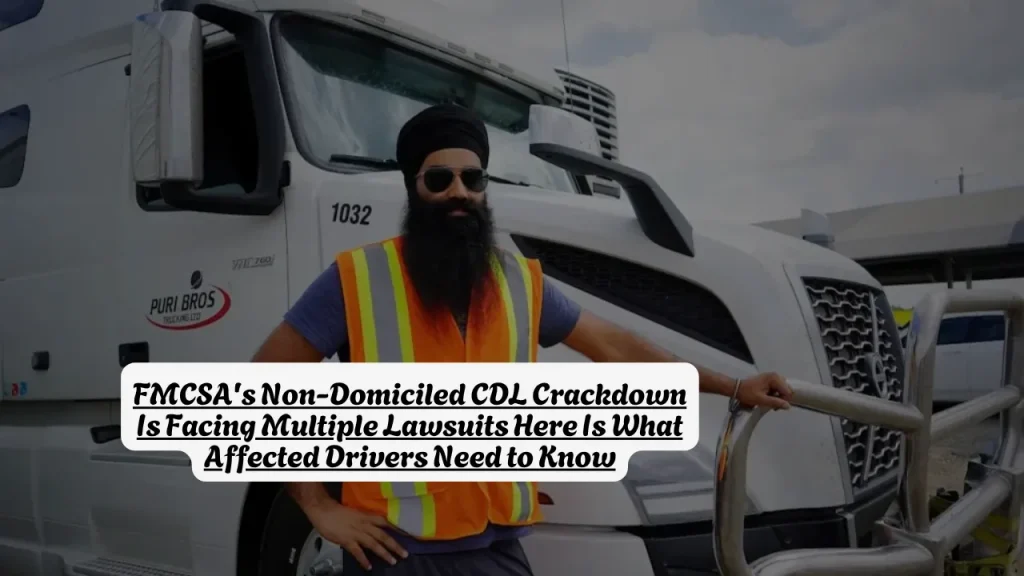
FMCSA’s Non-Domiciled CDL Crackdown Is Facing Multiple Lawsuits Here Is What Affected Drivers Need to Know
FMCSA’s non-domiciled CDL rule, which took effect on March 16, 2026, aimed to take approximately 200,000 CDL holders off the road. Under the rule, an Employment Authorization Document (EAD) is no longer enough to obtain a non-domiciled CDL. Asylum seekers, asylees, refugees, and Deferred Action for Childhood Arrivals (DACA) recipients are ineligible.
Multiple federal lawsuits are now challenging the rule as unconstitutional and “arbitrary and capricious.” If you hold a non-domiciled CDL — or held one that was revoked — you need to understand what these cases mean for your ability to work.
What Is the FMCSA Non-Domiciled CDL Rule and Who Does It Affect?
A non-domiciled CDL is a commercial driver’s license issued by a U.S. state to a person who lives outside that state — typically a foreign national legally present in the United States who drives commercially in American states. Historically, State Driver’s Licensing Agencies (SDLAs) could issue non-domiciled CDLs to individuals presenting proof of lawful presence, such as an unexpired Employment Authorization Document or a foreign passport with Form I-94.
The FMCSA’s Final Rule, released on February 13, 2026, limits non-domiciled CDL eligibility to individuals holding only three immigration statuses: H-2A (temporary agricultural workers), H-2B (temporary non-agricultural workers), or E-2 (treaty investors). Everyone else — including DACA recipients who have lived in the U.S. their entire lives and asylum seekers with full work authorization — is shut out.
Restricting CDL eligibility to those groups would cut the non-domiciled CDL population down from 200,000 to just 6,000 over the next five years, FMCSA estimated. That is a 97% reduction in the workforce category.
The legal theory courts are examining comes down to one core question: did FMCSA have the authority and the evidence to do this, and did it follow the correct legal process?
What Is the FMCSA Non-Domiciled CDL Rule About? Rivera Lujan et al. v. FMCSA, No. 25-1215 (D.C. Circuit)
This is the lead federal case and the one most likely to determine the rule’s fate.
On October 20, 2025, two truck drivers — DACA recipient Jorge Rivera Lujan and asylum seeker Aleksei Semenovskii — along with the American Federation of State, County and Municipal Employees (AFSCME) and the American Federation of Teachers (AFT), filed a petition for review in the U.S. Court of Appeals for the District of Columbia Circuit. They were represented by the Public Citizen Litigation Group and challenged the rule under the Administrative Procedure Act, 5 U.S.C. §§ 551 et seq.
The D.C. Circuit paused the earlier Interim Final Rule in November 2025 after finding the petitioners were likely to succeed. The court observed that “FMCSA’s own data appears to indicate that the CDL holders excluded by the rule are involved in fatal crashes at a lower rate than CDL holders who are not excluded” and that “non-domiciled CDL holders account for approximately 5 percent of all CDL holders but only about 0.2 percent of fatal crashes.”
FMCSA responded by publishing a Final Rule in February 2026. The latest petition argues that changes aimed at addressing objections to the rule simply are not to be found in the Final Rule — “The Rule is substantively identical to the IFR,” petitioners argue.
For an employment discrimination attorney or consumer rights lawyer representing affected drivers, this D.C. Circuit petition is the primary vehicle to watch.
Related article: Two Fired Immigration Judges Sue the DOJ Over Wrongful Termination One Served at the Concord Court in California
Are You Part of the Non-Domiciled CDL Lawsuit?
You may be affected by this rule and the lawsuits if:
- You are a DACA recipient who held or applied for a non-domiciled CDL and had it denied or revoked
- You are an asylum seeker or refugee with a valid Employment Authorization Document who previously qualified for a CDL
- You hold an H-2A, H-2B, or E-2 visa — you are currently the only non-domiciled CDL holders still eligible under the new rule
- You live in Florida and held a non-domiciled CDL that Florida stopped processing, renewing, or issuing under FMCSA’s corrective action plan
- You are a carrier or employer in New York, California, Florida, Illinois, or North Carolina with non-domiciled CDL drivers on your payroll whose credentials may now be flagged as noncompliant
You are likely NOT included in any individual compensation claim if:
- You are a U.S. citizen or lawful permanent resident — domestic CDL rules do not change under this rule
- Your CDL was revoked due to a separate safety violation unrelated to immigration status
The Florida Lawsuit: 19 Drivers Sue FMCSA and the State
A separate lawsuit was filed in the U.S. District Court for the Southern District of Florida on April 15, 2026, on behalf of nineteen non-domiciled CDL holders living in Florida. The suit names FMCSA, the U.S. Department of Transportation, Florida Highway Safety and Motor Vehicles (FLHSMV), FMCSA Administrator Derek Barrs, Transportation Secretary Sean Duffy, and FLHSMV Executive Director Dave Kerner.
The lawsuit claims that both the federal rule and Florida’s implementation of the rule are unconstitutional. Plaintiffs argue that FMCSA’s non-domiciled rule is unlawful because it bypassed the rulemaking process. Non-domiciled drivers also claim they were not afforded due process by effectively losing their CDLs without hearings or individualized review.
The lawsuit states: “The combined effect of FMCSA’s and Florida’s actions has been catastrophic for Plaintiffs: they cannot work, they cannot earn a living, they face financial ruin, and they have been deprived of vested property and liberty interests without due process of law — all without any individualized determination of fault, misconduct, or safety concern.”
The drivers ask the court to declare the rule unconstitutional and order Florida to immediately resume processing non-domiciled CDL applications and renewals.
New York Sues DOT Over $73 Million in Withheld Highway Funding
The state-level fight is just as intense. On April 16, 2026, the U.S. Department of Transportation announced that FMCSA is withholding $73,502,543 in federal highway funds from the State of New York for failing to revoke non-domiciled CDLs it issued. A July 2025 audit of 200 sampled records found 107 were issued in violation of federal law — a failure rate of over 53%.
New York Attorney General Letitia James filed a lawsuit in the Second Circuit Court of Appeals challenging DOT’s decision to withhold the funding, arguing the determination is “predicated on an erroneous reading of its own long-standing regulations.” New York Governor Kathy Hochul called the funding cut “political payback.”
California also faces a similar situation — DOT announced in January 2026 it would withhold approximately $158 million from California, which has appealed to the D.C. Circuit. Illinois, North Carolina, and Pennsylvania have also faced scrutiny.
What Should You Do Right Now If You Are Affected?
Most non-domiciled CDL holders do not need to file a lawsuit individually — the D.C. Circuit and Florida cases are proceeding on behalf of the affected class. Here is what you should do today:
- Do not surrender your CDL voluntarily before seeking legal advice — speak with an employment discrimination attorney or an immigration-focused consumer rights lawyer about your specific situation
- Save all documents related to your CDL, visa status, work authorization, and any letters or notices from FMCSA or your state DMV
- Monitor the D.C. Circuit for its ruling on the stay motion in Rivera Lujan v. FMCSA — if the court grants a stay, enforcement of the rule would be paused again
- Check your state’s current status — Florida has paused CDL processing, while other states are under varying degrees of pressure from FMCSA
- If you are a carrier or fleet operator, audit your driver qualification files now under 49 CFR Part 391 — dispatching a driver on a noncompliant credential creates liability for your company regardless of whether you knew about the issue
If you need a free legal consultation on how the FMCSA rule affects your CDL status or employment, the Public Citizen Litigation Group and immigration advocacy organizations including MALDEF are actively involved in these cases and may be able to direct you to resources.
FMCSA Non-Domiciled CDL Lawsuit Timeline
| Milestone | Date |
| FMCSA Interim Final Rule Published | September 29, 2025 |
| Rivera Lujan Petition Filed (D.C. Circuit) | October 20, 2025 |
| D.C. Circuit Stays Interim Final Rule | November 13, 2025 |
| FMCSA Final Rule Published | February 13, 2026 |
| New Petition Filed Against Final Rule (D.C. Circuit) | February 12, 2026 |
| Final Rule Takes Effect | March 16, 2026 |
| Florida 19-Driver Lawsuit Filed | April 15, 2026 |
| FMCSA Withholds $73.5M From New York | April 16, 2026 |
| New York AG Files Lawsuit (Second Circuit) | Late April 2026 |
| D.C. Circuit Stay Decision on Final Rule | TBD — pending court ruling |
| Next Scheduled Status in D.C. Circuit | TBD — court has not set date |
Frequently Asked Questions
Is there a class action lawsuit against FMCSA over the non-domiciled CDL rule?
There are multiple active lawsuits. The lead case, Rivera Lujan et al. v. FMCSA, No. 25-1215, is pending in the U.S. Court of Appeals for the D.C. Circuit. A separate suit covering 19 Florida drivers was filed on April 15, 2026 in the U.S. District Court for the Southern District of Florida. These are not traditional class actions seeking money damages — they seek to block or reverse the rule entirely.
Do I need to do anything right now to stay included in the lawsuits?
No. If the courts strike down the rule, the relief — restoration of CDL eligibility — flows to all affected drivers. You do not need to file paperwork to benefit. However, you should preserve all documentation of your CDL status, immigration documents, and any FMCSA or DMV correspondence.
Can DACA recipients still get a non-domiciled CDL?
Not under the current rule. FMCSA excluded DACA recipients despite the fact that many, like lead plaintiff Jorge Rivera Lujan, have exclusively U.S. driving records. The D.C. Circuit previously found this exclusion was likely arbitrary — its ruling on the Final Rule’s stay request will clarify whether enforcement continues.
When will a court decision come in the D.C. Circuit?
TBD — the court has not set a ruling date on the stay motion against the Final Rule. The November 2025 stay of the Interim Final Rule came within weeks of the petition, but timing for this new challenge is not confirmed.
Can I file my own individual lawsuit against FMCSA?
You can consult a class action lawsuit attorney about individual options, but the D.C. Circuit cases are the most direct path. Individual litigation against a federal agency is expensive and complex. If you believe your due process rights were violated — particularly in Florida — consult a lawyer about the April 2026 Florida lawsuit.
How will I know if the rule is struck down?
FMCSA will be required to notify state DMVs of any court order changing its enforcement obligations. Your state DMV would then resume CDL processing. Monitor fmcsa.dot.gov and the D.C. Circuit docket for updates.
What about the $73 million withheld from New York — does that affect my CDL?
If you hold a New York-issued non-domiciled CDL, it depends on whether your specific credential is flagged as noncompliant. New York has contested FMCSA’s findings and has not revoked the licenses. If New York loses its lawsuit in the Second Circuit, forced revocations of flagged credentials could follow.
Sources & References
- FMCSA — Non-Domiciled CDL 2026 Final Rule FAQs: fmcsa.dot.gov
- U.S. DOT — Announcement of New York Funding Withholding, April 16, 2026: transportation.gov
- New York AG Petition for Review, Second Circuit, April 2026: ag.ny.gov
Prepared by the AllAboutLawyer.com Editorial Team and reviewed for factual accuracy against FMCSA official publications, DOT press releases, and federal court records on May 7, 2026. Last Updated: May 7, 2026
Disclaimer: This article is for informational purposes only and does not constitute legal advice. Legal claims and outcomes depend on specific facts and applicable law. For advice regarding a particular situation, consult a qualified attorney.
About the Author
Israr Ahmad is a legal content researcher with 4+ years of experience covering class action settlements and consumer rights cases. He has researched and published coverage of 2,500+ settlements using verified court records, settlement administrator filings, and government sources. Learn more about Israr.