
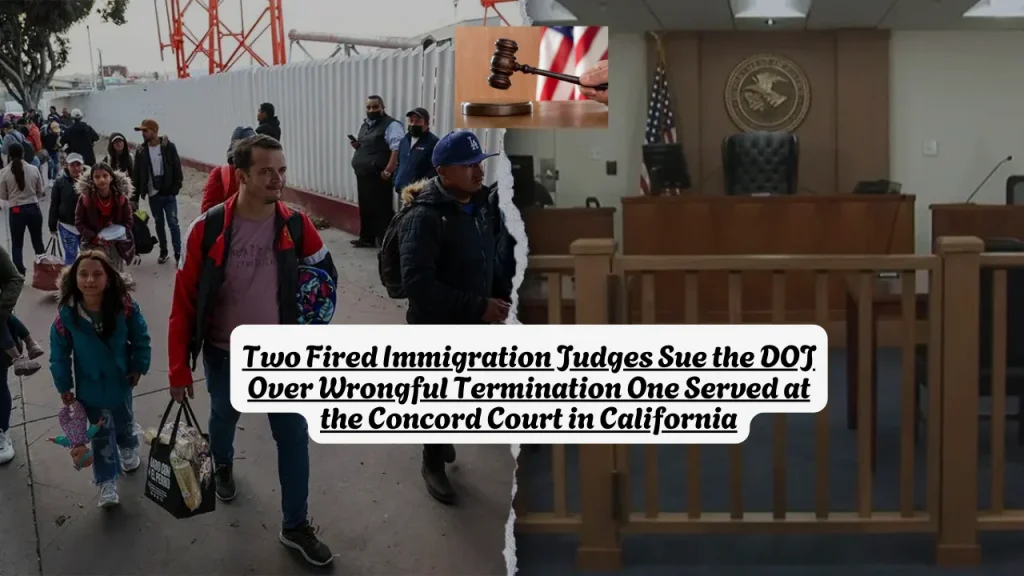
Two Fired Immigration Judges Sue the DOJ Over Wrongful Termination One Served at the Concord Court in California
Two former immigration judges have sued President Donald Trump’s administration over their removal, alleging they were discriminated against for political affiliation, sex, race, and past association with immigrant advocacy groups. The lawsuits, filed days apart in early May 2026, are the latest challenge to a sweeping removal of immigration judges that has reshaped the federal immigration court system since 2025.
Carla Espinoza is one of 113 immigration judges who have been removed during the current Trump administration, according to the National Association of Immigration Judges. The second plaintiff, Kyra Lilien, served at the Concord Immigration Court in California — a Bay Area court now operating with a fraction of its former bench.
What These Two Lawsuits Are About
Kyra Lilien — Concord Immigration Court, California
Kyra Lilien filed her suit in U.S. District Court in Northern California on May 1, 2026. The 14-page lawsuit names the DOJ and acting U.S. Attorney General Todd Blanche as defendants. Lilien was hired as an immigration judge in Concord on July 23, 2023, and received satisfactory assessments — the highest possible rating — throughout her probationary period, with 96% of her motions adjudicated on time.
On July 11, 2025, Lilien was told via email that her probationary term would not be extended. According to her complaint, the email said she needed to turn in her laptop and badge immediately and leave — and it arrived while she was presiding over a hearing.
Lilien’s suit names nearly 30 other immigration judges fired or not converted from probationary periods from around the country, including 14 from the Concord and San Francisco immigration courts — judges who were “overwhelmingly female.” The suit notes that four white male judges were kept on.
Lilien claims she was not retained because she is a woman over the age of 40, fluent in Spanish, and has associations with the Hispanic community. The lawsuit alleges her termination violated her civil and First Amendment rights.
Carla Espinoza — Chicago Immigration Court, Illinois
Carla Espinoza, a former judge in Chicago, filed her lawsuit on May 6, 2026, accusing the federal government of firing her based on her previous work as an immigration lawyer, as well as her race and sex. She was appointed as a judge in August 2023 and was dismissed in August 2025.
Espinoza alleges in the complaint that following policy shifts, the federal government “chose to fire from EOIR a disproportionate number of women, people of color, ethnic minorities, and persons associated therewith.”
Both judges had been in temporary probationary periods. They argue in their complaints that the DOJ had a policy and custom that upon completion of a temporary term, the agency would routinely convert that probationary judge’s status to a permanent immigration judge — a conversion that never happened for either of them.
The DOJ Memos at the Center of Both Cases
Both lawsuits point to a series of internal DOJ memoranda as direct evidence of discriminatory intent.
According to the filings, DOJ’s Executive Office for Immigration Review began issuing memos in early 2025 that characterized immigrant advocacy organizations as “extremist” and promised to “penalize illegal DEI preferences.”
One memo, allegedly issued by Sirce Owen — acting EOIR director at the time — stated that the agency had reviewed the hiring materials of all immigration judges hired under the prior administration and alleged that persons of “certain backgrounds” were given favorable treatment over others, concluding that EOIR was “committed to rectifying those harms.”
Related article: Delta Airlines Is Being Sued for Hiding Your Cash Refund Behind an Expiring eCredit Here Is What Passengers Need to Know
Lilien’s attorney Kevin Owen of Gilbert Employment Law stated: “The President and the Attorney General have taken an expansive view of executive power and are claiming that federal employment statutes passed by Congress do not apply to Immigration Judges. In other words, DOJ is asserting that the Attorney General and the President are permitted to discriminate against Immigration Judges on the basis of their race, sex, national origin, religion, age, color, or disability.”
The DOJ has not commented on either pending case.
Are You Part of This Lawsuit?
These are individual employment discrimination lawsuits, not class action settlements with a claim form or payout. But the broader pattern affects a significant group of people. You may be directly relevant to this litigation if:
- You are a former immigration judge terminated or not converted from a probationary period between 2025 and 2026 under the Trump administration
- You worked at the Concord, San Francisco, or Chicago immigration courts — Lilien’s case specifically names 14 judges from those courts
- You were fired while serving a two-year probationary period and believe your termination was based on your sex, age, race, political affiliation, or prior work with immigrant advocacy organizations
- You are a current immigration judge who has faced pressure over your rulings and fears retaliation
If you believe you experienced a wrongful termination lawsuit scenario similar to these cases, consulting an employment discrimination attorney or a consumer rights lawyer familiar with federal civil service law is the appropriate first step. The Washington Litigation Group and Gilbert Employment Law are actively representing judges in related cases.
The National Association of Immigration Judges’ executive vice president Jeremiah Johnson — himself a former San Francisco judge who was fired — said the terminations have created fear among those still on the bench: “Judges are terrified. They are looking over their shoulder. They are working long hours through lunch, late into the evening, giving decisions.”
The Bigger Picture: 113 Judges Gone, Courts Under Pressure
These two lawsuits sit inside a much larger legal fight over executive power and judicial independence.
The Merit Systems Protection Board (MSPB) issued a March 20, 2026 decision reversing an earlier administrative judge’s ruling that had ordered the reinstatement of two fired immigration judges, finding that the president can terminate these judges without restriction. Senior counsel Nathaniel Zelinsky of the Washington Litigation Group called the MSPB decision “dead wrong” and warned it “contradicts more than a century of binding Supreme Court precedent, dating to the 1800s.”
An NPR analysis found that judges with backgrounds defending immigrants — and no prior work history at the Department of Homeland Security — made up about 44% of the firings, more than double the share of those who had only prior DHS experience. Judges with prior DHS experience made up the largest share still on the bench.
Jeremiah Johnson said the outcome of Lilien’s case and others like it could ultimately be decided by the Supreme Court: “Eventually Judge Lilien’s case here in the Northern District of California and others will ultimately be decided by the Supreme Court — what is the authority? How much power does the President and this executive have to fire federal employees?”
Immigration Judge Lawsuit Timeline
| Milestone | Date |
| EOIR DEI memos issued by acting director Sirce Owen | Early 2025 |
| Kyra Lilien notified her term would not be converted | July 11, 2025 |
| Carla Espinoza dismissed from Chicago Immigration Court | August 2025 |
| MSPB administrative judge orders reinstatement of two other fired judges | August 2025 |
| Total immigration judges removed under Trump (per NAIJ count) | 113 as of May 2026 |
| MSPB reverses reinstatement order | March 20, 2026 |
| Kyra Lilien files lawsuit — U.S. District Court, Northern District of California | May 1, 2026 |
| Carla Espinoza files lawsuit — location TBD, pending court filing confirmation | May 6, 2026 |
| DOJ response to both lawsuits | TBD — DOJ has declined to comment |
| Next court dates | TBD — cases newly filed |
Frequently Asked Questions
Is there a class action lawsuit against the DOJ over fired immigration judges?
Not yet as a certified class action. The two current lawsuits — by Kyra Lilien (filed May 1 in the Northern District of California) and Carla Espinoza (filed May 6, 2026) — are individual discrimination suits. However, Lilien’s case names nearly 30 other fired judges, and her attorney has indicated more judges are expected to file similar claims.
Do I need to do anything right now to be included?
If you are a former immigration judge who was fired or not converted during your probationary period, you are not automatically included in these suits. You would need to consult a federal employment discrimination attorney to file your own claim or join as a related plaintiff. The cases are too new for a formal class to have been certified.
When will a settlement be reached in these cases?
TBD — the cases were just filed in early May 2026. Federal employment discrimination cases typically take one to three years to resolve. No settlement talks have been reported.
Can I file my own lawsuit against the DOJ instead?
Former federal employees can pursue claims through the Equal Employment Opportunity complaint process and federal court. The MSPB route — used by other fired judges — recently resulted in a decision against reinstatement, which is now being appealed. An independent federal court lawsuit, as Lilien and Espinoza filed, is currently the more viable path.
How will I know if these lawsuits succeed?
The National Association of Immigration Judges and outlets including the Federal News Network are tracking these cases closely. Any ruling that reinstates judges or establishes that EEO protections apply to EOIR judges would set binding precedent. Monitor the Northern District of California docket for the Lilien case directly.
What does this mean for immigrants with cases pending in these courts?
The loss of experienced judges — particularly at courts like Concord and San Francisco, which have already closed — creates severe delays for pending asylum cases. People with hearings at these courts should consult their immigration attorney immediately about the status of their proceedings.
Sources & References
- ABC News — “2 former immigration judges sue Trump administration over their removal,” May 6, 2026: abcnews.com
Prepared by the AllAboutLawyer.com Editorial Team and reviewed for factual accuracy against ABC News, KTVU, Fox News, and Federal News Network reporting on May 7, 2026. Last Updated: May 7, 2026
Disclaimer: This article is for informational purposes only and does not constitute legal advice. Legal claims and outcomes depend on specific facts and applicable law. For advice regarding a particular situation, consult a qualified attorney.
About the Author
Israr Ahmad is a legal content researcher with 4+ years of experience covering class action settlements and consumer rights cases. He has researched and published coverage of 2,500+ settlements using verified court records, settlement administrator filings, and government sources. Learn more about Israr.