
Fireflies.AI Class Action, Meeting Participants Sue Over Alleged Voice Data Harvesting
On March 10, 2026, a class action lawsuit was filed against Fireflies.AI Corp. in the U.S. District Court for the Northern District of Illinois. The complaint alleges the company’s AI notetaking bot unlawfully collects and stores “voiceprints” of meeting participants without the written consent required by the Illinois Biometric Information Privacy Act (BIPA). The case is currently in the early litigation phase with no settlement reached.
| Field | Detail |
| Case Name | Fricker v. Fireflies.AI Corp. |
| Court | U.S. District Court for the Northern District of Illinois |
| Date Filed | March 10, 2026 |
| Defendant | Fireflies.AI Corp. |
| Lead Plaintiff | Ethan Fricker |
| Alleged Violation | Illinois Biometric Information Privacy Act (BIPA) |
| Products Affected | Fireflies.ai AI Notetaker / Meeting Assistant |
| Geographic Scope | Illinois (Statewide Class) |
| Settlement | None — litigation phase only |
| Claim Form Available | No |
| Plaintiffs’ Attorneys | Douglas M. Werman and John J. Frawley (Werman Salas P.C.) |
What Actually Happened?
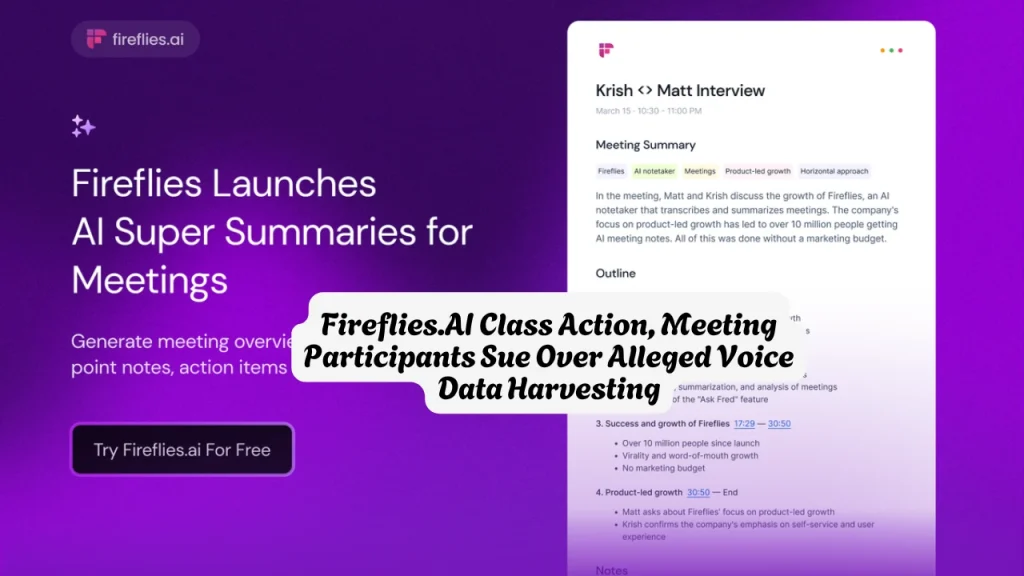
Fireflies.AI provides an artificial intelligence service that users “invite” to virtual meetings on platforms like Zoom, Google Meet, and Microsoft Teams. Once present, the bot records the audio, transcribes the conversation, and provides summaries. Consumers often use the tool to automate administrative tasks, trusting the platform to handle sensitive workplace discussions securely.
The lawsuit was triggered by allegations that the bot’s “auto-join” feature allows it to record participants who never signed up for the service themselves. According to the complaint, lead plaintiff Ethan Fricker participated in meetings where the bot was present but never provided permission for his vocal characteristics to be analyzed. The legal action was initiated to address concerns that AI companies are bypassing state-level privacy safeguards to train their models.
What Does the Lawsuit Allege?
The complaint alleges that Fireflies.AI uses sophisticated software to create “voiceprints”—unique digital identifiers that map a person’s vocal geometry. According to the complaint, this data is used for “Speaker Recognition” to distinguish between different people in a transcript. The plaintiff claims that this process constitutes the collection of biometric identifiers, which are highly sensitive and cannot be changed if a data breach occurs.
Furthermore, the lawsuit alleges that Fireflies.AI fails to provide the specific legal notices required by law. Specifically, the complaint claims the company does not inform non-users in writing that their biometrics are being harvested, nor does it publish a clear schedule for when that data will be permanently destroyed. The plaintiff alleges that Fireflies.AI essentially “eavesdrops” on participants who have no direct contractual relationship with the company.
What Laws Were Allegedly Violated?
- Informed Consent Requirements (BIPA Section 15(b)): This law requires private entities to obtain a written release before collecting an individual’s biometric data.
- Data Retention Policy Disclosure (BIPA Section 15(a)): This requires companies to publish a written policy establishing a retention schedule and guidelines for permanently destroying biometric data.
- Prohibition on Profiting (BIPA Section 15(c)): This law prevents companies from selling or otherwise profiting from an individual’s biometric identifiers.
Who Does This Lawsuit Affect?
- You may be affected if you participated in a virtual meeting (Zoom, Teams, etc.) where a Fireflies.ai assistant was present.
- You may be affected if you were physically located in Illinois at the time of the recording.
- You may be affected if you never created a Fireflies account but your voice was captured by another user’s bot.
- You may be affected if your voice was recorded within the last five years.
No action is required right now. Save any meeting invitations, calendar links, or confirmation emails that show a Fireflies bot was present during your calls — these may matter if a settlement is reached.
Related article: GM Class Action, Drivers Claim Popular SUVs Have Dangerous Brake Failures
What Is the Company Saying?
Fireflies.AI Corp. has not issued a public statement in response to the lawsuit as of March 23, 2026. However, the company’s current Terms of Service and Data Processing Addendum state that customers are responsible for ensuring they have “suitable safeguards” and consents in place before using the service to record third parties. AllAboutLawyer.com will update this article when a formal legal response or motion to dismiss is filed.
What Happens Next?
- Defendant’s Response: Fireflies.AI is expected to file an answer to the complaint or a motion to dismiss by early April 2026.
- Discovery Phase: If the case proceeds, both sides will exchange internal documents and data logs to determine the scale of the collection.
- Class Certification: A judge must decide if the case can officially represent all affected Illinois residents as a single “class.”
- Timeline: Most BIPA cases of this complexity take between 12 and 24 months to reach a resolution, either through a court ruling or a settlement.
This page will be updated as the case develops.
Important Case Dates
| Milestone | Date |
| Lawsuit Filed | March 10, 2026 |
| Defendant Answer Due | TBD (Estimated April 2026) |
| Discovery Period | TBD |
| Class Certification Hearing | TBD |
| Trial Date (if set) | TBD |
| Settlement (if reached) | TBD |
Frequently Asked Questions
Is the Fireflies.AI lawsuit real/legitimate?
Yes. The lawsuit was formally filed in the U.S. District Court for the Northern District of Illinois under case number 1:26-cv-02675. It is an active civil matter involving allegations of state privacy law violations.
Can I file a claim against Fireflies.AI right now?
No. There is no claim form available because the case has not settled. You do not need to “sign up” for the lawsuit at this stage; if it eventually settles, eligible participants will be notified by a court-appointed administrator.
Do I need a lawyer to join this lawsuit?
No. You do not need to hire your own attorney to be part of a class action. The lead plaintiff has already hired Werman Salas P.C. to represent the interests of the entire class of affected individuals.
What happens if the case settles?
If a settlement is reached, a “Settlement Fund” is usually created. Eligible class members would then be able to submit a claim form to receive a portion of that fund after attorney fees and administrative costs are deducted.
Will I get notified if there is a settlement?
Typically, yes. If the company has your email address through meeting metadata, you may receive an email. Otherwise, notice is often provided through public advertisements or dedicated settlement websites once the court approves the plan.
Should I stop using Fireflies.ai because of this?
This is a personal or business decision. The lawsuit alleges that the company’s data collection practices violate Illinois law, but it does not claim the software itself is “malware.” You may want to review your company’s privacy policies.
How much money could I get if this settles?
BIPA allows for $1,000 to $5,000 in statutory damages per violation. However, in large class actions, settlement amounts are often lower and depend on the total number of people who file a valid claim.
Disclaimer: This article is for informational purposes only and does not constitute legal advice. Legal claims and outcomes depend on specific facts and applicable law. For advice regarding a particular situation, consult a qualified attorney.
About the Author
Israr Ahmad is a legal content researcher with 4+ years of experience covering class action settlements and consumer rights cases. He has researched and published coverage of 2,500+ settlements using verified court records, settlement administrator filings, and government sources. Learn more about Israr.