
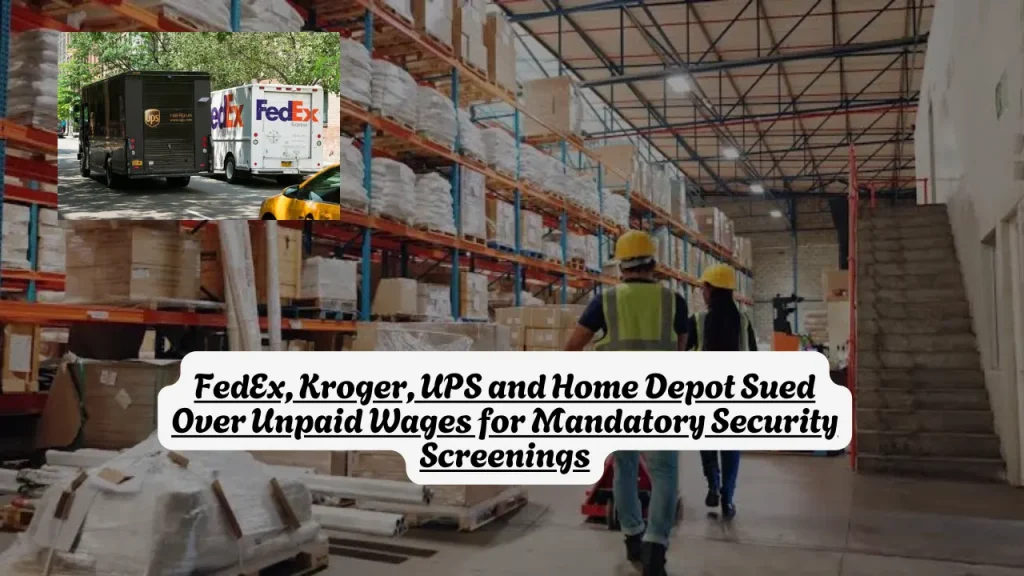
FedEx, Kroger, UPS and Home Depot Sued Over Unpaid Wages for Mandatory Security Screenings
Quick answer: if you worked a shift at FedEx, Kroger, UPS or Home Depot in Colorado or Connecticut and had to pass through a security checkpoint before or after clocking in, you may be owed money. Four separate lawsuits filed in July 2026 claim that screening time, plus related waiting and walking, should have been paid — and wasn’t.
FedEx, Kroger, UPS and Home Depot Wage Lawsuits — Key Facts
| Defendant | Case No. & Court | Filed | Core Allegation |
| FedEx Ground Package System, Inc. & Federal Express Corporation | No. 1:26-cv-03029, U.S. District Court, District of Colorado | July 7, 2026 | Unpaid security screening and locker-walk time |
| The Kroger Co. | No. 1:26-cv-03036, U.S. District Court, District of Colorado | July 7, 2026 | Unpaid screening time, missed rest breaks, deducted meal breaks |
| United Parcel Service, Inc. | No. 1:26-cv-03038, U.S. District Court, District of Colorado | UNVERIFIED — reported filed the same week as the FedEx and Kroger cases | Unpaid screening and “guard shack” walk time, missed rest breaks |
| Home Depot U.S.A., Inc. | No. 3:26-cv-01084, U.S. District Court, District of Connecticut | UNVERIFIED — exact date not independently confirmed | Unpaid badge-scan and screening time |
| Settlement Status | No settlement. No class certified in any of the four cases. | ||
| Last Updated | July 25, 2026 |
Why Are FedEx, Kroger, UPS and Home Depot Being Sued Over Security Screening Pay?
All four companies require warehouse or distribution workers to pass through a security checkpoint before leaving the building — a step meant to catch employee theft, not to help customers. The lawsuits argue that once a company keeps someone on its property for that step, state wage law says it has to pay for the time.
What’s specific to each case, based on the allegations:
- FedEx — workers weren’t allowed to carry phones onto the floor, so they had to walk to a locker both before and after the metal-detector line.
- Kroger — the complaint adds a second proposed class of delivery drivers who say they lost 3 to 5 minutes a shift gathering and returning equipment at a dispatch office.
- UPS — workers allegedly spent 10 to 15 minutes walking between a checkpoint called the “guard shack” and their workstations, plus 2 to 4 minutes logging into the timekeeping system.
- Home Depot — employees had to scan an ID badge to enter the warehouse on top of the screening line. This isn’t Home Depot’s first wage and hour fight in the past year.
Why State Law, Not Federal Law, Is Doing the Work Here
None of these four lawsuits lean on the federal wage law most people have heard of. That’s not an accident. In 2014, the U.S. Supreme Court ruled in Integrity Staffing Solutions v. Busk that security screening time isn’t compensable under the federal Fair Labor Standards Act, because screenings aren’t “integral and indispensable” to the actual job. That ruling has shielded employers from this exact claim for over a decade.
These four cases route around it. Colorado never adopted the federal Portal-to-Portal Act, so its “continuous workday” rule can still require pay for screening and walking time that federal law wouldn’t touch. Connecticut’s route is even more direct: in February 2026, the Connecticut Supreme Court ruled in Del Rio v. Amazon.com Services that mandatory screening time counts as compensable “hours worked” under state law, with no exception carved out for small amounts of time. The Home Depot complaint cites that decision directly.
In plain terms: FedEx, Kroger, UPS and Home Depot have all won this fight before, under federal law. These four lawsuits are betting that state law is different — and in Connecticut, a court has already said it is.
Related article: Tesla Supercharger Idle Fee Settlement, Check If You Qualify — Shenkman v. Tesla, Inc., No. RG21102833
Are You Part of One of These Wage Lawsuits?
Here’s exactly how to know if any of the four includes you.
- Current or former employees who completed a security screening at a FedEx, Kroger or UPS facility in Colorado in the three years before each complaint was filed may be covered by that company’s proposed class.
- A former Home Depot warehouse worker in Connecticut who went through the same kind of screening may be covered by that separate case.
- Kroger delivery drivers who lost equipment-handling time at a dispatch office fall under a second, separate proposed class in that lawsuit.
- UPS hourly employees who were denied a 10-minute break every four hours fall under a second, separate proposed class in that lawsuit.
- Workers outside Colorado or Connecticut aren’t covered by these four specific cases — but the underlying issue may still apply under your own state’s wage law.
FedEx, Kroger, UPS and Home Depot Workers Outside Colorado and Connecticut — Are You Still Covered?
Not by these four cases specifically. Each lawsuit is built on the wage law of one state — Colorado for three of them, Connecticut for Home Depot — and only covers work performed there. If you went through the same kind of screening somewhere else, whether you have a claim depends entirely on your own state’s wage-and-hour law, since Busk closed the federal door on this theory back in 2014.
Not sure if your state protects you the way Colorado and Connecticut do? A free consultation with a wage and hour attorney or consumer rights lawyer can tell you whether your own state treats screening time the same way — before you assume you have no claim.
If you clocked out but stayed on company property waiting your turn at a metal detector, that time might not have been yours to give away for free.
What Are Workers Asking the Court to Award?
All four lawsuits seek the same basic categories: unpaid minimum and overtime wages for the screening and related time, statutory penalties, interest, and attorneys’ fees. Each includes a jury trial demand. No settlement fund exists yet, and there’s no claim form to fill out for any of the four cases — all are still at the complaint stage, with compensation for damages still months or years away if they ever resolve.
What Could FedEx, Kroger, UPS or Home Depot Workers Receive If These Cases Resolve?
Impossible to say yet. Wage and hour recoveries typically come down to how many minutes a court finds compensable per shift, multiplied by shifts worked over up to three years, plus whatever penalties a given state’s law adds on top. Talk to a class action lawsuit attorney if you think your own screening time adds up — a free consultation costs nothing, and documenting your hours now beats trying to reconstruct them later.
Ten to fifteen minutes a day doesn’t sound like much until you multiply it by every shift over three years. That’s the math all four of these lawsuits are built on.
What Should FedEx, Kroger, UPS and Home Depot Workers Do Right Now?
- Figure out which case might apply to you: Colorado work history points to FedEx, Kroger or UPS; Connecticut work history points to Home Depot.
- Save your documentation now — pay stubs, shift schedules, and anything showing when you clocked in versus when you actually left the building.
- If you’re still working there, time yourself. Note how long the checkpoint line, locker walk, or badge scan actually takes.
- There’s no lead plaintiff deadline yet since none of these are certified classes — but wage claims run on their own statute-of-limitations clock, so don’t sit on it.
- Monitor the dockets: Nos. 1:26-cv-03029, 1:26-cv-03036 and 1:26-cv-03038 in the District of Colorado, and No. 3:26-cv-01084 in the District of Connecticut.
- If your state isn’t Colorado or Connecticut, an individual claim under your own state’s wage law may still be worth a conversation with a wage and hour attorney. FedEx and UPS drivers have seen this kind of multi-case pileup before — it’s a familiar pattern in logistics wage disputes.
FedEx, Kroger, UPS and Home Depot Wage Lawsuits — Full Timeline
| Milestone | Date |
| Connecticut Supreme Court decides Del Rio v. Amazon.com Services | February 10, 2026 |
| Abeyta v. FedEx Ground complaint filed, D. Colorado | July 7, 2026 |
| Curtis v. Kroger complaint filed, D. Colorado | July 7, 2026 |
| Reeves v. UPS complaint filed, D. Colorado | UNVERIFIED — reported filed the same week as the FedEx and Kroger cases |
| Hite-Reid v. Home Depot complaint filed, D. Connecticut | UNVERIFIED — exact date not independently confirmed |
| Next scheduled hearing (any case) | UNVERIFIED — requires PACER access to confirm |
| Expected resolution | UNVERIFIED — all four cases are in their earliest stages |
FedEx, Kroger, UPS and Home Depot Wage Lawsuits — Frequently Asked Questions, Nos. 1:26-cv-03029, 1:26-cv-03036, 1:26-cv-03038 and 3:26-cv-01084
Is there a real lawsuit against FedEx, Kroger, UPS and Home Depot for unpaid wages?
Yes — four separate complaints, not one combined case. FedEx, Kroger and UPS were sued in the U.S. District Court for the District of Colorado (Nos. 1:26-cv-03029, 1:26-cv-03036 and 1:26-cv-03038), and Home Depot was sued separately in the U.S. District Court for the District of Connecticut (No. 3:26-cv-01084).
Do I need to do anything right now to be part of one of these lawsuits?
No. None of the four cases has a certified class yet. If you think you’re covered by one of them, saving your documentation now matters more than trying to file anything today.
When will the FedEx, Kroger, UPS or Home Depot wage cases settle?
There’s no timeline. All four were filed in July 2026 and remain in their earliest stages, with no class certification, settlement, or trial date set as of this writing.
Can I file my own lawsuit instead of waiting for one of these four cases?
Yes, if your state has its own wage-and-hour law covering on-premises time the way Colorado and Connecticut do. A wage and hour attorney can review your state’s law and your work history for free.
How will I find out if these cases move toward a class action or settlement?
Court dockets are public. You can track Nos. 1:26-cv-03029, 1:26-cv-03036 and 1:26-cv-03038 through the District of Colorado’s PACER system, and No. 3:26-cv-01084 through the District of Connecticut’s system.
Why did these lawsuits use state law instead of federal wage law?
Because the U.S. Supreme Court ruled in Integrity Staffing Solutions v. Busk that security screening time isn’t compensable under the federal Fair Labor Standards Act. Colorado and Connecticut wage laws don’t carry that same limit.
What specific laws do FedEx, Kroger, UPS and Home Depot allegedly violate?
The Colorado cases cite Colorado wage-and-hour regulations and the state’s “continuous workday” rule. The Home Depot case cites Connecticut General Statutes § 31-76b(2)(A), the same law applied against Amazon in Del Rio.
How much could workers get if these cases succeed?
It depends on how many minutes per shift a court finds compensable, multiplied by shifts worked over up to three years, plus whatever penalties, interest and attorneys’ fees apply. Nothing is guaranteed at this stage.
Sources Used in This FedEx, Kroger, UPS and Home Depot Wage Lawsuit Article
- Court Docket — Abeyta, et al. v. Fedex Ground Package System, Inc., et al., No. 1:2026cv03029, U.S. District Court for the District of Colorado, filed July 7, 2026: https://dockets.justia.com/browse/state-colorado/court-codce
- Court Docket — Curtis, et al. v. The Kroger Co., No. 1:2026cv03036, U.S. District Court for the District of Colorado, filed July 7, 2026: https://dockets.justia.com/browse/state-colorado/court-codce
- Court Docket — Hite-Reid v. Home Depot U.S.A., Inc., No. 3:26-cv-01084, U.S. District Court for the District of Connecticut: https://www.pacermonitor.com/public/case/65586534/HiteReid_v_Home_Depot_USA,_Inc
- U.S. Supreme Court Opinion — Integrity Staffing Solutions, Inc. v. Busk, 574 U.S. 27 (2014): https://supreme.justia.com/cases/federal/us/574/27
- Connecticut Supreme Court Opinion — Del Rio v. Amazon.com Services, Inc., 354 Conn. 151 (2026), officially released February 10, 2026: https://www.jud.ct.gov/external/supapp/Cases/AROcr/CR354/CR354.16.pdf
Researched and written by Israr Ahmad, legal content researcher and founder of AllAboutLawyer.com. All facts verified against official court records and the sources listed above on July 25, 2026. Last Updated: July 25, 2026.
This article is for informational purposes only and does not constitute legal advice. Laws vary by state and individual circumstances differ. For advice about your specific situation, consult a qualified attorney.
About the Author
Israr Ahmad is a legal content researcher with 4+ years of experience covering class action settlements and consumer rights cases. He has researched and published coverage of 2,500+ settlements using verified court records, settlement administrator filings, and government sources. Learn more about Israr.