
ECI Deployment Termination Lawsuit, Were You Treated the Same Way? — Jones v. Electrical Components International
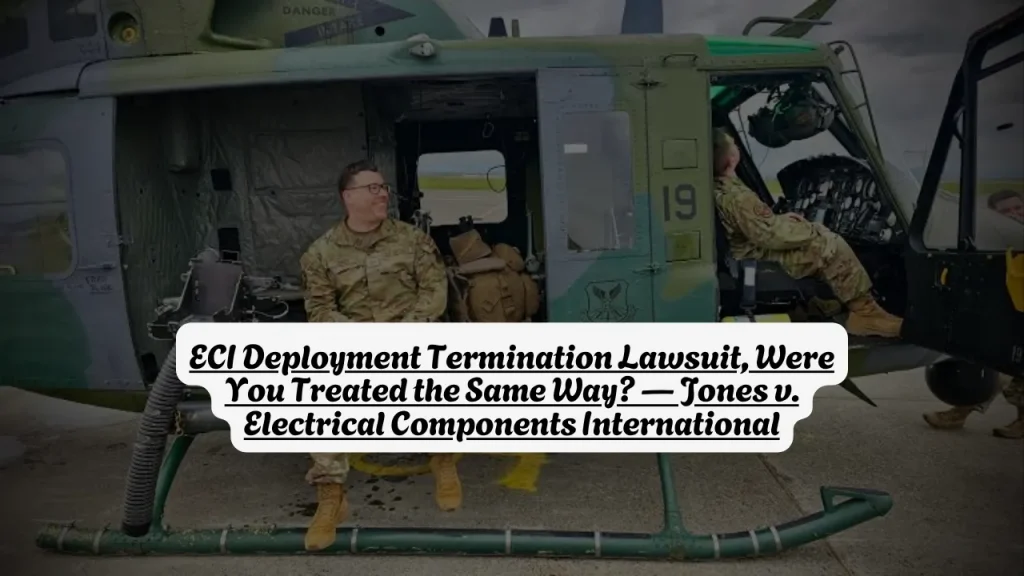
If you’ve ever told your employer about a deployment and watched things quietly change afterward — fewer meetings, less communication, a sudden “performance concern” out of nowhere — this case is worth reading closely. A Michigan Air National Guardsman is now suing his former employer, claiming they used his upcoming deployment as the real reason for firing him, then dressed it up as a performance issue.
ECI USERRA Lawsuit — Key Facts
| Field | Detail |
| Plaintiff | Christopher Jones, Royal Oak, Michigan — cybersecurity engineer, Michigan Air National Guard |
| Defendant | Electrical Components International (ECI) |
| Court | U.S. District Court, Eastern District of Michigan |
| Case Number | UNVERIFIED — not disclosed in current reporting |
| Lawsuit Filed | Early July 2026 |
| Alleged Harm | Termination shortly after disclosing a six-month active-duty deployment |
| Law Alleged | Uniformed Services Employment and Reemployment Rights Act (USERRA), 38 U.S.C. §4301 et seq. |
| Plaintiff’s Attorney | Tad Roumayah, Sommers Schwartz (Southfield, Mich.) |
| Remedies Sought | Back pay, lost wages, lost benefits, liquidated damages, attorneys’ fees |
| Case Type | Individual lawsuit — not a class action |
| Current Stage | Early litigation, recently filed |
| Last Updated | July 22, 2026 |
Who Is Electrical Components International, and What Is Christopher Jones Accusing Them Of?
Electrical Components International (ECI) is a Delaware-incorporated company with its main office in Southfield, Michigan, where it makes wiring and electrical components. Jones started there as a global cybersecurity engineer on March 31, 2025 — a role the lawsuit says he performed “in an exemplary manner,” with no write-ups or discipline of any kind before the events that led to his firing.
What Did ECI Allegedly Do After Jones Disclosed His Deployment?
Jones told ECI in April 2025 that he’d need time off for military training in early June. Then, in early May, the Air Force notified him he’d be activated for six months starting that September. He passed that news to ECI right away, on or around May 5.
That’s when the lawsuit says things shifted. Jones was allegedly cut out of meetings he used to attend regularly. His supervisor, IT infrastructure and operations director Scott Loney, allegedly stopped looping him into communications relevant to his own job.
On May 27, Loney called Jones in over a work matter that had come up during Memorial Day weekend — one Jones hadn’t responded to immediately because he was dealing with a sick family member. Jones says he’d never been told he had to be reachable on weekends with no notice. Loney allegedly told him ECI expected him available “24/7.” That same day, Loney sent an email titled “Cybersecurity Role Expectations” laying out concerns the two had supposedly never discussed in person.
Jones went to his week of military training on June 2, came back June 9, and one week later — June 16 — he was fired for “poor performance.” The lawsuit says ECI never actually specified what that poor performance was.
Losing a job over military service isn’t just bad management — it’s exactly what federal law was written to stop.
Related article: Cadillac Vistiq Third-Row Seat Recall, Third-Row Seat Trap Risk, Is Your SUV Affected?
Does This Match What Happened to You?
Jones isn’t the only guardsman or reservist who’s run into this. If you’ve experienced something similar, here’s the pattern USERRA claims tend to follow:
- Your employer knew about your military obligation before things changed at work.
- You started getting excluded from meetings, projects, or communication you’d previously been part of.
- New “expectations” or performance concerns showed up in writing right around the same time — often with no prior discussion.
- You were disciplined or fired using vague language (“poor performance,” “not a good fit”) without specifics.
- You had a clean record beforehand, with no history of write-ups.
USERRA covers members of the National Guard and Reserve, as well as anyone called to active duty, and it applies to virtually every U.S. employer regardless of size. Where you’re stationed or deployed doesn’t change your rights — this is federal law, and it applies the same way in every state.
Think your situation matches this pattern? A free consultation with an employment discrimination attorney who handles USERRA cases can tell you whether you have a claim worth pursuing.
What Can You Actually Recover Under USERRA?
There’s no payout figure attached to Jones’ case yet — his attorney has said only that he intends to “pursue every remedy to the fullest.” But USERRA lays out what’s available if a claim succeeds:
- Back pay and lost wages for the time you were out of work
- Lost benefits you would have kept if you hadn’t been let go
- Liquidated damages, which can double the amount owed if the violation was willful
- Reasonable attorneys’ fees and litigation costs, so a claim doesn’t require paying out of pocket up front
That last point matters — it’s part of why USERRA claims exist as a real option even for someone rebuilding their finances after a deployment, not just people who can afford a long legal fight.
What Should You Do If You Think Your Employer Violated USERRA?
- Write down the timeline — when you told your employer about your service, and what changed afterward.
- Save everything in writing: emails, performance notices, texts, anything that shows the sequence of events.
- Note any communication that mentions your deployment or military status directly, even in passing.
- Contact the Department of Labor’s Veterans’ Employment and Training Service (VETS), which investigates USERRA complaints, or an employment attorney directly — you can do either first.
- Don’t sign a severance agreement or release before an attorney reviews it.
- Act relatively soon — while USERRA doesn’t have the short deadlines some employment laws do, evidence and witness memory fade fast.
ECI USERRA Lawsuit — Frequently Asked Questions
What is Christopher Jones suing Electrical Components International for?
Jones alleges ECI violated USERRA by terminating him shortly after he disclosed an upcoming six-month military deployment, using a vague “poor performance” claim he says was never substantiated.
Is this a class action lawsuit?
No. This is an individual lawsuit filed by one plaintiff. There’s no class to join, but the underlying law — USERRA — protects any service member who experiences similar treatment from their own employer.
What is USERRA and who does it protect?
USERRA is the federal law that protects National Guard members, reservists, and other uniformed service members from being fired, demoted, or discriminated against because of their military obligations.
How much money is Christopher Jones seeking from ECI?
No specific dollar figure has been disclosed. His attorney has said the case will pursue back pay, lost benefits, liquidated damages, and attorneys’ fees available under USERRA.
Can my employer legally fire me for being deployed?
No. Federal law prohibits terminating an employee because of military service obligations, and employers generally can’t use a deployment as cover for a pretextual performance issue either.
What should I do if I think I was fired for the same reason as Christopher Jones?
Document the timeline of what happened, save any written communication, and speak with an employment attorney who handles USERRA claims or file a complaint with the Department of Labor’s VETS office.
Sources Used in This Article
- Military.com — Air Force Guardsman Allegedly Fired by Employer Due to Being Deployed: Lawsuit, July 21, 2026: https://www.military.com/air-force-guardsman-allegedly-fired-by-employer-due-to-being-deployed
- U.S. Department of Justice — Guide to the Uniformed Services Employment and Reemployment Rights Act: https://www.justice.gov/servicemembers/page/file/1245336/dl?inline
- U.S. Department of Labor — USERRA Compliance Assistance Materials: https://www.dol.gov/node/103119
Researched and written by Israr Ahmad, legal content researcher and founder of AllAboutLawyer.com. Facts verified against Military.com’s reporting and federal USERRA guidance on July 22, 2026. Last Updated: July 22, 2026.
This article is for informational purposes only and does not constitute legal advice. Laws vary by state and individual circumstances differ. For advice about your specific situation, consult a qualified attorney.
About the Author
Israr Ahmad is a legal content researcher with 4+ years of experience covering class action settlements and consumer rights cases. He has researched and published coverage of 2,500+ settlements using verified court records, settlement administrator filings, and government sources. Learn more about Israr.