
Dove Collagen Body Wash Lawsuit, Fitzgerald v. Unilever Says “Vegetable Collagen” Isn’t Collagen
A New York woman is suing Unilever over a bottle of Dove body wash. Her complaint says the front label promises collagen, the ingredient list names only “Vegetable Collagen,” and plants do not make collagen at all.
The case is Fitzgerald v. Unilever United States Inc., Case No. 1:26-cv-01488, filed July 31, 2026 in the U.S. District Court for the Northern District of New York. It is a putative class action. No class has been certified, Unilever has not been found liable for anything, and there is no settlement, no claim form and no money to claim right now.
Dove Collagen Body Wash Lawsuit Quick Facts
| Detail | Information |
| Case name | Fitzgerald v. Unilever United States Inc. |
| Case number | 1:26-cv-01488 |
| Court | U.S. District Court, Northern District of New York |
| Judges | District Judge Mae A. D’Agostino; Magistrate Judge Daniel J. Stewart |
| Date filed | July 31, 2026 |
| Plaintiff | Lillian Fitzgerald, Rensselaer, New York |
| Defendant | Unilever United States, Inc. (Delaware corporation, principal place of business in Hoboken, New Jersey) |
| Product | Dove Vitality Renewal Firming Body Wash, labeled “4% Restoring Serum with Collagen” |
| Core allegation | The label and online listings say the product contains collagen, but the ingredient list shows only “Vegetable Collagen,” a plant-derived ingredient |
| Plaintiff’s attorneys | Adrian Gucovschi and Nathaniel H. Sari, Gucovschi Law Firm, PLLC |
| Proposed subclasses | Buyers in 32 jurisdictions: New York, the District of Columbia and 30 other states |
| Jury demanded? | Yes, by the plaintiff |
| Status | Complaint filed; no class certified; no settlement |
| Next scheduled dates | Case management plan and mandatory disclosures due October 26, 2026; initial conference November 2, 2026 at 10:00 a.m. in Albany |
| Money available to claim? | No |
What the Fitzgerald v. Unilever Complaint Says About Dove Vitality Renewal Firming Body Wash
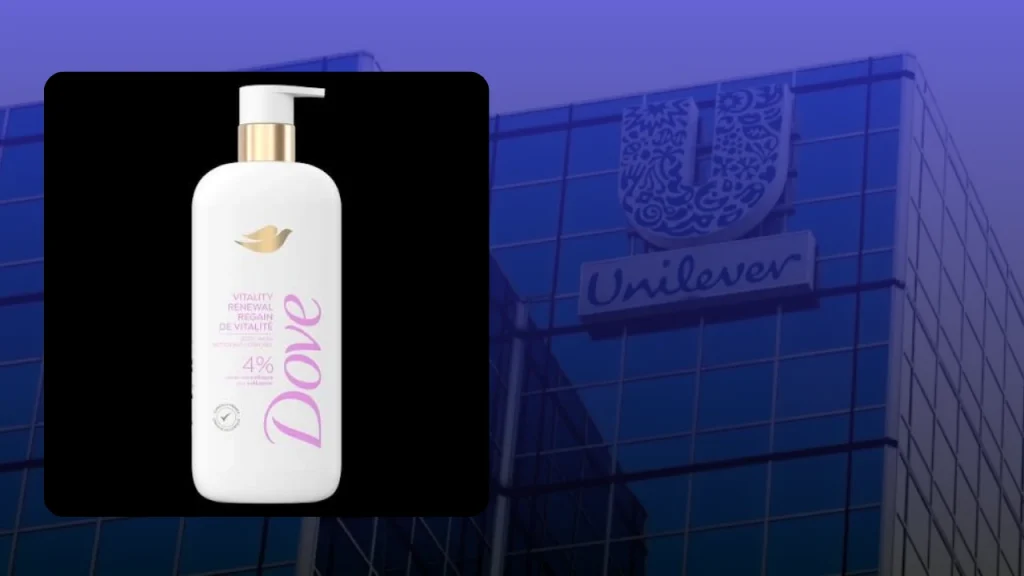
The complaint focuses on one product. The front label of Dove Vitality Renewal Firming Body Wash reads “4% Restoring Serum with Collagen.” According to the complaint, Dove’s online listing goes further. A “what’s in it” graphic lists “Collagen” as an ingredient, and the product copy describes the wash as made with ingredients “inspired by face care like Vitamin C, Hyaluronic Acid, and Collagen.”
The back of the bottle tells a different story. The complaint says the ingredient list shows only “Vegetable Collagen.” Fitzgerald’s lawyers call that a plant-derived imitation that “is not, and cannot be, genuine collagen.”
The argument rests on basic biology. The complaint says collagen is a structural protein found in humans and animals, mainly in connective tissue like skin, bones and cartilage, and that it is not found in plants. It calls the phrase “vegetable collagen” an oxymoron.
The complaint also says Unilever knew exactly what was in the bottle. It alleges the company formulated the product, picked every ingredient, approved the packaging and wrote “Vegetable Collagen” on the ingredient list itself. On cost, it alleges that using a plant ingredient is cheaper than using genuine collagen and likely widens Unilever’s profit margin.
These are allegations. The court has not decided whether the label or online marketing would mislead a reasonable consumer. The complaint does not claim the body wash is unsafe. The case is about what the label promised and what buyers paid for it.
Who Is Lillian Fitzgerald and What Did She Buy From Unilever?
Fitzgerald lives in Rensselaer, New York. The complaint says she bought the body wash for her own use around July 2025 on Walmart’s website. She saw it labeled and marketed as containing collagen, understood that as a promise of genuine collagen, and paid what the complaint calls a price premium because of it. She says she would not have bought it, or would have paid less, had she known what the complaint alleges about the ingredient.
On August 6, 2025, her lawyers sent Unilever a written notice and demand by certified mail, addressed to the company’s counsel in Hoboken and to its registered agent in Wilmington, Delaware. The complaint says Unilever did not fix the problem and the labeling is unchanged. The letter matters legally because several claims, including the New York warranty claim, depend on the seller getting notice and a chance to cure before suit.
Related article: Costa Del Mar $21.75M Sunglasses Repair Fee Settlement, Who Qualifies, How to Claim and Key Deadlines
Claims Against Unilever United States, Inc. in the Putative Class Action
The complaint pleads 35 counts, which fall into four groups.
New York General Business Law §§ 349 and 350 (Counts I and II). These are New York’s deceptive practices and false advertising statutes. The complaint says Fitzgerald brings the § 349 claim under the statute’s deceptive prong. For New York buyers it asks for the greater of actual damages or $50 under § 349, and the greater of actual damages or $500 under § 350, with the court free to increase the awards up to three times actual damages (capped at $1,000 and $10,000) if the conduct was willful or knowing.
Consumer protection laws of 31 other jurisdictions (Counts III through XXXIII). Each count invokes the consumer protection statute of another state or the District of Columbia. Remedies differ by jurisdiction. Some allow treble damages, some allow punitive damages and some set statutory minimums.
Breach of express warranty, New York only (Count XXXIV). The complaint says the “Collagen” statement on the front label was a specific, verifiable promise about the product and part of the basis of the bargain, and that it was false. It says the statement is not puffery.
Unjust enrichment (Count XXXV). This is pleaded in the alternative on behalf of every subclass. It asks the court to make Unilever give back the premium it allegedly collected for the collagen claim.
The complaint seeks class certification, compensatory, statutory and punitive damages, prejudgment interest, restitution, and attorneys’ fees and costs, and it demands a jury trial. These are requests, not awards.
New York Law Behind the Fitzgerald v. Unilever Collagen Claims
This section explains the legal framework the complaint relies on. It is background and does not add claims.
N.Y. General Business Law § 349. Section 349 makes deceptive acts or practices in the conduct of business in New York unlawful. New York courts generally ask whether the practice was consumer-oriented, whether it was misleading in a material way, and whether the plaintiff was injured as a result. The standard for “misleading” is an objective one: whether the label would mislead a reasonable consumer acting reasonably under the circumstances. The statute lets a person who is injured sue for actual damages or $50, whichever is greater, and lets the court increase damages up to three times actual damages, up to $1,000, if the violation was willful or knowing. It also allows a court to award reasonable attorneys’ fees to a prevailing plaintiff.
N.Y. General Business Law § 350. Section 350 prohibits false advertising. Its remedy is the greater of actual damages or $500, with the court able to increase it up to three times actual damages, capped at $10,000, for willful or knowing violations.
Express warranty under New York law. An express warranty arises from an affirmation of fact or promise about goods that becomes part of the basis of the bargain. Under the Uniform Commercial Code as adopted in New York, a buyer who has accepted goods generally must notify the seller of a breach within a reasonable time. That is why the August 6, 2025 demand letter appears in the complaint.
Federal cosmetic labeling background. Cosmetics sold in the United States must list ingredients under FDA rules (21 C.F.R. § 701.3), and a cosmetic can be treated as misbranded if its labeling is false or misleading (21 U.S.C. § 362). The federal Food, Drug, and Cosmetic Act does not give private individuals a right to sue under it directly (21 U.S.C. § 337(a)), which is why consumer cases like this one are brought under state consumer protection and warranty laws. The complaint here relies on state law, and the docket lists the basis for federal jurisdiction as 28 U.S.C. § 1332.
Class certification. Whether a class is certified is decided under Federal Rule of Civil Procedure 23. A judge must find that the proposed group meets the Rule’s requirements before any class exists. Nothing in the docket shows a motion for certification has been filed.
Who Could Be in the Proposed Dove Collagen Subclasses?
The complaint asks the court to certify separate subclasses of people who bought the body wash for personal, family or household use, and not for resale, in each of 32 jurisdictions: New York, the District of Columbia and 30 other states.
Those states are Alaska, Arizona, California, Colorado, Delaware, Florida, Hawaii, Idaho, Illinois, Kansas, Kentucky, Maryland, Michigan, Minnesota, Missouri, Nebraska, Nevada, New Hampshire, New Jersey, New Mexico, North Carolina, North Dakota, Oklahoma, Oregon, Pennsylvania, Rhode Island, South Dakota, Vermont, Virginia and Washington.
Nothing here makes anyone a class member yet. A judge decides whether to certify a class, and none has. The complaint also reserves the right to change the class definitions later and to add more. A plaintiff who bought in New York will also have to show she can represent buyers in the other jurisdictions, which is a common point of dispute in multistate consumer cases.
Earlier Collagen Labeling Cases Cited in the Fitzgerald Complaint
Fitzgerald’s lawyers lean on prior decisions. The complaint cites Kandel v. Dr. Dennis Gross Skincare, LLC, 721 F. Supp. 3d 291 (S.D.N.Y. 2024), and quotes it for the statement that collagen is “a protein found exclusively in humans and animals.” It also cites Gunaratna v. Dennis Gross Cosmetology LLC, a 2023 decision from the Central District of California. The complaint’s reading of both is that courts have found it plausibly misleading to advertise a cosmetic as containing collagen when it holds only a plant-derived substitute.
That is the plaintiff’s framing. A ruling at the motion-to-dismiss stage says a claim can go forward, not that the claim is right, and the facts of each product differ.
Dove has faced consumer labeling suits before. For a recent example involving the same brand, read Dove Deodorant Class Action Lawsuit, Dove Men+Care “Alcohol-Free” Deodorant Actually Contains Alcohol—New Class Action Filed Days Before New Year. That is a separate lawsuit over a different product.
Dove Collagen Lawsuit Timeline
| Date | Event |
| About July 2025 | Fitzgerald buys the body wash on Walmart’s website (per the complaint) |
| August 6, 2025 | Her lawyers send Unilever a written notice and demand for corrective action |
| July 31, 2026 | Complaint filed in the Northern District of New York; summons issued August 3, 2026 |
| August 17, 2026 | Attorney Adrian Gucovschi files a notice of appearance |
| October 26, 2026 | Civil case management plan and mandatory disclosures due |
| November 2, 2026, 10:00 a.m. | Initial conference before Magistrate Judge Daniel J. Stewart in Albany |
The public docket we reviewed was last retrieved on August 17, 2026, and shows no response from Unilever. Check PACER for anything filed since.
What Happens Next in Fitzgerald v. Unilever?
Unilever has several options. It can answer the complaint, ask the court to dismiss some or all of the claims, or negotiate. This article relies on the complaint and the public docket, so any response from Unilever is not reflected here.
Cases like this one usually turn on early motions. A federal court will look at whether the label would plausibly mislead a reasonable consumer, whether a plaintiff who bought in New York can pursue claims for buyers in 31 other jurisdictions, and whether each claim was adequately pleaded. If any claims survive, the next step is a motion for class certification. A settlement, if one ever comes, would be announced with court approval and a claims process. The scheduled October 26 and November 2 dates are procedural milestones. They do not mean the judge has accepted the allegations.
What Should Dove Vitality Renewal Body Wash Buyers Do Right Now?
There is no claim form to file, no deadline to meet and no money on offer. If you bought the body wash, keeping the receipt, online order confirmation or a photo of the label and ingredient list is a reasonable habit. Claim processes in later settlements often ask what you bought and where. You do not need to contact the court or the law firm to stay eligible for anything, because nothing has been opened.
Be careful with websites or messages claiming a payment is already available for this lawsuit. None has been announced.
For a look at how a settled false advertising case works once money is on the table, read Balance of Nature $9.95M False Advertisement Class Action Settlement: Who Qualifies, How to File by March 11, 2026.
Frequently Asked Questions About the Dove Collagen Body Wash Lawsuit
What is the Dove collagen body wash lawsuit about?
Fitzgerald v. Unilever United States Inc. is a putative class action alleging that Dove Vitality Renewal Firming Body Wash is marketed as containing collagen when its ingredient list shows only “Vegetable Collagen,” which the complaint says is not collagen.
Which Dove product does the Fitzgerald v. Unilever lawsuit cover?
One product: Dove Vitality Renewal Firming Body Wash, labeled “4% Restoring Serum with Collagen.”
Can I join the Unilever Dove collagen lawsuit or claim money?
Not at this point. No class has been certified, and there is no settlement or claim form. If a class is certified or the case settles, notice would go out through the court process.
Which states does the proposed Dove collagen class cover?
The complaint proposes subclasses for buyers in New York, the District of Columbia and 30 other states, listed above. It is a proposal only.
Who is suing Unilever over Dove body wash, and who represents her?
Lillian Fitzgerald of Rensselaer, New York, represented by Adrian Gucovschi and Nathaniel H. Sari of Gucovschi Law Firm, PLLC.
Has a court ruled that Dove Vitality Renewal Firming Body Wash is falsely advertised?
No. The docket shows no ruling on the merits. The complaint’s statements are unproven allegations, and Unilever has not been found liable.
Does the lawsuit say Dove body wash is unsafe?
No. The complaint is about the accuracy of the collagen claim and the price buyers paid. It does not allege the body wash caused injuries.
What does Fitzgerald want from Unilever?
The complaint seeks class certification, compensatory, statutory and punitive damages, prejudgment interest, restitution, and attorneys’ fees and costs. It also demands a jury trial.
When will the Dove collagen case be decided?
There is no decision date. The case must move through the federal process, which can include motions to dismiss, discovery and a class certification decision. A settlement or trial could come later, but neither is guaranteed.
Update Log
| Date | Update |
| October 14, 2026 | Article published, based on the complaint filed July 31, 2026 and the public docket |
Sources
- Class Action Complaint, Fitzgerald v. Unilever United States, Inc., Case No. 1:26-cv-01488 (N.D.N.Y. filed July 31, 2026), Document 1, via CourtListener: https://storage.courtlistener.com/recap/gov.uscourts.nynd.155279/gov.uscourts.nynd.155279.1.0.pdf
- Docket, Fitzgerald v. Unilever United States, Inc., Justia Dockets (last retrieved by Justia August 17, 2026): https://dockets.justia.com/docket/new-york/nyndce/1%3A2026cv01488/155279
- N.Y. General Business Law § 349, New York State Senate: https://www.nysenate.gov/legislation/laws/GBS/349
This article is general information, not legal advice. The lawsuit contains allegations that have not been proven in court, and laws vary by state. For advice about your situation, consult a qualified attorney.
Researched and written by Israr Ahmad, legal content researcher and founder of AllAboutLawyer.com. All facts verified against the complaint filed in Fitzgerald v. Unilever United States Inc. (N.D.N.Y., Case No. 1:26-cv-01488, Document 1), the public court docket and the New York State Senate’s published text of N.Y. General Business Law § 349, as of October 14, 2026. Last Updated: October 14, 2026.
About the Author
Israr Ahmad is a legal content researcher with 4+ years of experience covering class action settlements and consumer rights cases. He has researched and published coverage of 2,500+ settlements using verified court records, settlement administrator filings, and government sources. Learn more about Israr.