
DOJ Backs OpenAI and Microsoft Against The New York Times, The Full Story
The Justice Department has stepped into one of the most consequential copyright cases of the AI era — and it picked a side. On September 2, 2026, the government told a Manhattan federal court that OpenAI and Microsoft did not break copyright law when they trained ChatGPT on New York Times articles, framing a healthy AI industry as a matter of national security. It’s the first time the DOJ has weighed in on any AI copyright case. Here’s the full background, the law both sides are fighting over, and what happens next.
At a Glance
| Case Name | The New York Times Co. v. Microsoft Corp. et al. |
| Court & Docket | U.S. District Court, Southern District of New York, No. 1:23-cv-11195 |
| Judge | Sidney H. Stein |
| Filed | December 27, 2023 |
| Plaintiffs | The New York Times, Daily News (8 newspapers including NY Daily News and Chicago Tribune), Center for Investigative Reporting |
| Defendants | OpenAI and Microsoft |
| Core Claims | Direct and contributory copyright infringement, trademark dilution; some DMCA claims narrowed by the court |
| DOJ Filing | Statement of interest filed Sept. 1, 2026, backing OpenAI and Microsoft |
| Current Deadline | Summary judgment motions due Friday, Sept. 4, 2026 |
| Damages Sought | Times says “billions of dollars” in statutory and actual damages; no specific figure has been publicly quantified |
| Last Updated | September 3, 2026 |
How the Case Got Here
The Times sued OpenAI and Microsoft in December 2023, after licensing talks between the paper and OpenAI reportedly broke down. The Times says the companies copied millions of its articles to train the models behind ChatGPT and Microsoft’s Copilot, and that the resulting chatbots now compete directly with the paper as a source of news — in some cases reproducing Times reporting nearly word for word when prompted. The Daily News coalition of eight newspapers and the Center for Investigative Reporting filed related suits that were later folded into the same proceeding before Judge Stein.
OpenAI and Microsoft moved to dismiss in early 2024, arguing their use of the articles was transformative fair use and that isolated instances of near-verbatim output were a rare quirk rather than proof the models functioned as copies of the Times’ work. In a ruling issued in spring 2025, Judge Stein rejected most of that motion. He let the core direct and contributory infringement claims and the trademark dilution claims move forward, while trimming back some of the DMCA claims tied to stripped copyright management information and dismissing a common-law unfair competition claim outright. Crucially, Stein didn’t rule on whether the training itself was fair use — he said that question needed a fuller factual record, which is exactly what the case has spent the past year and a half building through discovery.
That discovery process has been unusually aggressive. At one point the court ordered OpenAI to preserve all ChatGPT output logs that would otherwise be deleted, overriding the company’s normal data-retention practices. Expert reports were due in November 2025, and the parties are now under a court deadline to file summary judgment motions by this Friday, September 4, 2026 — the filing the DOJ’s statement was clearly timed to influence.
What the DOJ Actually Argued
A “statement of interest” is a formal tool the federal government can use to weigh in on private litigation without becoming a party to the case, typically invoked under 28 U.S.C. § 517 when the government believes a ruling could affect a broader public or national interest. The DOJ has never used it in an AI copyright case before this one.
The government’s filing argues that training AI systems on the Times’ articles sufficiently transforms the material into something new, which it says falls within fair use under existing copyright law. It frames a competitive American AI industry as a national security priority and argues that the benefits of that industry to the country outweigh any competitive harm to publishers. Associate Attorney General Stanley Woodward Jr. called the filing “a historic statement of interest,” tying it to the administration’s broader position that AI leadership is central to national security and economic growth.
The Times pushed back hard. A spokesperson said the DOJ was siding with a handful of trillion-dollar AI companies over the interests of American creators, and warned that letting AI companies use journalism without permission or payment threatens the kind of human-created content that both society and AI itself depend on. OpenAI didn’t respond to requests for comment; Microsoft declined to comment.
More related article: DOJ v. Kansas City, Kansas Public Schools, The Full Legal Breakdown
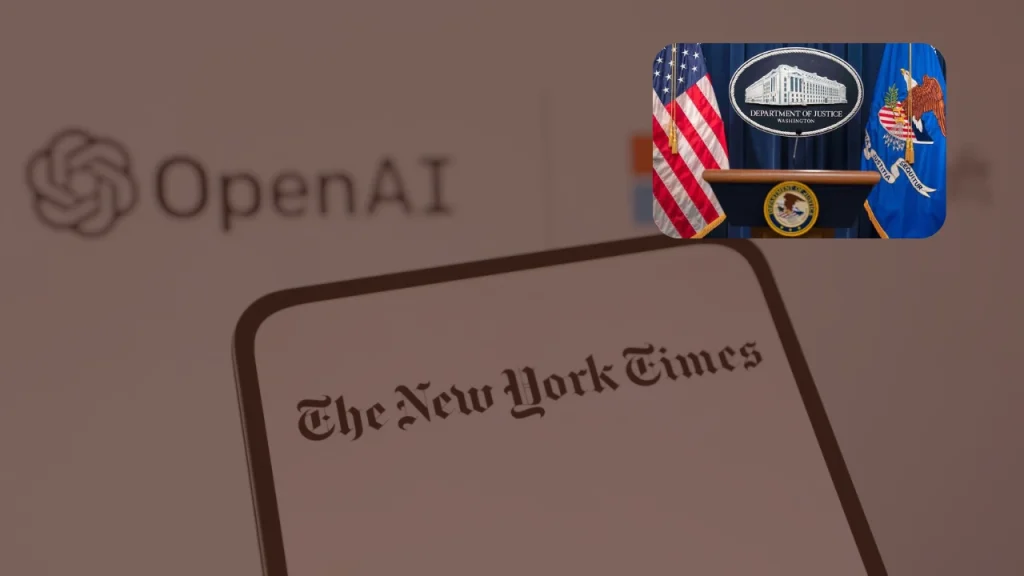
The intervention fits a broader pattern. The Trump administration has generally pushed back against efforts to regulate the AI industry at the state and federal level, and officials have reportedly discussed the possibility of the government taking direct equity stakes in AI companies. None of that changes what a federal judge is required to do with the DOJ’s filing — a statement of interest carries persuasive weight but isn’t binding, and Judge Stein is free to disregard it entirely.
The Legal Standard: What “Fair Use” Actually Means
Everything in this case turns on one legal test: the fair use doctrine under 17 U.S.C. § 107. Courts weigh four factors, and no single one is automatically decisive:
- Purpose and character of the use — including whether it’s “transformative” (creates something new with a different purpose) versus merely substituting for the original
- Nature of the copyrighted work — factual works get thinner protection than creative ones
- Amount and substantiality used — how much of the original was copied, and whether the “heart” of the work was taken
- Effect on the market — whether the use harms the market for, or value of, the original work
OpenAI and Microsoft argue their training process is transformative: the models learn statistical patterns from text rather than storing and redistributing the articles themselves, and ChatGPT is not a substitute product for reading the Times. The Times argues the opposite — that when its articles can be reproduced almost verbatim by prompting the right query, that’s not transformation, it’s substitution, and it directly threatens subscription and advertising revenue that depends on readers coming to the Times itself.
How Other AI Copyright Cases Have Ruled — and Why They Don’t Settle This One
This isn’t the first time a court has had to apply fair use to AI training, and the results so far cut in both directions:
Bartz v. Anthropic (N.D. Cal.) — Judge William Alsup ruled that training an AI model on legally purchased books was highly transformative fair use. But he also ruled that pirating copies of books to build a permanent training library was not fair use, regardless of how the copies were later used. That piracy finding is what pushed Anthropic into a record $1.5 billion settlement with authors and publishers in May 2026.
Kadrey v. Meta (N.D. Cal.) — Judge Vince Chhabria likewise found Meta’s book training highly transformative. But in the same ruling, he suggested that a newer theory of harm — “market dilution,” where AI-generated works flood a market and depress the value of human-created originals in the same genre — could defeat a fair use defense in future cases if plaintiffs present strong evidence of it. The plaintiffs in that case didn’t make that showing well enough to win, but Chhabria’s reasoning left the door open for someone else to.
Thomson Reuters v. Ross Intelligence (D. Del.) — This case went the other way entirely. Judge Stephanos Bibas ruled that using Westlaw headnotes to train a competing legal research tool was not fair use, since the AI tool competed directly in the same market as the copyrighted material. That ruling is now on interlocutory appeal to the Third Circuit.
None of these rulings bind Judge Stein directly, since they came from different courts. But they show judges applying the same four-factor test and reaching different outcomes depending on how directly the AI product competes with the original work — which is precisely the question at the center of the Times’ case, given that ChatGPT and Copilot compete for the same audience the Times relies on for subscriptions.
The Strongest Arguments on Each Side
What publishers and their supporters argue: Journalism is expensive to produce and easy to copy. If AI companies can train on copyrighted reporting without a license and then compete with the outlets that produced it, the economic model that funds original reporting collapses — and AI itself eventually runs out of new human-generated material to learn from. The fact that ChatGPT can reproduce Times text nearly verbatim, they argue, shows this goes well beyond “learning from” the work.
What OpenAI, Microsoft, and the DOJ argue: Fair use has always allowed transformative uses of copyrighted material, and training a model to recognize patterns across billions of documents is fundamentally different from republishing those documents. A ruling against AI companies on this scale, they argue, could cripple the U.S. AI industry’s ability to compete globally — especially against Chinese AI development — at a moment when the government considers AI leadership a strategic priority. Isolated instances of near-verbatim output, in this view, are edge cases rather than proof of how the system works day to day.
Both arguments have genuine legal and economic weight, and no court has yet resolved which one prevails when the AI product and the copyrighted work compete in the same market — which is exactly the question Judge Stein now has to answer.
What Happens Next
Both sides must file summary judgment motions by Friday, September 4, 2026. Judge Stein will then decide whether the fair use question can be resolved as a matter of law or whether it needs to go to a jury — the outcome that determined how the Anthropic and Meta cases played out. No trial date has been set. Given the stakes and the novel legal questions involved, an appeal to the Second Circuit is widely expected regardless of which side wins at the district court level, and the losing side could seek further review after that.
Frequently Asked Questions
Does the DOJ’s filing mean OpenAI has already won the case?
No. A statement of interest is persuasive, not binding. Judge Stein can weigh it however he chooses, and he still has to rule on the merits of the fair use defense independently.
Will this affect people who currently use ChatGPT or Copilot?
Not immediately. There’s no injunction in place, and the case is still in the summary judgment stage. Any outcome that changed how these products work would take effect only after further rulings, likely followed by appeals.
Is this a class action other content creators can join?
No. This is a direct lawsuit between named plaintiffs (the Times, the Daily News coalition, and the Center for Investigative Reporting) and OpenAI and Microsoft. It isn’t a certified class, and there’s no way for other publishers or writers to join this specific case.
Why did the Justice Department get involved in a private lawsuit?
The DOJ used a legal mechanism called a statement of interest, which lets the federal government weigh in on cases it believes affect a broader public interest — in this case, the government’s stated position that a competitive AI industry is tied to national security.
How does this compare to the Anthropic book-piracy settlement?
Differently. Anthropic settled for $1.5 billion after a judge found it had pirated copies of books to build its training library — a fact pattern the Times case doesn’t involve, since OpenAI and Microsoft haven’t been accused of pirating Times content, only of using it without a license.
When will this case actually be decided?
Summary judgment briefing closes September 4, 2026. A ruling could take weeks to months after that, and whichever side loses is expected to appeal, which could extend final resolution well into 2027 or beyond.
Sources Used in This Article
- The New York Times, via GV Wire — “Justice Dept. Sides With OpenAI in New York Times Copyright Suit,” Sept. 2, 2026: https://gvwire.com/2026/09/02/justice-dept-sides-with-openai-in-new-york-times-copyright-suit/
- The Washington Post — “DOJ urges judge to rule for OpenAI, Microsoft in N.Y. Times lawsuit,” Sept. 2, 2026: https://www.washingtonpost.com/technology/2026/09/02/doj-urges-judge-rule-openai-microsoft-ny-times-lawsuit/
- Justia — The New York Times Co. v. Microsoft Corp. et al., No. 1:23-cv-11195, Dkt. 514 (S.D.N.Y., signed April 4, 2025): https://law.justia.com/cases/federal/district-courts/new-york/nysdce/1:2023cv11195/612697/514/
- Wikipedia — “The New York Times v. Microsoft and OpenAI” (case background and timeline): https://en.wikipedia.org/wiki/The_New_York_Times_v._Microsoft_and_OpenAI
- The Global Legal Post — “US judge refuses OpenAI’s motion to dismiss New York Times copyright infringement claims,” April 8, 2025: https://www.globallegalpost.com/news/us-judge-refuses-openais-motion-to-dismiss-new-york-times-copyright-infringement-claims-887263879
- Davis Wright Tremaine — “Thomson Reuters v. Ross Intelligence: Copyright, Fair Use, and AI (Round One)”: https://www.dwt.com/blogs/artificial-intelligence-law-advisor/2025/02/reuters-ross-court-ruling-ai-copyright-fair-use
Researched and written by Israr Ahmad, legal content researcher and founder of AllAboutLawyer.com. Facts verified against court records and contemporaneous reporting as of September 3, 2026. Last Updated: September 3, 2026.
This article is for informational purposes only and does not constitute legal advice. It presents multiple perspectives on a contested legal question and does not take a position on the merits of either side’s claims. Laws vary by state and individual circumstances differ. For advice about your specific situation, consult a qualified attorney.
About the Author
Israr Ahmad is a legal content researcher with 4+ years of experience covering class action settlements and consumer rights cases. He has researched and published coverage of 2,500+ settlements using verified court records, settlement administrator filings, and government sources. Learn more about Israr.