
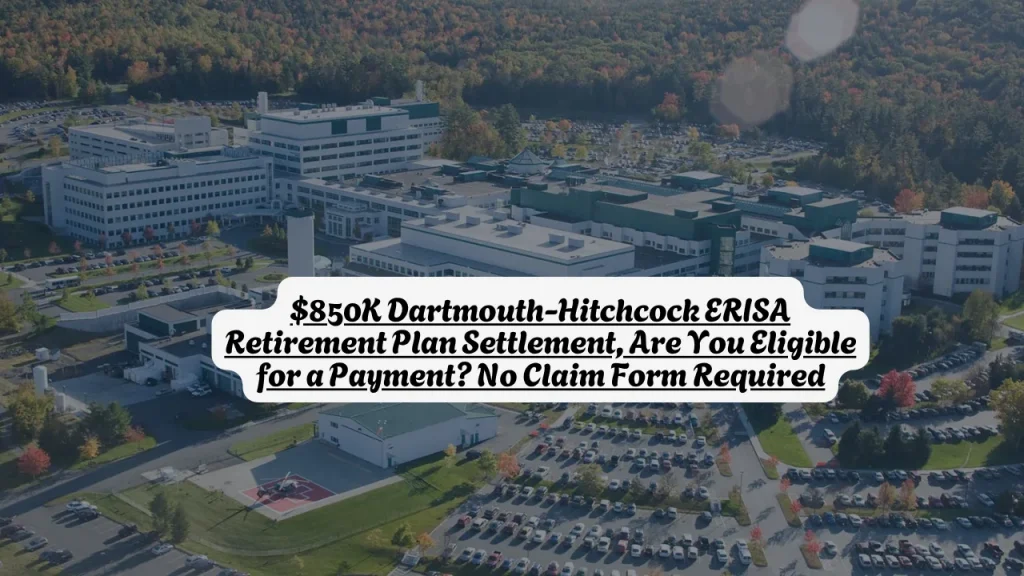
$850K Dartmouth-Hitchcock ERISA Retirement Plan Settlement, Are You Eligible for a Payment? No Claim Form Required
The Dartmouth-Hitchcock ERISA settlement is a retirement plan class action where eligible participants in the Dartmouth-Hitchcock Retirement Plan and Dartmouth-Hitchcock Employee Investment Plan can receive a payment without filing any claim form. Three plan participants sued Dartmouth-Hitchcock Clinic in the U.S. District Court for the District of New Hampshire, accusing the company of paying excessive recordkeeping fees and failing to properly monitor its plan committee. The parties reached a $850,000 settlement, which has received preliminary court approval.
Quick Facts: Adams et al. v. Dartmouth-Hitchcock Clinic
| Field | Detail |
| Settlement Amount | $850,000 |
| Claim Deadline | No claim form required — distribution is automatic |
| Who Qualifies | Participants or beneficiaries in either Dartmouth-Hitchcock Plan from March 18, 2016 to March 25, 2026 |
| Payout Per Person | TBD — calculated proportionally based on each member’s average account balance during the class period |
| Proof Required | No |
| Settlement Status | Preliminarily Approved |
| Administrator | Analytics Consulting, LLC, P.O. Box 2007, Chanhassen, MN 55317-2007 |
| Official Website | www.DartmouthHitchcockERISASettlement.com |
| Toll-Free Number | 844-286-3944 |
| Last Updated | May 20, 2026 |
Current Status of the Dartmouth-Hitchcock Settlement
- The court granted preliminary approval, and the Final Approval Hearing is scheduled for August 13, 2026 at 2:00 p.m. before Judge Landya B. McCafferty in Concord, New Hampshire.
- Class members who want to object must submit a written objection to the court by July 14, 2026.
- There is no opt-out option — because the class was certified under Federal Rule of Civil Procedure 23(b)(1), all class members are automatically bound by the settlement outcome.
What Is the Dartmouth-Hitchcock Lawsuit About? Adams et al. v. Dartmouth-Hitchcock Clinic, No. 1:22-cv-00099-LM
Dartmouth-Hitchcock Clinic runs two retirement plans for its employees: the Dartmouth-Hitchcock Retirement Plan and the Dartmouth-Hitchcock Employee Investment Plan. Three plan participants — Debra M. Adams, Danillie L. Mars, and Michelle L. Miller — filed this lawsuit on March 18, 2022 in the U.S. District Court for the District of New Hampshire.
Related article: What IRS Audits Were Actually Pending Against Trump? The Complete Breakdown
The plaintiffs alleged that Dartmouth-Hitchcock violated the Employee Retirement Income Security Act of 1974 (ERISA), specifically by paying higher recordkeeping and administrative fees than a plan of its size should have been paying, and by failing to properly monitor the plan committee responsible for overseeing those fees. ERISA is the federal law that requires employers who sponsor retirement plans to act in the financial interest of plan participants — not in the interest of the company or service providers.
For anyone who participated in a Dartmouth-Hitchcock retirement plan during this period, the allegation is direct: money that should have stayed in your retirement account may have gone toward inflated fees instead. If you are looking for more background on how these cases work, our guide to consumer class action lawsuits and your rights explains how ERISA fiduciary breach cases are built and what plan members can typically expect. Dartmouth-Hitchcock denies all wrongdoing and settled to avoid the cost and uncertainty of continued litigation.
Are You Part of the Dartmouth-Hitchcock ERISA Class Action?
If you were part of either Dartmouth-Hitchcock retirement plan during the class period, here is how to know whether this settlement includes you.
You may be part of this class if:
- You were a participant in the Dartmouth-Hitchcock Retirement Plan or Dartmouth-Hitchcock Employee Investment Plan at any point between March 18, 2016 and March 25, 2026
- You were a beneficiary of either plan during that same period
- You are an alternate payee under a Qualified Domestic Relations Order (QDRO) connected to either plan during the class period
- Your plan account had a balance greater than $0 at any point during the class period
You are likely NOT included if:
- You are a named defendant in the case, or an immediate family member of a defendant
- You are a former participant whose calculated share of the settlement is $5.00 or less — the settlement excludes these de minimis amounts for former participants only
- You never participated in either of the two named Dartmouth-Hitchcock retirement plans
If you are a current participant, your payment will be deposited directly into your plan account — no action is required on your end. If you are a former participant with a balance over $5.00, you will receive a check mailed to your last known address. This is an automatic distribution settlement — there is no claim form to file. Similar cases like the Northwell Health ERISA settlement used the same automatic distribution model.
How Much Can Dartmouth-Hitchcock Plan Members Expect to Receive?
The gross settlement amount is $850,000. Before any money reaches plan members, several deductions come out of that fund:
- Attorneys’ fees: Class Counsel, Capozzi Adler P.C., will seek up to $283,333.33 (one-third of the settlement)
- Litigation costs: up to $150,000
- Case contribution awards: up to $10,000 each for the three class representatives
- Administrative expenses: fees for Analytics Consulting, the independent fiduciary, the plan recordkeeper, and taxes
What remains after those deductions is called the Net Settlement Amount, and that is what gets divided among class members. Each person’s share is calculated proportionally based on their average account balance across every year of the class period compared to the total of all class members’ balances. People who had higher balances for more years receive a larger share. Individual payout amounts will vary and are not yet determined — the Settlement Administrator will make those calculations once the court grants final approval.
Current participants receive their share as a deposit into the plan account with the highest balance if they hold both plans. Former participants whose share exceeds $5.00 receive a check from Analytics Consulting. That check is valid for 90 days from the date it is issued. If you are a former participant and your mailing address has changed, update it through the settlement website immediately so your check reaches you.
Important Dates in the Dartmouth-Hitchcock ERISA Settlement
| Milestone | Date |
| Lawsuit Filed | March 18, 2022 |
| Settlement Agreement Signed | June 17, 2025 |
| Preliminary Approval Granted | March 25, 2026 |
| Class Period End Date | March 25, 2026 |
| Attorneys’ Fee Motion Filed By | June 14, 2026 |
| Objection Deadline | July 14, 2026 |
| Notice of Intent to Appear Deadline | July 14, 2026 |
| Final Approval Hearing | August 13, 2026 at 2:00 p.m. |
| Expected Payment Date | TBD — pending final court approval on August 13, 2026 |
What Should You Do If You Were a Dartmouth-Hitchcock Plan Participant?
You do not need to file a claim form. The settlement is designed as an automatic distribution — the plan recordkeeper already has the data needed to identify class members and calculate payments.
Here is what you should do right now:
Step 1 — Confirm your contact information is current. If you are a former participant receiving a check, make sure the plan or settlement administrator has your current mailing address. Visit www.DartmouthHitchcockERISASettlement.com or call 844-286-3944.
Step 2 — Review the Plan of Allocation posted on the settlement website to understand how your share will be calculated.
Step 3 — If you want to object to any part of the settlement, file a written objection with the Clerk of the Court at 55 Pleasant Street, Room 110, Concord, NH 03301-3941 by July 14, 2026. Your objection must include your full name, address, phone number, signature, and the grounds for your objection.
Step 4 — Monitor the settlement website for updates after the August 13, 2026 Final Approval Hearing. Payment timelines will be confirmed once the court enters its final order.
Step 5 — If you are a former participant, keep the check you receive safe. It is only valid for 90 days.
Estimated time to update your address if needed: under 5 minutes.
Frequently Asked Questions
Is there a class action lawsuit against Dartmouth-Hitchcock?
Yes. Three former plan participants filed Adams et al. v. Dartmouth-Hitchcock Clinic, No. 1:22-cv-00099-LM in the U.S. District Court for the District of New Hampshire on March 18, 2022, alleging ERISA fiduciary duty violations related to excessive retirement plan fees.
Do I need to file a claim to get paid from this settlement?
No. This is an automatic distribution settlement. Analytics Consulting, LLC, will use plan records to identify class members and calculate payments. Current participants receive a deposit into their plan account; former participants receive a check by mail.
Do I need to do anything right now to be included in this settlement?
If your information is current with the plan, no action is needed. Former participants should confirm their mailing address is up to date by visiting the official settlement website or calling 844-286-3944 before payments go out.
When will I receive my payment from the Dartmouth-Hitchcock settlement?
Payments will not be distributed until after the court grants final approval at the August 13, 2026 hearing. If no appeals follow, distributions will be made within approximately 30 days of the settlement becoming final. Exact timing is TBD — pending the court’s final order.
Can I opt out of the Dartmouth-Hitchcock settlement?
No. Because this class was certified under Federal Rule of Civil Procedure 23(b)(1), there is no opt-out option. Your only recourse if you disagree with the settlement is to file a written objection by July 14, 2026.
Will this settlement payment affect my taxes?
Possibly. Settlement payments in ERISA cases are generally treated as restorative payments — a tax-advantaged classification — but your individual tax situation may vary. Consult a tax professional before filing your return for the year in which you receive your payment. The settlement agreement states class members are responsible for any applicable taxes on their distributions.
Do I need a lawyer to participate in this settlement?
No. Class Counsel, Capozzi Adler P.C., already represents all class members collectively. Their fees come out of the $850,000 settlement fund — you pay nothing separately. If you prefer independent legal representation, you can retain a consumer rights lawyer at your own expense.
How will I know if the Dartmouth-Hitchcock settlement is finally approved?
Updates will be posted at www.DartmouthHitchcockERISASettlement.com after the August 13, 2026 hearing. You can also monitor the court docket electronically at https://ecf.nhd.uscourts.gov.
Sources & References
- Settlement Agreement, Adams et al. v. Dartmouth-Hitchcock Clinic et al., No. 1:22-cv-00099-LM, Doc. 65-2 (D.N.H. June 17, 2025): dartmouthhitchcockerisasettlement.com
- Long Form Settlement Notice, Adams et al. v. Dartmouth-Hitchcock Clinic et al., No. 1:22-cv-00099-LM (D.N.H. 2026): dartmouthhitchcockerisasettlement.com
- U.S. District Court for the District of New Hampshire PACER docket: https://ecf.nhd.uscourts.gov
Prepared by the AllAboutLawyer.com Editorial Team and reviewed for factual accuracy against the official settlement agreement and long-form notice posted at DartmouthHitchcockERISASettlement.com. Last Updated: May 20, 2026
Disclaimer: This article is for informational purposes only and does not constitute legal advice. Legal claims and outcomes depend on specific facts and applicable law. For advice regarding a particular situation, consult a qualified attorney.
About the Author
Israr Ahmad is a legal content researcher with 4+ years of experience covering class action settlements and consumer rights cases. He has researched and published coverage of 2,500+ settlements using verified court records, settlement administrator filings, and government sources. Learn more about Israr.