
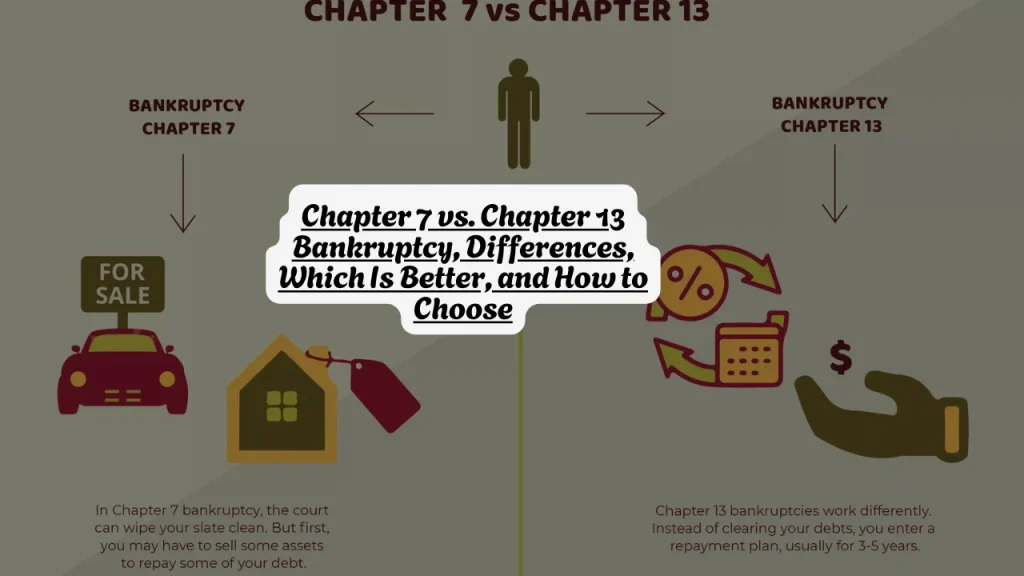
Chapter 7 vs. Chapter 13 Bankruptcy, Differences, Which Is Better, and How to Choose
Chapter 7 bankruptcy eliminates most unsecured debts in 3–6 months through a court-supervised liquidation process under 11 U.S.C. Chapter 7, while Chapter 13 bankruptcy lets you keep your property and catch up on missed payments through a court-approved 3–5 year repayment plan under 11 U.S.C. Chapter 13. The biggest difference between Chapter 7 and Chapter 13 bankruptcy is how your debt gets handled. Chapter 7 wipes out eligible unsecured debts in about 3–4 months without requiring a repayment plan. Chapter 13 takes 3–5 years because you make monthly payments through a court-approved repayment plan. The right choice depends entirely on your income, what property you want to keep, and what type of debt is crushing you.
Quick Comparison
| Chapter 7 | Chapter 13 | |
| Also Called | Liquidation bankruptcy | Reorganization / Wage earner’s plan |
| Governing Law | 11 U.S.C. Chapter 7 | 11 U.S.C. Chapter 13 |
| Timeline | 3–6 months | 3–5 years |
| Income Requirement | Must pass means test | Must have regular income |
| Repayment Plan | None | Yes — 3 to 5 years |
| Non-exempt Assets | Trustee may sell them | You keep everything |
| Stop Foreclosure Long-Term | No | Yes |
| Credit Report | 10 years | 7 years |
| Filing Fee | $338 | $313 |
| Last Updated | May 12, 2026 | May 12, 2026 |
The Core Difference: Wipe Out vs. Pay Back
These two chapters take completely opposite approaches to solving a debt problem.
Chapter 7, often called the liquidation chapter, is used by individuals, partnerships, or corporations who are unable to repair their financial situation. In Chapter 7 asset cases, the debtor’s estate is liquidated — the non-exempt property is sold for cash by a trustee and the proceeds are distributed to creditors. In most personal cases, however, exemptions protect everything and nothing gets sold.
Chapter 13 permits the debtor to file a plan in which the debtor agrees to pay a certain percentage of future income to the bankruptcy court trustee for payment to creditors. If the court approves the plan, the debtor will be under the court’s protection while repaying such debts. You pay creditors through your income, not by selling your possessions.
Who Qualifies for Each Chapter
Chapter 7 has an income limit. You must pass the means test — a formula under 11 U.S.C. § 707(b)(2) that compares your average monthly income over the past six months to your state’s median family income. If your income falls below the median, you qualify automatically. If it exceeds the median, you may still qualify if your disposable income after allowed expenses is too low to fund a Chapter 13 plan.
Chapter 13 has no income ceiling, but requires that you have regular income — a job, self-employment earnings, or steady benefits — sufficient to fund a repayment plan. Your income being too high to pass the Chapter 7 means test is actually one of the situations where Chapter 13 works well, as it gives you time to repay debts through a structured plan while stopping interest from accruing on priority debts.
Related article: What Does Chapter 13 Bankruptcy Mean? How the Repayment Plan Works and Who Qualifies
What Happens to Your Property in Each Chapter
This is where the two chapters feel most different in practice.
In Chapter 7, a trustee reviews your assets and can sell any property not protected by your state’s exemptions. Most Chapter 7 filers keep all their possessions because they fall within exemption limits. Non-exempt assets typically include vacation homes, expensive collections, and luxury items.
In Chapter 13, you keep everything. Chapter 13 allows you to keep your assets while repaying debts because you pay creditors through your income instead of asset sales. If you own a vacation home, valuable collections, or equity above your state’s exemption limit, Chapter 13 protects all of it — as long as you complete the repayment plan.
Can Chapter 7 or Chapter 13 Save Your House?
This is the single most important practical difference for homeowners.
Chapter 7 cannot save your home if you are behind on your mortgage. It temporarily stops foreclosure through the automatic stay, but filing Chapter 7 temporarily halts foreclosures and repossessions but cannot prevent a lender from seizing an asset used to secure an unpaid loan once the stay lifts.
Chapter 13 can. Chapter 13 bankruptcy allows homeowners who have fallen behind on mortgage payments to catch up or “cure” past due mortgage payments. You may be able to save your home from foreclosure and get rid of many debts, such as credit card balances, medical bills, and sometimes second and third mortgages. Chapter 7 does not offer homeowners a way to make up mortgage arrears.
For anyone behind on their mortgage who wants to keep their home, Chapter 13 is the only bankruptcy path that works. For a detailed look at how vehicle surrender and reaffirmation work specifically in Chapter 7, see our guide on surrendering your vehicle in Chapter 7 bankruptcy.
How the Credit Impact Differs
Both chapters damage your credit, but not equally. Chapter 7 bankruptcy stays on your credit report for 10 years from the filing date, while Chapter 13 stays for 7 years. If rebuilding credit faster matters to you — and you can afford the repayment plan — Chapter 13 leaves your credit history three years sooner.
Which Is Better: Chapter 7 or Chapter 13?
Neither is better in every situation. The biggest difference is that Chapter 7 focuses on discharging unsecured debt like credit cards, personal loans, and medical bills, while Chapter 13 allows you to catch up on secured debts like your home or car while also discharging unsecured debt.
Chapter 7 is likely the better fit if your income is below the state median, you have mostly credit card and medical debt, you do not own significant non-exempt assets, and you need relief fast.
Chapter 13 is likely the better fit if you are behind on your mortgage and want to keep your home, your income is too high to pass the Chapter 7 means test, you own property that exceeds your state’s exemption limits, or you have debts like recent taxes and back child support that require a repayment structure.
For more on how Chapter 7 works start to finish, read our full guide on how Chapter 7 bankruptcy works.
Frequently Asked Questions
Is Chapter 7 or Chapter 13 better for stopping foreclosure?
Chapter 13 is the only option that permanently stops foreclosure. It lets you spread missed mortgage payments over a 3–5 year plan under 11 U.S.C. § 1322. Chapter 7 only temporarily pauses foreclosure and cannot cure mortgage arrears.
Do I need a lawyer to choose between Chapter 7 and Chapter 13 bankruptcy?
You are not legally required to hire one, but the wrong choice can cost you your home or result in a discharge-less filing. The U.S. Courts strongly recommend working with a bankruptcy attorney, especially for any case involving secured debt.
What law governs Chapter 7 and Chapter 13 bankruptcy?
Both are governed by Title 11 of the U.S. Bankruptcy Code — Chapter 7 cases under 11 U.S.C. §§ 701–784, and Chapter 13 cases under 11 U.S.C. §§ 1301–1330. The Cornell Law LII full text is the authoritative free public reference.
Can I switch from Chapter 13 to Chapter 7 if I can no longer afford the payments?
Yes. Many Chapter 13 cases fail because a lot can happen during a 3–5 year repayment plan — an unexpected layoff, illness, or divorce. Sticking to a Chapter 13 budget can prove difficult, and failure to keep up with payments can leave you with little option but eventually filing Chapter 7.
How long after Chapter 7 can I file Chapter 13?
Four years from your Chapter 7 filing date under 11 U.S.C. § 1328(f)(1). For a full breakdown of all refiling waiting periods, see our article on how often you can file Chapter 7 bankruptcy.
Is Chapter 13 more expensive than Chapter 7?
Yes — significantly. Attorney fees for Chapter 13 average around $3,000–$4,000 compared to $1,200–$2,000 for Chapter 7, and the process runs 3–5 years versus 3–6 months. However, attorney fees in Chapter 13 can often be rolled into the repayment plan, reducing the upfront cost.
Disclaimer: This article is for general informational and educational purposes only and does not constitute legal advice. Laws vary by state and jurisdiction. For advice about your specific situation, consult a qualified attorney.
Prepared by the AllAboutLawyer.com Editorial Team and reviewed for factual accuracy against 11 U.S.C. Chapters 7 and 13 (Cornell Law LII), U.S. Courts Bankruptcy Basics, and the U.S. Bankruptcy Court FAQ. Last Updated: May 12, 2026.