
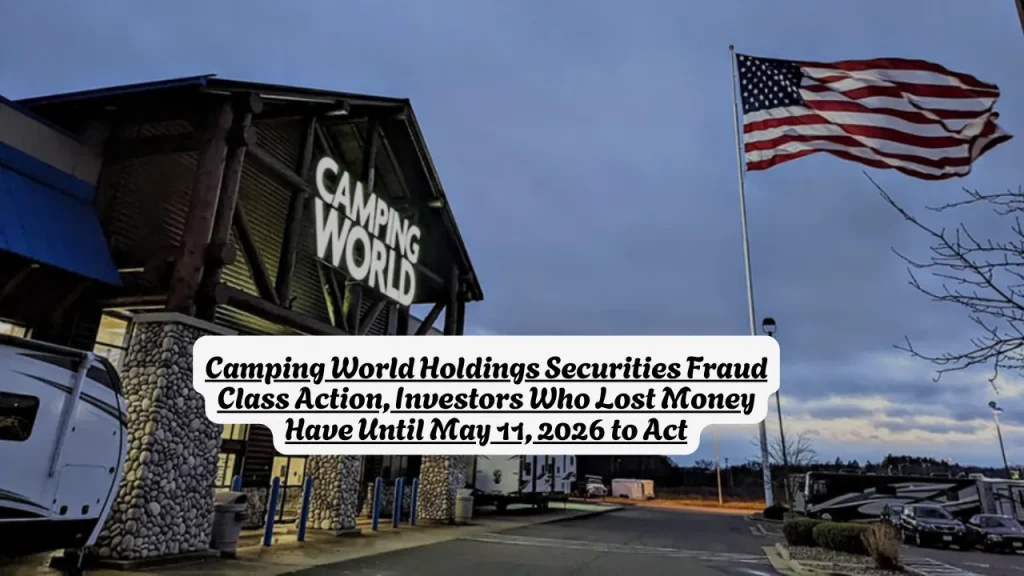
Camping World Holdings Securities Fraud Class Action, Investors Who Lost Money Have Until May 11, 2026 to Act
Camping World Holdings, Inc. (NYSE: CWH) is facing a securities fraud class action lawsuit filed in the U.S. District Court for the Northern District of Illinois, captioned Siverd v. Camping World Holdings, Inc., et al., No. 1:26-cv-02710, on behalf of investors who purchased Camping World securities between April 29, 2025 and February 24, 2026.
The lawsuit claims that Camping World and three of its senior executives told investors the company was expertly managing its RV inventory using data analytics — while the reality was far worse. When the truth came out in two separate earnings disclosures, the stock dropped nearly 25% in a single day, then another 16.5% months later.
If you bought CWH stock during that period and lost money, you have until May 11, 2026 to ask the court to appoint you as lead plaintiff.
Quick Facts: Camping World CWH Securities Fraud Lawsuit
| Field | Detail |
| Case Name | Siverd v. Camping World Holdings, Inc., et al. |
| Case Number | No. 1:26-cv-02710 |
| Court | U.S. District Court for the Northern District of Illinois |
| Lawsuit Filed | March 10, 2026 |
| Class Period | April 29, 2025 – February 24, 2026 |
| Defendants | Camping World Holdings, Inc.; Marcus A. Lemonis (former CEO); Matthew D. Wagner (current CEO); Thomas E. Kirn (CFO) |
| Statutes Alleged | Sections 10(b) and 20(a) of the Securities Exchange Act of 1934 |
| Largest Stock Drop | October 29, 2025 — 24.8% ($4.17 per share) |
| Second Stock Drop | February 25, 2026 — 16.5% ($1.79 per share) |
| Settlement Status | None — active litigation; no claim form exists |
| Lead Plaintiff Deadline | May 11, 2026 |
| Last Updated | May 5, 2026 |
What Is the Camping World Securities Lawsuit About? Siverd v. Camping World Holdings, Inc., No. 1:26-cv-02710
The complaint alleges that between April 29, 2025 and February 24, 2026, Camping World failed to disclose to investors that it overstated its ability to surgically manage its inventory to optimize profit using data analytics; that it overstated the retail demand it was experiencing and reasonably expected; and that, as a result, the company would require strict, corrective inventory management objectives that would negatively impact gross profit and margins.
Put plainly: Camping World told investors everything was under control. It was not.
During the relevant period, Camping World stated it was confident in its ability to deliver growth in excess of low-double digits in used units and low single digits in new units, and vehicle gross margins within its historical range. The company also stated it was laser focused on balancing inventory supply and demand, and that it was able to surgically manage its inventory — including using data analytics to put the right inventory on the ground at the right time and the right price.
Investors relied on those statements. The lawsuit says those statements lacked a reasonable basis at the time they were made.
This is a textbook securities fraud class action allegation — one that follows the same legal theory used in cases like the Rivian $250 million securities class action settlement, where investors alleged the company made materially misleading statements about production and demand that inflated the stock price before the truth came out.
The Two Stock Drops That Triggered the Camping World Lawsuit
The lawsuit points to two specific dates when the alleged truth emerged — and investors paid the price.
October 28–29, 2025 — The First Drop
On October 28, 2025, Camping World released its Q3 2025 financial results, reporting that new vehicle revenue was $766.8 million — a decrease of $58.1 million, or 7.0% — and that the average selling price of new vehicles sold decreased 8.6%, with new vehicle gross margin decreasing 81 basis points driven primarily by that average price decline.
The next day, during the earnings call on October 29, 2025, CEO Marcus Lemonis admitted he had been more aggressive in pushing the team to liquidate inventory and acknowledged that when looking back on what happened over history, the company may have gone into years with a delusion about what was happening because it was outperforming everyone else, only to find out 18 months later that it had to discount its way out of inventory — directly undermining the prior inventory management claims.
CWH shares declined 24.8% on October 29, 2025, closing at $12.65, down from $16.82 the prior day.
February 24–25, 2026 — The Second Drop
On February 24, 2026, Camping World released its Q4 2025 financial results, reporting that it had implemented strict, corrective inventory management objectives to structurally improve its turnover rates, posted a net loss of $109.1 million for the quarter — an increased loss of $49.6 million, or 83.3% — and announced an immediate pause to its quarterly cash dividend.
Gross profit fell $38.7 million. SG&A as a percent of gross profit improved only 190 basis points, falling far short of even the reduced 300 to 400 basis point target.
This news caused Camping World stock to drop $1.79 per share, or 16.5%, from a closing price of $10.85 on February 24, 2026 to $9.06 per share on February 25, 2026.
Who Is Named in the Camping World Lawsuit?
The complaint targets Camping World Holdings, Inc. and three executives: Marcus A. Lemonis, who served as Chief Executive Officer from 2006 through December 31, 2025; Matthew D. Wagner, who became CEO on January 1, 2026 after serving as President; and Thomas E. Kirn, the company’s Chief Financial Officer.
The lawsuit identifies what each defendant allegedly did: Lemonis personally signed or approved SEC filings and press releases throughout most of the class period; Wagner issued statements about inventory procurement, unit growth, and SG&A guidance; and Kirn, as CFO, was responsible for the accuracy of financial reporting, including revenue, margin, and expense disclosures.
The complaint charges that these officers knew, or were severely reckless in not knowing, that the company’s claims of surgical inventory management, record procurement momentum, and a fortified balance sheet lacked a reasonable basis.
Under the Sarbanes-Oxley Act, the CEO and CFO personally certify that quarterly and annual SEC filings fairly present the company’s financial condition. The lawsuit argues those certifications were made while material problems went undisclosed to shareholders.
Related article: Management & Training Corporation $1.4M Wage Settlement, Check If You Qualify for a Payment
Are You Part of the Camping World CWH Class Action Lawsuit?
This case does not require you to apply or register to be included. Class membership is automatic if you qualify. But understanding whether you qualify matters — especially if you are considering applying for the lead plaintiff role before the May 11, 2026 deadline.
You may be part of this class action if:
- You purchased or acquired Camping World Holdings (NYSE: CWH) securities at any point between April 29, 2025 and February 24, 2026
- You suffered a loss on that investment — whether you sold the shares at a loss or still hold shares worth less than what you paid
- You bought shares in any eligible Camping World security, including common stock
You are likely not included if:
- You did not buy CWH securities during the class period
- You are a Camping World customer — this is an investor lawsuit, not a consumer protection case. It covers shareholders, not RV buyers or retail customers
No claim form exists yet. The case is in its earliest stage — the court has not yet appointed a lead plaintiff, and no settlement has been negotiated. What matters right now is the May 11, 2026 deadline for investors seeking to lead the litigation.
What Are Camping World Investors Seeking?
The purported stockholder seeks to represent a class of investors who purchased or acquired Camping World stock between April 29, 2025 and February 24, 2026, and seeks compensatory damages, attorneys’ fees and costs, and other relief as the court may deem just and proper.
No specific dollar amount has been filed as a damages claim. In securities class actions, the total damages are typically calculated during litigation based on the difference between what investors paid for the shares at the artificially inflated price and what the shares were actually worth. Given the two stock drops totaling more than 40% in combined declines, the investor losses across all class members could be substantial.
Camping World’s position: The company has stated it intends to vigorously defend this action and that any potential liability that may arise from the alleged claims is not currently probable or reasonably estimable.
For investors who want to understand how securities fraud cases typically resolve, the PayPal securities fraud class action is a useful comparison — it follows the same legal framework under Sections 10(b) and 20(a) of the Securities Exchange Act of 1934, and illustrates how the lead plaintiff process works before a case moves toward settlement or trial.
What Should You Do Right Now If You Owned CWH Stock?
You do not need to take any action today to preserve your ability to share in a future recovery. Class members are automatically included and do not need to register or file anything at this stage.
However, there are practical steps worth taking now:
- Gather your brokerage records. Pull all statements showing CWH purchases, sales, and holdings between April 29, 2025 and February 24, 2026.
- Calculate your losses. Know how many shares you bought, at what price, and what they sold for — or what they are worth today.
- Contact a securities attorney if you had significant losses. Investors with the largest losses typically seek lead plaintiff status, which gives them a role in directing the litigation and selecting counsel. The deadline for that is May 11, 2026 — just days away.
- Monitor the case docket. Once a lead plaintiff is appointed, the case will move into discovery and briefing. Updates will come through court filings under Case No. 1:26-cv-02710 in the Northern District of Illinois.
All securities class action attorneys work on contingency — you pay nothing unless there is a recovery.
Camping World CWH Lawsuit Timeline
| Milestone | Date |
| Class period begins | April 29, 2025 |
| Q3 2025 results released; first stock drop (24.8%) | October 28–29, 2025 |
| Marcus Lemonis steps down as CEO | December 31, 2025 |
| Matthew Wagner becomes CEO | January 1, 2026 |
| Q4 2025 results released; second stock drop (16.5%); dividend paused | February 24–25, 2026 |
| Class period ends | February 24, 2026 |
| Siverd complaint filed | March 10, 2026 |
| Lead plaintiff application deadline | May 11, 2026 |
| Lead plaintiff appointment | TBD — pending court order |
| Discovery and briefing phase | TBD — follows lead plaintiff appointment |
| Trial or settlement | TBD — securities cases of this type typically take 2–4 years |
Frequently Asked Questions
Is there a class action lawsuit against Camping World Holdings?
Yes. A purported stockholder filed a class action lawsuit on March 10, 2026, captioned Siverd v. Camping World Holdings, Inc., et al., in the U.S. District Court for the Northern District of Illinois, alleging violations of the Securities Exchange Act of 1934. The case is in its early stages.
Do I need to do anything right now to be included in the Camping World lawsuit?
No — if you purchased CWH securities between April 29, 2025 and February 24, 2026, you are automatically included in the class. The only urgent deadline is May 11, 2026, and it applies only to investors who want to be considered for the lead plaintiff role.
When will there be a settlement in the Camping World CWH case?
TBD — no settlement has been proposed or negotiated. The case is in its early stages, with lead plaintiff motions currently due May 11, 2026. Securities fraud cases of this type typically take two to four years to resolve.
Can I file my own individual lawsuit against Camping World instead?
Yes, but most securities attorneys advise against opting out of class actions unless your individual losses are large enough to justify the cost of separate litigation. Consulting a class action lawsuit attorney is the best way to evaluate your options.
How will I know if the Camping World lawsuit settles?
The court will require formal notice to class members if a settlement is reached. Watch for mail or email from a court-appointed settlement administrator, and monitor Case No. 1:26-cv-02710 at the U.S. District Court for the Northern District of Illinois.
Does being a Camping World customer make me part of this lawsuit?
No. This is a securities fraud lawsuit — it covers investors who bought CWH stock, not customers who purchased RVs or services. If you are a consumer with a complaint about a Camping World product or service, this lawsuit does not apply to you.
What law does the Camping World lawsuit allege was violated?
The class action asserts securities fraud claims under Sections 10(b) and 20(a) of the Securities Exchange Act of 1934 on behalf of investors in Camping World securities. Section 10(b) and Rule 10b-5 prohibit companies from making false or misleading statements that artificially affect a stock’s price.
Sources & References
- Camping World Holdings, Inc. Form 10-Q (SEC EDGAR), Q1 2026: sec.gov
- Bleichmar Fonti & Auld LLP — Official Case Page: bfalaw.com
- Levi & Korsinsky Investor Alert, April 29, 2026: prnewswire.com
- Camping World Q3 2025 Earnings Release: investor.campingworld.com
- Camping World Q4 2025 Earnings Release: investor.campingworld.com
Prepared by the AllAboutLawyer.com Editorial Team and reviewed for factual accuracy against Camping World’s Form 10-Q filed with the U.S. Securities and Exchange Commission and official case filings in the U.S. District Court for the Northern District of Illinois. Last Updated: May 5, 2026
Disclaimer: This article is for informational purposes only and does not constitute legal advice. Legal claims and outcomes depend on specific facts and applicable law. For advice regarding your specific situation, consult a qualified attorney.
About the Author
Israr Ahmad is a legal content researcher with 4+ years of experience covering class action settlements and consumer rights cases. He has researched and published coverage of 2,500+ settlements using verified court records, settlement administrator filings, and government sources. Learn more about Israr.