
California Plastic Bag Ban 2026, What It Bans, What It Allows, and What It Costs You Rules Every Shopper Must Know
California’s most comprehensive plastic bag ban is now in effect. Governor Gavin Newsom signed Senate Bill 1053, authored by Sen. Catherine Blakespear (D–Encinitas), banning the distribution of plastic bags at grocery stores, pharmacies, and retail checkout counters beginning January 1, 2026. This is not a lawsuit or settlement — it is a state law already in force. This article covers every rule shoppers and retailers need to know, including what bags are still legal, what they cost, who pays fines, and where this law came from.
Quick Facts
| Field | Detail |
| Law | Senate Bill 1053 (SB 1053) |
| Author | Sen. Catherine Blakespear (D–Encinitas) |
| Signed by Governor | September 22, 2024 |
| Effective Date | January 1, 2026 |
| What It Bans | All plastic carryout bags — thin and thick — at checkout |
| What’s Still Allowed | Recycled paper bags, certified compostable bags, non-plastic reusable bags |
| Paper Bag Fee | Minimum $0.10 per bag |
| Fee Exemption | Shoppers using food assistance programs (SNAP/EBT) |
| Recycled Content Deadline | 50% post-consumer recycled content required in paper bags by January 1, 2028 |
| Fines for Retailers | Up to $5,000 per day for repeat violations |
| Enforcement | Attorney General, district attorneys, city attorneys, CalRecycle |
| Builds On | SB 270 (2014), Proposition 67 (2016) |
Current Status
- SB 1053 is now in effect as of January 1, 2026. All stores covered by the law must comply immediately.
- On October 17, 2025, California’s Attorney General announced a settlement with four large plastic bag manufacturers requiring them to stop selling single-use plastic bags in the state and to pay roughly $1.7 million in penalties and fees.
- Beginning January 1, 2028, recycled paper carryout bags must contain at least 50% post-consumer recycled material.
- Produce and pre-checkout bags changed earlier — those rules took effect January 1, 2025.
Why Did California Pass This Law? The History Behind the Ban
To understand SB 1053, you need to go back more than a decade. California has been trying to eliminate plastic bag waste since 2014 — but the original law created a problem it did not anticipate.
The updated law stems from Senate Bill 270, which was first introduced in 2014. It previously allowed the use of reusable bags — which were made of a thicker plastic. Senate Bill 1053 now eliminates the distribution of those thicker film plastic bags.
The logic behind the original law made sense on paper: ban thin, flimsy single-use bags but allow thicker bags that people could reuse. In practice, it backfired. In practice, those bags were rarely reused and were nearly impossible to recycle, leading to even more waste than before the law went into effect, according to the California Public Interest Research Group.
A 2023 Environment California report found that plastic bag waste actually increased by more than 80% since the original 2016 statewide bag ban took effect. The thicker bags, made of high-density polyethylene, cannot go in curbside blue recycling bins. Most ended up in landfills, defeating the entire purpose of the original restriction.
Regulators also found that plastic bag manufacturers were misleading the public by claiming the thicker bags were recyclable — a finding that led to the October 2025 settlement requiring four manufacturers to stop selling those bags in California and pay $1.7 million in penalties. SB 1053 was designed to close this loophole permanently.
Related article: Audi Door Lock Class Action, Are You Driving One of the Affected Models?
What Does SB 1053 Actually Ban?
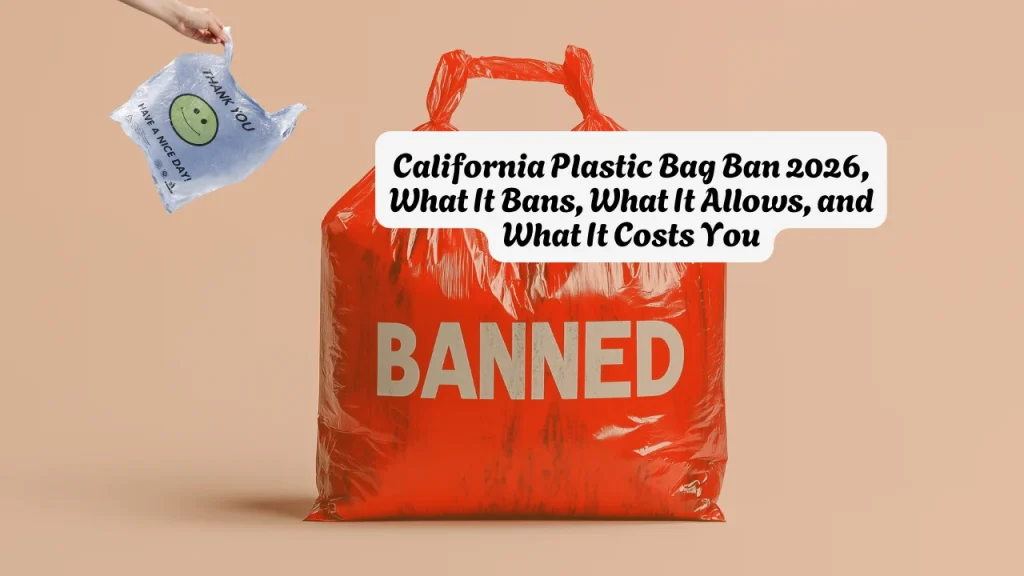
SB 1053 prohibits stores from offering any plastic bags — regardless of thickness or whether they are labeled reusable. This is the key change from the previous law. It does not matter how thick the bag is, how many times the manufacturer says it can be reused, or what label appears on the bag. If it is made of plastic film, it is banned at checkout.
SB 1053 amends California’s existing plastic bag laws by banning all plastic carryout bags at the point of sale. Earlier legislation restricted thin, single-use plastic bags but allowed thicker plastic bags if they met durability and recyclability standards. That exception no longer exists.
Which Stores Does the Ban Cover?
The law applies to grocery stores, big-box retailers with pharmacies, convenience stores, food marts, and liquor stores. Essentially, any store in California that sells food and was covered under the earlier SB 270 framework must now comply with the complete plastic bag ban.
Non-food retail stores are not uniformly covered by the state law. Local ordinances may differ — so a clothing store or a home goods retailer may operate under different rules depending on which city or county they are in.
Online orders delivered to your home or picked up curbside are subject to the same rules, so specify in advance if you need to purchase carryout bags. The ban applies at all points of sale, including self-checkout kiosks, in-store pickup, curbside, and home delivery.
What Bags Are Still Legal?
Three types of bags remain permitted under SB 1053:
Recycled Paper Bags — The primary replacement for plastic at checkout. Shoppers at grocery stores, pharmacies, liquor stores, and convenience stores will be limited to paper bags, which will continue to cost at least 10 cents each. These bags must be made from recycled material and must be recyclable through standard California systems. They cannot have plastic laminations or plastic-based coatings.
Certified Compostable Bags — Compostable bags must follow specific guidelines: they cannot show the recycling symbol or chasing arrows, cannot be labeled as “biodegradable,” “degradable,” or “decomposable,” the opening of the bag must be at least 15 inches wide, and they must show the word “compostable” on both sides in one-inch green letters or inside a one-inch green band.
Non-Plastic Reusable Bags — Cloth tote bags, canvas bags, and other durable non-plastic reusable bags remain fully permitted. These are encouraged as the long-term solution. Shoppers who bring their own reusable bag pay nothing at checkout.
The 10-Cent Paper Bag Fee — Who Pays and Who Doesn’t
If you need a bag at checkout and do not bring your own, you will pay for it.
Retailers must charge customers at least $0.10 per recycled paper carryout bag. The charge is mandatory and may not be waived, even as part of promotions or customer loyalty programs. Stores keep this fee — it is not sent to the state. The fee is intended to help retailers offset the higher cost of compliant paper bags compared to plastic.
Some cities charge more. San Francisco, for example, requires stores to charge at least 25 cents per checkout bag under its own local ordinance. Local governments can always adopt stricter rules than the state minimum.
One significant exemption exists. Individuals enrolled in food assistance programs will not be charged the 10-cent paper bag fee. This covers shoppers using SNAP (food stamps), EBT cards, WIC, and other qualifying programs.
What About Produce Bags and Pre-Checkout Bags?
These changed on a different timeline than checkout bags and are governed by slightly different rules.
Pre-checkout bags for produce, meat, and bakery must be recycled paper or certified compostable starting January 1, 2025. Conventional thin plastic produce bags are now banned separately from the checkout bag restriction.
The ban does not apply to compostable plastic bags used for produce — so the very thin certified compostable bags you might use at the produce scale remain permitted, as long as they meet California’s compostability standards.
The 2028 Recycled Content Deadline
The law includes a future milestone that both retailers and suppliers need to plan for now.
Beginning January 1, 2028, recycled paper carryout bags must contain at least 50% post-consumer recycled material. Retailers relying on national or international suppliers should confirm well in advance that future inventory will meet this standard.
This requirement phases in additional environmental accountability and ensures that the paper bags replacing plastic are themselves made from recycled material rather than virgin paper.
Fines and Enforcement — What Happens If a Store Violates the Law?
The state has empowered the Attorney General, district attorneys, and city attorneys to enforce the ban. A first violation carries a fine of $1,000 per day. A second violation carries a fine of $2,000 per day. Subsequent violations can reach up to $5,000 per day.
These are per-day penalties — meaning a store that continues distributing plastic bags faces compounding fines for every day of non-compliance. For small independent businesses, this level of enforcement could be financially devastating. For large chains, the reputational damage compounds the financial exposure.
CalRecycle, the state agency overseeing carryout bag compliance, provides oversight and guidance for retailers. Enforcement is handled at both the state and local level.
What Did the Plastic Bag Manufacturers Do?
Before SB 1053 took effect, the state took direct legal action against the companies that made the thicker bags at the center of the loophole controversy.
In October 2025, Attorney General Rob Bonta announced a settlement with four major plastic bag manufacturers after a two-year probe alleging deceptive claims that thicker “reusable” bags were recyclable. The companies agreed to stop selling single-use plastic bags in California and to pay a combined $1.7 million in penalties and fees.
Regulators said the settlement plus SB 1053 together close the loophole that kept thicker film bags in widespread use despite the spirit of the 2014 and 2016 rules.
What Critics and Businesses Have Said
Not everyone welcomed the ban without reservation.
Business groups, including the California Grocers Association, raised concerns that a ban on all plastic carryout bags could burden retailers and increase costs for customers. Opponents argue that paper and compostable alternatives also have environmental and production drawbacks, though lawmakers maintained that ending plastic waste must remain the top priority.
Critics note trade-offs: paper production can have higher energy and water use, and cloth or heavy non-woven bags must be used many times to offset their environmental footprint compared to single-use plastic. Environmental advocates counter that the visible pollution from plastic bags — in waterways, on beaches, and in the food supply — makes the trade-off worthwhile.
How Does California Compare to Other Places?
California’s complete plastic bag ban puts it among the stricter jurisdictions in the United States, but it is not alone globally. Dozens of countries have implemented full or partial plastic bag bans, including the United Kingdom, France, Kenya, and Bangladesh. Within the U.S., Hawaii, New York, and Maine have their own statewide restrictions, though California’s framework — with its detailed compliance requirements, mandatory fees, and escalating fines — is among the most comprehensive.
Important Dates
| Milestone | Date |
| SB 270 (Original Plastic Bag Ban) Passed | 2014 |
| Proposition 67 Upholds SB 270 (Voter Referendum) | November 2016 |
| SB 1053 Signed by Governor Newsom | September 22, 2024 |
| Produce/Pre-Checkout Bag Rule Takes Effect | January 1, 2025 |
| AG Settlement with Plastic Bag Manufacturers ($1.7M) | October 17, 2025 |
| Full Plastic Bag Ban Takes Effect (SB 1053) | January 1, 2026 |
| 50% Recycled Content Requirement for Paper Bags | January 1, 2028 |
Frequently Asked Questions
Can California grocery stores still give out plastic bags?
No. As of January 1, 2026, all plastic carryout bags — including the thicker reusable ones previously available — are banned at grocery stores, pharmacies, liquor stores, convenience stores, and food marts. Only recycled paper bags, certified compostable bags, and non-plastic reusable bags are permitted.
How much does a paper bag cost at checkout in California?
Retailers must charge a minimum of 10 cents per recycled paper bag. Some cities — like San Francisco — charge more under local ordinances. Stores keep the fee; it does not go to the state.
I use SNAP or EBT. Do I still have to pay the paper bag fee?
No. Shoppers enrolled in food assistance programs, including SNAP and EBT, are exempt from the 10-cent paper bag fee under SB 1053.
What is the difference between SB 1053 and the old plastic bag law?
California’s original 2014 law (SB 270) banned thin single-use plastic bags but allowed thicker plastic bags marketed as reusable. SB 1053 eliminates that exception entirely. All plastic carryout bags — regardless of thickness or label — are now banned.
What stores are NOT covered by California’s plastic bag ban?
Stores covered by the ban are those selling food — grocery stores, pharmacies, liquor stores, convenience stores, and food marts. Non-food retail stores like clothing shops or hardware stores may not be subject to the state law, though local city or county ordinances may apply additional restrictions.
What happens to stores that still hand out plastic bags?
Violations carry civil fines enforced by the Attorney General, district attorneys, and city attorneys. A first violation costs $1,000 per day. A second violation costs $2,000 per day. Repeated violations can reach $5,000 per day.
Do I still have to pay for bags when ordering groceries online or curbside?
Yes. The same rules apply to online orders, in-store pickup, and curbside delivery in California. If you need a bag, you must pay at least 10 cents for a compliant paper bag, or bring your own reusable bag.
What happened to the plastic bag manufacturers?
In October 2025, California’s Attorney General settled with four major plastic bag manufacturers, requiring them to stop selling single-use plastic bags in California and pay approximately $1.7 million in combined penalties after they were found to have falsely marketed thicker bags as recyclable.
Last Updated: April 12, 2026
Disclaimer: This article is for informational purposes only and does not constitute legal advice. Legal claims and outcomes depend on specific facts and applicable law. For advice regarding a particular situation, consult a qualified attorney.
About the Author
Israr Ahmad is a legal content researcher with 4+ years of experience covering class action settlements and consumer rights cases. He has researched and published coverage of 2,500+ settlements using verified court records, settlement administrator filings, and government sources. Learn more about Israr.
what about the plastic bags used at meat counters that sell seafod and meat? Aren’t plastics bags still allowed for these to prevent cross contamination? nothing mentioned here…
Sorry for not covering them here, Will Cover them in new article
Thanks for pointing out
I brought my own plastic bags to Safeway to use and they still charged me a bag fee. Is this legal? I can’t find anything on their website that references this.