
Brandon Ingram vs. Frito-Lay, A Navy Veteran Was Electrocuted at Work Then the Fight for Benefits Nearly Broke His Family
Brandon Ingram served his country in the U.S. Navy, came home to St. Louis, and threw himself into a job at Frito-Lay he thought would secure his family’s future. Then a routine button press on October 2, 2016, changed everything. What followed — denied medical care, disputed workers’ compensation, surveillance of his wife and children, and a legal fight still unresolved in public records as of the time of this writing — is one of the most widely reported workplace injury disputes in recent memory.
This is not a class action. It is one man’s fight against one of the world’s largest snack food companies. It matters because it shows, in precise detail, exactly how workers’ compensation and employer-sponsored disability systems can be weaponized against the very employees they are supposed to protect.
Brandon Ingram vs. Frito-Lay — Key Facts
| Field | Detail |
| Worker | Brandon Ingram, Florissant, Missouri |
| Employer | Frito-Lay, Inc. (subsidiary of PepsiCo) |
| Incident | Electric shock at Frito-Lay St. Louis warehouse |
| Date of Injury | October 2, 2016 |
| Injuries Confirmed | Liver disease; two herniated discs; pinched nerve; two spinal surgeries |
| Employer Confirmed Incident? | Yes — Frito-Lay publicly confirmed the electric shock occurred |
| Claim Type | Missouri Workers’ Compensation; employer-sponsored long-term disability |
| Legal Forum | Missouri Workers’ Compensation Courts |
| Mediation | Matter went through Missouri Workers’ Compensation mediation |
| Settlement Offer | Made by PepsiCo in September 2021; declined by the Ingram family |
| Long-Term Disability | Frito-Lay confirmed Ingram was receiving LTD benefits as of July 2021 |
| Final Outcome | TBD — no confirmed resolution has been publicly reported |
| Attorney | Rana Law Group (confirmed by attorney’s own website) |
| Last Updated | May 28, 2026 |
Who Is Frito-Lay and Why Did This Workplace Injury Dispute Become a National Story?
Frito-Lay, Inc. is a wholly owned subsidiary of PepsiCo — one of the largest food and beverage companies in the world. The company operates dozens of warehouses and manufacturing plants across the United States and generates billions in annual revenue. Brandon Ingram’s case gained national attention in July 2021 because it broke in the same week that hundreds of Frito-Lay workers in Topeka, Kansas, went on strike over mandatory overtime and working conditions — making it impossible to see Ingram’s story in isolation from a broader pattern of how the company treated frontline workers.
If you are a current or former Frito-Lay or PepsiCo employee who was injured on the job and is struggling with a workers’ compensation or disability claim, this case directly illustrates the obstacles you may face.
What Happened to Brandon Ingram at the Frito-Lay St. Louis Warehouse?
Brandon Ingram joined Frito-Lay’s St. Louis, Missouri team in 2011 after serving in the U.S. Navy. He threw himself into the job, working up to 20 hours straight and 26 days in a row. He became a site lead and trainer, developed knowledge of both sales and operations, and earned numerous awards from Frito-Lay and PepsiCo.
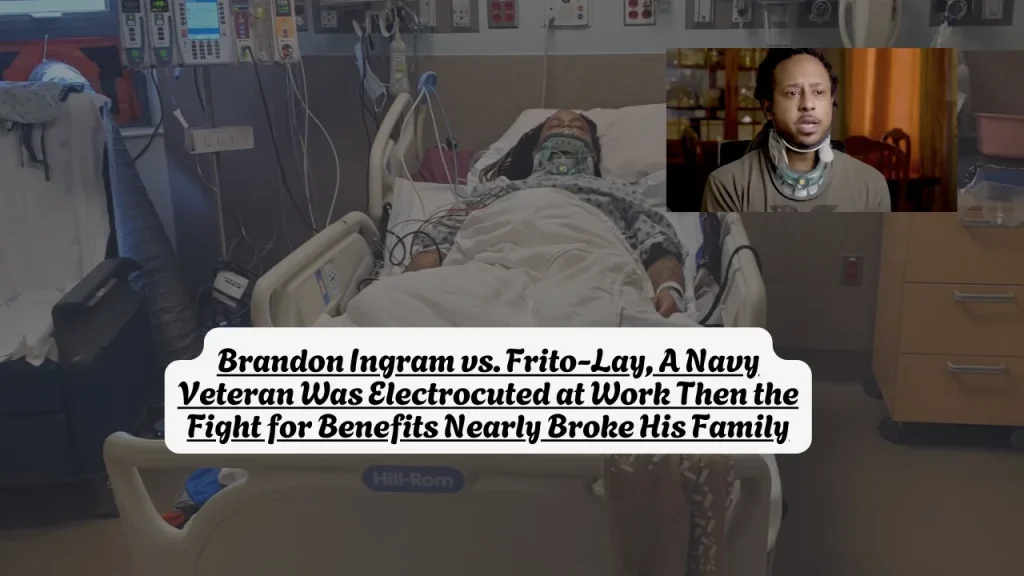
On October 2, 2016, he pressed a button for a dock door — a routine part of his daily job. “I felt a strong attachment and then I went a little dizzy for a moment,” Ingram said. “I am in pain every day. It’s excruciating. It’s running down my body through my leg. It hurts.”
Frito-Lay confirmed that, in 2016, Brandon Ingram was exposed to an electric shock while at work. The company stated it provided medical treatment and monitoring for five months after Ingram was released and returned to work, and provided short-term and long-term disability benefits when medical experts determined he could no longer return to work.
But the Ingrams tell a very different story about what those first weeks looked like. Despite going to the ER and reporting severe pain, the company did not give Brandon any time off after the incident, forcing him to call in sick the next day. Frito-Lay also refused to adjust his work hours and responsibilities. Frito-Lay forced Brandon to see company-approved doctors who provided inadequate care — passing four hospitals on the way to the one under contract with the company. The Frito-Lay affiliated physicians denied Brandon’s requests for an MRI, prescribing physical therapy that Melissa believes made his condition worse.
When Brandon finally got an MRI from his primary care physician, they found two herniated discs in his back. His condition could only be fixed through surgery. “If I didn’t have the surgery, the doctor said any small fall, or accident, or something like that and I would have been paralyzed from the neck down, or dead,” Brandon said.
What followed was a long journey of medical care, including spine surgeries which did not fully heal him or return him to pre-injury status. As a result of his injuries, Brandon is no longer able to handle the rigors of his job at Frito-Lay. He made a workers’ compensation claim, however, the company doctor released him as soon as possible.
This is a pattern that workers’ compensation attorneys see often: a company doctor with a financial relationship to the employer clears an injured worker quickly, placing the burden on that worker to prove the injury’s severity using their own resources — resources that, in Brandon’s case, were rapidly disappearing.
How the Ingrams Fought for Workers’ Compensation Benefits — and What Frito-Lay Did in Response
In order to obtain long-term disability, Brandon had to prove he was injured, requiring multiple doctors’ visits to confirm his condition. But his health insurance through PepsiCo/Frito-Lay had been cut off. “So guess what? I borrowed money, or used credit cards, or whatever I could. I even took money out of my kid’s piggy bank,” Brandon said.
With nowhere else to turn, the Ingrams sued Frito-Lay several months after the accident. “I never wanted to have a lawsuit. It’s just not me,” Brandon said. “But I did ask for help and I wasn’t getting it.”
In response to the lawsuit, Frito-Lay hired private investigators to try and discredit Brandon’s injury. “I don’t know how many people they’ve given our address, and name, and information to, just to prove my husband wrong,” Melissa said. “Recording my kids playing in the yard, recording me doing yard work, recording me going through drive-thrus. They follow me in traffic on the highway, in streets. They followed me when I gave birth to my baby. They followed me when I went to my daughter’s school.” The years of surveillance drove the family to homeschool their daughter because of fears for her safety.
Frito-Lay denied conducting surveillance of the Ingram family in its public statement, telling the family to involve law enforcement if they had concerns.
The family claims Frito-Lay and PepsiCo refused to help with disability or workers’ comp, and that the couple drained all their savings and pensions, even their kids’ college funds. “We have had to change our goals and replan our entire lives around this devastating injury,” Melissa wrote.
If you are a worker dealing with a disputed workers’ compensation claim where the employer’s insurer or company doctor is minimizing your injury, consulting a workers’ compensation attorney early is one of the most important steps you can take. Once you are locked into the company’s medical network without documentation from independent physicians, fighting your way out becomes significantly harder.
What Did the Missouri Workers’ Compensation Process Look Like for Brandon Ingram?
Workers’ compensation in Missouri is handled through an administrative process, not a standard civil courtroom. Workers file claims with the Missouri Division of Workers’ Compensation, and disputed matters go through a mediation and hearing process before an administrative law judge.
According to Frito-Lay’s own public statement, this matter was mediated through the Missouri Workers’ Compensation courts. In September 2021, a settlement offer was conveyed to Brandon Ingram and his family. PepsiCo described the offer as generous and said it was in line with the recommendations made by mediating officials. That offer was made in addition to medical claims PepsiCo said it had already paid, along with disability benefits. The Ingram family declined the offer.
Frito-Lay noted that medical experts disagreed over whether Ingram’s back and neck injuries were work-related, but confirmed that Ingram remained eligible for, and was receiving, benefits under the company’s long-term disability program for as long as he was unable to work.
The dispute about causation — whether the spinal injuries are a direct result of the electric shock — is legally significant. In Missouri workers’ compensation law, an injured worker must prove both that an accident occurred at work and that the accident caused the medical condition they are claiming. Frito-Lay’s position appears to be that the electric shock happened, but that the spinal injuries are not necessarily a consequence of it. The Ingrams dispute this, supported by their own treating physicians.
What Are Brandon Ingram and Melissa Ingram Asking For?
The Ingrams have sought two things from the start: full workers’ compensation benefits covering Brandon’s work-related injuries, and accountability for what they describe as years of harassment and surveillance directed at their family by agents working on Frito-Lay’s behalf.
“We want justice for our pain and suffering as well as all the medical bills we have had to pay ourselves,” Melissa wrote in the GoFundMe campaign. “My husband and I have four young children and we worked hard to make sure we could give them a good future. Those plans all came crashing down when he was hurt on the job.”
“Why are you fighting so hard to say that I’m not hurt instead of just, look at the paperwork, look at the medical stuff, look at everything I’ve been through,” Brandon said.
No final judgment, confirmed settlement amount, or public resolution of the workers’ compensation case has been reported from any primary source as of May 28, 2026. Settlements in Missouri workers’ compensation disputes can be confidential, so the absence of public reporting does not necessarily mean the case is still open — only that no outcome has been publicly disclosed.
Are You a Frito-Lay or PepsiCo Worker in a Similar Situation? Here Is What to Do.
Brandon Ingram’s case is not a class action, and there is no claim form to file. But if you are a current or former Frito-Lay or PepsiCo employee who was injured on the job and is fighting a workers’ compensation or disability claim, his experience maps closely to patterns that employment and workers’ compensation attorneys see regularly. Here is what matters.
Protect yourself from the start:
- See your own doctor as soon as possible after any workplace injury — not only the company-designated physician. Independent medical documentation is critical to any future claim.
- File a written incident report with your employer on the day of the injury. Verbal reports can be disputed later.
- Keep all medical records, bills, pay stubs, and any written communications from the employer or insurance company.
- If you are offered a workers’ compensation settlement, do not sign anything before speaking with your own attorney. Once you settle, you typically waive the right to future claims related to that injury.
- If you believe you are being surveilled by private investigators hired by your employer, document it with dates, times, and photographs if possible, and report it to law enforcement.
- If you receive employer-sponsored long-term disability benefits through your job, those benefits are likely governed by ERISA (the Employee Retirement Income Security Act of 1974), a federal law that gives you the right to appeal a denial and, in some cases, to sue in federal court.
If you are unsure about your rights as an injured worker or are having difficulty getting a fair assessment of your claim, a free consultation with a workers’ compensation attorney can help you understand your options before deadlines pass.
What Laws Apply to a Case Like Brandon Ingram’s?
This case involves two overlapping legal systems, which is part of what makes it complicated.
Missouri Workers’ Compensation Law — Missouri Revised Statutes Chapter 287 governs workplace injury claims in Missouri. It is an exclusive remedy system, meaning workers generally cannot sue their employer in civil court for a work injury — they must go through the workers’ comp system. However, there are exceptions, and disputes about causation go through administrative hearings and appeals.
ERISA (29 U.S.C. § 1001 et seq.) — Brandon’s long-term disability benefits came from an employer-sponsored plan, which means they are governed by ERISA, a federal law that sets minimum standards for how those benefit plans must operate. Thankfully, Brandon purchased optional long-term disability insurance through Frito-Lay from which he received some benefits — however, Frito-Lay was fighting him on the workers’ compensation case, going so far as to conduct surveillance on his family. ERISA gives employees the right to appeal benefit denials internally and then to sue in federal court, where the standard of review depends on whether the plan gives the administrator discretionary authority.
Frequently Asked Questions — Brandon Ingram vs. Frito-Lay Workers’ Compensation Dispute
1. Did Frito-Lay admit that Brandon Ingram was electrocuted on the job?
Yes. Frito-Lay publicly confirmed that in 2016, Brandon Ingram was exposed to an electric shock while at work. The company stated it immediately implemented its process following health incidents, provided medical treatment and monitoring for five months after Ingram was released and returned to work, and provided short-term and long-term disability benefits when medical experts determined he could no longer return to work.
2. Is there a class action lawsuit against Frito-Lay related to Brandon Ingram’s case?
No. This is an individual workers’ compensation and disability dispute, not a class action. There is no claim form to file and no settlement fund for other workers. If you are a Frito-Lay worker with your own injury claim, you would need to pursue that separately through Missouri Workers’ Compensation (or the applicable state system) or an attorney.
3. What is the current status of Brandon Ingram’s case against Frito-Lay?
No confirmed final resolution — verdict, settlement amount, or dismissal — has been publicly reported from any primary source as of May 28, 2026. The most recent confirmed fact is that the Ingram family declined a PepsiCo settlement offer that was conveyed in September 2021 through Missouri Workers’ Compensation mediation.
4. Did Frito-Lay really hire private investigators to follow Brandon Ingram’s family?
The Ingrams have alleged this since at least 2021. Frito-Lay’s public statement denied involvement in surveillance of the Ingram family and suggested they involve law enforcement if they had concerns. Hiring private investigators in workers’ compensation disputes is a legal and common insurance industry practice — it is not illegal for a company or its insurer to conduct surveillance in public places to verify a disability claim. Whether the conduct described by Melissa Ingram crossed legal lines is a question only a court could resolve.
5. Why did the Ingrams decline the September 2021 settlement offer?
The specific terms of the offer are not publicly known, and the Ingram family has not given a detailed public explanation. The family’s consistent public position is that they want full accountability for the injuries and the years of impact on their lives, not a quick exit. Their attorney, Rana Law Group, was still actively representing them in the workers’ compensation case as of August 2023 based on the attorney’s own website.
6. Can other Frito-Lay or PepsiCo workers use Brandon Ingram’s case as a precedent?
Not directly, since workers’ compensation decisions in Missouri are administrative rather than precedential court opinions. But his case is highly instructive as a roadmap of the obstacles injured workers face: company-designated doctors, insurance company surveillance, disputed causation, and the pressure to accept early low offers. A workers’ compensation attorney can help you navigate each of these specifically.
Sources Used in This Brandon Ingram / Frito-Lay Workers’ Compensation Article
- More Perfect Union — “A Frito-Lay Worker Was Electrocuted, Denied Medical Care & Stalked by Company Agents,” July 23, 2021: https://perfectunion.us/a-frito-lay-worker-was-electrocuted-denied-medical-care/
- Frito-Lay, Inc. — Official Statement Regarding Brandon Ingram (published on fritolay.com, February 2022): https://www.fritolay.com/frito-lay-statement-regarding-brandon-ingram
Prepared by the AllAboutLawyer.com Editorial Team and reviewed for factual accuracy against Frito-Lay’s official public statement, More Perfect Union’s primary reporting, and KSDK’s local news coverage. Last Updated: May 28, 2026.
This article is for informational purposes only and does not constitute legal advice. Workers’ compensation laws vary by state. For advice about your specific workplace injury situation, consult a qualified workers’ compensation attorney.
About the Author
Israr Ahmad is a legal content researcher with 4+ years of experience covering class action settlements and consumer rights cases. He has researched and published coverage of 2,500+ settlements using verified court records, settlement administrator filings, and government sources. Learn more about Israr.