
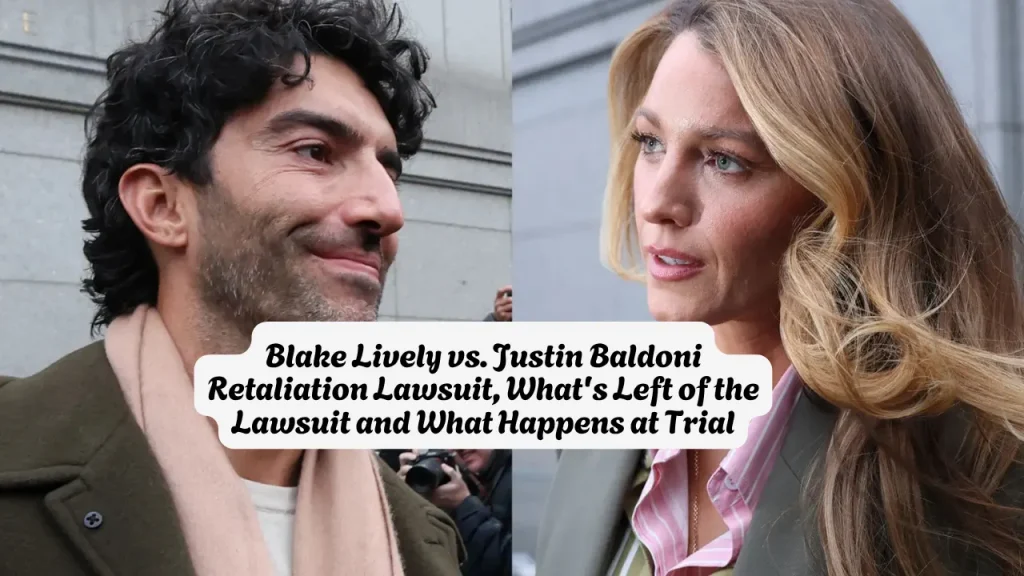
Blake Lively vs. Justin Baldoni Retaliation Lawsuit, What’s Left of the Lawsuit and What Happens at Trial
Blake Lively sued Justin Baldoni in December 2024 over alleged sexual harassment on the set of It Ends With Us and a coordinated online smear campaign she says his team launched against her in retaliation. On April 2, 2026, a federal judge dismissed 10 of her 13 claims — including sexual harassment — on legal technicality grounds. Three claims survive and head to trial on May 18, 2026: breach of contract, retaliation, and aiding and abetting retaliation. Both sides were called in for a last-ditch settlement attempt on April 7, which ended without a deal.
Quick Facts
| Field | Detail |
| Case Name | Blake Lively v. Justin Baldoni et al. |
| Court | U.S. District Court, Southern District of New York |
| Presiding Judge | Judge Lewis J. Liman |
| Claims Filed | 13 |
| Claims Dismissed | 10 (April 2, 2026) |
| Claims Going to Trial | 3 — Breach of contract, Retaliation, Aiding & abetting retaliation |
| Defendants at Trial | Wayfarer Studios, Crisis PR defendants (not Baldoni personally) |
| Trial Start Date | May 18, 2026 |
| Damages Sought | ~$200 million |
| Settlement Status | No deal reached as of April 7, 2026 |
Current Status and What Comes Next
- Attorneys for both sides were directed to contact U.S. Magistrate Judge Sarah Cave on Monday, April 7, for separate phone sessions to report their clients’ updated settlement positions — but those talks ended without an agreement.
- Judge Lewis Liman dismissed 10 of the 13 claims in Lively’s lawsuit on April 2, 2026, leaving only three claims — none of which name Baldoni personally as a defendant — heading to trial.
- Lively’s remaining claims of retaliation and breach of contract against Wayfarer Studios, as well as aiding and abetting retaliation against associated PR defendants, are scheduled to proceed to trial on May 18, 2026.
What Is the Blake Lively vs. Justin Baldoni Lawsuit About?
Blake Lively filed a complaint with the California Civil Rights Department in December 2024 and formalized it into a federal lawsuit on December 31, 2024. She accused Baldoni of sexual harassment on the set of It Ends With Us and accused both Baldoni and his production company, Wayfarer Studios, of engaging in a social manipulation campaign to destroy her reputation after she complained about alleged on-set misconduct.
Lively’s lawyers argued that Baldoni was “consistently inappropriate” and crossed “boundaries” on set, claiming their client was “kissed, nuzzled and touched” without her consent. Lively also alleged that Baldoni’s production company, Wayfarer Studios, retaliated against her after she raised concerns about his behavior — a claim her legal team described as the “beating heart” of her lawsuit.
The retaliation part of the lawsuit centers on what Lively called a coordinated digital smear campaign. Her complaint alleged that the Baldoni-Wayfarer team created, planted, amplified, and boosted content designed to damage her credibility — engaging in the same techniques to bolster Baldoni’s standing and suppress negative content about him. Baldoni’s team denied those allegations throughout, arguing the negative online reaction to Lively was organic — not manufactured.
In January 2025, Baldoni filed a $400 million countersuit against Lively and her husband Ryan Reynolds, alleging the couple hijacked his film and attempted to destroy his career. A federal judge dismissed that countersuit in June 2025. Baldoni did not refile an amended complaint before the court’s deadline, formally ending his claims.
Related article: $2.5M FCSC FY 2027 Performance Budget Explained, What the Foreign Claims Settlement Commission Is Asking For and Why
Why Were Most of Lively’s Claims Dismissed?
The dismissal of 10 claims on April 2, 2026, was a major legal development — but Lively’s attorneys stressed the reasons were procedural, not a judgment on the facts.
Lively’s attorney Michael Gottlieb explained that the court dismissed her sexual harassment claims because she did not sign a formal employment contract, making her an independent contractor rather than an employee, and because the alleged offensive conduct occurred in New Jersey rather than California — which affected which laws applied.
Liman ruled that Lively could not bring a sexual harassment claim under federal law because she was an independent contractor. He also ruled that she could not file a harassment claim under California law because the filming took place in New Jersey.
Importantly, Baldoni himself is not a named defendant in any of the three surviving claims. One claim against his production company, Wayfarer, remains. A public relations company retained by his team and the LLC for the film are the other defendants in the remaining claims.
Despite the dismissals, Judge Liman found enough evidence to send the retaliation claims to a jury. In his written ruling, he noted that Lively had provided more than a minimal showing of evidence — enough for a reasonable jury, viewing the facts in her favor, to find that Wayfarer and its PR defendants took adverse action against her because she spoke up about workplace safety.
What Three Claims Are Going to Trial?
Breach of Contract — Lively alleges that Wayfarer Studios violated written or implied contractual obligations she had as a producer and star of the film. The specific terms at issue involve protections she says she was promised and then denied.
Retaliation — This is the core surviving claim. Lively alleges that after she privately raised concerns about Baldoni’s on-set behavior, his production company and its hired PR team launched a coordinated campaign to damage her reputation as payback. A magistrate judge who presided over a prior mandatory settlement conference in February noted the judge’s recent April ruling may have altered the negotiating position of both sides heading into the new settlement talks.
Aiding and Abetting Retaliation — This claim targets the crisis PR firms and individuals Baldoni’s team allegedly hired to execute the smear campaign, holding them jointly liable for participating in the retaliation.
For a full background on how this lawsuit developed from its earliest filing through early 2026, see the Blake Lively sexual harassment lawsuit against Justin Baldoni coverage on AllAboutLawyer.com.
The Settlement Attempts — And Why They Keep Failing
This case has now gone through multiple failed settlement attempts. Lively and Baldoni both attended a court-ordered settlement conference in New York City on February 11, 2026 — the first time the two had been in court at the same time. After a full day of closed-door sessions with their respective legal teams and Magistrate Judge Sarah Cave, Baldoni’s attorney Bryan Freedman announced the attempts had proven “unsuccessful.”
After the April 2 dismissals changed the legal landscape, the court called both sides back in. Attorneys were directed to contact Magistrate Judge Cave on Monday, April 7, in separate phone sessions to report their clients’ updated settlement positions — calls that were not open to the public. Those talks again ended without a resolution.
Lively’s attorney Sigrid McCawley hinted that Lively may feel she has already achieved part of what she set out to accomplish, noting that the people and the playbook behind the coordinated digital attacks have already been exposed and are being held accountable by other women they’ve targeted — while also confirming Lively still plans to testify at trial in May.
What to Expect at the May 18 Trial
The trial is expected to last approximately one month. Both Lively and Baldoni are widely expected to testify. Ryan Reynolds and potentially Taylor Swift and Hugh Jackman are on the witness list, though their appearances remain TBD.
The jury will focus almost entirely on the question of retaliation — specifically, whether Wayfarer Studios and its PR partners took deliberate steps to harm Lively’s reputation because she raised concerns about workplace safety, and whether those steps caused her financial and professional damage.
Lively claimed she lost approximately $161 million because of the smear campaign that Baldoni’s team allegedly orchestrated — an allegation his lawyers have denied, characterizing the dispute as being about Hollywood reputations, not genuine legal wrongs.
The trial will also bring significant public attention to questions of digital retaliation — the use of coordinated online campaigns, bot activity, and PR manipulation to silence or discredit people who speak up about workplace misconduct. Regardless of the outcome, this case has already changed how entertainment industry lawyers and studios think about retaliation liability.
Important Dates
| Milestone | Date |
| Lively Files CRD Complaint | December 20, 2024 |
| Lively Files Federal Lawsuit | December 31, 2024 |
| Baldoni Files $400M Countersuit | January 2025 |
| Baldoni Countersuit Dismissed | June 2025 |
| First Settlement Conference | February 11, 2026 |
| 10 of 13 Claims Dismissed | April 2, 2026 |
| Second Settlement Attempt (Phone) | April 7, 2026 — No deal |
| Trial Start Date | May 18, 2026 |
| Estimated Trial Length | ~4 weeks |
Frequently Asked Questions
Is Blake Lively suing Justin Baldoni directly?
As of April 2026, Baldoni is not a named defendant in any of the three surviving claims. The remaining defendants include Wayfarer Studios, a PR company retained by Baldoni’s team, and the LLC set up for the film — not Baldoni personally. However, he is widely expected to testify at trial in May.
Why were the sexual harassment claims dismissed if Lively had evidence?
The court dismissed Lively’s sexual harassment claims because she did not sign a formal employment contract — making her an independent contractor rather than an employee — and because the alleged conduct occurred in New Jersey rather than California, affecting which harassment laws applied. Her attorneys stressed this was a legal technicality, not a finding that the conduct did not occur.
What is “retaliation” in a legal context?
Retaliation occurs when an employer, production company, or their agents take harmful action against a person because that person reported or opposed unlawful conduct. In Lively’s case, she alleges Wayfarer and its PR team launched a digital smear campaign specifically because she raised concerns about Baldoni’s behavior on set — that is the retaliation claim heading to trial.
Will this case settle before May 18, 2026?
It is possible but appears unlikely after two failed settlement attempts. A magistrate judge ordered both sides into phone conferences on April 7 to share their updated settlement positions following the April 2 rulings — a sign the court sees a changed negotiating landscape — but no deal was reached.
Do I need a lawyer to file my own similar case?
This is Lively’s individual lawsuit, not a class action — the public cannot file claims in this case. However, if you have experienced workplace retaliation or a coordinated smear campaign after reporting misconduct, you should consult an employment attorney. Many workplace retaliation claims can be filed with the EEOC or your state’s civil rights department at no cost.
What is the “DARVO” defense mentioned by Baldoni’s attorneys?
DARVO stands for Deny, Attack, and Reverse Victim and Offender. Lively’s legal team used the term to describe what they alleged was Baldoni’s litigation strategy — denying the conduct, attacking her credibility, and recasting himself as the victim. Baldoni’s lead attorney Bryan Freedman addressed the DARVO allegation directly, stating that his clients were not afraid of the truth and that none of the defendants engaged in the sexual harassment of Blake Lively.
What laws are at the center of the remaining claims?
The surviving claims rely on contract law (breach of contract) and California’s Fair Employment and Housing Act, along with related civil liability theories (aiding and abetting retaliation). The court’s prior rulings on which laws apply — based on where filming occurred and Lively’s contractor status — have already significantly shaped the legal landscape heading into trial.
- Court Docket: Lively v. Baldoni et al., U.S. District Court, Southern District of New York (Judge Lewis J. Liman)
Last Updated: April 5, 2026
Disclaimer: This article is for informational purposes only and does not constitute legal advice. Legal claims and outcomes depend on specific facts and applicable law. For advice regarding a particular situation, consult a qualified attorney.
About the Author
Israr Ahmad is a legal content researcher with 4+ years of experience covering class action settlements and consumer rights cases. He has researched and published coverage of 2,500+ settlements using verified court records, settlement administrator filings, and government sources. Learn more about Israr.