
Baxter Sodium Chloride Injection Recall, Fiberglass Contamination in IV Saline
If you or a family member received IV fluids at a hospital or clinic in one of fourteen states in early August 2026, this recall is worth paying attention to. Baxter International has pulled two lots of its 0.9% Sodium Chloride Injection — a saline solution used constantly in hospitals for hydration, medication dilution, and dialysis — after finding fiberglass particles in the solution itself.
Baxter Sodium Chloride Injection Recall — Key Facts
| Field | Detail |
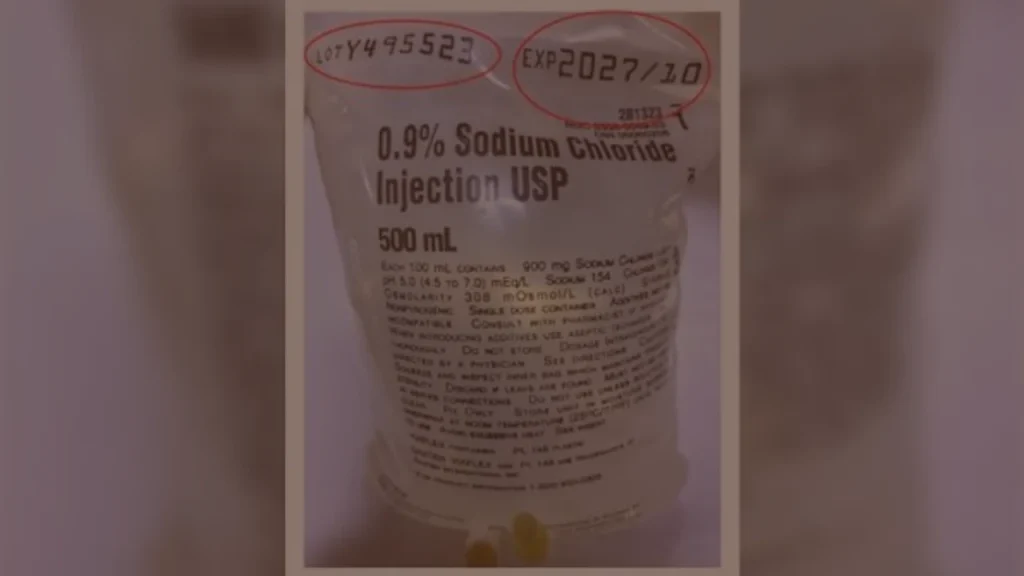
| Product | 0.9% Sodium Chloride Injection, USP, 500 mL VIAFLEX Plastic Container |
| Product Code | 2B1323Q |
| Lot Numbers | Y495523 and Y495523A |
| Expiration Date | October 31, 2027 |
| NDC Number | 0338-0049-03 |
| Recall Announced | August 25, 2026 (FDA publish date: August 26, 2026) |
| Contaminant | Particulate matter identified as fiberglass, found in the solution |
| Distribution Window | July 31, 2026 – August 3, 2026 |
| States | Florida, Illinois, Indiana, Louisiana, Maryland, Missouri, North Carolina, New Jersey, Nevada, New York, Ohio, South Carolina, Texas, and Virginia |
| Distributed To | Healthcare providers and distributors — not sold directly to consumers |
| Adverse Events Reported | None as of August 25, 2026 |
| Last Updated | August 29, 2026 |
Why Fiberglass in IV Saline Is Serious
This isn’t a product you’d notice sitting on a store shelf — 0.9% Sodium Chloride Injection is administered directly into a patient’s bloodstream through an IV line. Baxter’s own risk statement is blunt about what that means: particulate matter in an IV solution can block or clot blood vessels, cut off blood flow to organs, and in the worst case cause a life-threatening pulmonary embolism or permanent organ damage. Short of that, the particles can also cause local vein irritation, inflammation, or allergic reactions, and can aggravate an infection a patient already has.
The product has two common uses that make this recall matter beyond routine hydration: it’s used as a general source of water and electrolytes, and specifically as a priming solution in hemodialysis procedures — meaning dialysis patients are among those with direct exposure risk if a recalled bag was used.
No adverse events had been reported to Baxter as of the company’s August 25 announcement. That’s a meaningful data point, but it doesn’t mean no one was affected — reactions to particulate matter, especially milder ones like vein irritation, aren’t always reported back to the manufacturer.
Related article: Publix GreenWise Blueberry Recall, E. coli Contamination, Class I Risk, and What to Do
Where the Recalled Product Went
Baxter says the affected lots were distributed between July 31 and August 3, 2026, to healthcare providers and distributors across 14 states: Florida, Illinois, Indiana, Louisiana, Maryland, Missouri, North Carolina, New Jersey, Nevada, New York, Ohio, South Carolina, Texas, and Virginia.
That’s a fairly tight four-day distribution window, but Baxter’s saline is a workhorse product used in emergency rooms, operating rooms, and dialysis centers — so a narrow shipping window can still mean a meaningful number of patients had contact with it before the recall went out.
This Isn’t a Return-It-Yourself Recall
Because this product goes to hospitals and clinics rather than individual consumers, there’s no store to bring it back to. Baxter is contacting affected healthcare facilities directly by email with instructions on how to identify and return the impacted product, and facilities are expected to discontinue use and return units according to their own internal process.
If you’re a patient, there’s nothing for you to physically return — the responsibility for pulling the product sits with the facility that received it. What matters for you is whether you or a family member received IV fluids during that early-August window in one of the affected states, and whether anything about that experience is worth following up on.
What to Do If You Think You Were Affected
- If you or a family member received IV saline treatment, hydration therapy, or dialysis at a hospital or clinic in one of the 14 listed states between July 31 and August 3, 2026, it’s reasonable to ask the facility whether they received product from lot Y495523 or Y495523A.
- If you experienced unexplained vein irritation, an allergic reaction, or a worsening of symptoms during or shortly after IV treatment in that window, contact your physician or healthcare provider and describe what happened.
- Adverse reactions can also be reported directly to the FDA’s MedWatch program, separately from anything you report to your provider.
- Keep records of the treatment date, facility name, and any symptoms you experienced — this kind of documentation matters if it turns out to be relevant later.
- If you or a family member suffered a serious complication — a blood clot, organ damage, or a severe allergic reaction — following IV treatment in the affected window, that’s worth a conversation with a product liability attorney rather than something to sort out on your own.
This Isn’t Baxter’s First Particulate-Matter Recall
Baxter has dealt with contamination issues in its IV product line before. In August 2024, the company recalled a lot of Heparin Sodium in 0.9% Sodium Chloride Injection over elevated endotoxin levels. In prior years, the company has also recalled IV solutions after finding insect fragments in sealed containers. Reporting around this same August 2026 recall also noted Baxter separately pulling a lot of Anticoagulant Sodium Citrate Solution and a lot of 70% Dextrose Injection for unrelated particulate concerns — fiberglass in one case, stainless steel in the other — around the same time.
None of that means this recall is connected to those earlier incidents. It does mean this is a recurring category of problem for a company whose products sit in nearly every hospital in the country, which is part of why the FDA treats these recalls seriously even before any injury is confirmed.
Baxter Sodium Chloride Injection Recall — Frequently Asked Questions
Do I need to do anything if I received IV saline recently?
Only if your treatment happened between July 31 and August 3, 2026, in one of the 14 affected states. If so, it’s reasonable to ask the treating facility whether they received the recalled lots.
Has anyone been injured by this recall?
No adverse events had been reported to Baxter as of the company’s August 25, 2026 announcement.
Why can’t I just return this product like a normal recall?
This product is distributed to hospitals and healthcare facilities, not sold directly to patients. Baxter is working with facilities directly to identify and return affected units.
What does “particulate matter identified as fiberglass” actually mean?
It means Baxter identified small fiberglass fragments within the saline solution itself, not just on the packaging. The company hasn’t stated how the contamination occurred.
Is this connected to Baxter’s 2024 Heparin Sodium recall?
Not that has been stated publicly. It’s a separate recall, though both fall into the broader pattern of particulate-matter issues that have periodically affected Baxter’s IV product line.
What should I do if I think I was harmed by contaminated IV fluid?
Talk to your healthcare provider first, and consider reporting the reaction to the FDA’s MedWatch program. If the harm was serious, a product liability attorney can help you understand whether you have a claim against the manufacturer.
Sources Used in This Baxter Sodium Chloride Injection Recall Article
- U.S. Food and Drug Administration — “Baxter Issues Voluntary Nationwide Recall for Two Lots of 0.9% Sodium Chloride Injection Due to Potential Presence of Particulate Matter,” August 25, 2026: https://www.fda.gov/safety/recalls-market-withdrawals-safety-alerts/baxter-issues-voluntary-nationwide-recall-two-lots-09-sodium-chloride-injection-due-potential
- U.S. Food and Drug Administration — “Baxter Issues Voluntary Nationwide Recall of One Lot of Heparin Sodium 0.9% Sodium Chloride Injection Due to Potential for Elevated Endotoxin Levels,” August 5, 2024: https://www.fda.gov/safety/recalls-market-withdrawals-safety-alerts/baxter-issues-voluntary-nationwide-recall-one-lot-heparin-sodium-09-sodium-chloride-injection-due
Researched and written by Israr Ahmad, legal content researcher and founder of AllAboutLawyer.com. All facts verified against the official FDA recall notice dated August 25, 2026, as of August 29, 2026.
Last Updated: August 29, 2026
This article is for informational purposes only and does not constitute legal or medical advice. Laws vary by state and individual circumstances differ. For advice about your specific situation, consult a qualified attorney or healthcare provider.
About the Author
Israr Ahmad is a legal content researcher with 4+ years of experience covering class action settlements and consumer rights cases. He has researched and published coverage of 2,500+ settlements using verified court records, settlement administrator filings, and government sources. Learn more about Israr.