
Axon License Plate Tracking Class Action, Are Millions of California Drivers Being Monitored Illegally?
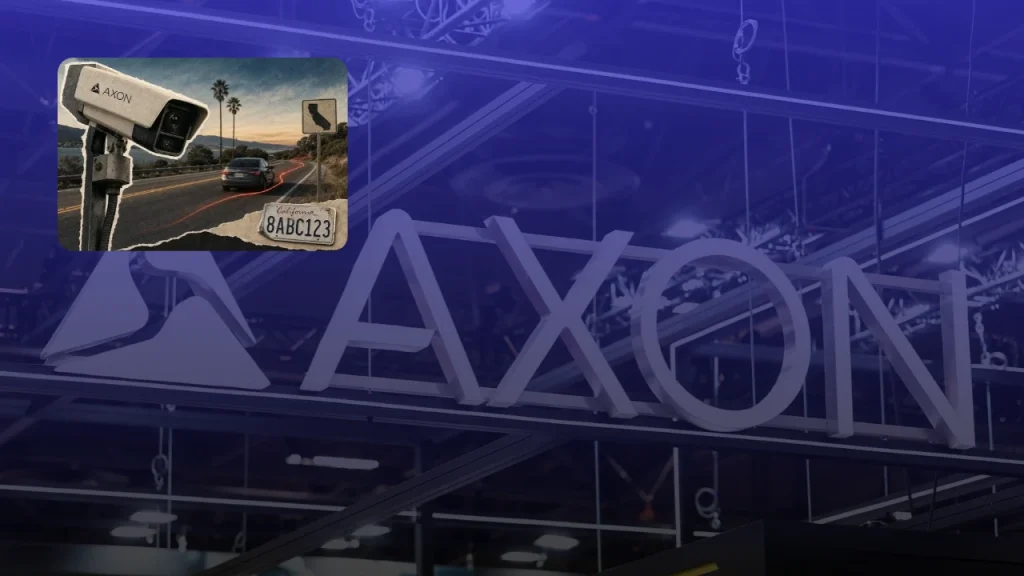
Millions of California drivers may have had their license plates, vehicle descriptions and travel locations recorded by Axon Enterprise’s automated surveillance cameras, according to a new federal lawsuit filed November 3, 2026.
The proposed class action, Mun v. Axon Enterprise, Inc., No. 3:26-cv-13127, alleges that Axon operates a large license plate tracking network without providing the public usage and privacy policy required by California law.
Two California drivers accuse the company of collecting and storing sensitive location information, potentially allowing law enforcement agencies to reconstruct people’s daily movements without their knowledge.
The lawsuit seeks damages of at least $2,500 for qualifying violations under California law, but no class has been certified, no settlement exists and no payments have been awarded. Axon disputes the allegations and argues that the statute does not apply to it as plaintiffs contend.
The biggest legal questions are whether Axon’s cameras violate California privacy requirements, whether ordinary drivers can establish legally recognizable harm and whether a company supplying surveillance technology can be held responsible for its customers’ use of that technology.
Axon License Plate Tracking Lawsuit: Key Facts
| Case detail | Information |
| Case name | Ryan Scott Mun and Felix Phan v. Axon Enterprise, Inc. |
| Case number | 3:26-cv-13127 |
| Filed | November 3, 2026 |
| Court | U.S. District Court, Northern District of California, San Francisco Division |
| Defendant | Axon Enterprise, Inc. |
| Plaintiffs | Ryan Scott Mun and Felix Phan |
| Main allegations | Failure to publish required ALPR privacy policy and unlawful invasion of privacy |
| California law | Civil Code §§ 1798.90.5–1798.90.55 |
| Proposed class period | November 3, 2023, to present |
| Potential damages | At least $2,500 under the statute if legal requirements are established |
| Class certified? | No |
| Settlement or claim form? | None |
| Current status | Early litigation; allegations disputed |
The complaint was filed by attorneys from Gibbs Mura LLP and Hausfeld LLP.
Why Are California Drivers Suing Axon Over License Plate Tracking?
The lawsuit centers on how automated license plate recognition, or ALPR, technology collects information from vehicles traveling on public roads.
Axon is best known for manufacturing TASER devices, police body cameras and law enforcement technology. Its products also include police-vehicle-mounted cameras, fixed license plate readers and software for organizing surveillance information.
According to the complaint, an ALPR camera can capture:
- A vehicle’s license plate number.
- The date and time the vehicle passed the camera.
- Its location and direction of travel.
- Its color, make, body style and other characteristics.
- Data that can be combined with other records to identify patterns of movement.
A camera may record a vehicle even when its driver has committed no offense.
The plaintiffs argue that collecting these observations over time allows users to reconstruct where people work, seek medical care, attend religious services and spend their free time.
The lawsuit alleges that Axon operates more than 1,000 ALPR cameras in California and processes information relating to millions of drivers. Those figures are allegations; the exact number of unique people affected has not been established by the court.
The missing privacy policy allegation
The central legal accusation is not simply that Axon uses cameras.
California’s ALPR Privacy Act requires covered operators and end-users to maintain written policies describing how license plate information is collected, accessed, protected, shared and retained.
The plaintiffs allege that Axon has not implemented or conspicuously posted a compliant, ALPR-specific policy.
According to the complaint, Axon’s general privacy notices and options allowing police customers to publish their own policies do not satisfy the company’s alleged independent duties under California law.
Axon disputes that interpretation.
How Does Axon’s License Plate Surveillance Technology Work?
The complaint identifies several components of Axon’s technology.
Axon Fleet 3: Police-vehicle camera systems with ALPR capabilities that can scan surrounding vehicles during patrols.
Axon Outpost and Lightpost: Fixed camera products installed in locations such as streets and intersections.
Axon Evidence: A digital evidence management platform that can support searches and analysis of collected information.
Axon Fusus: A platform designed to integrate information from different camera systems and public-safety technologies.
The lawsuit alleges that these products can combine individual license plate observations into searchable vehicle histories.
For example, according to a public-records response described in the complaint, Fremont Police Department’s mobile Axon ALPR cameras recorded nearly 5 million license plate reads in a 90-day period.
That figure represents observations, not 5 million different people. The same vehicle may be scanned repeatedly.
The plaintiffs also allege that Axon’s software and customer arrangements permit certain forms of data aggregation and reuse beyond an individual camera’s immediate purpose.
Whether those practices violate applicable law remains disputed.
Where Are Axon License Plate Cameras Used in California?
The November 3 complaint identifies several locations where Axon technology allegedly operates.
| California location | Technology identified in the lawsuit |
| Los Angeles | Police-vehicle ALPR systems |
| Fremont | Police-vehicle ALPR systems |
| Sacramento | Police-vehicle ALPR systems |
| Antioch | Police-vehicle ALPR systems |
| Alameda | Police-vehicle ALPR systems |
| Hayward | Police-vehicle ALPR systems |
| Beverly Hills | Fixed cameras |
| Burbank | Fixed cameras |
| Palm Desert | Fixed cameras |
| Daly City | Fixed cameras |
| UCLA area | Fixed cameras |
| California State University, Long Beach | Fixed cameras |
These are locations identified in the plaintiffs’ filing, not a complete independently verified inventory of operational cameras.
Simply driving through one of these locations does not prove that Axon processed or stored a particular driver’s data.
Why is Los Angeles especially important?
Los Angeles has been debating the expansion of license plate surveillance after concerns about another vendor, Flock Safety.
In October 2026, the Los Angeles City Council intervened in plans for an Axon license plate reader pilot project. Separate reporting later described efforts to move the project forward.
The dispute reflects concerns about data sharing, oversight and whether police technology suppliers can provide meaningful safeguards.
The November 3 lawsuit targets Axon as a technology company, not the Los Angeles Police Department as a defendant.
Related article: Amazon FTC Advertising Lawsuit, Did Hidden Auction Surcharges Inflate Sellers’ Costs by Up to 250%?
Who Filed the Axon Class Action Lawsuit?
Two California residents brought the proposed class action.
Ryan Scott Mun — Daly City, California
Mun lives in Daly City, San Mateo County.
He alleges that Axon cameras collect information about his vehicle during ordinary travel and that the company’s practices interfere with his ability to understand how his location data is being processed.
Mun claims the resulting surveillance interferes with his privacy and personal autonomy.
Felix Phan — Palm Desert, California
Phan lives in Palm Desert, Riverside County.
He alleges that his vehicle regularly passes Axon fixed cameras and that the company collects and aggregates information about his travels.
Phan raises concerns about potential errors, unauthorized data sharing and the absence of a clear process for correcting inaccurate license plate information.
Both plaintiffs seek to represent other individuals whose data was allegedly collected or processed under similar circumstances.
Their experiences are allegations made in the complaint, not established findings of wrongdoing.
Who Could Qualify for the Axon License Plate Tracking Class Action?
The proposed class includes:
All individuals whose ALPR information was collected in California and processed or stored by Axon’s ALPR system from November 3, 2023, to the present.
That definition matters for three reasons.
First, the proposed class concerns the location of data collection, not merely whether someone currently resides in California. An out-of-state driver whose information was captured in California might fall within the proposed wording, depending on how the court interprets and ultimately defines the class.
Second, the class is limited to information processed or stored by Axon’s system. A scan performed only by Flock Safety, Motorola or another unrelated provider would not automatically qualify someone for this lawsuit.
Third, the court has not certified the class. It may narrow the proposed definition, reject certification or dismiss claims.
The complaint’s November 2023 starting date is a proposed litigation period, not an independently established eligibility deadline or a universal statute-of-limitations rule.
Can California Drivers Receive $2,500 From Axon’s Lawsuit?
California Civil Code § 1798.90.54 provides that an individual harmed by a violation of the ALPR statute may sue a person who knowingly caused the harm.
For a successful qualifying claim, the court may award actual damages, with a statutory liquidated-damages minimum of $2,500, along with certain additional remedies.
But the statute does not promise $2,500 to everyone whose license plate was photographed.
To obtain relief, plaintiffs must establish applicable legal requirements, including harm and the defendant’s responsibility for it.
The complaint also seeks punitive damages, attorney’s fees, injunctive relief and a court declaration concerning the alleged violations.
There is no approved compensation fund, settlement administrator or claims process.
A major obstacle: The July 2026 Mata decision
An especially important precedent could affect this case.
On July 20, 2026, the California Court of Appeal decided Mata v. Digital Recognition Network, Inc., No. D084781.
That case also involved a private license plate recognition company and California’s ALPR statute.
The court held that a person must demonstrate actual harm caused by a statutory violation to sue under Civil Code § 1798.90.54. The mere collection of license plate information, accompanied by a subjective belief that privacy was invaded, was insufficient in that case.
This matters directly to Mun v. Axon.
The plaintiffs will need to establish why their alleged injuries satisfy the law. They may attempt to distinguish their case by pointing to different conduct, lack of a required policy, actual data use or other evidence of harm.
The Mata decision does not automatically defeat every Axon claim, but it prevents a responsible assessment from treating the $2,500 amount as guaranteed compensation.
Federal standing requirements may present an additional obstacle.
What California Privacy Laws Does the Axon Lawsuit Involve?
The complaint asserts three causes of action, supported by California’s ALPR statute and broader privacy protections.
1. California’s ALPR Privacy Act — Civil Code §§ 1798.90.5–1798.90.55
California enacted Senate Bill 34 in 2015, with the relevant ALPR requirements taking effect January 1, 2016.
The law governs operators and end-users of automated license plate recognition systems.
Its major provisions include:
| Statute | What it regulates |
| § 1798.90.5 | Defines ALPR systems, operators, end-users and information |
| § 1798.90.51 | Requires operators to maintain security practices and public usage/privacy policies |
| § 1798.90.52 | Requires covered operators to keep access records and restrict access to authorized purposes |
| § 1798.90.53 | Establishes security and policy obligations for ALPR end-users |
| § 1798.90.54 | Provides a civil remedy for individuals harmed by knowing violations |
| § 1798.90.55 | Regulates public agency ALPR programs, including public comment and information sharing |
A compliant policy must address authorized uses, employee access, training, safeguards, information sharing, data accuracy and retention practices.
A central unresolved question is whether Axon’s role as a vendor and software provider makes it an operator or end-user subject to the duties alleged in the complaint.
2. California Constitution — Article I, Section 1
California’s Constitution expressly protects privacy.
Unlike the federal Fourth Amendment, the California constitutional privacy right can apply in certain circumstances to conduct by private entities.
The plaintiffs allege that Axon’s aggregated collection of vehicle-location information seriously invades legally protected privacy interests.
Under Hill v. National Collegiate Athletic Association, 7 Cal. 4th 1 (1994), important questions include whether there is a protected privacy interest, a reasonable expectation of privacy and a serious invasion of that interest.
The case may require the court to distinguish an ordinary observation of a vehicle in public from persistent collection that reveals a detailed travel history.
3. Intrusion upon seclusion — California common law
The third claim alleges intrusion upon seclusion, a recognized privacy tort.
This claim generally requires an intentional intrusion into private matters that would be highly offensive to a reasonable person.
The plaintiffs argue that extensive tracking and aggregation of vehicle movements exceed ordinary public observation.
Axon may contend that license plates are publicly visible, that the technology supports lawful police functions and that the challenged conduct does not meet the legal standard for a serious privacy intrusion.
Those competing arguments require judicial resolution.
Does the Fourth Amendment make Axon’s cameras illegal?
Not automatically.
The Fourth Amendment primarily restricts government searches and seizures. Axon is a private company, and the November 3 complaint does not assert a standalone Fourth Amendment claim.
The U.S. Supreme Court’s decision in Carpenter v. United States, 585 U.S. 296 (2018), recognizes privacy protections for certain historical cellphone location records, but it did not decide that all license plate reading or every warrantless ALPR database search is unconstitutional.
The legal rules can differ depending on who collects the data, how long it is retained, how comprehensive the tracking is and how government officials access it.
For a related challenge against a local government, see Tan v. City of San Jose, Residents File Federal Class Action Over Mass Driver Surveillance.
What Has Axon Said About the Lawsuit?
Axon has disputed the allegations involving California’s ALPR disclosure law.
In its Form 10-Q for the quarter ended September 30, 2026, filed in November, the company disclosed other related proposed class actions in federal and California state courts.
Axon stated that it denies the allegations, including the assertion that the statute applies to Axon, and intends to defend the cases vigorously.
The company also disclosed a newly filed third ALPR complaint and said related lawsuits would likely be consolidated.
This is significant because the November 3 case may eventually proceed alongside other litigation involving Axon’s ALPR technology.
However, anticipated consolidation is not an actual consolidation order, and the different lawsuits retain their own procedural histories until the courts determine otherwise.
No ruling establishing Axon’s liability in Mun was verified as of November 11.
How Is This Different From the Flock Safety Tracking Lawsuit?
The Axon case is part of a wider legal dispute about license plate databases, but the defendants and claims are not interchangeable.
Flock Safety and Axon are different technology companies.
Some Flock lawsuits challenge how police or vendors collect, search or share location data. The Axon Mun complaint specifically focuses on California’s statutory ALPR policy requirements, state constitutional privacy and intrusion upon seclusion.
There is also a separate Axon lawsuit in the Northern District of California, No. 3:26-cv-11183, and another in Riverside County Superior Court, No. CVRI26O6719.
The cases should not be combined into one nationwide compensation program.
Read Flock Police Tracking Lawsuit, Were You Affected? Whitson v. Flock Group Inc., No. 1:26-mi-99999-UNA for background on the separate Flock litigation.
How Can California Drivers Check Whether They Were Tracked?
There is currently no verified public Axon settlement lookup tool that allows drivers to enter a license plate number and confirm membership in the proposed class.
Drivers concerned about ALPR surveillance can take practical steps:
- Identify the relevant technology. Review public city council records, police ALPR policies and contracts to see whether an agency uses Axon equipment.
- Record relevant information. Note approximate dates and locations where your vehicle may have been scanned, especially if you have documentation of a particular incident.
- Preserve evidence of specific harm. Save police notices, records of inaccurate plate matches, improper searches or other documentation if you believe data was misused.
- Review official court developments. Monitor Case No. 3:26-cv-13127 for changes to the class definition, dismissal rulings or certification.
- Consider legal advice where warranted. A California privacy attorney can assess whether your circumstances involve legally cognizable harm.
California’s ALPR law requires public privacy policies from covered entities. It does not automatically guarantee that any driver can obtain a complete copy of every scan from a law enforcement database.
Do not pay anyone to enroll you in an Axon settlement. There is no verified settlement to join.
California has also investigated separate problems involving automobile location data. For comparison, see General Motors $12.75 Million OnStar Data Privacy Settlement, Did GM Sell Your Driving Data? Here Is What California Drivers Need to Know.
What Happens Next in Mun v. Axon Enterprise?
The complaint was filed November 3, followed by early procedural activity, including issuance of a summons and an initial case management scheduling order.
The next important litigation developments may include:
- Axon’s formal response or motion to dismiss.
- Arguments over whether the ALPR statute applies to Axon.
- Challenges concerning actual harm and federal standing.
- Possible consolidation with other Axon ALPR lawsuits.
- Discovery about Axon’s policies, system operations and data practices.
- A request for class certification under Federal Rule of Civil Procedure 23.
The plaintiffs rely on the Class Action Fairness Act, 28 U.S.C. § 1332(d), to establish federal jurisdiction.
The complaint alleges that more than $5 million is in controversy. That is a jurisdictional allegation, not an announced settlement fund.
No class-certification decision, liability ruling or compensation deadline has been established.
Frequently Asked Questions About the Axon License Plate Lawsuit
Is Axon illegally tracking millions of California drivers?
That is the plaintiffs’ allegation. The federal court has not determined that Axon’s surveillance practices violate California law.
Can I get $2,500 because an Axon camera scanned my license plate?
Not automatically. California law allows that minimum liquidated-damages amount for qualifying harm, but the elements of liability and standing must be established. The 2026 Mata decision makes that distinction particularly important.
Does the lawsuit cover all California residents?
No. The proposed class concerns individuals whose ALPR information was collected in California and processed or stored by Axon’s system during the specified period. It is not every resident or every licensed driver.
Can someone from another state qualify?
Possibly under the proposed wording if their information was collected in California and processed or stored by Axon. The court has not approved or finally interpreted the class definition.
Is every license plate reader camera illegal in California?
No. California permits ALPR technology subject to applicable legal requirements. The lawsuit alleges that Axon’s particular practices and policy arrangements violate those requirements.
Can police search license plate records without a warrant?
Some ALPR searches occur without warrants, but legality depends on the circumstances and governing law. The Fourth Amendment and California privacy rules do not establish a blanket answer covering every ALPR search.
Is this an Axon settlement?
No. This is an active putative class action. There is no certified class, approved settlement, claim form or guaranteed payment.
When is the next Axon court hearing?
The reviewed materials confirm early case management activity, but a specific upcoming hearing date should be taken from the current federal docket rather than assumed from the November 3 complaint.
What This Lawsuit Could Mean for California Drivers
Mun v. Axon Enterprise asks an important question: when companies help law enforcement build searchable records of people’s movements, what obligations do those companies have to explain how the information is collected and used?
The plaintiffs argue that Axon’s surveillance infrastructure and alleged lack of a compliant privacy policy violate California law. Axon disputes the allegations and the law’s application to its business.
The outcome may help clarify technology vendors’ responsibilities under California’s ALPR Privacy Act and whether people whose public movements were recorded can establish the harm necessary for a private lawsuit.
For now, the case remains unresolved. California drivers should distinguish the possibility that their vehicle was scanned from proof of unlawful conduct, eligibility for a certified class or entitlement to compensation.
Primary Sources and Legal References
Court filings and company disclosures
- Mun v. Axon Enterprise, Inc., Class Action Complaint, Document 1, November 3, 2026 — Original 41-page complaint, proposed class and three causes of action.
- Mun v. Axon Enterprise, Inc., Federal Docket — Filing date, case number and procedural information.
- Axon Enterprise, Form 10-Q for September 30, 2026 — Company’s statements concerning related litigation and its defense.
- Gibbs Mura, Axon ALPR Lawsuit — Plaintiffs’ counsel’s case information.
Statutes and judicial decisions
- California Civil Code §§ 1798.90.5–1798.90.55 — ALPR Privacy Act.
- Mata v. Digital Recognition Network, Inc., California Court of Appeal, July 20, 2026 — Published opinion addressing the statute’s actual-harm requirement.
- California Constitution, Article I, Section 1 — Right to privacy.
- Hill v. National Collegiate Athletic Association, 7 Cal. 4th 1 (1994) — California constitutional privacy analysis.
- Carpenter v. United States, 585 U.S. 296 (2018) — Fourth Amendment principles concerning historical location information.
- Federal Rule of Civil Procedure 23; 28 U.S.C. § 1332(d) — Class certification and federal class-action jurisdiction.
Research note: This article was prepared using the November 3 complaint, Axon’s own SEC disclosure, California statutes and judicial opinions. Allegations and proposed remedies have been distinguished from judicial findings. Last reviewed November 11, 2026.
Legal disclaimer: AllAboutLawyer.com provides independent U.S. legal information, not legal advice. A filed complaint does not establish wrongdoing, class membership or entitlement to compensation. Anyone seeking advice about their specific privacy rights should consult a qualified attorney.
About the Author
Israr Ahmad is a legal content researcher with 4+ years of experience covering class action settlements and consumer rights cases. He has researched and published coverage of 2,500+ settlements using verified court records, settlement administrator filings, and government sources. Learn more about Israr.