
AT&T Sues Comcast Over Xfinity Fiber Claims, What “Fiber-Powered” Internet Really Means
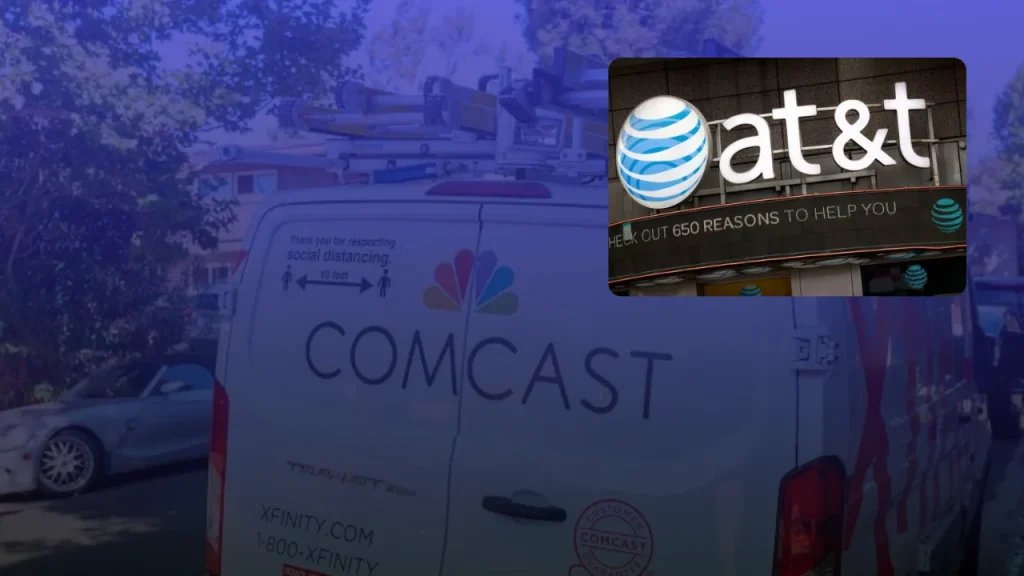
AT&T has filed a federal false-advertising lawsuit accusing Comcast of misleading potential Xfinity customers by promoting its home internet as “fiber-powered” even though most connections still use coaxial cable to reach individual homes.
The lawsuit, filed November 13, 2026, in the U.S. District Court for the Northern District of California, alleges that Comcast’s marketing makes its hybrid fiber-cable service look comparable to the fiber-to-the-home internet AT&T sells.
The court has not ruled that Comcast violated the law. This is not a consumer class action, and there is no settlement, refund program, or claim deadline. For Xfinity subscribers, the practical questions are what kind of connection actually reaches their home and whether the advertising explains it accurately.
AT&T v. Comcast: Quick Facts
| Detail | Information |
| Case name | AT&T Teleholdings, Inc. et al. v. Comcast Cable Communications, LLC |
| Case number | 3:26-cv-13704 |
| Filed | November 13, 2026 |
| Court | U.S. District Court, Northern District of California |
| Plaintiffs | AT&T Teleholdings, Inc. and AT&T Wireline Holdings, LLC |
| Defendant | Comcast Cable Communications, LLC |
| Advertising challenged | Xfinity “Fiber-Powered” internet and Wi-Fi claims |
| Main allegation | Misleading consumers about fiber versus coaxial connections |
| Federal law | Lanham Act, 15 U.S.C. § 1125(a)(1)(B) |
| California laws | Business and Professions Code §§ 17500 and 17200 |
| Relief requested | Injunction, profits, damages, restitution, legal costs |
| Status | Newly filed; no liability ruling |
| Customer compensation | None established |
Court record: AT&T v. Comcast, No. 3:26-cv-13704.
Why Did AT&T Sue Comcast?
The lawsuit centers on one phrase: “Fiber-Powered.” According to the 21-page complaint, Comcast uses wording such as “Fiber-Powered internet,” “Powered by fiber,” and “the most reliable, fiber-powered WiFi” to promote Xfinity. AT&T argues these statements suggest a fiber-optic connection directly into the home.
According to the complaint, the overwhelming majority of Xfinity subscribers actually get service over a hybrid fiber-coaxial (HFC) network, where fiber carries data through much of the network and coaxial cable makes the final connection to the residence. AT&T says the difference matters because consumers associate fiber-to-the-home with faster uploads, lower latency, and dependable performance, and that Comcast is using fiber language to attract people who might otherwise buy AT&T Fiber. It claims this harms its customer relationships, reputation, revenue, and competitive position.
These are AT&T’s allegations, not judicial findings.
Is “Fiber-Powered” Xfinity Internet Real Fiber?
Xfinity’s fiber-powered advertising describes a network that uses fiber-optic technology, which does not necessarily mean fiber reaches the subscriber’s home. Comcast’s own educational materials distinguish two approaches:
- Fiber-to-the-home (FTTH): fiber-optic cable runs directly to the residence.
- Fiber-to-the-node (FTTN): fiber reaches a neighborhood node, and another medium, such as coaxial cable, carries the signal into homes.
Most of Comcast’s traditional residential cable network uses the second approach, also called HFC.
| Feature | Fiber-to-the-home | Hybrid fiber-coaxial |
| Connection into home | Fiber-optic cable | Usually coaxial cable |
| Upload speeds | Often symmetrical with downloads | Frequently lower, though newer upgrades can improve uploads |
| Download speeds | Gigabit and multigigabit possible | Gigabit and, in some areas, multigigabit possible |
| Latency | Often low and consistent | Can also be low, varies by network design |
| Shared capacity | May exist upstream | Coaxial segments share capacity |
| Key point | Fiber reaches the premises | Fiber is used in part of the network |
Hybrid cable is not automatically slow or unreliable, and fiber-to-the-home does not guarantee perfect performance. Congestion, Wi-Fi interference, router limits, and plan restrictions can affect either. The lawsuit is about whether the advertising communicates the distinction clearly enough, not whether every Xfinity connection performs poorly. Source: Xfinity: What Is Fiber-Powered Internet?.
What Does AT&T Say Is Misleading?
The complaint points to several examples of Comcast’s online marketing.
1. “The most reliable, fiber-powered WiFi.” AT&T argues consumers could read this as describing an all-fiber connection. But Wi-Fi is wireless networking that uses radio signals regardless of whether the internet line is fiber or coax. The line feeding the router and the Wi-Fi inside the home are separate components.
2. “Built for Speed. Powered by Fiber.” The complaint cites a Gig WiFi ad with this headline, alleging the explanation of the coaxial connection is buried among extensive offer terms. It includes screenshots of Xfinity ads reviewed in early November 2026.
3. Small-print disclosures. Some ads state that Xfinity Internet is powered by fiber and connected to premises by coaxial cable. AT&T argues that does not correct the overall impression created by the larger fiber claims, and that ordinary customers may not understand what coaxial cable is.
The court must decide whether the advertising is legally false or misleading under the statutes invoked.
Related article: CIA January 6 Records, Why the CIA Refused to Confirm or Deny Documents After Judge Jia M. Cobb Ordered Production in Judicial Watch v. CIA
Did an Advertising Watchdog Already Rule on This?
Yes, and it matters. On June 3, 2026, BBB National Programs’ National Advertising Division (NAD) announced a decision on Xfinity’s fiber-powered ads, following a challenge by AT&T Services, Inc., an AT&T affiliate.
NAD found that Comcast’s disclosure adequately explained that the service was not fiber-to-the-home, but recommended improving its placement and visibility. Some explanations sat inside long blocks of terms, and in other examples customers had to scroll to find them. NAD recommended placing the explanation closer to the claim. Comcast said it would comply.
So NAD did not declare the “fiber-powered” wording unlawful. It addressed whether consumers could clearly see the explanation of the coax connection. The federal suit raises broader claims, including that the representations are themselves false or misleading, and NAD’s self-regulatory decision does not bind the court. Source: BBB National Programs, June 3, 2026 NAD decision.
Which Laws Does the Lawsuit Involve?
The complaint has three counts.
Count 1: Lanham Act false advertising, 15 U.S.C. § 1125(a)(1)(B). This federal provision covers false or misleading statements in commercial advertising about the nature, characteristics, or qualities of goods and services. AT&T must prove elements including falsity or deception, materiality, and injury tied to the advertising. It asserts both literal falsity and misleading implication, and says Comcast’s ads divert customers and weaken the advantage of its fiber network. See 15 U.S.C. § 1125.
Count 2: California False Advertising Law, Bus. & Prof. Code § 17500. It bars untrue or misleading statements made to sell goods or services when the advertiser knows or should know they are misleading. AT&T says Comcast misrepresents the technology behind Xfinity internet. The case is in California because Comcast advertises and provides service there, including in the Northern District, and AT&T alleges competitive harm in that market.
Count 3: California Unfair Competition Law, Bus. & Prof. Code § 17200. It addresses unlawful, unfair, or fraudulent business practices. AT&T claims Comcast’s marketing makes HFC service look equivalent to AT&T’s fiber-to-the-home service.
Do FTC and FCC rules matter?
They provide context but are not the claims in this case. Section 5 of the FTC Act addresses unfair or deceptive practices, and the FTC generally handles deceptive advertising complaints. The FCC requires broadband providers to display consumer labels showing typical speeds, latency, pricing, and fees under 47 C.F.R. § 8.1. AT&T’s complaint asserts no separate FTC Act claim or stand-alone FCC label violation. The case is about competitor false advertising under the Lanham Act and California law.
What Does AT&T Want the Court to Order?
AT&T seeks a permanent injunction barring Comcast from using the challenged fiber-powered descriptions for its HFC service. It also seeks:
- An accounting and recovery of profits attributable to the disputed advertising, if established
- Actual damages in an amount to be determined, with enhancement where permitted
- Restitution and interest
- Attorneys’ fees and costs
- A jury trial on issues triable to a jury
The complaint names no specific damages figure. The relief addresses AT&T’s alleged competitive losses. It is not a request to pay Xfinity customers.
Can Xfinity Customers Get Refunds?
Not through this case as filed. AT&T and an affiliate, not subscribers, are the plaintiffs. The complaint proposes no consumer class, settlement administrator, or eligibility rules, and there is no claim form.
Customers who feel personally misled may have separate options depending on their state, the ads they actually saw, their contract terms, and whether they suffered a legally recognized loss. Being an Xfinity HFC subscriber does not automatically entitle anyone to compensation. For a different example of broadband advertising producing consumer relief, see Spectrum Lawsuit Settlement: Are You Owed Part of the $193M Payout?. That matter involved different companies, claims, and government proceedings and does not show Comcast customers qualify for anything here.
How to Tell Whether Your Internet Is Fiber or Coaxial
- Check the FCC National Broadband Map. Go to BroadbandMap.FCC.gov, enter your address, and review the reported fixed broadband technologies. If Comcast is listed as cable at your address, that generally points to a coax-based connection. The map shows provider-reported availability, not proof of what is installed at your home.
- Read your plan’s Broadband Facts label. It lists typical download and upload speeds, latency, price, and data terms. It helps compare performance and cost but does not necessarily say what physical cable enters your home.
- Look at upload speed, with caution. A large gap, such as 1,000 Mbps down and far lower up, often suggests a cable connection, while matching speeds often suggest fiber. Newer cable upgrades can narrow the gap, so it is a clue, not proof.
- Look at the equipment. Fiber-to-the-home typically uses an optical network terminal (ONT) in or on the home, while cable uses a coaxial cable modem.
- Ask your provider. Try: “Is my address served by fiber-to-the-home or hybrid fiber-coaxial, and does fiber or coaxial cable enter my home?” Request the answer in writing.
- Test your connection. Use a reputable speed test over wired Ethernet at different times of day. A speed test alone cannot show whether your line is fiber or coax.
What If You Feel Misled?
First confirm what technology is actually supplied at your address. Keep the ad, order confirmation, broadband label, contract, bills, and any written statements from sales staff, then ask Xfinity for clarification or a resolution. For speed, billing, or performance problems, you can file with the FCC Consumer Complaint Center. The FCC treats false advertising as primarily an FTC matter, so deceptive-ad concerns may be better directed to the FTC or your state attorney general. If specific promises materially influenced your purchase, a licensed consumer-protection attorney can assess your state-law options.
Cancellation rights depend on your service agreement, applicable law, and equipment terms. The AT&T lawsuit does not cancel contracts or waive fees.
Did AT&T Also Sue Spectrum?
Yes. AT&T filed a similar suit against Charter Communications, which provides Spectrum internet, in August 2026, challenging fiber-related marketing for service delivered over an HFC network. Charter has contested the allegations and argued that “fiber-powered” appropriately describes fiber’s role in its network. Neither case establishes that all hybrid fiber-coaxial advertising is unlawful.
Is This the Same as the Comcast or AT&T Data Breach Settlements?
No. This case is about advertising, not stolen data. The Comcast Xfinity $117.5M Data Breach Settlement and the AT&T $177 Million Data Breach Settlement arose from separate security incidents and have their own eligibility rules and deadlines.
Frequently Asked Questions
Is Comcast’s Xfinity internet fake fiber?
Not necessarily. Comcast uses real fiber-optic infrastructure, but many subscribers receive the final connection over coaxial cable. The dispute is about how that mixed network is described in ads.
Is Xfinity’s fiber-powered advertising illegal?
That has not been decided. AT&T alleges violations of federal and California law, and no court has ruled on the merits.
Is fiber-powered Wi-Fi the same as fiber-to-the-home?
No. Wi-Fi is wireless connectivity inside a home. Fiber-to-the-home is the physical line into the premises.
Does coaxial cable mean slow internet?
No. Modern cable can deliver gigabit downloads. Real-world performance depends on network design, upgrades, your plan, and other factors.
Can I join the AT&T v. Comcast lawsuit?
No. It is a business-to-business false-advertising case, not a consumer class action, so there is no process for customers to join.
Will Comcast have to stop saying “fiber-powered”?
Only if Comcast changes its ads voluntarily or a court orders it. AT&T requests an injunction, but none has been entered in the docket reviewed.
Can I cancel Xfinity without fees because of this lawsuit?
No. The filing alone does not waive contract fees. Your rights depend on your service terms and applicable consumer law.
Who is the judge?
The November 13 docket lists Magistrate Judge Alex G. Tse as the initially assigned judicial officer, with a November 27, 2026 deadline to consent to or decline magistrate jurisdiction. The assignment says nothing about the merits.
What happens next?
Comcast will respond to the complaint, likely through an answer or motion to dismiss. The parties may then dispute whether the ads are actionable, whether the statements are materially misleading, and whether AT&T can show competitive injury and entitlement to relief. No trial date, settlement, or customer payment schedule appeared in the initial docket.
Why This Case Matters
The case raises a question that goes beyond two telecom giants: when a provider advertises internet service as fiber-powered, how clearly must it explain what actually connects the customer’s home? Fiber can offer real performance advantages, and the final-connection technology may affect what subscribers get. Yet HFC networks can deliver high-quality broadband, and a coaxial connection does not by itself prove deception. The court will have to separate honest descriptions of fiber infrastructure from advertising that unlawfully misleads. Until then, customers should compare broadband labels, check the FCC map, and ask their provider what enters their home before buying.
As of November 18, 2026, the lawsuit is newly filed, the allegations are unproven, and no consumer compensation program exists.
Primary Sources
- AT&T v. Comcast: November 13, 2026 Federal Complaint, Document 1
- AT&T Teleholdings Inc. et al. v. Comcast Cable Communications LLC: Federal Docket
- BBB National Programs: June 3, 2026 Xfinity Fiber-Powered Advertising Decision
- Xfinity: What Is Fiber-Powered Internet?
- 15 U.S.C. § 1125: Lanham Act False Advertising
- California Business and Professions Code § 17500
- California Business and Professions Code § 17200
- FCC: How to Use the National Broadband Map
- FCC: Broadband Consumer Complaint Guidance
Legal disclaimer: This article offers general legal information, not legal advice. AT&T’s allegations remain contested. AllAboutLawyer.com is not affiliated with AT&T, Comcast, the court, or the parties’ counsel.
Prepared by the AllAboutLawyer.com legal content research team.
About the Author
Israr Ahmad is a legal content researcher with 4+ years of experience covering class action settlements and consumer rights cases. He has researched and published coverage of 2,500+ settlements using verified court records, settlement administrator filings, and government sources. Learn more about Israr.