
Assisted Suicide in Switzerland, What the Law Actually Says 2026
Yes — Switzerland has permitted assisted suicide since 1942 under Article 115 of the Swiss Penal Code. The law allows assistance in suicide as long as the person helping has no selfish motive. Switzerland is the only country that accepts non-residents. Active euthanasia — where a doctor administers the drug — remains illegal.
Does Switzerland have assisted suicide?
Yes — Switzerland has permitted assisted suicide since 1942 under Article 115 of the Swiss Penal Code. The law allows assistance in suicide as long as the person helping has no selfish motive. Switzerland is the only country that accepts non-residents. Active euthanasia — where a doctor administers the drug — remains illegal.
Switzerland occupies a unique position in the global debate over assisted dying. It is the world’s oldest jurisdiction tolerating assisted suicide — and the only one that opens its doors to people regardless of nationality or residency. Every eight days, a British citizen alone travels to Switzerland to die, according to the advocacy group Dignity in Dying.
Yet despite this global reputation, there is no specific federal law in Switzerland regulating the details of assisted suicide. At the federal level, assisted suicide is only explicitly mentioned in criminal law. What exists is not a detailed statute — it is a single clause in an 84-year-old criminal code, interpreted by courts and implemented by nonprofit organizations operating in a legal gray space.
This article explains exactly what Swiss law permits and prohibits, who qualifies, how the major organizations work, what it costs, and what legal risks exist for everyone involved. For a broader comparison of assisted dying laws globally, see our guide to where assisted suicide is legal around the world. For a plain-English explanation of how physician-assisted suicide works generally, see our overview of what physician-assisted suicide is. For U.S.-specific laws, see our guide to assisted suicide laws across the United States.
What Swiss Law Actually Says: Article 115
Article 115 of the Swiss Criminal Code states: “Any person who for selfish motives incites or assists another to commit or attempt to commit suicide is, if that other person thereafter commits or attempts to commit suicide, liable to a custodial sentence not exceeding five years or to a monetary penalty.”
The key phrase is “for selfish motives.” By making selfishness the only crime, the law — entirely by omission — permits assisted suicide when the person helping acts altruistically. Thus in Switzerland, there is no prosecution if the person assisting a suicide successfully claims that they are acting unselfishly. While this results in de facto legalization, assisted suicide is not legal — only unpunishable — unless a selfish motive can be proved.
This distinction matters enormously. Switzerland never passed a “Death with Dignity” law. It never held a referendum approving assisted suicide. This law, which dates from 1942, was not at all drafted with a physician-assisted suicide state of mind — it was written with suicides motivated by a loss of honor in mind. What exists today emerged from courts, nonprofit organizations, and medical ethics guidelines filling a legal vacuum that has never been formally addressed by the Swiss parliament.
What Article 115 does NOT permit: All forms of active euthanasia, such as administering lethal injection, remain prohibited in Switzerland. Swiss law only allows providing means to die by suicide, and the reasons for doing so must not be based on self-interest. The action which directly causes death must be performed by the one wishing to die.
Who Qualifies for Assisted Suicide in Switzerland?
Swiss law itself sets only two hard requirements. It is a legal requirement that the final act leading to death must be performed by the person concerned themselves. If assisted suicide is to be permissible, the person concerned must have capacity.
Beyond those two legal minimums, eligibility is shaped by the organizations that facilitate the process — not by statute. Access is available to any adult with decision-making capacity. The person must be able to do the act which brings about death themselves — for example, drink the lethal medication or open the valve of a drip.
Crucially, Switzerland operates under a unique “civil model” of assisted dying. Unlike the Netherlands, Belgium, and most countries where assisted dying is a medical act integrated into the healthcare system, in Switzerland it is primarily facilitated by non-profit organizations with the support of medical doctors.
What Swiss law does NOT require — unlike most other countries:
- A terminal illness diagnosis
- A prognosis of six months or less to live
- Swiss residency or citizenship
- A waiting period between requests
- Multiple physician confirmations
This makes Switzerland significantly more accessible than any U.S. state or country with formal MAID legislation — but it also means eligibility rests heavily on the individual organization’s own rules.
The Major Organizations: Dignitas, Exit, Pegasos, and Others
Since assisted suicide is not legally considered a medical act, it is conducted in Switzerland by associations: Dignitas, Exit, Lifecircle, Pegasos, and ExInternational. Apart from Exit, which only deals with Swiss residents, the others accept foreigners.
Dignitas
Dignitas is a Swiss nonprofit organization providing physician-assisted suicide, supported by independent Swiss doctors. By the end of 2020, they had assisted 3,248 people die by suicide in Switzerland. Dignitas accepts members even if they are not resident in Switzerland and have foreign citizenship — though it can only provide its members with support within Swiss national territory. Dignitas requires applicants to have a terminal illness, an unendurable incapacitating disability, or unbearable and uncontrollable pain. The base fee for VAD with Dignitas is CHF 11,000.
Exit
Exit was founded in 1982 and has more than 130,000 members. The association is strictly reserved for Swiss residents and favours a local approach, supporting around 800 people per year. Exit is the largest assisted dying organization in Switzerland by membership but does not accept non-residents under any circumstances.
Pegasos
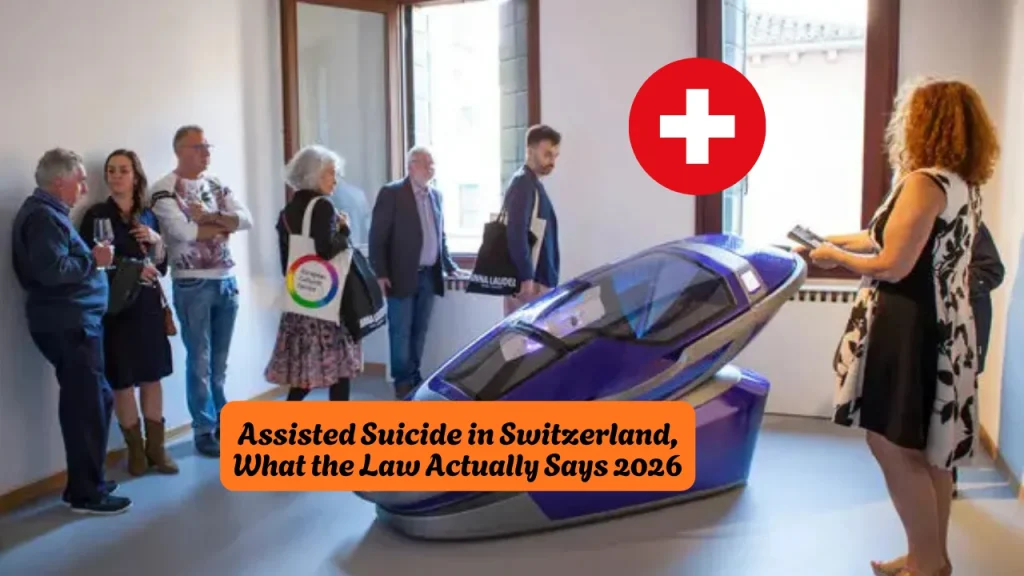
Pegasos is a newer organization that accepts international members. Pegasos has developed an ingenious device that requires a simple bump to start the infusion, where even tetraplegic people can operate the drip themselves. Pegasos takes the position that voluntary assisted dying is a human right for any rational adult of sound mind, regardless of their state of health.
| Organization | Accepts Non-Residents | Founded | Approx. Cost (CHF) |
| Dignitas | Yes | 1998 | ~11,000 |
| Exit | No — Swiss only | 1982 | ~7,000+ |
| Pegasos | Yes | 2019 | ~10,000 |
| Lifecircle | Yes | 2011 | ~10,000 |
| ExInternational | Yes | 1997 | Varies |
The Legal Process: What Actually Happens
Every assisted suicide in Switzerland triggers a mandatory legal process regardless of whether anything went wrong.
In Switzerland, every assisted suicide triggers a mandatory investigation due to its classification as a non-natural death. This legal requirement is enshrined in the Swiss Criminal Procedure Code. Since no crime has been committed in the absence of a selfish motive, these are mostly open-and-shut cases. Prosecution can occur if doubts are raised about the patient’s competence to make an autonomous choice, or about the motivation of anyone involved.
The practical steps for a non-resident accessing assisted suicide through an organization like Dignitas are:
- Apply for membership — Submit an application, personal letter explaining the wish to die, and full medical records
- Preliminary assessment — Organization reviews records and provides a provisional assessment (Dignitas charges CHF 4,000 for this stage)
- Swiss physician consultation — An independent Swiss doctor conducts at least two face-to-face meetings to confirm eligibility and willingness
- Prescription issued — Doctor prescribes pentobarbital, the standard lethal medication used in Switzerland
- Travel to Switzerland — Applicant travels to Switzerland; the procedure must take place on Swiss territory
- Self-administration — Applicant self-administers the medication in the presence of organization staff and, typically, family members
- Police notification — Death is reported to Swiss authorities, triggering mandatory investigation
- Death certificate issued — Cause of death recorded as the underlying illness or condition
Because Swiss authorities require specific documentation, it is advisable to begin the application process at least six months in advance, though it may be possible to apply and receive VAD more quickly than that.
Frequently Asked Questions
Is there a statute of limitations or legal deadline to apply for assisted suicide in Switzerland?
There is no formal statute of limitations. The practical constraint is the applicant’s own mental capacity and physical ability to self-administer — both of which must be intact at the time of the procedure. Organizations such as Dignitas advise beginning the application process at least six months before you intend to use the service, because documentation review, physician consultations, and scheduling take considerable time.
How long does the process take from first application to the procedure in Switzerland?
The timeline varies by organization and individual circumstances. Dignitas advises a minimum of three to six months from initial application to the procedure for most applicants. Cases involving psychiatric illness or complex medical histories may take longer due to additional evaluation requirements. Urgent cases — where the applicant faces imminent loss of capacity — can sometimes be processed more quickly.
Do I need a lawyer to access assisted suicide in Switzerland?
You do not need a lawyer to apply to Dignitas or another Swiss organization. However, consulting a healthcare attorney in your home country before traveling is strongly advisable. A lawyer can review how your home country’s laws treat accompanying family members, whether your life insurance policy will be affected, and whether your advance directives and estate documents are in order before you travel.
Does traveling to Switzerland for assisted suicide create legal risk for family members who accompany you?
In Switzerland itself, family members present at the procedure face no legal liability as long as they did not assist the patient in taking the medication. The risk lies in your home country’s laws. In the United Kingdom, for example, assisting a suicide remains a criminal offense under the Suicide Act 1961, punishable by up to 14 years in prison — though no family member accompanying a loved one to Switzerland has been prosecuted to date. The legal risk varies significantly by country. Consult an attorney in your home jurisdiction before making any travel plans.
Does Switzerland require a terminal illness to access assisted suicide?
Swiss law itself does not require a terminal illness — only mental capacity and the ability to self-administer. However, the individual organizations set their own eligibility criteria. Dignitas requires a terminal illness, unendurable disability, or unbearable and uncontrollable pain. Pegasos takes a broader position, considering any rational adult of sound mind eligible regardless of health status. Exit, which serves only Swiss residents, follows Swiss Medical Association guidelines requiring documented suffering substantiated by a medical diagnosis.
Legal Terms Used in This Article
Article 115 — Swiss Penal Code: The single clause in Switzerland’s 1942 Criminal Code that makes assisted suicide legally tolerable by criminalizing it only when the assisting party acts from selfish motives.
Active euthanasia: The direct administration of a lethal drug by a physician or third party to end a patient’s life. Prohibited in Switzerland under Article 114 of the Swiss Penal Code, regardless of consent or motive.
Selfish motive: The legal threshold under Article 115. If the person assisting a suicide stands to gain financially or otherwise from the death, they face criminal prosecution. Nonprofit organizations operating without personal financial gain satisfy this requirement.
Decision-making capacity: The legal and medical standard confirming a person can fully understand, process, and communicate their own healthcare decisions without cognitive or psychiatric impairment. Required at the time of self-administration under Swiss law.
Pentobarbital: The sodium pentobarbital solution prescribed by Swiss physicians and used as the standard lethal medication in Swiss assisted suicide procedures. It is a controlled substance requiring a doctor’s prescription under Swiss narcotics law.
Suicide tourism: The term — criticized by Swiss organizations as stigmatizing — used to describe the practice of traveling to Switzerland from countries where assisted suicide is illegal to access the procedure legally.
Mandatory investigation: The legal requirement under the Swiss Criminal Procedure Code that every assisted suicide be reported to police and investigated as a non-natural death, even when no crime is suspected.
Conclusion
Switzerland’s approach to assisted suicide is genuinely unlike any other country in the world. The Swiss model emphasizes individual autonomy — the state does not grant the right to die, but rather refrains from punishing those who altruistically assist someone who is competent and acts autonomously to exercise that right. It is a system built not on legislation but on a single criminal law clause, filled in by courts, medical ethics guidelines, and nonprofit organizations over more than 80 years.
For anyone considering this option — whether as a Swiss resident or a foreign national — legal preparation in your home country is as important as the Swiss application process itself. Estate documents, advance directives, and family legal considerations all need to be in order before any travel plans are made. Visit AllAboutLawyer.com to connect with a qualified healthcare attorney who can guide you through every legal step.
This article is for informational purposes only and does not constitute legal advice. Swiss laws and organizational policies may change. Consult a licensed attorney in your jurisdiction for advice specific to your situation. Visit AllAboutLawyer.com to find a qualified healthcare attorney near you.