
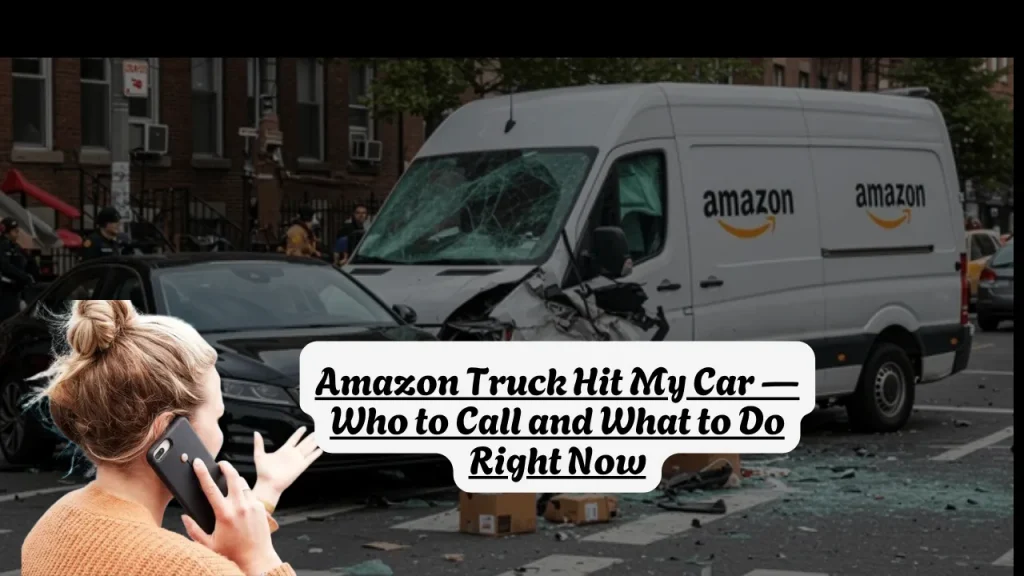
Amazon Truck Hit My Car Who to Call and What to Do Right Now
Take a breath. You can handle this — but the order in which you make these calls matters more than most people realize.
Here is exactly who to contact, what to say, and what to avoid doing in the hours after an Amazon delivery truck hits your car.
Call 1: 911 — Do This First, Before Anything Else
Whether you are involved in an accident with an Amazon semi-truck or an Amazon van out making deliveries, your first call should be to the police — especially if there are any injuries. You should not delay by calling Amazon’s customer service line first. They will not send help.
When you call 911, tell the dispatcher: there has been a vehicle collision, give your location, and say whether anyone appears injured. Police will document the scene, take statements, and create an official police report — a document you will need for any insurance claim or lawsuit.
Even if the accident occurred on private property, call the police. A car accident that scratches your paint will likely cost more than $500 to repair — and in many states, that threshold triggers a legal requirement to file a police report.
Do not skip the police report even if the Amazon driver asks you to handle it privately. That report is one of the most important pieces of evidence in your claim.
While You Wait for Police — What to Do at the Scene
You do not need to do all of this perfectly. Do what you safely can.
Check yourself for injuries first. Adrenaline after a crash masks pain. You may feel fine and discover hours later that you are not. If you are injured, seek medical attention immediately. Getting treatment right away establishes a direct connection between the accident and your injuries. If you wait, insurance adjusters will argue something else caused them.
Move your vehicle if it is safe to do so. Turn on your hazard lights. If you cannot move the car safely, stay inside until police arrive.
Exchange information with the Amazon driver. Get their name, contact details, insurance information, license plate number, and the name of the company they drive for. Also ask whether they are on duty — if they were actively delivering packages at the time of the crash, Amazon’s commercial insurance may apply.
Photograph everything. Take photos of both vehicles, the damage, the road, any skid marks, traffic signs, and your own injuries if visible. Take a short video on your phone describing what happened while it is fresh. Take photos from multiple angles. This documentation is essential for insurance claims and any potential legal action.
Talk to any witnesses. Get their names and phone numbers. Bystanders who saw the crash can be invaluable if Amazon later disputes who caused it.
Do not admit fault. Do not say “I’m sorry” or “I didn’t see you.” Do not speculate about what happened. Stick to basic facts when speaking with police.
Call 2: A Personal Injury Attorney Before You Talk to Insurance
This is the call most people make too late.
When Amazon’s insurance company contacts you after an accident, they are not doing so with your best interests in mind. Their goal is to get you to settle as quickly as possible — because they know what your claim is truly worth, and they want to pay you less than that.
Amazon’s adjusters are trained at this. They may call you within 24 to 48 hours sounding friendly and sympathetic. They may offer you a quick payment. Contacting an experienced accident attorney immediately helps protect your rights, prevent insurance manipulation, and maximize your financial recovery.
Most personal injury attorneys who handle Amazon truck accidents work on contingency — meaning you pay nothing unless they win for you. A free consultation costs you nothing, and it could be the most valuable call you make.
Related article: Can You Sue Amazon, FedEx, or UPS If Their Delivery Truck Hit You?
Do not give a recorded statement to Amazon’s insurance team before speaking with an attorney. That statement will be used against you. You are not required to give one.
Call 3: Amazon — To Report the Accident
This call is for documentation purposes only — not to negotiate or settle anything.
Amazon provides a customer service hotline at 1-888-280-4331 for reporting accidents involving their drivers. You can also file a claim with Amazon by calling 844-311-0406 or through Amazon’s website or app. This helps start the claims process.
When you report it, provide basic factual information — the time, location, the driver’s name, and the police report number. Do not volunteer opinions about fault. Do not accept any offer of payment on this call. Do not sign anything.
You should see a doctor before reporting the accident to Amazon. By telling your doctor that you were in an accident with an Amazon vehicle, you create an evidence chain tying the accident to your injuries — which is essential for your personal injury claim.
Call 4: Your Own Insurance Company
Notify your insurer about the accident promptly. Most policies require timely reporting. Provide the facts — when, where, what happened, the other driver’s information — and let your attorney handle any communications that could affect your claim’s value.
If the Amazon driver was uninsured or underinsured, your own uninsured motorist coverage may provide an important safety net. Your attorney can walk you through how those policies interact.
Go to the Emergency Room Even If You Feel Fine
This is not optional if you want to protect your claim.
Some injuries from delivery truck accidents do not show symptoms until hours, days, or even weeks after the crash. Getting evaluated by a medical professional right away can identify injuries that are not immediately apparent — and those medical records serve as vital evidence proving the extent of your injuries.
Traumatic brain injuries, internal bleeding, spinal injuries, and soft tissue damage can all develop or worsen after the immediate shock of the crash wears off. Tell the doctor that you were in a collision with a delivery truck. Get everything documented.
The One Mistake That Destroys Amazon Accident Claims
Accepting Amazon’s first settlement offer before understanding what your case is worth.
Amazon and their insurers move fast. An adjuster may contact you within 48 hours with an offer that sounds fair when you are still in shock and worried about your car and your medical bills. Once you accept a settlement and sign a release, you cannot go back — even if you later discover your injuries are more serious than they appeared.
Amazon cases are more complex than standard car accident claims because of corporate discovery, multiple defendants, and Amazon’s aggressive defense strategy. What Amazon offers early and what a jury ultimately awards can differ by millions of dollars. The $44.6 million South Carolina verdict and the $16.2 million Georgia verdict both involved plaintiffs who did not take Amazon’s early framing of the situation at face value.
Speak to an attorney first. It is free, and it protects everything.
What Happens After You Call a Lawyer
Your attorney will move quickly on several fronts simultaneously.
The most urgent task is evidence preservation. Amazon’s in-van camera footage, delivery route data, driver safety scores from the Mentor app, GPS logs, and the DSP contract between Amazon and the driver are all critical evidence. A preservation demand must be sent within 48 to 72 hours to prevent data deletion. Electronic logging device data from Amazon’s vehicles is only kept for six months before being overwritten. Once it is gone, it is gone.
Your attorney will also identify every party who can be held liable — the driver, the Delivery Service Partner, and Amazon itself — and every insurance policy available to cover your damages. Amazon requires its DSPs to carry at least $1 million in commercial auto insurance. Amazon may also carry additional umbrella coverage beyond that.
You can read about how Amazon’s liability structure works and what courts have found in our article on what happens if you get hit by an Amazon truck at AllAboutLawyer.com. For a full picture of what settlements and verdicts have looked like in these cases, see our breakdown of how much money you can get if you get hit by an Amazon truck.
Frequently Asked Questions
What is the very first call I should make after an Amazon truck hits my car?
Call 911. Not Amazon, not your insurance company, not anyone else. Get police to the scene, create an official record, and make sure anyone who is injured receives medical attention. Everything else comes after.
Should I talk to Amazon’s insurance company after the accident?
Not before speaking with a personal injury attorney. Amazon’s insurance adjusters are not acting in your interest. Their job is to resolve your claim for as little money as possible. Anything you say can be used to reduce your payout.
What information do I need from the Amazon driver?
Get their full name, phone number, the name of the company they drive for, their insurance information, the truck’s license plate number, and whether they were actively on a delivery at the time of the crash. That last detail determines which insurance policy applies.
What if the Amazon driver drove away without stopping?
Call the police immediately and report it as a hit-and-run. Officers will investigate using nearby cameras, witnesses, and crash scene evidence. Your own uninsured motorist coverage may help cover your injuries and property damage while the driver is identified.
Do I really need a lawyer for an Amazon truck accident?
Amazon has dedicated legal and insurance teams handling these claims every single day. Having an attorney levels the playing field, preserves evidence you cannot preserve yourself, and prevents you from making statements that reduce your claim’s value. Most work on contingency — no fee unless they win.
How long do I have to file a claim against Amazon?
Most states allow two years from the date of the accident. Some allow more time, a few allow less. But the practical window to preserve the most valuable evidence — including in-van camera footage and GPS data — is 48 to 72 hours. Do not wait on the legal question either.
What if the Amazon driver says it was my fault?
That is for the investigation to determine — not the driver. Say nothing about fault at the scene beyond basic facts. Let the police report and physical evidence do the work. An attorney can challenge any attempt by Amazon to assign you a share of the blame.
Legal Terms Used in This Article
Delivery Service Partner (DSP): A third-party contractor company Amazon hires to handle package deliveries using Amazon-branded vans. When a DSP driver causes an accident, both the DSP and Amazon may be held liable.
Amazon Flex Driver: An independent gig worker who uses their own personal vehicle to make Amazon deliveries. Different insurance rules apply to Flex drivers versus DSP drivers.
Commercial Auto Insurance: Insurance covering vehicles used for business purposes. Amazon requires DSPs to carry at least $1 million in commercial coverage per incident for accidents that occur while a driver is on an active delivery route.
Uninsured Motorist Coverage: A provision in your own auto insurance policy that covers your injuries and property damage if the at-fault driver is uninsured or flees the scene.
Police Report: An official document created by law enforcement at the accident scene. It records the facts of the crash, driver information, and any initial fault assessment. Critical for any insurance claim or lawsuit.
Statute of Limitations: The legal deadline for filing your lawsuit. In most states, two years from the date of the accident. Missing this deadline permanently eliminates your right to compensation.
Contingency Fee: A payment arrangement where your attorney only receives a fee — typically a percentage of your settlement — if they win your case. Standard in Amazon truck accident cases, meaning no upfront cost to you.
Litigation Hold: A formal legal demand sent by your attorney to Amazon requiring them to preserve all evidence related to your accident — including camera footage, GPS data, and driver logs — before it is deleted or overwritten.
The Bottom Line Make These Calls in This Order
One: call 911. Two: get medical care. Three: call a personal injury attorney before speaking to Amazon’s insurance team. Four: report the accident to Amazon. Five: notify your own insurer.
That order matters. Reversing it — especially by talking to Amazon’s adjusters before you have legal representation — is the single most common mistake accident victims make, and it routinely costs them thousands of dollars they were entitled to.
VisitvAllAboutLawyer.com to connect with a personal injury attorney in your area who handles Amazon delivery truck accidents — and protect your claim before Amazon’s team gets a head start.
Prepared by the AllAboutLawyer.com Editorial Team and reviewed for factual accuracy against verified legal sources, Amazon’s published claims procedures, and official legal reporting. Last Updated: May 3, 2026.
Disclaimer: This article is for informational purposes only and does not constitute legal advice. Laws vary by state and individual circumstances differ. For advice regarding your specific situation, consult a qualified attorney licensed in your state.