
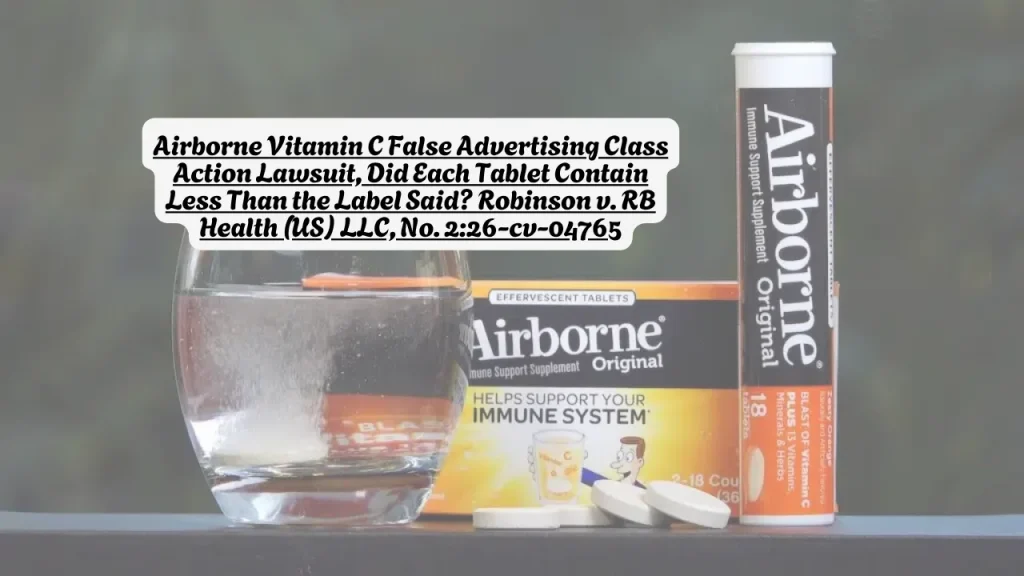
Airborne Vitamin C False Advertising Class Action Lawsuit, Did Each Tablet Contain Less Than the Label Said? Robinson v. RB Health (US) LLC, No. 2:26-cv-04765
Airborne is facing a new class action lawsuit — Robinson v. RB Health (US) LLC, No. 2:26-cv-04765 — filed May 2, 2026, in U.S. District Court in California, alleging that the company’s vitamin C supplements are labeled with dosage amounts — like “Vitamin C 1,000mg” — that consumers reasonably understand to mean per tablet or gummy, when in reality that amount only applies to the full serving size, which requires swallowing multiple units. If you bought Airborne chewable tablets, gummies, or effervescent tablets expecting a specific vitamin C dose, this case is about exactly what you paid for.
Airborne Vitamin C False Advertising Lawsuit — Key Facts
| Field | Detail |
| Lawsuit Filed | May 2, 2026 |
| Defendant | RB Health (US) LLC |
| Parent Company | Reckitt (global consumer health company, owner of Airborne brand since 2012) |
| Case Name | Robinson v. RB Health (US) LLC |
| Court & Case Number | U.S. District Court, Central District of California — No. 2:26-cv-04765 |
| Alleged Harm | False and misleading vitamin C dosage labeling — per-serving dose advertised as per-unit dose |
| Specific Laws Alleged | California Unfair Competition Law; California Consumers Legal Remedies Act; California False Advertising Law |
| Products at Issue | Airborne Vitamin C 1,000mg Chewable Tablets (Very Berry & Zesty Orange); Airborne Immune Support Gummies (750mg); Airborne Vitamin C + Zinc Gummies; Airborne Elderberry + Zinc + Vitamin C Gummies; Airborne Triple Action Immune Support Effervescent Tablets |
| Who Is Affected | California consumers who purchased these products for personal use within the statute of limitations |
| Current Court Stage | Active lawsuit — recently filed, class not yet certified |
| Settlement Status | No settlement — active litigation |
| Lead Plaintiff Deadline | N/A — no lead plaintiff deadline for individual consumers |
| Last Updated | June 3, 2026 |
Who Is RB Health and Why Is Airborne Facing a False Advertising Lawsuit?
RB Health (US) LLC is the U.S. subsidiary of Reckitt, a British consumer goods multinational. Reckitt acquired Schiff Nutrition — the Salt Lake City-based manufacturer that owned the Airborne brand — in November 2012 for $1.4 billion. Airborne is sold in grocery stores, drug stores, and mass retailers across the country and is one of the most recognizable immune support supplement brands in the U.S. The lawsuit argues that the prominent dosage numbers Airborne prints on the front of its packaging — “1,000mg” of vitamin C — create a false impression in the minds of ordinary shoppers about how much they are actually getting per tablet or gummy.
What Airborne’s Labels Say Versus What Each Tablet Actually Contains
The complaint is built around one specific distinction: the difference between what a single unit contains and what a full serving requires.
The lawsuit alleges that RB Health prominently advertises certain dosages, such as “Vitamin C 1,000mg,” on the front labels of the Airborne vitamin C supplements, but fails to properly inform consumers that each chewable tablet, gummy, or effervescent tablet contains just a fraction of the advertised dose per unit.
The complaint spells out exactly how this plays out in practice. “For example, consumers must ingest four chewable tablets of the Airborne Vitamin C 1,000mg Very Berry Chewable Tablet product to achieve the advertised dosage of vitamin C,” the case says. “This leads consumers to overpay for the products by a significant margin.”
According to the false advertising lawsuit, consumers understand Airborne’s packaging to mean that each gummy or tablet — not each serving — contains the stated amount of vitamin C. The case says that Airborne makes these representations to “grab the consumer’s attention.”
The lawsuit does not stop at one product. The supplements at issue include the Airborne Vitamin C 1,000mg Very Berry Chewable Tablets, Airborne Vitamin C 1,000mg Zesty Orange Chewable Tablets, Airborne Immune Support Gummies (750mg Vitamin C), Airborne Vitamin C + Zinc Gummies, Airborne Elderberry + Zinc + Vitamin C Gummies, and Airborne Triple Action Immune Support Effervescent Tablets.
The complaint draws a direct line from this labeling practice to a pricing problem. The suit contends Airborne charges consumers a price premium while “reaping the financial benefits” of selling allegedly mislabeled supplements. The primary purpose of these products is to provide the advertised dose of vitamin C. By failing to deliver the stated dosage per unit, Airborne has provided consumers with a product worth less than what they paid — the supplements contain between 750mg and 1,000mg of vitamin C per serving, not per tablet or gummy, a fact not disclosed on the front labels.
The suit also notes that many of Airborne’s competitors avoid this problem entirely by clearly stating their dosage representations on a per-tablet, per-gummy, or per-serving basis.
This case fits a broader pattern of supplement labeling lawsuits where the gap between prominent front-label claims and the fine print drives the legal theory. If you have followed AllAboutLawyer.com’s coverage of the Balance of Nature federal class action dismissal and California settlement over overstated supplement health benefits, you will recognize the same core allegation: a supplement company prominently marketed a specific health or dosage claim that its products could not actually back up per unit. For an example of how a similar Reckitt-adjacent consumer product labeling dispute unfolded, our coverage of the P&G Metamucil lead lawsuit and how that supplement class action is moving forward in federal court shows how supplement false advertising cases are increasingly surviving early motions to dismiss under state consumer protection statutes — the same laws Airborne faces here.
If you bought any of the Airborne products listed above believing you were getting 1,000mg or 750mg of vitamin C per tablet or gummy — this case may be about the money you overpaid.
Related article: Kettle Cuisine Recalls Whole Foods Market Minestrone Soup Over Undeclared Shrimp, FDA Allergy Alert Issued May 21, 2026
Are You Part of the Airborne Vitamin C Class Action?
The proposed class is currently defined around California purchasers, but here is exactly what the filing says and who it covers.
You may be included if:
- You purchased any of the named Airborne vitamin C products in California for personal or household use — not for resale
- You bought the product within the applicable statute of limitations period, running back from the May 2, 2026 filing date
- You understood the “1,000mg” or “750mg” front-label claim to mean per tablet or gummy, not per serving requiring multiple units
You likely do NOT qualify if:
- You bought the products outside California (this case is currently a California state law class action — nationwide claims have not been filed here)
- You purchased Airborne products for resale or commercial purposes rather than personal use
- You only purchased Airborne products that are not among the six specifically named in the complaint
Airborne buyers outside California — are you still covered?
This specific lawsuit is filed under California state consumer protection laws and proposes a class limited to California purchasers. If you live outside California and bought the same products, this particular case does not directly cover you at this stage. However, similar false advertising theories under your own state’s consumer protection laws could support a separate action. If you bought these products outside California and feel you were misled, a free consultation with a product liability attorney or consumer rights lawyer in your state can help you understand what options exist.
If you are unsure whether your specific Airborne purchases qualify under this lawsuit’s class definition, speaking with a consumer rights lawyer before this case progresses is the most direct way to assess your situation.
What Are Plaintiffs Asking the Court to Award Against RB Health?
No money is available yet. There is no settlement and no claim form. The case was filed just over a month ago and is in its earliest stages.
The complaint was filed under California’s Unfair Competition Law, the California Consumers Legal Remedies Act, and California’s False Advertising Law — all of which allow for restitution, injunctive relief, and statutory damages on behalf of affected consumers.
What Could Airborne Buyers Receive If This Case Settles?
No dollar amount has been set, and any specific figure at this stage would be speculation. What a future recovery looks like depends on how many California consumers are certified in the class, what the price premium evidence shows, and what the parties negotiate or a court awards. Airborne and its parent company Reckitt have not yet responded to the complaint publicly.
For context: this is not the first time Airborne has faced this kind of legal challenge. The company previously agreed to pay $23.3 million to settle a class action lawsuit brought by the Center for Science in the Public Interest and others claiming false advertising — a settlement in which the company did not admit any wrongdoing. That earlier case focused on immune-boosting efficacy claims rather than dosage labeling, but it shows Airborne has resolved large consumer protection actions before. Past outcomes do not predict future results, and every case turns on its own facts. Consulting a consumer rights lawyer is the best way to understand your individual situation.
What Should Airborne Supplement Buyers Do Right Now?
No action is required right now to preserve your potential place in the class. If the court certifies the class and a settlement is reached, California buyers of the named products would typically be notified. Here is what makes practical sense at this stage:
- Locate your purchase receipts or records. Check your Amazon order history, store loyalty card purchase records, or credit card statements for Airborne purchases within the past several years. Save screenshots or download the records now.
- Hold onto the packaging if you have it. The front label is central to the complaint. If you still have any Airborne boxes with the “1,000mg” or “750mg” claims displayed prominently, keep them.
- Check which products are named. The complaint targets six specific Airborne vitamin C products. If you bought a different Airborne product — such as the original effervescent formula without vitamin C dosage claims on the front — confirm whether it falls within the described class.
- Note your location. The proposed class covers California purchasers. If you bought Airborne outside California, monitor whether any follow-on nationwide filing is made.
- Monitor the docket. The case is Robinson v. RB Health (US) LLC, No. 2:26-cv-04765, in the U.S. District Court for the Central District of California. Public filings are available through PACER at pacer.gov.
Airborne Vitamin C False Advertising Lawsuit Timeline
| Milestone | Date |
| Airborne brand acquired by Reckitt | November 2012 |
| Prior Airborne false advertising class action settled | March 4, 2008 ($23.3 million) |
| Robinson v. RB Health complaint filed | May 2, 2026 |
| RB Health response to complaint due | TBD — pending court schedule |
| Class certification briefing | TBD — case in early litigation stage |
| Expected resolution | TBD — no trial date set |
Airborne Vitamin C Labeling Lawsuit — Frequently Asked Questions, No. 2:26-cv-04765
Is there a real class action lawsuit against Airborne over vitamin C dosage labels right now?
Yes. Robinson v. RB Health (US) LLC, No. 2:26-cv-04765, was filed May 2, 2026, in the U.S. District Court for the Central District of California. The 21-page lawsuit alleges that RB Health prominently advertises certain dosages, such as “Vitamin C 1,000mg,” on the front labels of the Airborne vitamin C supplements, but fails to properly inform consumers that each chewable tablet, gummy, or effervescent tablet contains just a fraction of the advertised dose per unit. The case is active. RB Health has not yet responded to the complaint.
Do I need to do anything right now to be included in the Airborne class action?
No. If the court certifies a California class, eligible buyers are typically included automatically. You do not need to sign up, register, or contact a lawyer right now to preserve your place. A claim form, if the case settles, will be announced publicly at that time.
What does “per serving” versus “per tablet” actually mean on supplement labels?
Per tablet means each individual pill, gummy, or chewable contains the stated amount. Per serving means you need to take multiple units — in Airborne’s case, as many as four chewable tablets — to reach the advertised dose. The lawsuit claims consumers understand Airborne’s front-label claims to mean per unit, not per serving, and that this misunderstanding causes them to “grossly overpay” for the products.
When will the Airborne vitamin C lawsuit settle?
There is no way to know. RB Health has not yet filed its answer. Consumer false advertising class actions of this type typically take one to three years from filing to resolution, if they settle at all.
Can I file my own individual lawsuit against RB Health for Airborne’s labeling instead of joining this class?
Potentially. If your individual purchases and overpayment are significant enough, a consumer rights lawyer can advise whether individual action makes more financial sense than waiting for the class action to resolve.
What specific California laws does RB Health allegedly violate in the Airborne dosage case?
The complaint alleges violations of the California Unfair Competition Law, the California Consumers Legal Remedies Act, and the California False Advertising Law. These three statutes together prohibit misleading business practices, false advertising, and deceptive representations made to California consumers, and allow for restitution, injunctions, and statutory penalties.
How will I find out if the Airborne lawsuit settles?
If a settlement is reached and a California class is certified, eligible consumers would typically receive notice by email, postal mail, or through a settlement administrator website. You can also monitor the case docket directly at pacer.gov under No. 2:26-cv-04765 in the Central District of California.
How much could California Airborne buyers receive from a future settlement?
No amount has been set and no prediction is reliable at this stage. Any payout would depend on the size of the certified class, the price premium the evidence supports, and how the parties resolve the case. Airborne previously settled a separate false advertising class action for $23.3 million — but that was a different case involving different claims. What this dosage labeling case produces depends entirely on its own facts and proceedings. A consumer rights lawyer can best advise on what your specific purchases might be worth.
Sources Used in This Airborne Vitamin C Labeling Lawsuit Article
- NC Governor’s Office — Reckitt/RB Health brand ownership confirmation, September 24, 2024: https://governor.nc.gov/news/press-releases/2024/09/24/global-maker-mucinex-consumer-health-medicines-selects-wilson-county-major-production-facility
Prepared by the AllAboutLawyer.com Editorial Team and reviewed for factual accuracy against the ClassAction.org complaint summary and verified court records on June 3, 2026. Last Updated: June 3, 2026.
This article is for informational purposes only and does not constitute legal advice. Laws vary by state and individual circumstances differ. For advice about your specific situation, consult a qualified attorney.
About the Author
Israr Ahmad is a legal content researcher with 4+ years of experience covering class action settlements and consumer rights cases. He has researched and published coverage of 2,500+ settlements using verified court records, settlement administrator filings, and government sources. Learn more about Israr.