
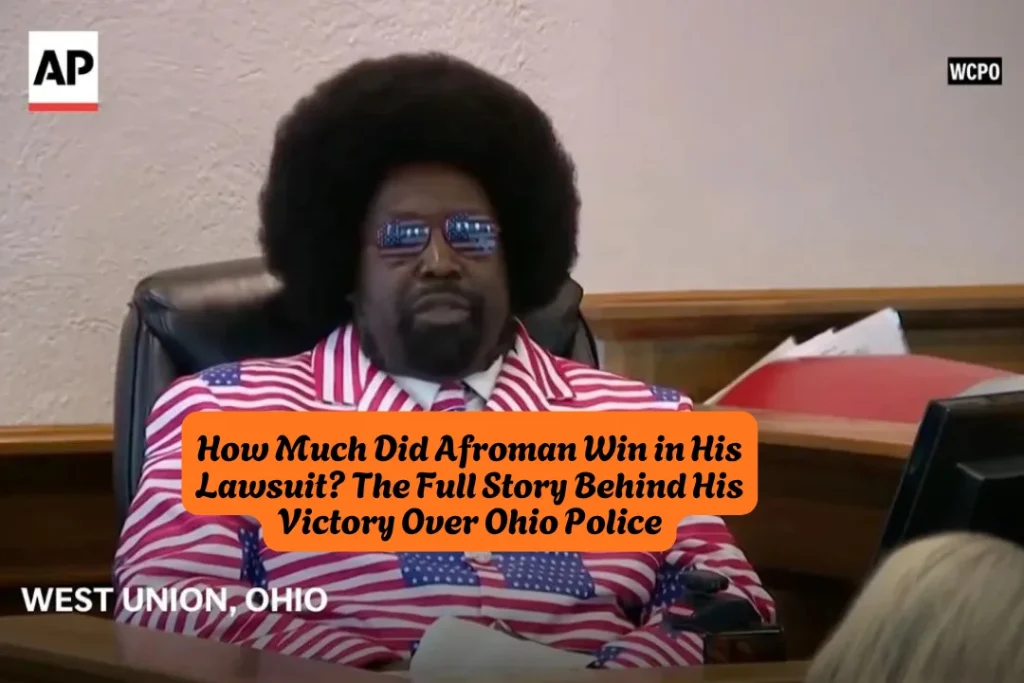
How Much Did Afroman Win in His Lawsuit? The Full Story Behind His Victory Over Ohio Police
Despite the eye-catching $3.9 million figure, Afroman did not receive a financial payout from the case. Instead, the jury delivered a decisive verdict in his favor, rejecting all claims brought by the deputies. What he won was something arguably more valuable — a complete legal vindication of his First Amendment right to mock, criticize, and satirize the police officers who raided his home.
“We did it, America! Yeah, we did it! Freedom of speech! Right on! Right on!” he shouted outside the courthouse after the Wednesday evening verdict.
Quick Case Snapshot
| Field | Detail |
| Case | Adams County Sheriff’s Deputies v. Joseph Foreman (Afroman) |
| Court | Adams County Court of Common Pleas, Ohio |
| Presiding Judge | Judge Jonathan P. Hein |
| Verdict Date | March 19, 2026 |
| Plaintiffs | Seven Adams County Sheriff’s Deputies |
| Defendant | Joseph Edgar Foreman (Afroman) |
| Claims Against Afroman | Defamation; invasion of privacy; unauthorized use of likeness |
| Damages Sought | Nearly $3.9 million collectively |
| Verdict | Complete defense verdict — all claims rejected |
| Cash Payout to Afroman | $0 — this was a defensive win, not a damages award |
What Started This Whole Thing — The 2022 Raid
In August 2022, police executed a search warrant at Afroman’s Ohio home as part of a drug and kidnapping investigation. No charges were ever filed following the raid.
Afroman said the raid traumatized his children, then aged 10 and 12, and caused significant property damage — including a broken front gate and door. “The whole raid was a mistake. All of this is their fault. If they hadn’t have wrongly raided my house, there would be no lawsuit. I would not know their names,” he said in testimony.
His response was not a complaint to a civilian oversight board. It was music.
The Songs That Started the Lawsuit
Afroman used footage from his home security cameras — which captured the officers entering and searching his property — to create a series of viral satirical music videos, including Lemon Pound Cake and Will You Help Me Repair My Door?
The videos racked up millions of views. In Will You Help Me Repair My Door?, Afroman raps directly at the officers: “Did you find what you were looking for?” and “Would you like a slice of lemon pound cake / You can take as much as you want to take / There must be a big mistake.”
In other videos, Afroman called them “crooked cops” and pointed to $400 that allegedly went missing during the raid. “Police officers shouldn’t be stealing civilians’ money,” he testified.
What the Deputies Claimed
Seven Adams County sheriff’s deputies filed suit against Afroman, collectively seeking nearly $3.9 million. Their claims covered defamation, invasion of privacy, and unauthorized use of their likenesses in music videos and merchandise.
The highest individual claim was from Deputy Lisa Phillips at $1.5 million. Deputies Brian Newland and Randy Walters each sought $1 million.
The deputies testified the songs ridiculed them personally. Deputy Lisa Phillips said one video questioned her gender and sexuality. Sgt. Randy Walters said his child had been hazed at school because of Afroman’s posts and came home crying. “Where in the world is it OK to make something up for fun that’s damaging to others when you know for sure it’s an absolute lie?” he asked.
Related article: Whatnot Lawsuit 2026, Card Breaks Called “Illegal Casino” — What Collectors Need to Know
How Afroman Won — The Legal Arguments That Worked
First Amendment — Parody and Social Commentary
Afroman’s defense rested entirely on the First Amendment. He consistently argued that his music was a form of artistic expression and social commentary. His legal team reinforced this argument, suggesting that no reasonable audience would interpret the videos as literal fact.
Defense lawyer David Osborne told the jury in closing arguments: “No reasonable person would expect a police officer not to be criticized. They’ve been called names before.”
Public Officials Face Higher Scrutiny
A core legal principle worked heavily in Afroman’s favor — public officials, including police officers, are held to a higher standard of scrutiny under defamation law. The jury ultimately agreed, siding with the defense and affirming that public officials, including police officers, are subject to criticism and parody. Under the landmark New York Times v. Sullivan standard, a public official cannot win a defamation claim unless they prove the defendant acted with “actual malice” — knowing the statement was false or acting with reckless disregard for the truth. Afroman’s team argued no such standard was met.
The Raid Itself Was the Foundation
Afroman’s most powerful argument was the simplest one. He had the right to tell his friends and fans what police had done — and the entire basis for his songs was real footage from a real raid that led to zero charges. His attorney argued that exaggeration in the context of artistic commentary is a recognized and protected form of speech — not defamation.
The Verdict — What the Judge Actually Said
“In all circumstances, the jury finds in favor of the defendant. No plaintiff verdict prevailed. So the matter will be concluded with defense verdicts,” said Judge Jonathan P. Hein.
Afroman cried after the verdict was announced. Minutes later he was outside the courthouse celebrating. He declared to the world: “I didn’t win, America won.”
So How Much Did Afroman Actually Win?
Afroman did not receive a financial payout from the case. The jury delivered a decisive verdict in his favor, rejecting all claims brought by the deputies. With the verdict now delivered, the deputies have no financial recovery, and Afroman faces no legal penalties.
During testimony, Afroman declined to specify how much he earned from the songs and related merchandise, only stating it was less than $24,000.
What he won was a clean sweep — zero liability on every single claim. In legal terms, a complete defense verdict of this kind is as decisive as a verdict gets. No damages. No injunction. No apology ordered. Nothing.
Why This Case Matters Beyond the Music
This verdict carries real legal weight for three reasons every American should understand.
1. Artists can use real footage of public officials in satirical work. The jury affirmed that using real security footage of law enforcement in comedic and critical creative content is protected speech — even when officers personally find it humiliating.
2. Police officers are public officials for defamation purposes. This case reinforced that law enforcement, when acting in their official capacity, must meet the actual malice standard to win a defamation claim — the same high bar that applies to politicians and other public figures.
3. The “it hurt my feelings” argument has limits. The deputies collectively sought nearly $4 million in damages arguing the videos caused them emotional distress and professional harm. The jury rejected every single claim. Distress caused by legitimate public criticism — no matter how pointed or humiliating — does not automatically equal defamation.
Frequently Asked Questions
How much money did Afroman win in his lawsuit?
Afroman did not receive a financial payout. The jury rejected all claims by the deputies, delivering a complete defense verdict in his favor. He won legal vindication — not a cash award. The $3.9 million figure was what the deputies were seeking from him, not a payment to him.
What was Afroman sued for?
Seven Adams County, Ohio sheriff’s deputies sued Afroman for defamation, invasion of privacy, and unauthorized use of their likenesses in music videos and merchandise after he used real security footage from a 2022 raid on his home to create satirical songs mocking the officers. No charges were ever filed against Afroman following that raid.
What songs was the lawsuit about?
The case centered on two music videos — Lemon Pound Cake and Will You Help Me Repair My Door? — both of which incorporated real footage from the 2022 police raid on Afroman’s Ohio home. Both went viral and gained millions of views.
How did Afroman win the case?
The jury accepted the defense argument that the videos were clearly satirical and comedic — not statements of literal fact — and that public officials, including police officers, are legally subject to criticism and parody. Afroman’s First Amendment defense prevailed on every count.
Will the deputies appeal?
No public statement about an appeal has been confirmed as of March 21, 2026. In civil defamation cases, appeals are possible but face a high bar — juries are given significant deference in their fact-finding, particularly on questions of whether content constitutes protected speech.
Last Updated: March 21, 2026
Disclaimer: This article is for informational purposes only and does not constitute legal advice. Allegations in a complaint are not findings of fact. All parties are presumed innocent unless and until proven otherwise in court.
About the Author
Israr Ahmad is a legal content researcher with 4+ years of experience covering class action settlements and consumer rights cases. He has researched and published coverage of 2,500+ settlements using verified court records, settlement administrator filings, and government sources. Learn more about Israr.