
$19M Village of Old Westbury Loses Religious Discrimination Case Over Chabad Synagogue
The Village of Old Westbury, a Long Island municipality in New York, must pay $19 million to Rabbi Aaron Konikov and Lubavitch of Old Westbury after a federal judge ruled the village unconstitutionally blocked the construction of a synagogue for nearly three decades. The two sides signed a federal consent agreement on March 18, 2026, ending a dispute that dates back to 1994. This is not a class action — it is a civil rights lawsuit brought by a religious organization against a local government for violating the First Amendment.
Quick Facts
| Field | Detail |
| Plaintiff | Rabbi Aaron Konikov / Lubavitch of Old Westbury |
| Defendant | Village of Old Westbury, New York |
| Settlement Amount | $19,000,000 |
| Who Pays | Village’s insurance providers |
| Case Filed | 2008 (U.S. Federal Court) |
| Presiding Judge | U.S. District Judge Gary Brown |
| Consent Decree Signed | March 18, 2026 |
| Permit Application Deadline | January 15, 2027 |
| Settlement Status | Finally Approved (Consent Decree) |
| Synagogue Size (Planned) | 20,875 square feet |
Where Things Stand Right Now
- U.S. District Judge Gary Brown signed the consent decree on March 18, 2026, finalizing the $19 million settlement.
- Lubavitch of Old Westbury has until January 15, 2027, to apply for a special-use permit from the village to build a synagogue.
- The village cannot apply its 2001 zoning law to that application — the court permanently barred it from doing so.
Related article: Vital Proteins Collagen Peptides Lawsuit, What Consumers Need to Know About Heavy Metal Allegations
What This Lawsuit Was Actually About
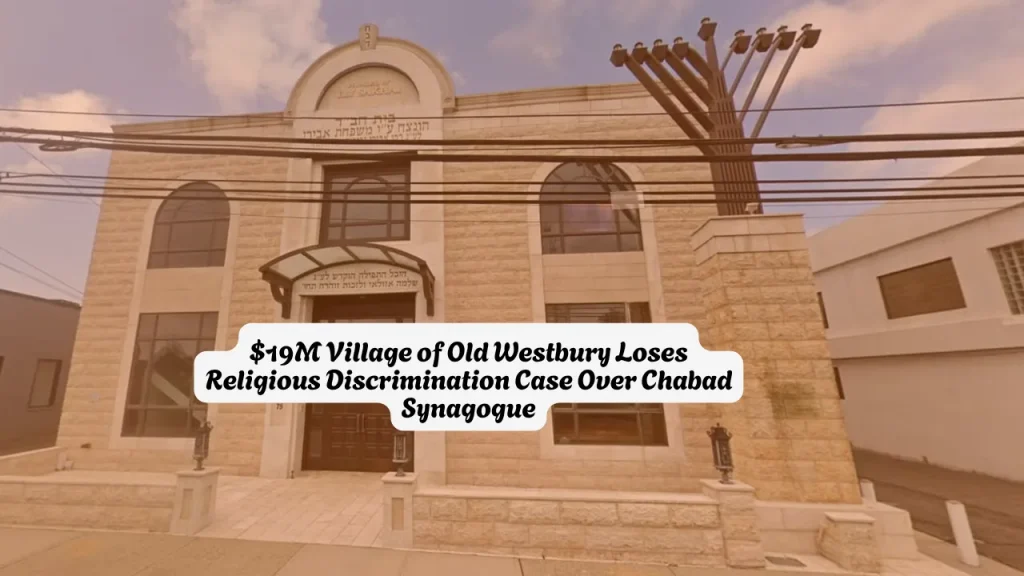
Rabbi Aaron Konikov and Lubavitch of Old Westbury sued the Village of Old Westbury in 2008 after the village passed a law in 2001 governing places of worship, enacted just as Konikov sought to build a synagogue on his property.
Local officials created the law two years after Konikov planned a ceremony to announce a new building on the land where he already operates a synagogue. They decreed that houses of worship could be built only on plots of 12 acres or more — and Konikov owns a 9-acre plot.
The lawsuit argued the village targeted religious institutions specifically and used zoning rules as a tool to prevent a synagogue from being built. In October 2025, U.S. District Judge Gary Brown ruled that the 2001 ordinance “unconstitutionally discriminates against the free exercise of religion and is therefore facially invalid.”
The legal fight stretched across three decades. Konikov’s landlord had previously kicked him out after he began religious activities at a rented space, which led his congregation to purchase the property that became the center of the lawsuit.
How a Local Zoning Law Became a Constitutional Violation
The First Amendment protects Americans’ right to practice their religion freely. When a government body — including a local village — passes laws that specifically burden religious organizations without a neutral, generally applicable reason, those laws can be struck down in federal court.
That is exactly what happened here. The village’s 12-acre minimum lot size rule applied to places of worship but effectively targeted Konikov’s 9-acre property. Federal courts found no legitimate, non-discriminatory reason for the rule.
Under the terms of the consent decree, the village is barred from applying the standards of its 2001 law to Chabad’s future permit application. That is a permanent legal protection, not just a financial payment.
The $19 Million Settlement — Who Pays and What It Means
The $19 million settlement will be paid by the village’s insurance providers, not by the village directly. This means Old Westbury taxpayers will not write a check from the municipal budget — the liability falls to the government’s insurers.
This is a significant amount for a local municipality case. It reflects nearly two decades of litigation costs, constitutional violations, and the denial of the congregation’s ability to build a permanent place of worship.
Konikov’s lawyer Eric Robinson said in a statement: “Rabbi Konikov struggled for 34 years to reach this point. He is grateful for the Constitution and the involvement of the Court.”
What Happens Next for the Synagogue
Preliminary plans call for a 20,875-square-foot synagogue and an adjacent parking lot on the more than 9-acre property. The congregation can now move through the permitting process without the 2001 zoning law standing in the way.
Lubavitch of Old Westbury must submit its special-use permit application by January 15, 2027. After that, the village must process the application without applying the now-invalidated 2001 ordinance.
Why This Case Matters Beyond Old Westbury
The ruling marks a notable victory for emissaries of the Chabad-Lubavitch movement, who have often faced legal challenges when establishing centers. This is not an isolated situation.
Last July, the Village of Atlantic Beach in New York agreed to pay Chabad of the Beaches $950,000 to settle a legal battle over the construction of a new community center. Communities across the country have faced similar disputes where local zoning rules have been used — intentionally or not — to block houses of worship.
Federal law, including the Religious Land Use and Institutionalized Persons Act (RLUIPA), protects religious organizations from discriminatory zoning. This case shows those protections have real force — and that municipalities that violate them face serious financial consequences.
Frequently Asked Questions
Is the Village of Old Westbury required to approve the new synagogue?
Not automatically. Lubavitch of Old Westbury must still apply for a special-use permit by January 15, 2027. However, the village cannot use its 2001 zoning law to deny the application. The court’s consent decree bars that specific obstacle.
Did Old Westbury taxpayers lose $19 million?
No. The $19 million settlement is paid by the village’s insurance providers, not from the municipal tax base. However, future insurance costs for the village may be affected.
What law did the village violate?
The village violated the First Amendment’s Free Exercise Clause, which prohibits government interference with religious practice. Judge Brown ruled the 2001 ordinance unconstitutionally discriminated against religion and declared it facially invalid.
What is RLUIPA and does it apply here?
RLUIPA stands for the Religious Land Use and Institutionalized Persons Act. It is a federal law that prevents governments from imposing zoning rules that substantially burden religious exercise without a compelling reason. Cases like this one are often argued under RLUIPA alongside First Amendment claims.
How long did this lawsuit take?
Rabbi Konikov first sought to build the synagogue in 1994. The village passed the restrictive 2001 zoning law in response. The federal lawsuit was filed in 2008. The consent decree settling the case was signed on March 18, 2026 — nearly 18 years after the lawsuit began.
Can other religious organizations use this ruling?
This ruling directly binds only the Village of Old Westbury. However, it reinforces existing federal law protecting religious organizations from discriminatory zoning. Other congregations facing similar local resistance can cite RLUIPA and First Amendment precedents in their own cases.
Does this settlement mean the village admitted wrongdoing?
Consent decrees typically do not include a formal admission of wrongdoing. However, Judge Brown’s October 2025 ruling explicitly found the village’s ordinance unconstitutional. The $19 million payment reflects the severity of the constitutional violation the court identified.
Sources & References
- Jewish Telegraphic Agency — Full report on the $19M settlement
Last Updated: April 8, 2026
Disclaimer: This article is for informational purposes only and does not constitute legal advice. Legal claims and outcomes depend on specific facts and applicable law. For advice regarding a particular situation, consult a qualified attorney.
About the Author
Israr Ahmad is a legal content researcher with 4+ years of experience covering class action settlements and consumer rights cases. He has researched and published coverage of 2,500+ settlements using verified court records, settlement administrator filings, and government sources. Learn more about Israr.