
$166 Billion Tariff Refunds Have Started IEEPA Duties Were Collected from More Than 330,000 Importers Across 53 million Shipments
What Just Happened?
Two months after the Supreme Court struck down President Trump’s sweeping tariffs, American importers — who are owed $166 billion in refunds plus interest — can now begin applying for reimbursement through a new U.S. Customs and Border Protection portal called CAPE (Consolidated Administration and Processing of Entries).
The Supreme Court struck down IEEPA tariffs on February 20, 2026, in a 6-3 ruling, invalidating both the “Trafficking” tariffs on Canada, Mexico, and China and the “Reciprocal” tariffs imposed globally on April 2, 2025. CBP stopped collecting IEEPA tariffs on February 24, 2026.
How Did We Get Here ON Tariff RefundS Condition? A Quick Background
The IEEPA tariffs were first imposed starting February 1, 2025, beginning with 25% tariffs on Canada, Mexico, and China related to fentanyl trafficking. Sweeping “Reciprocal” tariffs were then imposed globally on April 2, 2025 — affecting imports from dozens of countries at varying rates.
On March 6, 2026, the U.S. Court of International Trade paused its order directing CBP to immediately begin issuing refunds, recognizing that the agency needed time to build the infrastructure to manage the sheer volume and value of refunds — which ultimately led to the creation of CAPE.
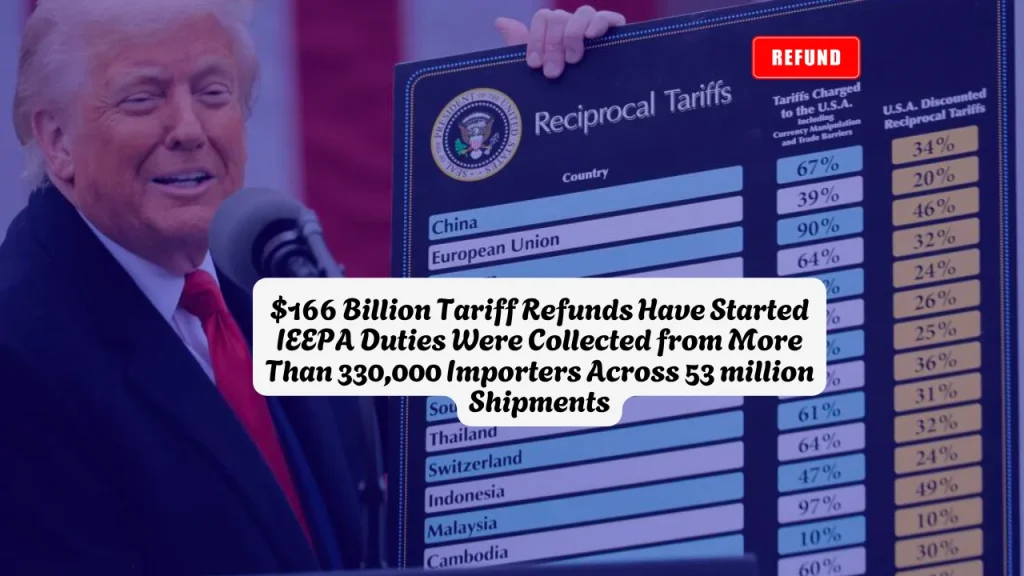
The numbers are staggering: approximately $166 billion in IEEPA duties were collected from more than 330,000 importers across 53 million shipments between April 2025 and February 2026. As of April 14, 56,497 importers had already completed ACH registration and are eligible for refunds totaling $127 billion including interest.
What Is the CAPE Portal?
CAPE is designed to consolidate refunds of IEEPA duties, including interest, rather than processing refunds on an entry-by-entry basis. This represents a significant operational improvement over traditional processing methods.
The portal lives inside the ACE (Automated Commercial Environment) Secure Data Portal — the same system importers already use for their regular entry filings — making it accessible to businesses already registered in that system.
Who Can Get a Tariff Refund?
Regular consumers cannot apply directly. Only the Importer of Record (IOR) — the business that actually paid the tariffs at the border — is entitled to a refund. Only the IOR or the licensed customs broker who filed the entries can file a CAPE Declaration.
Refunds go only to the Importer of Record or a designated notify party via CBP Form 4811 — not to the consignee, foreign supplier, or whoever actually absorbed the tariff cost in the supply chain. Non-IOR parties have contractual claims against the IOR, not direct claims against CBP.
What Gets Refunded — and What Doesn’t in Tariff?
Not every tariff paid during this period qualifies. Here’s the breakdown:
Refundable under CAPE:
CAPE Phase 1 refunds all duties paid under IEEPA authority — the reciprocal tariffs that took effect April 5, 2025 and the adjusted country-specific rates that took effect August 1, 2025. That covers both the 10% baseline reciprocal tariff and all country-specific rates above 10%, including Vietnam at 46%, Thailand at 36%, Taiwan at 32%, South Korea at 25%, the EU at 20%, and every other IEEPA rate. Refunds include statutory interest from the original entry date.
NOT Refundable Tariff:
Section 232 tariffs on steel (50%), aluminum (50%), autos (25%), copper (50%), semiconductors (25%), and lumber (10%) are not refundable — these were imposed under national security authority and were not part of the Supreme Court ruling. Section 301 tariffs on China (25–100%) also remain. And critically, the current 10% Section 122 tariff — Trump’s replacement signed on February 20, 2026 — is not refundable, as it is a different legal authority still in force and being collected.
Related article: $300K SDSU Title IX Athletic Aid Settlement, Are You Eligible to Claim?
How Much Interest Will You Receive?
The refund isn’t just the duty amount — it comes with interest. Interest accrues on duty overpayments from the date of deposit through the date of refund, at the rate established by the IRS under 26 USC 6621. For businesses that paid large sums in early-to-mid 2025, this interest could add up to a meaningful additional sum on top of the base refund.
Step-by-Step: How to Apply for Your Tariff Refund
The entire filing process runs through the ACE Portal:
Step 1: Register for an ACE Secure Data Portal account at ace.cbp.dhs.gov if you don’t already have one.
Step 2: Enroll in ACH for electronic refunds. CBP will not issue paper checks — payments must go to a U.S. bank account via ACH. This is a separate enrollment from your regular duty payment ACH setup.
Step 3: Prepare a CAPE Declaration — a CSV file listing every entry number for which you want a refund.
Step 4: Log into ACE, navigate to the new CAPE tab, and upload your CAPE Declaration file.
Step 5: Wait for CBP validation. CBP runs two rounds of checks — first at the declaration level (file formatting, importer identity, ACH status), then at the entry level (does each entry qualify, what rate applies, is it unliquidated or within the 80-day window).
Step 6: Refunds are issued via ACH within 60–90 days of declaration acceptance, including statutory interest calculated from the original entry date.
Critical Filing Rules You Must Know
Once a CAPE Declaration is accepted, it cannot be amended, and any entry already on an accepted declaration cannot be submitted on another. Each declaration can include up to 9,999 entries, and large importers can submit multiple declarations — but careful planning of how entries are grouped is essential before filing.
To initiate the process, importers must have an established ACE Secure Data Portal account. If you don’t already have one, you’ll need to submit Form 5106 to set one up. If you already have an ACE Portal account, you generally do not need to submit another Form 5106.
Phase 1 vs. Phase 2: What’s Covered Now and What’s Coming
Phase 1 (Now Open): Phase 1 covers two categories of entries: unliquidated entries — those CBP has not yet finalized, which covers most entries from the last 10–12 months — and entries that have been liquidated but are still within 80 days of liquidation, which is the statutory window for filing a protest. Older liquidated entries fall outside Phase 1.
Phase 2 and Beyond: Additional phases planned later in 2026 are intended to address more complex situations, including reconciliation entries, drawback claims, and historically liquidated entries. Businesses with older or more complex entries should monitor CBP’s official website for Phase 2 announcements.
How Long Until You Get Paid?
CBP’s public CAPE FAQ states that refunds will generally be issued within 60–90 days after acceptance of a CAPE Declaration, absent compliance concerns. In court filings, CBP has represented a 45-day internal target for simpler cases where no compliance issues arise. Both figures are best interpreted as planning horizons, not firm commitments — the actual timing on any given declaration will depend on volume, entry complexity, and individual CBP review.
Businesses can monitor the status of their refunds using the REV-615 CAPE Refunds Trade Report, accessible directly within the ACE Portal.
Catches and Complications to Watch Out For
It’s not automatic. You must proactively file a CAPE Declaration — CBP will not automatically send you a refund.
Errors will delay your refund. The CAPE process is unforgiving. If any entry on your declaration contains errors or formatting issues, CBP may reject the entire declaration or flag individual entries, pushing your refund timeline out further.
ACH enrollment is mandatory. An ACH setup for duty payment is not sufficient — CBP requires separate ACH refund enrollment, and refunds will be held until valid ACH refund information is on file.
The government could still appeal. The Trump administration retains the right to challenge the refund order. An appeal could jeopardize or pause the entire refund process, so businesses filing now should consult a trade attorney about protecting their claims.
What About Prices Consumers Already Paid?
Some businesses raised retail prices or added tariff surcharges to customers while the duties were in place. However, there is currently no mechanism for individual consumers to reclaim those costs. Many businesses argue that price increases didn’t fully offset what they actually paid in duties, making refunds primarily a relief measure for the business community.
Support Resources for Businesses
CBP’s Trade Transformation Office announced support webinars for businesses navigating the CAPE system, which are also being recorded and posted online. Ongoing updates on future phases are available at CBP’s official IEEPA Duty Refunds website.
For businesses without in-house trade expertise, working with a licensed customs broker or a trade attorney is strongly recommended — especially for large or complex filings where errors could result in significant delays or lost refunds.
Official CBP page: cbp.gov/trade/programs-administration/trade-remedies/ieepa-duty-refunds
Bottom Line: What You Should Do Right Now
If you are a business that paid IEEPA tariffs, here is your immediate action checklist:
- Check if you have an ACE Portal account — if not, register and file Form 5106 immediately.
- Enroll in ACH refund payments — this is separate from your payment ACH and is required before any refund can be issued.
- Compile your list of entry numbers on which IEEPA duties were paid.
- Prepare your CAPE Declaration CSV file carefully — remember, once submitted and accepted, it cannot be changed.
- Submit through the CAPE tab in ACE and monitor progress via the REV-615 CAPE Refunds Trade Report.
- Consult a customs broker or trade attorney if your entries are complex, older, or involve reconciliation or drawback claims.
This article is for informational purposes only and does not constitute legal or financial advice. Consult a qualified attorney or licensed customs broker for guidance specific to your situation.
About the Author
Israr Ahmad is a legal content researcher with 4+ years of experience covering class action settlements and consumer rights cases. He has researched and published coverage of 2,500+ settlements using verified court records, settlement administrator filings, and government sources. Learn more about Israr.