
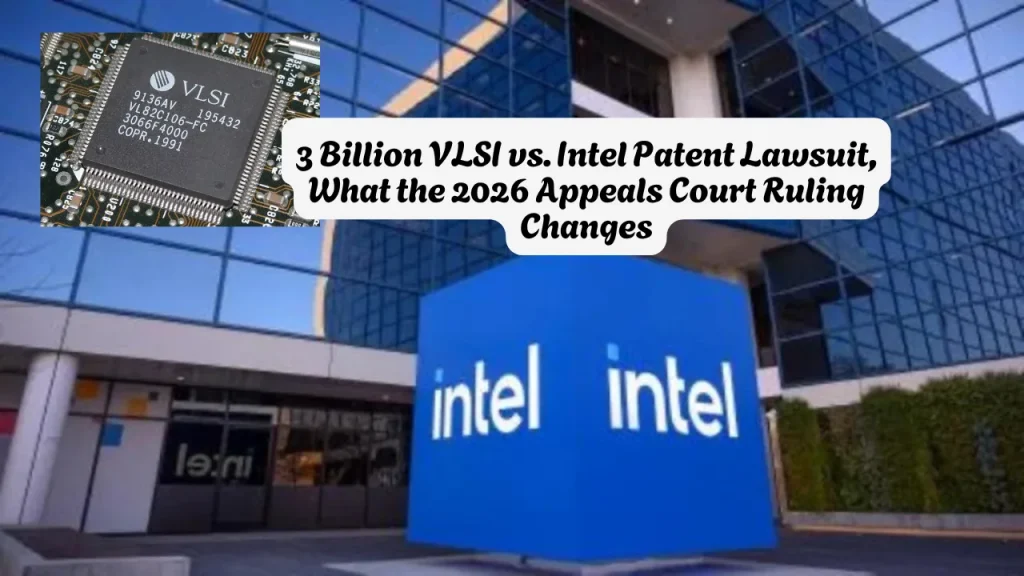
3 Billion VLSI vs. Intel Patent Lawsuit, What the 2026 Appeals Court Ruling Changes
A federal appeals court revived a major patent infringement lawsuit against Intel Corporation on April 14, 2026, sending the case back to a jury trial. VLSI Technology — backed by investment firm Fortress — sued Intel over chip patents that Intel processors allegedly violated. Prior verdicts in the case already topped $3 billion, and this latest ruling means the legal battle is far from over. This is not a consumer class action. No public claims are available.
Quick Facts
| Field | Detail |
| Case Name | VLSI Technology LLC v. Intel Corporation |
| Case Numbers | Case 24-1772 (CAFC); 6:21-cv-00057 (W.D. Tex.); N.D. Cal. (2017 case) |
| Patent at Issue (April 2026 ruling) | U.S. Patent No. 8,566,836 — “Multi-Core System on Chip” |
| Total Verdicts at Stake | Over $3 billion (across multiple cases) |
| Plaintiffs | VLSI Technology LLC (controlled by Fortress Investment Group) |
| Defendant | Intel Corporation |
| Ruling Court | U.S. Court of Appeals for the Federal Circuit (CAFC) |
| Ruling Date | April 14, 2026 |
| Case Status | Remanded — returns to district court for jury trial |
| Consumer Claims Open | No |
| Settlement | None |
Current Status & What Happens Next
- April 14, 2026: The Federal Circuit reversed the district court’s summary judgment of noninfringement and remanded the ‘836 patent case back to a lower court for jury proceedings.
- Licensing battle ongoing: A separate Texas jury ruled in May 2025 that Fortress controls both VLSI and Finjan — a finding Intel argues should nullify the $949 million verdict from 2022 and shield it from all VLSI claims under a 2012 license agreement.
- No trial date set: The remanded California case must return to district court for further proceedings; a new trial schedule is TBD.
What Is the VLSI vs. Intel Lawsuit About?
VLSI Technology filed multiple lawsuits against Intel across various U.S. courts and other jurisdictions, claiming infringement of 19 patents originating from Freescale, SigmaTel, and NXP. VLSI is not a chip manufacturer — it is a patent-holding entity that acquired these patents and then asserted them against Intel.
The patents in dispute cover core semiconductor technologies. The patent infringement disputes focus on three patents assigned to VLSI Technology, covering various innovations and methods involving integrated circuits. In plain terms, VLSI claims Intel’s processors used patented methods for managing voltage, clock speed, and multi-core CPU task selection without paying for those rights.
VLSI is controlled by Fortress Investment Group, which sits at the center of a key legal dispute. Fortress also controls Finjan, which is why Intel claims that a 2012 patent license agreement with Finjan covers these claims, as the deal granted rights to patents held by Finjan and other entities under common ownership.
What Did the Appeals Court Decide on April 14, 2026?
The U.S. Court of Appeals for the Federal Circuit issued a precedential decision authored by Chief Judge Moore, delivering a partial win for patent owner VLSI Technology against Intel Corporation.
The case centered on U.S. Patent No. 8,566,836, which covers a method for measuring maximum CPU frequency in a multi-core processor and using that data to assign tasks to cores. The U.S. District Court for the Northern District of California had concluded that Intel’s processors did not violate this patent, finding that the measurement-related steps were performed only outside the United States during testing and packaging — not on U.S. soil.
The Federal Circuit disagreed. The appellate panel determined the matter was not suitable for summary judgment and must instead be evaluated by a jury. As a result, the case — originally filed in California in 2017 — will return to district court for further proceedings.
Related article: Conor McGregor and Artem Lobov Settle Proper No. Twelve Whiskey Lawsuit What We Know
The court also ruled on a damages expert issue: the ruling does not determine liability but substantially shifts the case, as Intel loses early dismissal, and the dispute returns to a jury with viable infringement arguments, a broader reading of the claims, and the finding that Intel managed to prove measurement-related steps were infringed only outside the United States. VLSI may still pursue damages through another expert witness.
The Full Timeline: How This Case Reached $3 Billion
This dispute did not start with a single lawsuit — it spans years, multiple courts, and overlapping verdicts.
In April 2019, VLSI sued Intel over U.S. Patent Nos. 7,523,373 and 7,725,759, alleging infringement of multiple claims. A 2021 trial in the Western District of Texas resulted in a $1.5 billion verdict for the ‘373 patent and $675 million for the ‘759 patent. That combined $2.18 billion award stood as one of the largest patent verdicts in U.S. history.
Intel argued it held a license through a 2012 agreement with Finjan and its affiliates, but the district court rejected this defense in 2022, entering a final judgment of $2.18 billion plus $162 million in interest. Intel appealed.
On appeal, the Federal Circuit agreed that Intel infringed the ‘373 patent but canceled the damages award and sent the case back for reconsideration. For the ‘759 patent, the court found insufficient evidence and reversed the verdict. Meanwhile, in a related 2018 case, VLSI won $949 million in damages on U.S. Patent No. 7,247,552 in November 2022.
Intel’s Licensing Defense — and the May 2025 Jury Win
Intel’s most powerful counterargument rests on a 2012 license agreement it signed with Finjan. Intel argues that because Fortress controls both Finjan and VLSI, that license should extend to VLSI’s entire patent portfolio.
In May 2025, Intel convinced a Texas jury that VLSI Technology operates under the control of Fortress Investment Group, following a three-day trial. The ruling opens the door for Intel to potentially escape more than $3 billion in patent infringement verdicts.
VLSI argued throughout the trial that investors — not Fortress — control VLSI and Finjan, with investors owning more than 90% of the patent-monetization entity and separate investors owning 99% of Finjan. The Texas jury sided with Intel.
In 2024, Intel renewed its license defense, arguing that Fortress’s acquisition of Finjan placed both Finjan and VLSI under the same control. A Texas jury sided with Intel in May 2025, enabling the company to reclaim the $949 million awarded in the ‘552 case. This decision could also help Intel avoid more than $3 billion in damages linked to the ‘373 and ‘759 patents.
Important Dates & Milestones
| Milestone | Date |
| VLSI files California lawsuit (U.S. Patent No. 8,566,836) | 2017 |
| VLSI files Texas lawsuit (Patents ‘373 and ‘759) | April 2019 |
| Texas jury awards VLSI $2.18 billion | 2021 |
| Texas jury awards VLSI $949 million (‘552 patent) | November 2022 |
| Federal Circuit reverses $2.18B Texas verdict; remands | December 4, 2023 |
| District court dismisses California ‘836 case (summary judgment) | 2024 |
| Texas jury rules Fortress controls VLSI (Intel licensing defense win) | May 29, 2025 |
| Federal Circuit reverses California dismissal; remands for jury | April 14, 2026 |
| New trial date (California ‘836 case) | TBD |
| Expected resolution of licensing defense issues | TBD |
What This Means for Intel — and the Chip Industry
Intel faces continued financial and legal uncertainty from this case. VLSI Technology has won more than $3 billion in patent infringement verdicts against Intel Corp. in Texas federal court, but those victories account for just a portion of their cross-country and international feud over chip patents.
The April 2026 Federal Circuit ruling adds another front. Even as Intel scored a major win in Texas in May 2025 on the licensing issue, the California case now heads back to a jury with VLSI’s infringement claims intact.
The broader takeaway for the semiconductor industry: patent-holding firms backed by major investment groups continue to pursue large chip manufacturers through multi-court strategies, and courts are willing to send disputed technical questions to juries rather than resolve them at the summary judgment stage.
Frequently Asked Questions
Can I file a claim or get money from this lawsuit?
No. This is a patent infringement dispute between two companies — VLSI Technology and Intel Corporation. It is not a consumer class action. Everyday consumers have no claim to file and will receive no payment from any verdict in this case.
Do I need a lawyer to get involved in this case?
This case does not involve consumer participation of any kind. If you are a patent holder, inventor, or business with related IP concerns, you would need to consult a qualified intellectual property attorney separately.
Is this lawsuit legitimate?
Yes. VLSI Technology v. Intel Corporation spans multiple federal district courts and the U.S. Court of Appeals for the Federal Circuit. Court filings are publicly available through PACER, and the April 14, 2026 ruling is a published, precedential decision by Chief Judge Moore of the Federal Circuit.
When will this case be resolved?
No resolution date is set. The case remanded in April 2026 must return to the Northern District of California for scheduling. The licensing defense issue from the May 2025 Texas verdict also remains subject to further court action. Full resolution of all related proceedings could take years.
What if I missed a claim deadline?
No claim deadline exists because there is no consumer settlement or class action in this case. If that changes, this article will be updated with relevant information.
Will any outcome affect my taxes?
No tax implications apply to consumers because no consumer compensation is available in this case.
What is a “default judgment” versus what happened here?
A default judgment (like in the Anna’s Archive/Spotify case) happens when a defendant ignores a lawsuit entirely. In the VLSI v. Intel case, Intel actively defended itself through trial and appeals — this is standard contested litigation, not a default situation.
What is a “patent troll,” and does it apply here?
The term “patent troll” refers informally to companies that acquire patents solely to sue others without making products themselves. VLSI Technology holds patents it acquired from semiconductor companies but does not manufacture chips. Intel and others have used this framing in public commentary, though courts evaluate patent validity and infringement regardless of how a plaintiff acquired its patents.
Last Updated: April 16, 2026
Disclaimer: This article is for informational purposes only and does not constitute legal advice. Legal claims and outcomes depend on specific facts and applicable law. For advice regarding a particular situation, consult a qualified attorney.
About the Author
Israr Ahmad is a legal content researcher with 4+ years of experience covering class action settlements and consumer rights cases. He has researched and published coverage of 2,500+ settlements using verified court records, settlement administrator filings, and government sources. Learn more about Israr.